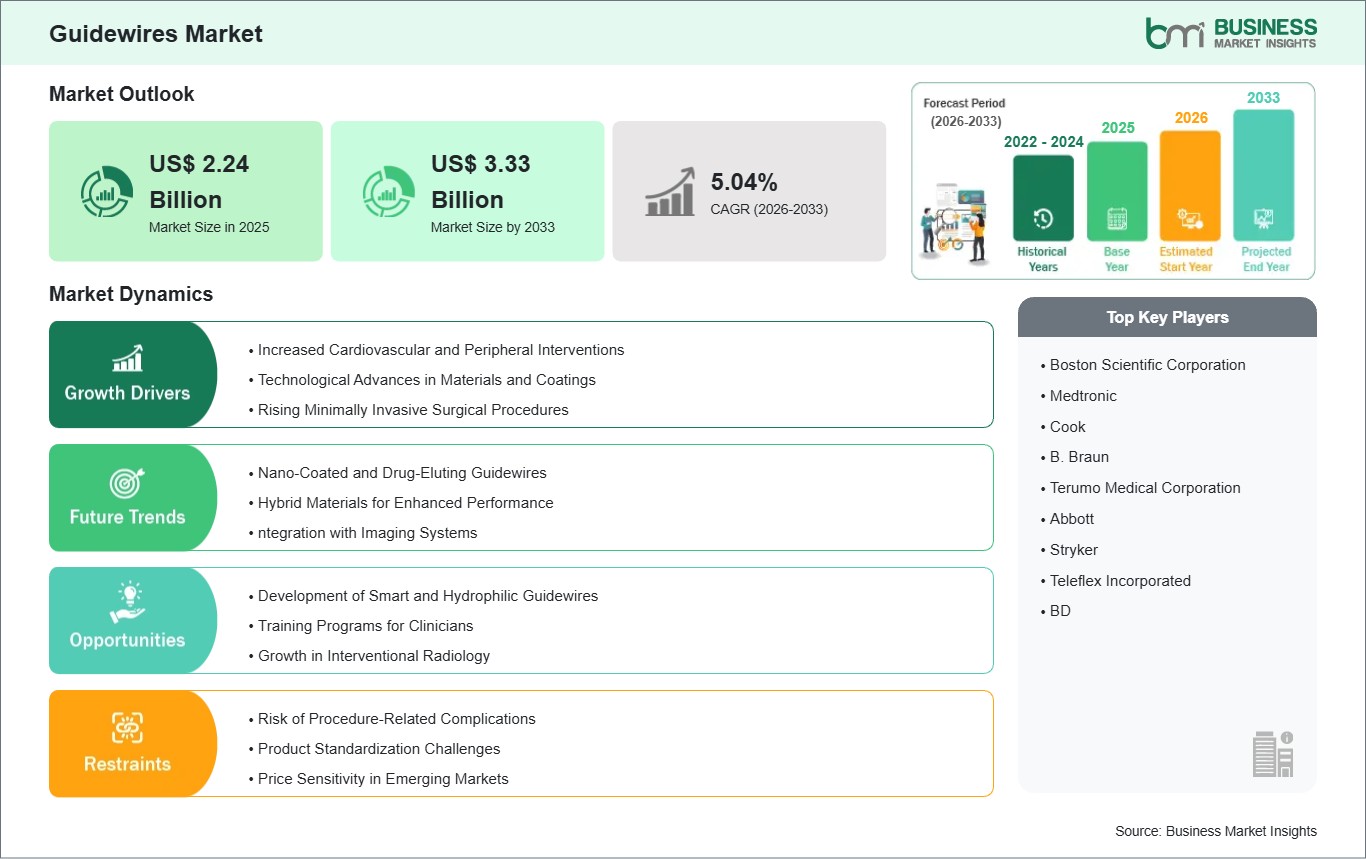
The Guidewires Market size is expected to reach US$ 3.33 billion by 2033 from US$ 2.24 billion in 2025. The market is estimated to record a CAGR of 5.04% from 2026 to 2033.
Guidewires are medical devices with special uses; these wires are thin and flexible, utilized in minimally invasive procedures to help catheters, stents, or other medical equipment pass through the body's blood vessels to a specific location from where the intervention aims to take place. They are central in a variety of medical procedures, including those undertaken by cardiologists, urologists, radiologists, or neurovascular specialists.
The global guidewire market has grown steadily and will continue to see further growth in the next decade, with the major driving force being the growing number of incidences of cardio and chronic diseases, the aging global population, and the growing usage of minimally invasive surgical procedures worldwide. The North American region currently leads the way in the global market because of the advanced state of its health care facilities and payment systems, while the Asia-Pacific region has emerged as a promising market with growing investments in the health care system and increased access to procedures. Technological advancement, including the development of advanced materials and smart guidewire designs, has helped improve performance and expand the scope of applications from cardiology to other fields, fueling the continued growth of the global market in the coming period.

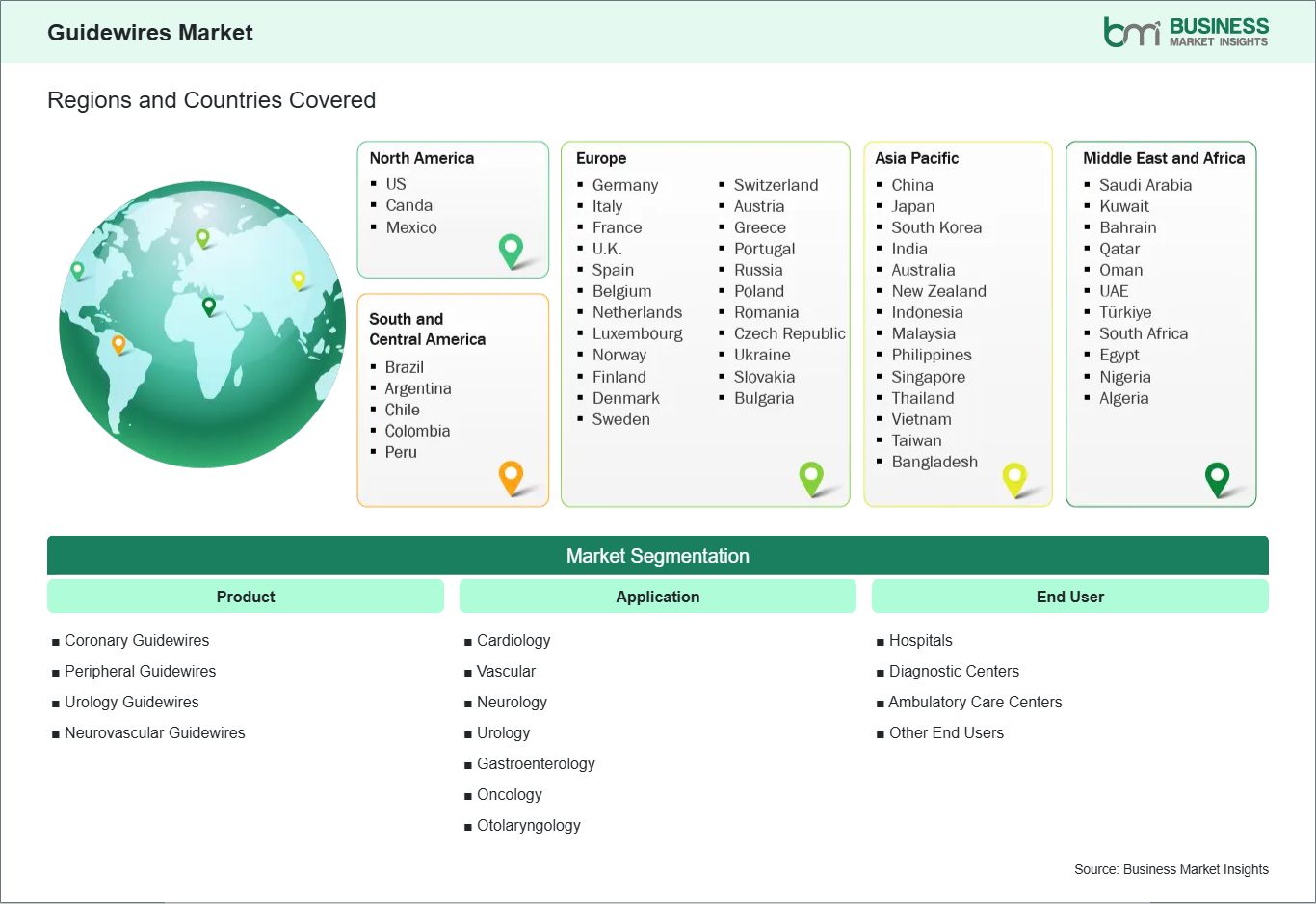
Key segments that contributed to the derivation of the guidewires market analysis are product, application, and end user.
The global guidewires market is majorly influenced by the increasing use of minimally invasive procedures, which is directly related to the rising number of cases of cardiovascular and other chronic diseases. The adoption of closed surgeries has become a trend due to the less physical trauma to patients, the quicker recovery period, and the overall reduced cost of healthcare. Guidewires are the tools that make these procedures possible; they help in finding the right path through the complicated vascular system and also in accurately placing the device. The world has an estimated ~620 million people who suffer from heart and blood vessel diseases, and there are 60 million new cases of heart and circulatory problems every year, which is the reason behind the demand for guidewire-based interventions. The volumes of less invasive interventions have increased by almost 43% as doctors and patients have been choosing the less dangerous routes for their treatment. The up-to-date technologies, such as hydrophilic coatings, better torque control, and imaging-integrated guidewires, have been the main reasons for the increase in the success rates of procedures, and so the adoption is further pushed not only in cardiology but also in neurology, urology, and vascular specialties. The whole changeover in the healthcare world to the less invasive method of treatment that is supported by the increasing number of chronic diseases, which in turn is caused by the aging population, is still one of the most important factors that lead to the guidewire market's growth.
One of the major factors that will propel growth in the global guidewires market is the rapid development of healthcare infrastructure alongside procedural access in emerging regions, particularly in the Asia-Pacific, Latin America, and some parts of the Middle East. With these investments from both the government and private sector into the primary care hospitals, catheterization labs, and specialized interventional centers, access to guidewire-reliant procedures is increased, hence giving rise to more uptake of these procedures. A good case in point is the Asia-Pacific region, which is making a huge leap in healthcare with the development of cardiac care facilities and the looming chronic disease burden, thus driving the demand for interventional tools like guidewires.
In addition, the improved digital health and telemedicine efforts are linking the less privileged populations to the doctors, thus, more referrals for the advanced procedures that require guidewires are being formed. Not only does this link-up enlarge patient outreach, but it also stimulates investments into training and the infrastructure necessary for the supply of guidewire technologies in areas that were previously neglected.
Furthermore, continuous technological advancements like new materials, coatings, and hybrid designs are creating a wide range of new paths for product differentiation and bespoke solutions across numerous clinical applications. In other words, the manufacturers who can adapt to the needs of the emerging markets and build good relationships with the regional healthcare systems will be the ones that get the chance for substantial growth beyond the traditional developed markets.
By product, the guidewires market is categorized into coronary guidewires, peripheral guidewires, urology guidewires, neurovascular guidewires. The coronary guidewires segment held the largest share of the market in 2025. Coronary guidewires lead the segment because they are essential in treating coronary artery disease, one of the most prevalent cardiovascular conditions worldwide. These guidewires enable cardiologists to navigate the complex coronary arteries during percutaneous coronary interventions, including angioplasty and stenting. The growing elderly population, increasing incidence of lifestyle-related heart diseases, and preference for minimally invasive procedures have driven demand. Moreover, innovations in guidewire materials, coatings, and flexibility improve procedural success and patient safety, reinforcing their adoption in hospitals and cardiac centers, keeping coronary guidewires at the forefront of the market.
By application, the market is segmented into cardiology, vascular, neurology, urology, gastroenterology, oncology, otolaryngology. The cardiology segment held the largest share of the market in 2025. Cardiology is the leading application segment because cardiovascular diseases remain the leading cause of death globally, prompting a surge in diagnostic and interventional procedures. Procedures like angioplasty, stenting, and electrophysiological studies rely heavily on guidewires to navigate complex vascular networks safely. Increasing awareness of heart health, improved access to healthcare facilities, and technological advancements in interventional cardiology support this trend. Consequently, guidewire utilization is highest in cardiac procedures, driving significant market growth in this application segment.
By end user, the guidewires market is segmented into hospitals, diagnostic centers, ambulatory care centers, other end users. The hospitals segment dominated the market in 2025. Hospitals dominate the segment because they perform the highest volume of complex interventional procedures requiring guidewires. They possess advanced imaging and catheterization laboratories, skilled specialists, and critical infrastructure to support minimally invasive surgeries across cardiology, neurology, urology, and vascular applications. Hospitals also have well-established procurement systems, enabling bulk purchases and access to the latest medical devices.
| Report Attribute | Details |
|---|---|
| Market size in 2025 | US$ 2.24 Billion |
| Market Size by 2033 | US$ 3.33 Billion |
| Global CAGR (2026 - 2033) | 5.04% |
| Historical Data | 2022 - 2024 |
| Forecast period | 2026-2033 |
| Segments Covered | By Product
|
| Regions and Countries Covered | North America
|
| Market leaders and key company profiles |
|
The " Guidewires Market Size and Forecast (2022–2033)" report provides a detailed analysis of the market covering below areas:
The geographical scope of the guidewires market report is divided into five regions: North America, Asia Pacific, Europe, Middle East & Africa, and South & Central America. The guidewires market in Asia Pacific is expected to grow significantly during the forecast period.
The Asia-Pacific guidewires market is segmented into China, Japan, South Korea, India, Australia, New Zealand, Indonesia, Malaysia, the Philippines, Singapore, Thailand, Vietnam, Taiwan, Bangladesh, and the Rest of Asia. The Asia-Pacific guidewires market is experiencing robust growth, due to the increasing incidence of chronic and lifestyle-related diseases, primarily CVDs, which in turn invite interventional procedures that depend on guidewires, e.g., angiography and stenting, and thus create their own demand. For instance, countries like India and China have witnessed steep rises in hypertension, obesity, and coronary diseases because of urbanization and less physically active lifestyles, resulting in more cardiac interventions being performed that are minimally invasive.
Moreover, the growing demand for healthcare services and the better facilities available in the emerging Asia-Pacific countries are other significant reasons for this growth. Governments are gradually investing in the hospital infrastructure, and the private sector is investing in the same, so quick & easy access to advanced treatments through hospitals, catheterization labs, and other specialized care facilities is being provided. In addition to that, the medical tourism industry of countries like India, Thailand, and Malaysia is catering to international patients who are looking for high-quality procedures that are also cost-effective.
The growth is also propelled by the technology advancements, which lead to innovations that enhance the guidewire performance and also make them applicable in areas such as peripheral, neurovascular, and others besides cardiology. Among the technological advancements are hydrophilic coatings, nitinol materials, and next-generation interventional platforms.

The guidewires market is evaluated by gathering qualitative and quantitative data post primary and secondary research, which includes important corporate publications, association data, and databases. A few of the key developments in the guidewires market are:
The Guidewires Market is valued at US$ 2.24 Billion in 2025, it is projected to reach US$ 3.33 Billion by 2033.
As per our report Guidewires Market, the market size is valued at US$ 2.24 Billion in 2025, projecting it to reach US$ 3.33 Billion by 2033. This translates to a CAGR of approximately 5.04% during the forecast period.
The Guidewires Market report typically cover these key segments-
The historic period, base year, and forecast period can vary slightly depending on the specific market research report. However, for the Guidewires Market report:
The Guidewires Market is populated by several key players, each contributing to its growth and innovation. Some of the major players include:
The Guidewires Market report is valuable for diverse stakeholders, including:
Essentially, anyone involved in or considering involvement in the Guidewires Market value chain can benefit from the information contained in a comprehensive market report.
Please tell us your area of interest
(Market Segments/ Regions and Countries/ Companies)