Market Summary
Executive Summary and Global Market Analysis
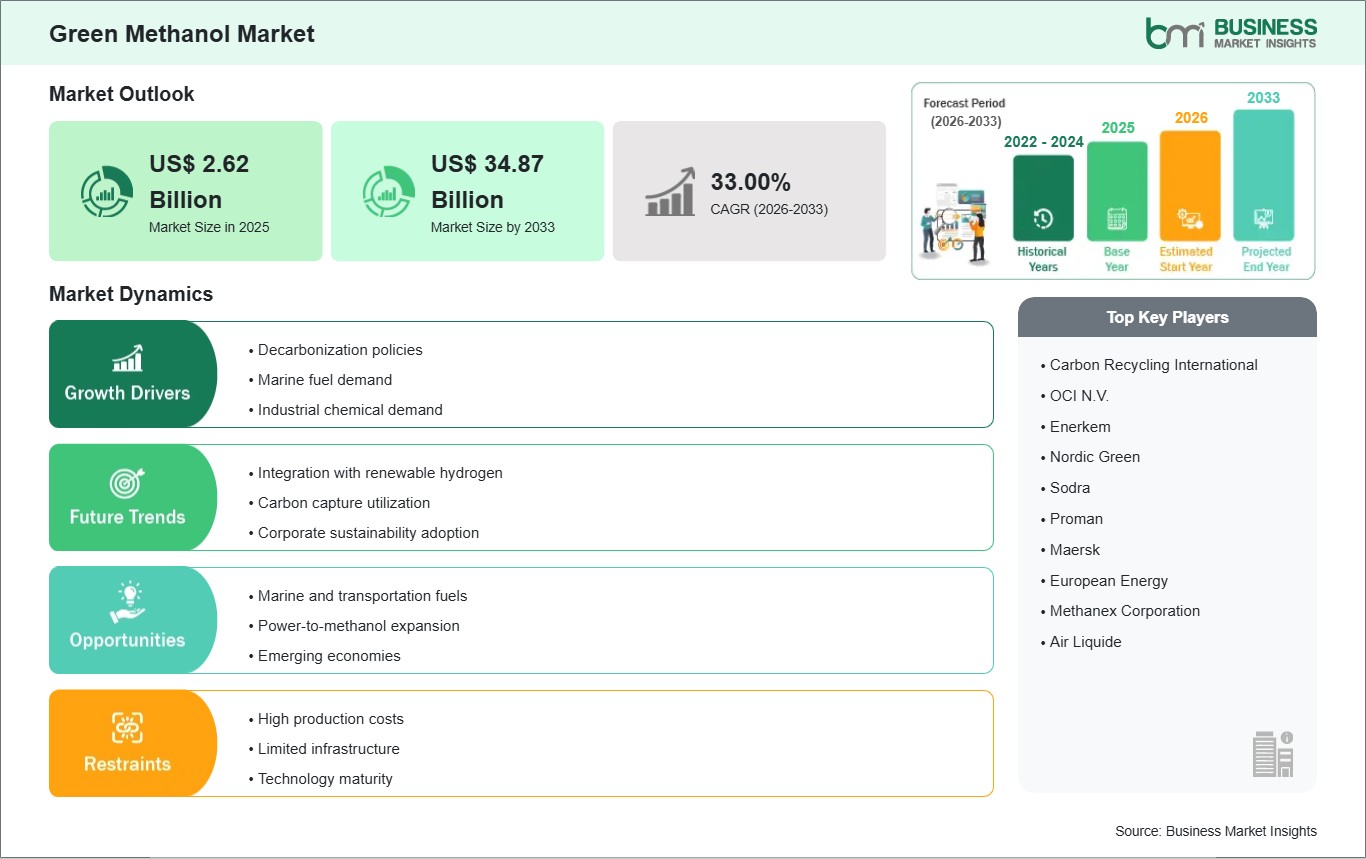
Green methanol is a sustainable alternative to traditional methanol made from fossil fuels. It is mainly derived from renewable sources like biomass, municipal waste, and captured carbon dioxide. It is often mixed with green hydrogen, which is produced through electrolysis using renewable energy. Green methanol can be used in various applications, including marine fuels, gasoline blending, and the production of formaldehyde, acetic acid, and other chemicals. It also has emerging uses in fuel cells and energy storage systems.
The green methanol market is growing for several reasons. There is an increasing global focus on decarbonization and carbon neutrality, which drives governments and industries to look for cleaner energy options. Regulatory support, such as subsidies for renewable fuels and tougher emissions standards in shipping and chemical industries, is boosting its adoption. Rising investments in renewable energy infrastructure, especially in solar and wind-powered hydrogen production, have made green methanol more practical and cost-effective. Moreover, more companies and consumers are becoming aware of environmental sustainability, which propels demand for low-emission fuels. Thus, regulatory support, technological progress, and increasing environmental concerns drive the growth of the green methanol market globally.
Segment Analysis
Green Methanol Market Segmentation
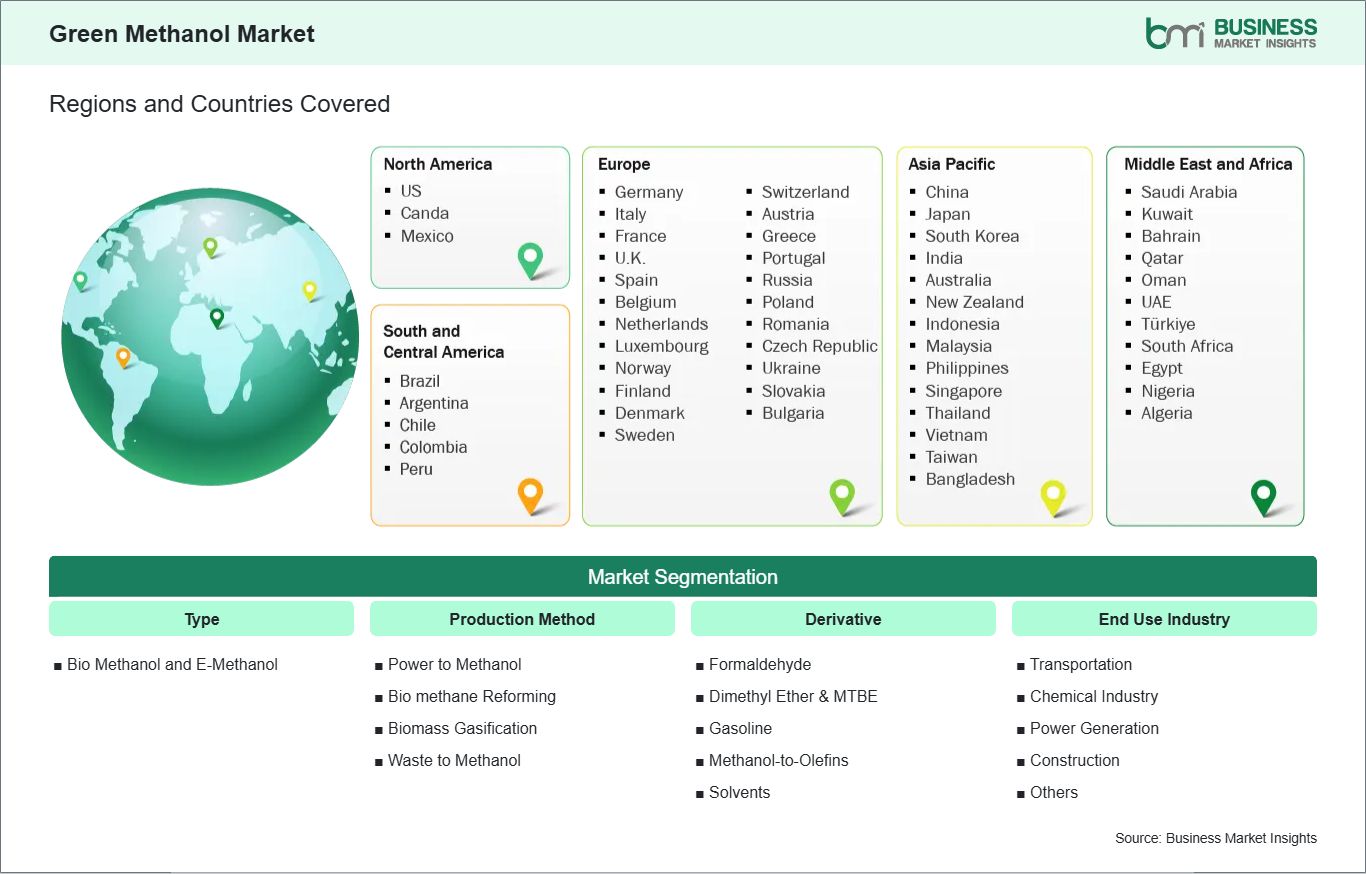
Key segments that contributed to the derivation of the green methanol market analysis are type, production method, derivative, and end-use industry.
- By type, the market is bifurcated into bio-methanol and e-methanol. The bio methanol segment accounted for the largest market share in 2025.
- By production method, the market is segmented into power to methanol, bio methane reforming, biomass gasification, and waste to methanol. The biomass gasification segment held the largest market share in 2025.
- Based on derivatives, the market is categorized into formaldehyde, dimethyl ether (DME) & MTBE, gasoline, methanol-to-olefins (MTO), and solvents. The formaldehyde segment accounted for the largest market share in 2025.
- On the basis of end-use industry, the market is segmented into transportation, chemical industry, power generation, construction, and others. The chemical industry segment held the largest market share in 2025.
Market Forces
Green Methanol Market Drivers and Opportunities
Global Decarbonization and Emission Reduction Policies
A primary driver of the green methanol market is the increasing global emphasis on decarbonization and cutting greenhouse gas emissions in industry and transportation. Governments around the world are tightening emissions rules and encouraging the use of cleaner fuels. This shift has propelled demand for low-carbon options like green methanol. In the marine sector, for example, the International Maritime Organization (IMO) rules that limit sulfur and carbon emissions have pushed for methanol as a sustainable marine fuel.
Similarly, the European Union, along with countries such as China and the US, is promoting green chemical feedstocks through subsidies, tax incentives, and renewable fuel standards. Green methanol, produced from biomass, waste, or CO- combined with renewable hydrogen, significantly reduces lifecycle carbon emissions compared to fossil-based methanol. Its compatibility with existing methanol infrastructure makes it easier to adopt industrial processes, fuel blending, and power generation. These regulatory pressures, along with corporate sustainability efforts and growing consumer awareness of environmental issues, are generating strong demand for green methanol.
Expansion in Marine and Transportation Fuel Applications
The green methanol market offers significant growth opportunities in marine and transportation fuel applications. As the shipping and transportation sectors witness increasing pressure to lower carbon emissions, green methanol provides a cleaner option compared to traditional fossil fuels. It has lower sulfur content and near-zero net CO- emissions when derived from renewable sources. Major shipping companies and fuel suppliers are actively looking into methanol-powered ships and bunkering solutions to meet IMO 2030/2050 emission targets.
Additionally, green methanol can be blended with regular fuels in engines, allowing for gradual adoption without needing a complete infrastructure change. Beyond shipping, it has potential as a sustainable fuel for trucks, buses, and industrial fleets in areas with stricter emission standards. Advances in methanol fuel cells and combustion systems improve their efficiency, safety, and performance, making them a more viable option for both on-road and off-road transportation. The mix of regulatory pressure, infrastructure compatibility, and environmental advantages positions green methanol as a key growth segment in the broader low-carbon fuel market, offering manufacturers, fuel suppliers, and investors a clear pathway for expansion globally.
Report Coverage
Green Methanol Market Report Coverage and Deliverables
The Green Methanol Market Size and Forecast (2022-2033) report provides a detailed analysis of the market covering below areas:
- Green methanol market size and forecast at global, regional, and country levels for all the key market segments covered under the scope
- Green methanol market trends, as well as market dynamics such as drivers, restraints, and key opportunities
- Green methanol market analysis covering key market trends, global and regional framework, major players, regulations, and recent market developments
Geographic Insights
Green Methanol Market Geographic Insights
The geographical scope of the green methanol market report is divided into five regions: North America, Asia Pacific, Europe, the Middle East & Africa, and South & Central America. The green methanol market in the Asia Pacific is expected to grow significantly during the forecast period.
Asia Pacific has emerged as the largest market for green methanol, attributed to strong industrial growth, rising energy demand, and expanding environmental regulations. Countries like China, India, Japan, and South Korea are investing heavily in efforts to cut emissions and promote sustainable energy solutions. This creates a favorable environment for adopting green methanol. The region is a key center for chemical manufacturing, including formaldehyde, acetic acid, and dimethyl ether production, which all depend on methanol as a feedstock. The growing emphasis on reducing carbon emissions in these industries has pushed demand for renewable methanol options.
Moreover, the shipping and transportation industries in Asia Pacific play a major role in carbon emissions. This has led governments and private companies to look for low-emission fuels. Green methanol is being recognized as a sustainable marine fuel. This shift is backed by regional policies that support the International Maritime Organization (IMO) emission targets. The abundant availability of renewable resources, such as biomass, agricultural waste, and municipal waste, also helps in producing bio-based methanol cost-effectively.
Report Guidance
Green Methanol Market Report Guidance
The report includes qualitative and quantitative data in the green methanol market, product type, application, and geography.
The report starts with the key takeaways (chapter 2), highlighting the key trends and outlook of the green methanol market.
Chapter 3 includes the research methodology of the study.
Chapter 4 further includes ecosystem analysis.
Chapter 5 highlights the major industry dynamics in the green methanol market, including factors that are driving the market, prevailing deterrents, potential opportunities, as well as future trends. Impact analysis of these drivers and restraints is also covered in this section.
Chapter 6 discusses the green methanol market scenario in terms of historical market revenues and forecast till the year 2033.
Chapters 7 to 10 cover the green methanol market segments by type, destination, end user, and geography across North America, Europe, Asia Pacific, the Middle East and Africa, and South and Central America. They cover the market volume, revenue forecast, and factors driving the market.
Chapter 11 describes the competitive analysis along with the heat map analysis for the key players operating in the market.
Chapter 12 describes the industry landscape analysis. It provides detailed descriptions of business activities such as market initiatives, new developments, mergers, and joint ventures globally, along with a competitive landscape.
Chapter 13 provides detailed profiles of the major companies operating in the green methanol market. Companies have been profiled on the basis of their key facts, business descriptions, products and services, financial overview, SWOT analysis, and key developments.
Chapter 14, i.e., the appendix, is inclusive of a brief overview of the company, a list of abbreviations, and a disclaimer.
Industry Activity
Recent Developments
The green methanol market is evaluated by gathering qualitative and quantitative data post-primary and secondary research, which includes important corporate publications, association data, and databases. A few of the key developments in the green methanol market are:
- In July 2025, Clariant Catalysts and Shanghai Electric formed a partnership to support China's energy transition. Through this collaboration, the companies aimed to expand biomass-to-green methanol production by using Clariant's MegaMax synthesis catalysts. This effort aims to boost capacity in renewable fuels.
- In November 2025, CapCO2 Solutions, AgriEnergy Innovations, and Methylennium Energy collaborated to convert an inactive ethanol plant in Luverne, Minnesota, into a facility for producing green methanol. This facility is expected to use waste CO-, creating new opportunities for sustainable fuel production.
Trust & Transparency
Research Methodology
The market analysis combines proprietary research with secondary data from government agencies, company disclosures, regulatory filings, industry databases and expert interviews. Market estimates are validated through data triangulation, cross-market benchmarking and analyst
review.
View Full Research Methodology
Key Sources Referred:
World Bank – Global Trade Indicators
European Chemicals Agency
International Council of Chemical Associations
(International Monetary Fund )IMF
World Trade Organization (WTO)
International Trade Administration (ITA)
Company website
Company annual reports
Company investor presentations