Market Summary
Executive Summary and Global Market Analysis
Executive Summary and Global Market Analysis:
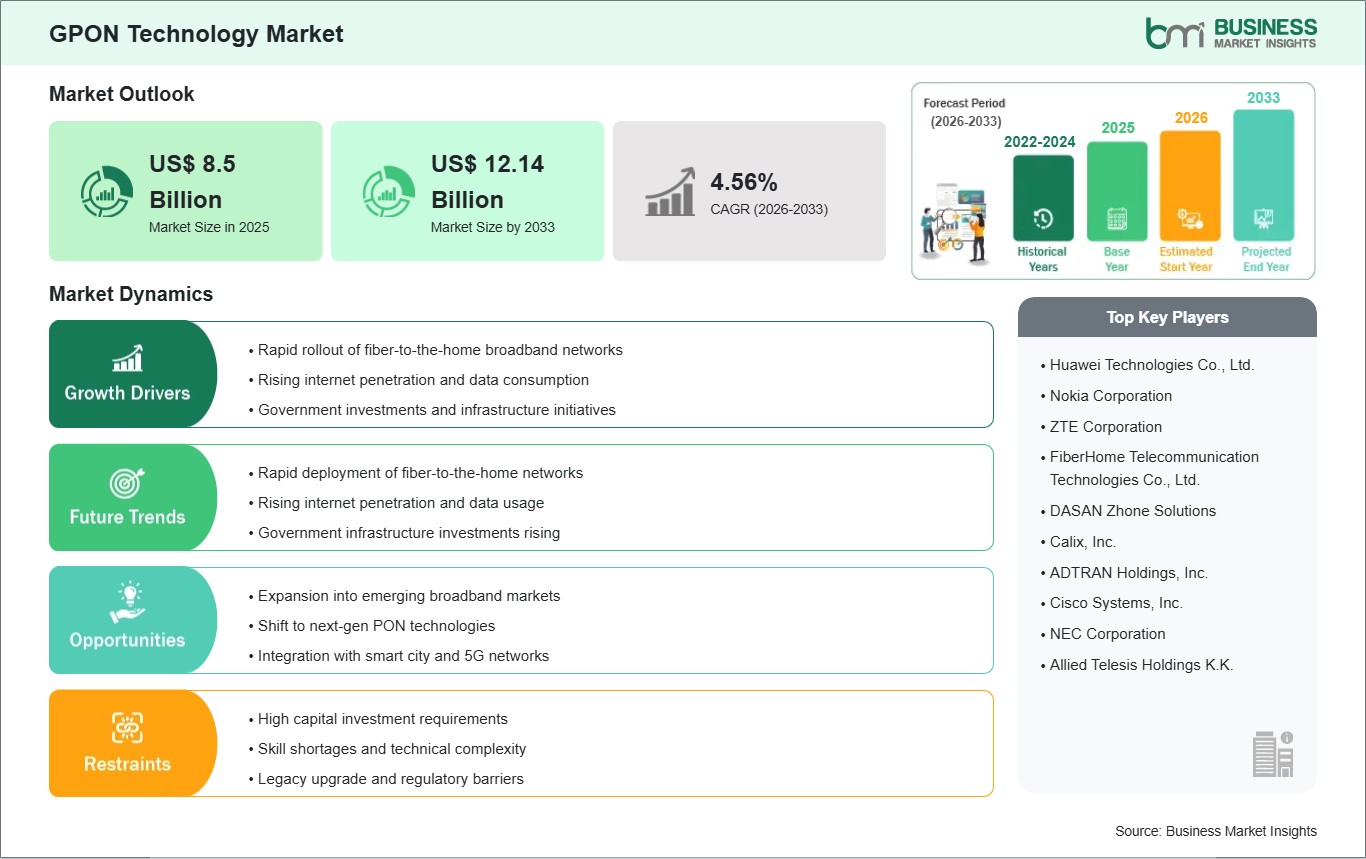
The GPON (Gigabit Passive Optical Network) technology market is experiencing robust growth due to rising demand for high-speed broadband, fiber-to-the-home (FTTH) deployments, and digital transformation initiatives. GPON provides cost-effective, scalable, and energy-efficient solutions for delivering high-speed internet, IPTV, and VoIP services, making it ideal for telecom operators worldwide. Key components such as Optical Line Terminals (OLT) and Optical Network Terminals (ONT) drive market adoption, while 2.5G PON remains the most widely deployed standard. The telecommunications vertical dominates usage, supported by increasing smart city projects, IoT integration, and 5G backhaul requirements.
Globally, the GPON market is witnessing significant expansion, particularly in Asia-Pacific, North America, and Europe. Asia-Pacific leads adoption due to high population density, government broadband initiatives, and extensive FTTH rollout in countries like China, India, and Japan. North America and Europe are driven by 5G deployment, enterprise connectivity, and the replacement of legacy copper networks. Key players such as Calix, Nokia, Huawei, and ZTE are introducing next-generation PON solutions, including XGS-PON and NG-PON2, enhancing capacity and network efficiency.
Segment Analysis
GPON Technology Market Segmentation
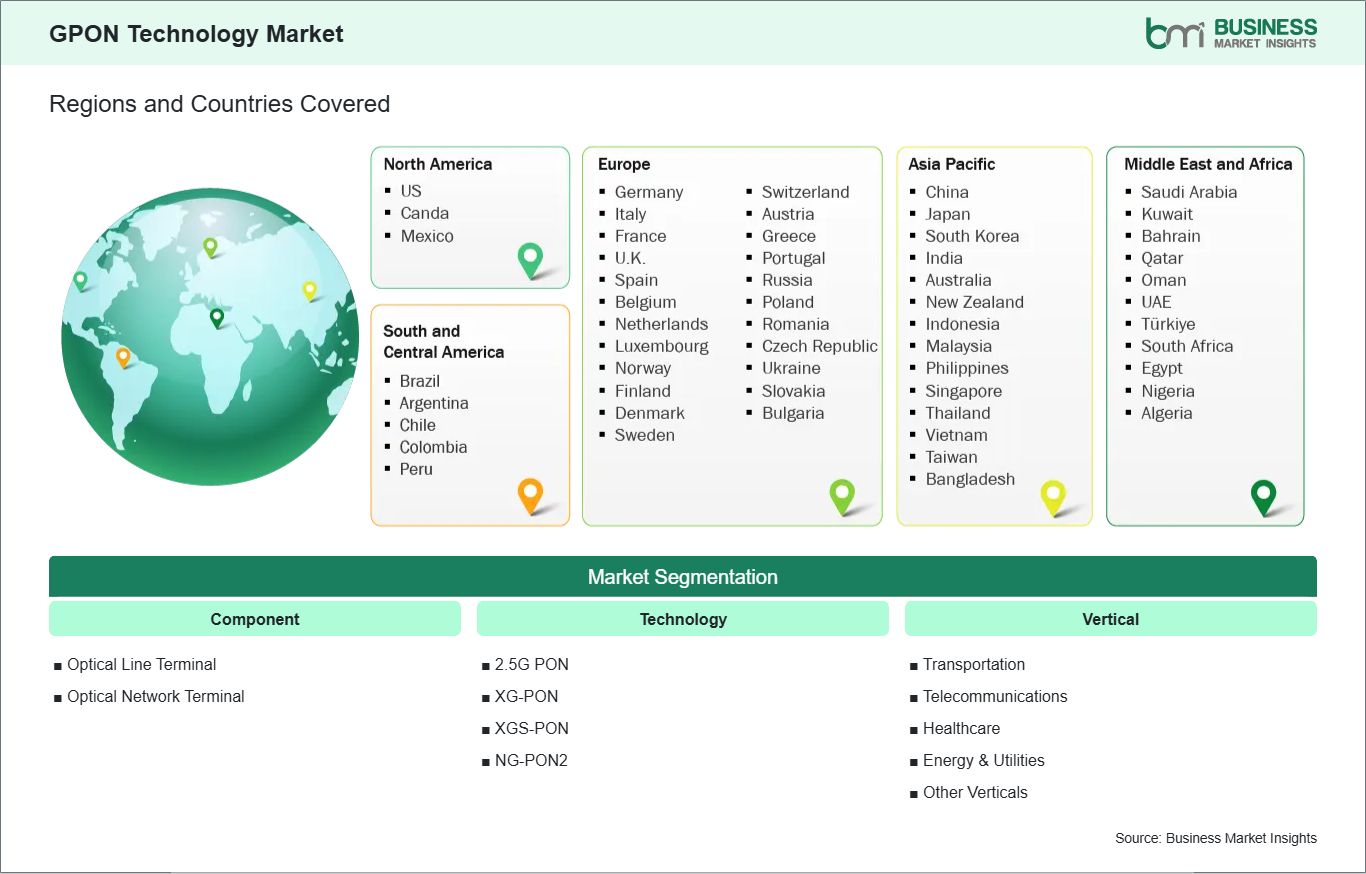
Key segments that contributed to the derivation of the GPON technology market analysis are Component, Technology, and Vertical.
- By Component, the GPON technology market is segmented into Optical Line Terminal (OLT), Optical Network Terminal (ONT). The Optical Line Terminal (OLT)segment dominated the market in 2025.
- By Technology, the GPON technology market is segmented into 2.5G PON, XG-PON, XGS-PON, and NG-PON2. The 2.5G PON segment dominated the market in 2025.
- By Vertical, the GPON technology market is segmented into Transportation, Telecommunications, Healthcare, Energy & Utilities, and Other Verticals. The Telecommunications segment dominated the market in 2025.
Market Forces
GPON Technology Market Drivers and Opportunities
Rising Demand for High-Speed Broadband
The growing need for high-speed internet in residential, commercial, and enterprise sectors is a key driver for the GPON market. Consumers increasingly demand seamless streaming, video conferencing, online gaming, and cloud services. GPON networks deliver high bandwidth efficiently, making them ideal for Fiber-to-the-Home (FTTH) deployments. Telecom operators adopt GPON to enhance network performance, reduce latency, and support multiple users on a single fiber, meeting escalating connectivity requirements. The continuous expansion of smart homes, IoT devices, and remote working trends further fuels the demand for GPON infrastructure globally, positioning it as a future-proof solution for broadband expansion.
Cost-Effective Network Deployment
GPON technology offers a significant cost advantage compared to traditional copper-based and active Ethernet networks. Its point-to-multipoint architecture allows service providers to serve multiple subscribers using a single fiber line, reducing infrastructure and maintenance costs. This efficiency makes it attractive for large-scale network rollouts, especially in developing regions. Additionally, GPON supports long-distance data transmission without the need for repeaters, lowering operational expenditures. The scalability and flexibility of GPON also enable service providers to upgrade networks without extensive overhauls, presenting opportunities to expand coverage and improve service quality economically.
Size and Share Analysis
GPON Technology Market Size and Share Analysis
By Component, the market is segmented into Optical Line Terminal (OLT), Optical Network Terminal (ONT). The Optical Line Terminal (OLT)segment dominated the market in 2025. The Optical Line Terminal (OLT) segment dominates the GPON market because it serves as the central control unit in fiber networks. Located at the service provider’s central office, it manages bandwidth distribution, traffic control, and connectivity for multiple subscribers efficiently.
By Technology, the market is segmented into 2.5G PON, XG-PON, XGS-PON, and NG-PON2. The 2.5G PON segment held the largest share of the market in 2025. 2.5G PON holds the largest market share due to its widespread adoption and cost-effectiveness. It offers sufficient bandwidth for most residential and small business applications, making it the preferred choice for telecom operators expanding fiber-to-the-home (FTTH) networks globally.
By Vertical, the market is segmented into Transportation, Telecommunications, Healthcare, Energy & Utilities, and Other Vertical. The Telecommunications segment held the largest share of the market in 2025. The telecommunications sector dominates GPON adoption as operators heavily invest in fiber infrastructure to deliver high-speed internet, IPTV, and voice services. Rising broadband demand, digital transformation, and 5G backhaul requirements further drive telecom providers to deploy GPON solutions extensively.
Report Coverage
GPON Technology Market Report Coverage and Deliverables
The "GPON Technology Market Size and Forecast (2022 - 2033)" report provides a detailed analysis of the market covering below areas:
- GPON technology market size and forecast at global, regional, and country levels for all the key market segments covered under the scope
- GPON technology market trends, as well as market dynamics such as drivers, restraints, and key opportunities
- GPON technology market analysis covering key market trends, global and regional framework, major players, regulations, and recent market developments
- Industry landscape and competition analysis covering market concentration, heat map analysis, prominent players, and recent developments for the GPON technology market
- Detailed company profiles, including SWOT analysis
Geographic Insights
GPON Technology Market Geographic Insights
The geographical scope of the GPON technology market report is divided into five regions: North America, Asia Pacific, Europe, Middle East & Africa, and South & Central America. The GPON technology market in Asia Pacific is expected to grow significantly during the forecast period.
The Asia-Pacific region dominates the GPON market due to rapid urbanization, growing digital infrastructure, and strong government initiatives promoting broadband connectivity. Countries like China, Japan, India, and South Korea are leading FTTH deployments, driven by high consumer demand for high-speed internet, IPTV, and cloud services. Telecom operators are aggressively investing in GPON to expand network coverage and support 5G backhaul requirements. Additionally, smart city projects and IoT adoption in the region are further boosting GPON deployment.
Cost-effective infrastructure and large-scale population centers make APAC highly attractive for GPON growth, with market expansion expected across both developed and emerging economies in the next decade.
Industry Activity
Recent Developments
The GPON technology market is evaluated by gathering qualitative and quantitative data post primary and secondary research, which includes important corporate publications, association data, and databases. A few of the key developments in the DIY Home Automation market are:
- In October 2023, Baicells announced a new portfolio of compact Optical Line Terminal (OLT) and Optical Network Terminal (ONT) products that support multiple PON interfaces, including GPON, XGS‑PON, XG‑PON and NG‑ This enables service providers and wireless ISPs to extend fiber networks with flexible deployment options at competitive price points.
- In June 2025, Huawei launched its next-generation SmartAX MA5800-X17 GPON/XGS-PON Optical Line Terminal (OLT) platform, designed to support ultra-broadband access and high-density fiber deployments. The upgraded system offers enhanced port capacity, improved energy efficiency, and integrated support for GPON, XG-PON, and XGS-PON technologies, enabling telecom operators to scale fiber-to-the-home (FTTH) and enterprise connectivity networks efficiently. The launch strengthens Huawei’s portfolio in next-generation passive optical network infrastructure.
Trust & Transparency
Research Methodology
The market analysis combines proprietary research with secondary data from government agencies, company disclosures, regulatory filings, industry databases and expert interviews. Market estimates are validated through data triangulation, cross-market benchmarking and analyst
review.
View Full Research Methodology
Key Sources Referred:
World Bank - Global Trade IndicatorsWorld Trade Organization (WTO)International Monetary Fund (IMF)International Trade Administration (ITA)Company websiteCompany annual reportsCompany investor presentations