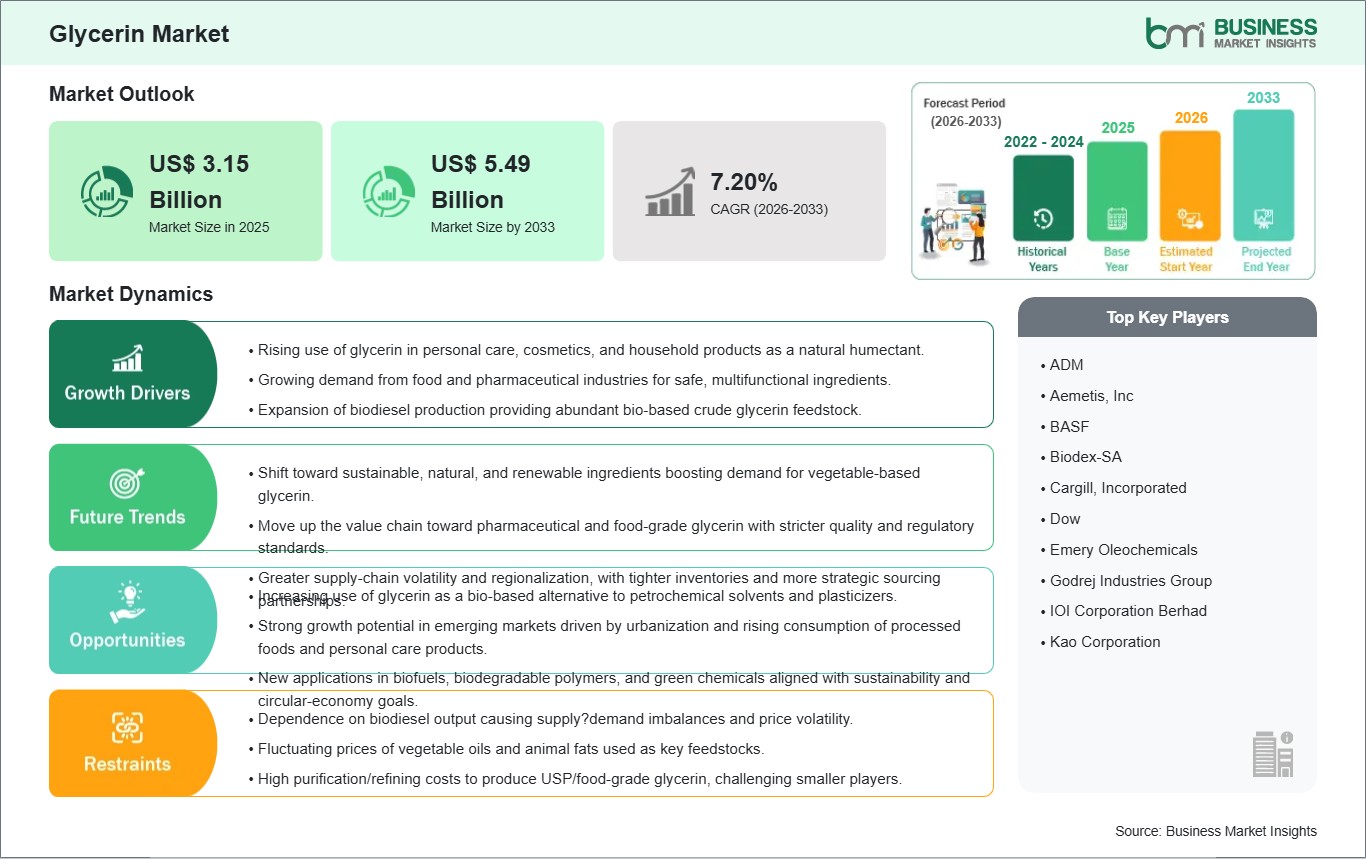
The Glycerin market size is expected to reach US$ 5.49 billion by 2033 from US$ 3.15 billion in 2025. The market is estimated to record a CAGR of 7.2% from 2026 to 2033.
Glycerin is a valuable substance in the pharmaceutical, personal care, and food sectors since it is able to render a moisturizing, humectant, as well as a stabilizing factor in assuring the performance and quality of different products. It is commonly applied in cosmetics, pharmaceuticals, food processing, and other industries. The benefits of glycerin are as follows: glycerin is very soluble in water, is non-toxic, and is versatile in terms of formulations. The increasing demand for personal care and cosmetic products on the world market, the development of the pharmaceutical and food sectors, and the increase in the popularity of natural and bio-based ingredients are driving the market. Moreover, the availability of bio-based glycerin, production techniques that do not harm the environment, and better purification processes contribute to its increased application and encouragement.
Nevertheless, market expansion can also be limited by changes in the prices of raw materials, strict regulations, and synthetic substitutes. The industry is also hit by challenges associated with ensuring a uniform quality, contaminants in the crude glycerin, and regional differences in standards. Regardless of these challenges, the market still presents opportunities because of rising investments in the pharmaceutical and personal care industries, the growing demand for natural additives, and the rising awareness of consumers with regard to the safety of the products. Innovation is likely to be motivated by government efforts, research and development, and transition to sustainable production that will create new market opportunities and long-term growth in the global glycerin industry.

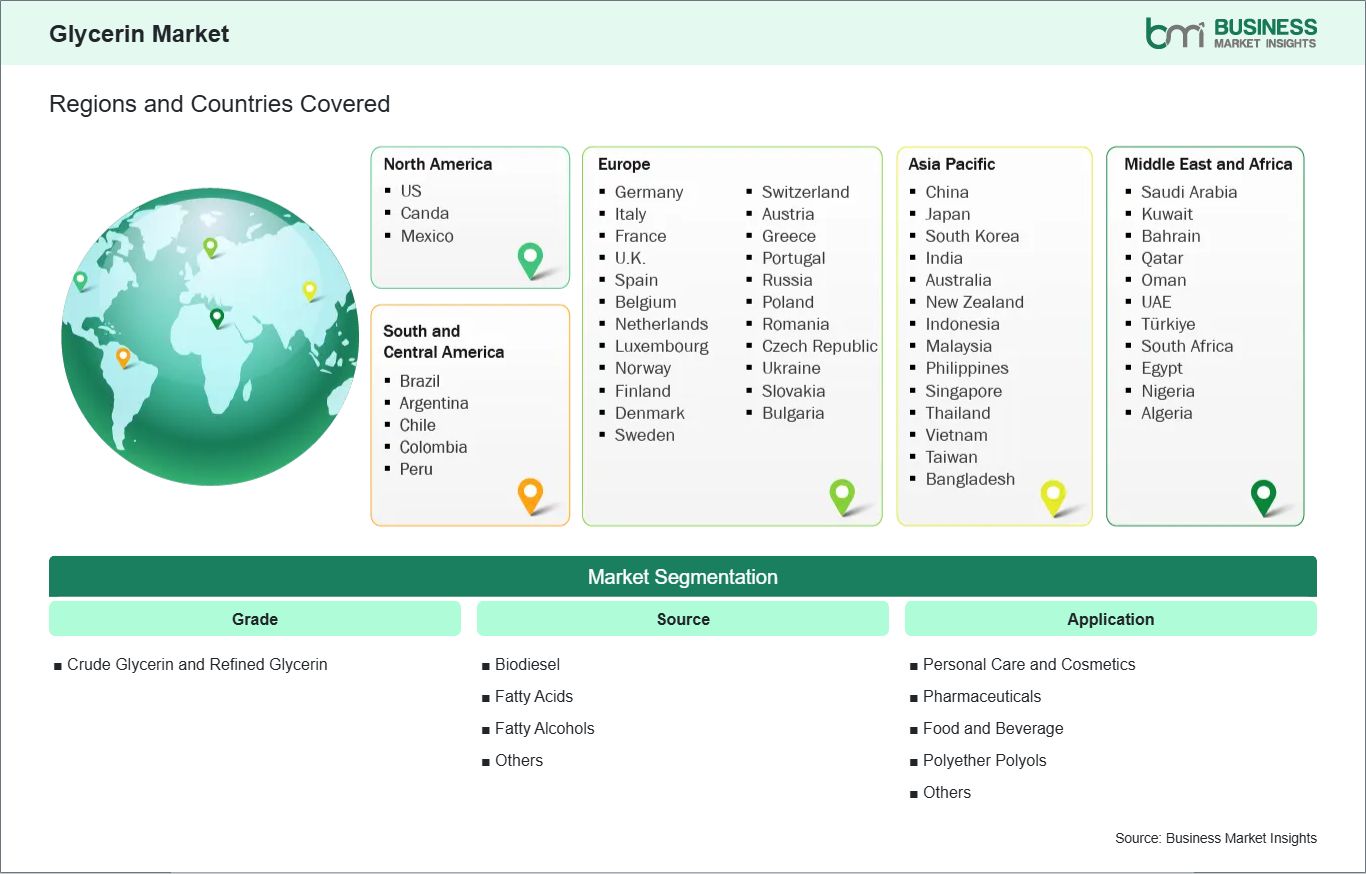
Key segments that contributed to the derivation of the Glycerin market analysis are grade, source, and application.
Glycerin is primarily used in personal care, cosmetic, and pharmaceutical products. The use of glycerin has been on the increase over time in the past years owing to the surge in the demand for moisturizers, creams, soaps, and pharmaceutical preparations in the world. Glycerin is a crucial ingredient used as a humectant, stabilizer, and excipient, which directly affects the effectiveness, quality, and shelf life of products. It preserves consistency of formulations, discourages dryness, and softens creams and gels. Glycerin is also being used in large-scale cosmetic and pharmaceutical manufacturing in large volumes due to its purity, safety, and performance.
One of the key drivers of the glycerin market in the world is the need to have safe, natural, and versatile ingredients. The quality of glycerin is a must in ensuring the products maintain their performance under different weather conditions and during storage. In North America and Europe, there are strict regulations and industry standards that guarantee the quality and monitoring of glycerin. Glycerin itself is simple to work with and can be used with various formulations, and is augmented by research and development in the sector. Further, more glycerin will be demanded due to the growth in investments in personal care, pharma, and food industries, which will contribute to market expansion in every corner of the world.
Glycerin is also re-formed using natural, bio-based, and sustainable sources, and has various benefits, such as non-toxicity, biodegradability, and eco-friendliness. The formulations are critical in enhancing the safety, stability of the formulation, as well as environmental sustainability, and minimizing the carbon footprint.
There has been an inclination towards the use of natural and sustainable ingredients, and this trend has led to the adoption of bio-based glycerin by manufacturers of cosmetics, foods, and pharmaceuticals worldwide. It finds more applications in organic skincare, food products, and in the pharmaceutical field as a measure of safety and regulatory compliance. Moreover, the glycerin, which is environment-friendly, minimizes the effects on the ecosystems and can be securely applied in sensitive applications. The use of these modern glycerins is additionally justified by the government policy, preference for green products, and environment laws. The better safety, sustainability, and long-term value of bio-based glycerin are some of the main reasons why this product is penetrating the market.

| Report Attribute | Details |
|---|---|
| Market size in 2025 | US$ 3.15 Billion |
| Market Size by 2033 | US$ 5.49 Billion |
| Global CAGR (2026 - 2033) | 7.20% |
| Historical Data | 2022 - 2024 |
| Forecast period | 2026-2033 |
| Segments Covered | By Grade
|
|
Regions and Countries Covered
| |
| North America | US, Canada, Mexico |
| Europe | Belgium, Austria, Finland, Denmark, Greece, Poland, Romania, Russia, Ukraine, Czech Republic, Slovakia, Bulgaria, Italy, Luxembourg, Germany, Switzerland, France, Netherlands, Norway, Portugal, Spain, Sweden, United Kingdom |
| Asia-Pacific | Australia, China, India, Japan, South Korea, Indonesia, Malaysia, Philippines, Singapore, Thailand, Vietnam, Bangladesh, New Zealand, Taiwan |
| South and Central America | Brazil, Argentina, Peru, Chile, Colombia |
| Middle East and Africa | Bahrain, Kuwait, Oman, Qatar, Saudi Arabia, United Arab Emirates, Turkiye, South Africa, Egypt, Algeria, Nigeria |
| Market leaders and key company profiles |
|
The Glycerin Market Size and Forecast (2022-2033) report provides a detailed analysis of the market covering below areas:
The geographical scope of the Glycerin market report is divided into five regions: North America, Asia Pacific, Europe, Middle East & Africa, and South & Central America. The Glycerin market in the Asia Pacific is expected to grow significantly during the forecast period.
The Asia-Pacific Glycerin market is segmented into China, Japan, South Korea, India, Australia, New Zealand, Indonesia, Malaysia, the Philippines, Singapore, Thailand, Vietnam, Taiwan, Bangladesh, and the Rest of Asia. Asia Pacific is one of the markets that is expanding at a very high rate in the consumption of glycerin due to the increased demand for personal care, pharmaceutical, and food products. China and India have some of the largest markets in terms of cosmetics, skincare, and pharmaceutical formulations. The governments are also promoting the development of such industries by giving positive policies and programs.
The Indian government has developed programs to encourage the pharmaceutical and personal care industries with a focus on quality, safety, and sustainability. In a similar way, the Government of Japan has proclaimed the stimulus plan in order to promote the production of bio-based and environment-friendly ingredients. The increased demand for glycerin is due to the increasing utilization of natural and high-quality ingredients, coupled with favorable government policies to make products effective, safe, and stable in the long term within formulations.

The Glycerin market is evaluated by gathering qualitative and quantitative data post-primary and secondary research, which includes important corporate publications, association data, and databases. A few of the key developments in the glycerin market are:
The Glycerin Market is valued at US$ 3.15 Billion in 2025, it is projected to reach US$ 5.49 Billion by 2033.
As per our report Glycerin Market, the market size is valued at US$ 3.15 Billion in 2025, projecting it to reach US$ 5.49 Billion by 2033. This translates to a CAGR of approximately 7.20% during the forecast period.
The Glycerin Market report typically cover these key segments-
The historic period, base year, and forecast period can vary slightly depending on the specific market research report. However, for the Glycerin Market report:
The Glycerin Market is populated by several key players, each contributing to its growth and innovation. Some of the major players include:
The Glycerin Market report is valuable for diverse stakeholders, including:
Essentially, anyone involved in or considering involvement in the Glycerin Market value chain can benefit from the information contained in a comprehensive market report.
Please tell us your area of interest
(Market Segments/ Regions and Countries/ Companies)