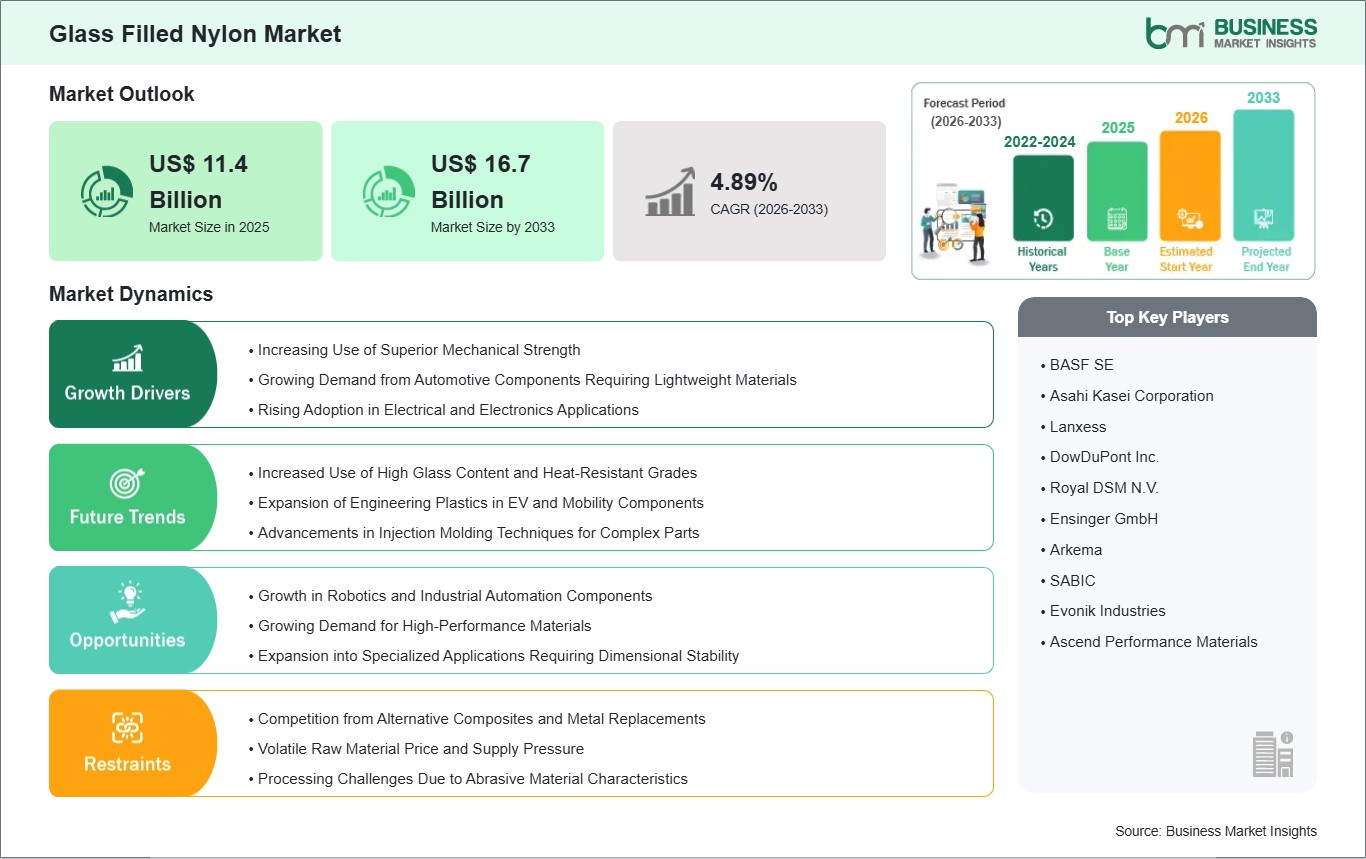
The Glass Filled Nylon Market size is expected to reach US$ 16.7 Billion by 2033 from US$ 11.4 Billion in 2025. The market is estimated to record a CAGR of 4.89% from 2026 to 2033.
The global glass filled nylon market has emerged as a critical segment within engineered thermoplastics, driven by the need for materials that deliver a superior balance of mechanical strength, thermal stability, and cost‑effective performance. Glass filled nylon is a composite material in which glass fibers are embedded within a nylon matrix to enhance stiffness, dimensional stability, and wear resistance. These enhanced attributes make it an attractive choice for demanding applications across automotive, industrial machinery, consumer goods, and electrical/electronics sectors.
The automotive industry, in particular, values glass filled nylon for components that must withstand vibration, heat, and long service life without degradation. In industrial settings, it supports bearings, gears, housings, and structural parts where high load tolerance and reduced maintenance are priorities. The main driving forces behind this market are material substitution trends, where plastics are being used instead of traditional metal or ceramic components to minimize their weights and manufacturing complexities. Increasing requirements for fuel efficiency, equipment reliability, and product life also contribute to the growing popularity of glass filled nylon. Also, advancements in compounding and molding processes have improved the efficiency and design capabilities for complex components.
However, the high cost of high-quality glass filled nylon compounds and the need for expertise in processing may limit the use of this material in low-margin manufacturing processes. Also, changes in raw material availability may have a negative impact on lead times and costs. Moreover, recycling issues related to plastics may also influence some users to consider alternative materials with circular economy credentials. Nevertheless, with its superior benefits and expanding design opportunities, glass filled nylon is a strategic material for high-performance components worldwide.

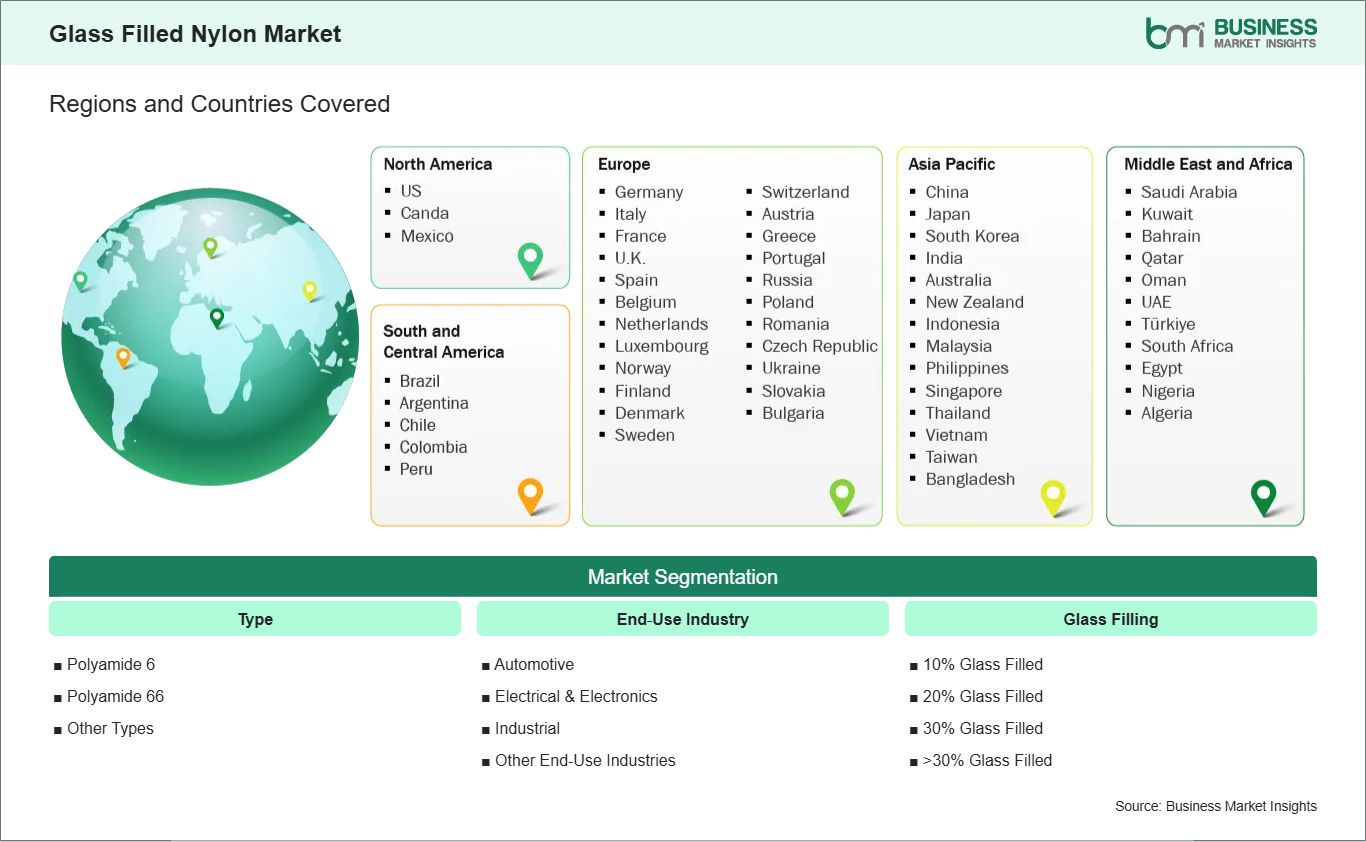
Key segments that contributed to the derivation of the glass filled nylon market analysis are type, end‑use industry, manufacturing process, and glass filling.
The increased demand for materials with high mechanical strength is creating a market for glass filled nylon in various industries and fields of engineering. The material's reinforced structure provides better stiffness, dimensional stability, and resistance to wear and fatigue compared to regular nylon materials. This makes glass filled nylon a better option for situations where high mechanical stress, vibrations, or thermal loading are encountered. The automotive industry, electrical industry, machinery industry, etc., are using glass filled nylon components to ensure the reliability and minimize the rate of failure for their equipment.
In industrial applications like gears, bearings, supporting structures, and conveyor system components, the high tensile strength and thermal properties offer a definite advantage. The fact that the components are both lightweight and strong enables the machines to operate efficiently without the need for excessive energy consumption. Moreover, the precision capabilities offered by the use of the material enable the creation of complex designs while still maintaining the required precision. This enables engineers to design the components for optimal performance while still reducing the cost of production. This makes the use of glass filled nylon a viable option for the creation of high-performance components.
Moreover, the resistance to wear, creep, and fatigue makes the use of the material a viable option for the creation of components that can be efficiently maintained. This enables the creation of cost-effective maintenance strategies for the machines and equipment. With the automotive, aerospace, and other industries demanding stronger and more reliable components for use in the creation of high-performance machines, the use of glass filled nylon is gaining popularity as a viable option for the creation of modern components for use in the creation of high-performance machines.
Robotics and industrial automation are also significant areas of growth for glass filled nylon. The strength-to-weight advantage, thermal properties, and dimensional stability of glass filled nylon make it suitable for precise moving parts of machines, such as actuator casings, gears, brackets, and frames. The parts are subject to repeated cycles of motion and mechanical stresses. Glass filled nylon ensures reliable performance, resisting deformations or thermal changes, which is critical in robotics and automation.
Automation systems, such as robotic arms, conveyor systems, and other precision handling devices, are increasingly utilizing glass filled nylon as a means of achieving a balance between material strength and operational efficiency. The lightweight nature of this material ensures lower power consumption and faster speeds, thus improving the performance of high-speed automation systems. Engineers and designers are utilizing the flexibility of this material to design complex components that satisfy strict operational requirements while allowing for spatial constraints, a common requirement of automated and robotics systems.
Another important factor contributing to the popularity of glass filled nylon is its ability to operate through numerous operational cycles without the need for replacement. In a bid to modernize automation systems, industries such as manufacturing, logistics, and electronics are increasingly utilizing sophisticated automation systems. The need for reliable and efficient materials such as glass filled nylon is bound to grow as the demand for modernization and operational benefits continues. The flexibility and strength of this material ensure its incorporation into the development of robotics and automated systems.

The glass filled nylon market is experiencing steady growth, with market size and share analysis reflecting evolving treatment preferences and competitive dynamics among key players. The report evaluates important subsegments categorized within type, end‑use industry, manufacturing process, and glass filling, highlighting their respective contributions to overall market performance.
By type, the polyamide 6 subsegment dominated the glass‑filled nylon market in 2025. Polyamide 6 offers excellent mechanical strength, chemical resistance, and processability, making it highly suitable for a wide range of industrial applications, which drives its widespread adoption.
Based on end-use industry, the automotive subsegment dominated the glass‑filled nylon market in 2025. Automotive applications demand high-performance materials with durability, heat resistance, and dimensional stability, making this segment highly suitable for components like engine parts and structural elements, which drives its widespread adoption.
On the basis of manufacturing process, the injection molding subsegment dominated the glass‑filled nylon market in 2025. Injection molding enables precise shaping and consistent material properties, making this process highly suitable for complex and high-volume production needs, which drives its widespread adoption.
In terms of glass filling, the 30% glass filled subsegment dominated the glass‑filled nylon market in 2025. A 30% glass content provides an optimal balance of strength, stiffness, and impact resistance, making this segment highly suitable for performance-critical applications, which drives its widespread adoption.
| Report Attribute | Details |
|---|---|
| Market size in 2025 | US$ 11.4 Billion |
| Market Size by 2033 | US$ 16.7 Billion |
| Global CAGR (2026 - 2033) | 4.89% |
| Historical Data | 2022-2024 |
| Forecast period | 2026-2033 |
| Segments Covered | By Type
|
|
Regions and Countries Covered
| |
| North America | US, Canada, Mexico |
| Europe | Belgium, Austria, Finland, Denmark, Greece, Poland, Romania, Russia, Ukraine, Czech Republic, Slovakia, Bulgaria, Italy, Luxembourg, Germany, Switzerland, France, Netherlands, Norway, Portugal, Spain, Sweden, United Kingdom |
| Asia-Pacific | Australia, China, India, Japan, South Korea, Indonesia, Malaysia, Philippines, Singapore, Thailand, Vietnam, Bangladesh, New Zealand, Taiwan |
| South and Central America | Brazil, Argentina, Peru, Chile, Colombia |
| Middle East and Africa | Bahrain, Kuwait, Oman, Qatar, Saudi Arabia, United Arab Emirates, Turkiye, South Africa, Egypt, Algeria, Nigeria |
| Market leaders and key company profiles |
|
The "Glass Filled Nylon Market Size and Forecast (2022 - 2033)" report provides a detailed analysis of the market covering below areas:
The geographical scope of the Glass Filled Nylon market report is divided into five regions: North America, Asia Pacific, Europe, Middle East & Africa, and South & Central America. The Glass Filled Nylon market in North America is expected to grow during the forecast period.
North America stands out as the dominant region in the global glass filled nylon market, supported by a strong industrial base, advanced manufacturing ecosystem, and early adoption of engineered materials. In this region, demand is particularly pronounced from automotive and industrial sectors that prioritize lightweighting, performance, and durability. Automakers and Tier‑1 suppliers leverage glass filled nylon for components such as intake manifolds, under‑hood brackets, gears, and structural fasteners to improve fuel efficiency and reduce maintenance costs. The region`s focus on electric vehicle platforms and hybrid drivetrain technologies has further amplified interest in engineered thermoplastics that offer strength without weight penalties.
Beyond automotive, North American industrial and consumer goods companies have utilized glass filled nylon within product designs that demand high mechanical reliability, such as power tools, appliance parts, and connectors. The availability of a well-developed plastics compounding industry and a supply chain infrastructure within North America enables a high degree of responsiveness to customer specifications and the ability to quickly prototype and scale product development. Regulatory drivers of product safety, emission reduction, and energy efficiency also correlate well with the performance benefits of glass filled nylon, making it an attractive choice for OEMs within North America.
Although North America is challenged by high product costs and competition from other materials, its position as a leader within the global glass filled nylon market is a result of its well-developed innovation base, relationships, and usage.

The glass filled nylon market is evaluated by gathering qualitative and quantitative data post primary and secondary research, which includes important corporate publications, association data, and databases. A few of the key developments in the glass filled nylon market are:
The Glass Filled Nylon Market is valued at US$ 11.4 Billion in 2025, it is projected to reach US$ 16.7 Billion by 2033.
As per our report Glass Filled Nylon Market, the market size is valued at US$ 11.4 Billion in 2025, projecting it to reach US$ 16.7 Billion by 2033. This translates to a CAGR of approximately 4.89% during the forecast period.
The Glass Filled Nylon Market report typically cover these key segments-
The historic period, base year, and forecast period can vary slightly depending on the specific market research report. However, for the Glass Filled Nylon Market report:
The Glass Filled Nylon Market is populated by several key players, each contributing to its growth and innovation. Some of the major players include:
The Glass Filled Nylon Market report is valuable for diverse stakeholders, including:
Essentially, anyone involved in or considering involvement in the Glass Filled Nylon Market value chain can benefit from the information contained in a comprehensive market report.
Please tell us your area of interest
(Market Segments/ Regions and Countries/ Companies)