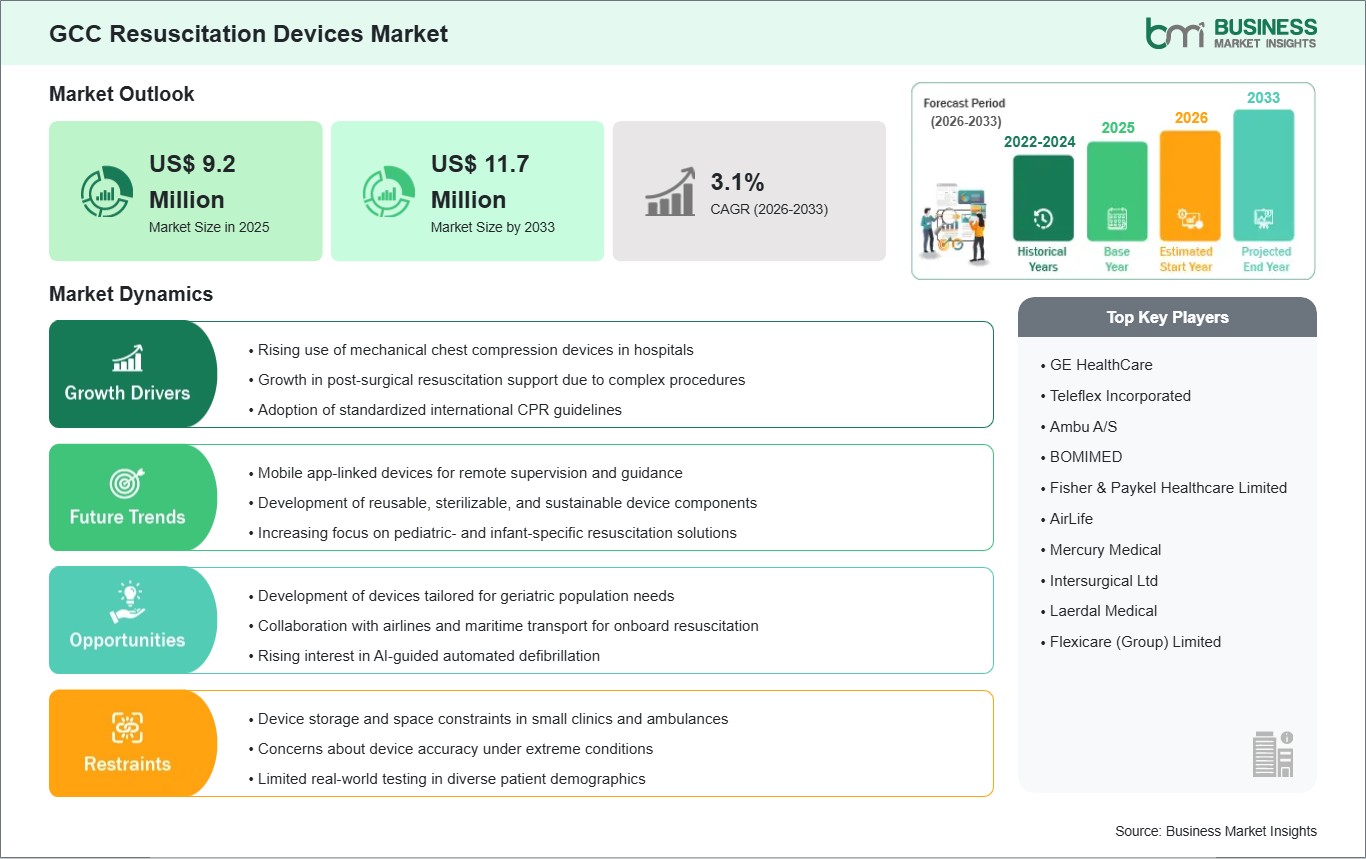
The GCC resuscitation devices market size is expected to reach US$ 11.7 million by 2033 from US$ 9.2 million in 2025. The market is estimated to record a CAGR of 3.1% from 2026 to 2033.
The GCC resuscitation devices market is highly marked by fast-paced expansion of health infrastructure, robust government-driven health modernization initiatives, and an ever-increasing need for emergency preparations at both private and public health sectors in the GCC. Cardiovascular emergencies, lifestyle diseases, and improved critical care facilities among the main drivers behind the rise in demand within the region's resuscitation devices market. In terms of market players, Saudi Arabia dominates the resuscitation devices market in the GCC due to the presence of large numbers of population, healthcare reform plans, and increased investment in emergency care services in line with national healthcare development blueprints. Due to the efforts by the authorities to modernize tertiary care hospitals, establish ambulance facilities, and deploy state-of-the-art life-support equipment, there is a considerable adoption of resuscitation equipment such as defibrillators, manual resuscitators, and ventilation devices. Similarly, the UAE and Qatar are also contributing to market growth by developing healthcare infrastructure and adoption of emergency care equipment technology especially in affluent areas. In the GCC region, another critical growth factor that is expected to support the development of emergency care in the region is the integration of the strategies developed by the government and emergency care modernization, particularly through mandatory equipment installation in all hospitals, airports, and other large public places. Moreover, an increase in awareness campaigns about the importance of dealing with cardiac arrest cases and training for medical practitioners will help raise the adoption rate of these devices. Nevertheless, there are several factors that may restrain the growth of this market, such as high reliance on medical devices from other countries, inadequate distribution of advanced emergency care in rural areas, and different training levels among expatriate medical practitioners.

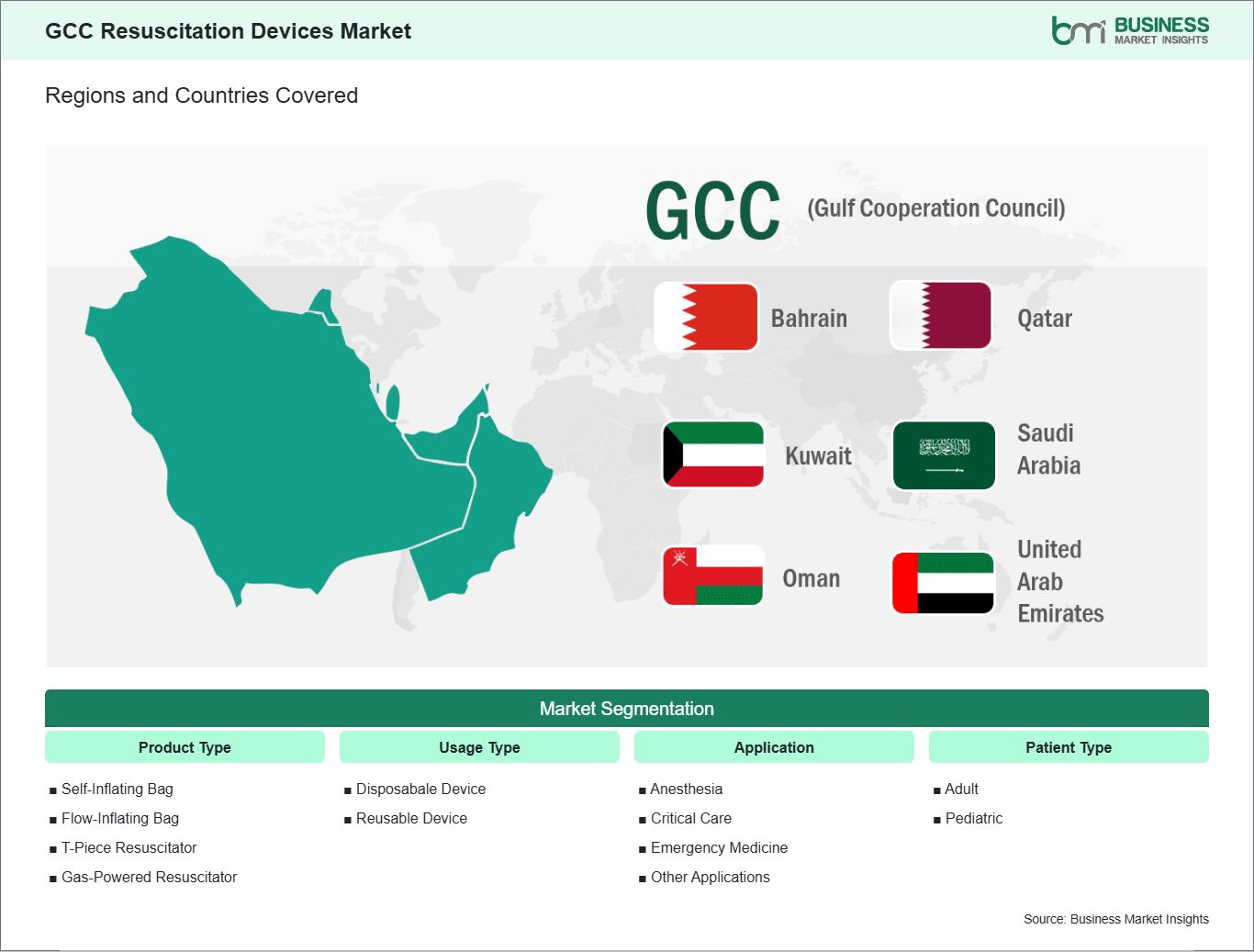
Key segments that contributed to the derivation of the GCC Resuscitation devices market analysis are product type, usage type, application, patient type, and end user.
The use of mechanical chest compression devices is becoming more prevalent in hospitals within the Gulf Cooperation Council countries as they strive to standardize their emergency response services and enhance patient outcomes. With increased cases of heart ailments caused by a sedentary lifestyle and metabolic problems, the occurrence of cardiac arrest in hospitals is rising. Consequently, hospitals are encouraged to replace traditional cardiopulmonary resuscitation with mechanical devices for providing reliable compressions.
The development of healthcare infrastructure in the region, especially in nations such as Saudi Arabia and the UAE, is adding momentum to this phenomenon. Hospitals are increasingly being built with an enhanced capacity for emergency services that involve resuscitation technologies as part of their critical care facilities. The increasing number of difficulties in staffing due to personnel shortages is also another factor driving the adoption of automated resuscitation technologies. With mechanical chest compressions, hospitals can lessen the need for a large team to respond and provide uninterrupted CPR even when resuscitating patients who require long sessions or during transportation within the healthcare facility premises.
Additionally, smart hospitals and technology-supported delivery of health care is another factor fueling the use of automated resuscitation techniques in the region. Hospitals in the Gulf Cooperation Council member states are increasingly adopting digital health technologies and connecting their devices through a seamless network, thereby fostering the deployment of automated resuscitation technologies. With such an ecosystem, healthcare providers can continuously monitor and record patient resuscitation activities using these technologies.
There are changes happening in the demographics of the GCC area, with people living longer lives and an increasing number of elderly people. These changing demographics mean there is a need for devices that will be able to cater to the physiological needs of elderly patients, whose bones are weak and who are likely to suffer from many diseases as well as having a low tolerance to vigorous procedures.
The Middle Eastern countries, including Saudi Arabia, the UAE, and Qatar, are focusing on the provision of healthcare services for their elderly population through various reforms in their healthcare system. Healthcare facilities are looking for resuscitation devices that could be applied safely according to the patient frailty level. Specifically, resuscitation devices that are able to offer adjustable force settings, as well as ergonomic interface features, are gaining much attention in order to accommodate specialists and nurses working in various healthcare environments.
Moreover, cultural and healthcare practices typical of the GCC, where home-based healthcare is becoming increasingly relevant, are impacting resuscitation technologies. In particular, there is currently a high demand for portable resuscitation devices that can be easily used both at hospital and in assisted and non-assisted home environments. With aging becoming more pronounced throughout the GCC region, the introduction of resuscitation devices suitable for their elderly patients is considered necessary for improving patients' survival chances and quality of life.

The GCC resuscitation devices market is experiencing steady growth, with market size and share analysis reflecting evolving treatment preferences and competitive dynamics among key players. The report evaluates important subsegments categorized within product type, usage type, application, patient type, and end user, highlighting their respective contributions to overall market performance.
By product type, the self-inflating Bag subsegment dominated the market in 2025, as they are easy to use and do not require external gas or power sources, making them ideal for emergencies. They allow precise manual control of ventilation, which is crucial in critical care. Their portability makes them suitable for both hospital wards and transport situations.
Based on usage type, the disposable devices subsegment dominated the market in 2025 due to their ability to prevent cross-contamination and infection. They eliminate the need for complex sterilization processes, saving time and reducing operational costs. In high-volume hospital settings, disposables improve workflow efficiency. This makes them highly preferred in emergency rooms, ICUs, and surgical units.
On the basis of application, the anesthesia subsegment dominated the market in 2025, as resuscitation devices are essential for safe ventilation during induction and recovery. They provide backup support if mechanical ventilators fail. Their precise control helps manage patients with varying lung compliances. Hospitals rely on these devices to prevent hypoxia and ensure patient safety during surgeries.
In terms of patient type, the adult subsegment dominated the market in 2025, as they experience more surgical procedures and critical emergencies than pediatric populations. Their larger lung capacity requires devices designed for adult ventilation. High prevalence of cardiac and respiratory conditions in adults increases usage frequency.
Based on end user, the hospitals subsegment dominated the market in 2025 due to constant emergency and surgical care needs. ICUs, operating rooms, and emergency departments require rapid access to resuscitation devices. High patient volume and stringent safety protocols make hospitals the key market driver. Their centralized procurement and standardized protocols ensure widespread device adoption.
| Report Attribute | Details |
|---|---|
| Market size in 2025 | US$ 9.2 Million |
| Market Size by 2033 | US$ 11.7 Million |
| CAGR (2026 - 2033) | 3.1% |
| Historical Data | 2022-2024 |
| Forecast period | 2026-2033 |
| Segments Covered | By Product Type
|
|
Regions and Countries Covered
| |
| GCC | UAE, Bahrain, Saudi Arabia, Oman, Qatar, Kuwait |
| Market leaders and key company profiles |
|
The "GCC Resuscitation Devices Market Size and Forecast (2022–2033)" report provides a detailed analysis of the market covering below areas:
The geographical scope of the GCC Resuscitation devices market report is divided into: Saudi Arabia, the UAE, Qatar, Kuwait, Bahrain, and Oman. Saudi Arabia held the largest share in 2025.
The Saudi Arabia market is the key contributor to the resuscitation devices in the GCC region due to its wide-ranging healthcare sector and consistent efforts towards modernizing its emergency services. There have been concerted efforts being made by Saudi Arabia for transforming its healthcare system, which has involved upgrading its hospitals and emergency services. Resuscitation devices are extensively used in hospitals and cardiac treatment facilities in the country. There has been increased use of automated external defibrillators, airway management, and portable ventilator devices among others in the country's major cities such as Riyadh, Jeddah, and Dammam. One of the key characteristics of the Saudi Arabian market is its highly regulated emergency response system, whereby the compulsory installation of life-saving equipment in airports, shopping complexes, and government buildings is steadily becoming more widespread. In addition, the implementation of nationwide programs for the development of healthcare professionals' basic life support skills, as well as those of the population, contributes to improving the efficiency of their application. Yet, difficulties still persist regarding equal access to advanced resuscitation devices in underdeveloped and sparsely populated territories, which have a relatively low density of the healthcare infrastructure network. The use of foreign-made equipment is another important factor in supply chain management. Yet, despite these issues, Saudi Arabia continues to occupy the prominent position of the major market driver in the GCC resuscitation devices segment.

The GCC resuscitation devices market is evaluated by gathering qualitative and quantitative data post primary and secondary research, which includes important corporate publications, association data, and databases. A few of the key developments in the GCC resuscitation devices market are:
The GCC Resuscitation Devices Market is valued at US$ 9.2 Million in 2025, it is projected to reach US$ 11.7 Million by 2033.
As per our report GCC Resuscitation Devices Market, the market size is valued at US$ 9.2 Million in 2025, projecting it to reach US$ 11.7 Million by 2033. This translates to a CAGR of approximately 3.1% during the forecast period.
The GCC Resuscitation Devices Market report typically cover these key segments-
The historic period, base year, and forecast period can vary slightly depending on the specific market research report. However, for the GCC Resuscitation Devices Market report:
The GCC Resuscitation Devices Market is populated by several key players, each contributing to its growth and innovation. Some of the major players include:
The GCC Resuscitation Devices Market report is valuable for diverse stakeholders, including:
Essentially, anyone involved in or considering involvement in the GCC Resuscitation Devices Market value chain can benefit from the information contained in a comprehensive market report.
Please tell us your area of interest
(Market Segments/ Regions and Countries/ Companies)