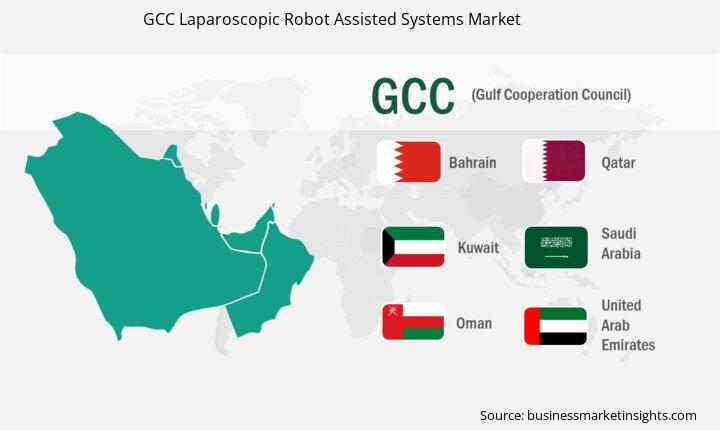
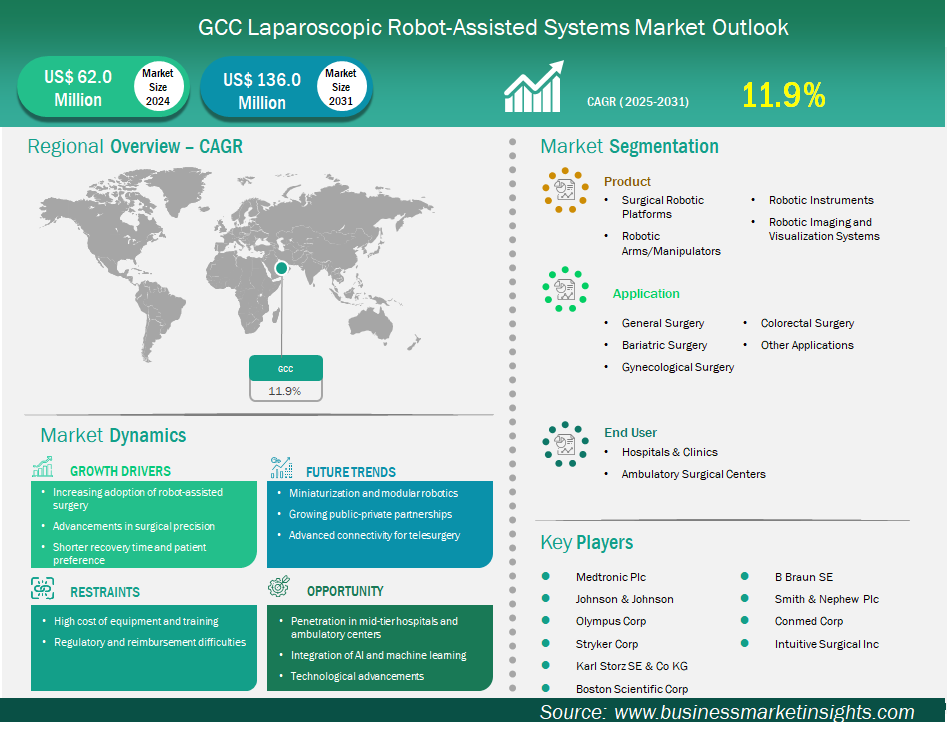
The GCC laparoscopic robot-assisted systems market size is expected to reach US$ 136.0 million by 2031 from US$ 62.0 million in 2024. The market is estimated to record a CAGR of 11.9% from 2025 to 2031.
Executive Summary and GCC Laparoscopic Robot-Assisted Systems Market Analysis:
The laparoscopic robot-assisted systems market in GCC is experiencing significant growth driven by increasing adoption of robot-assisted surgery, advancements in surgical precision, and shorter recovery times and patient preference. The GCC market for robot-assisted laparoscopic systems is strategically realigning itself, a change that is largely influenced by healthcare digitization, surgical modernization, and the increasing demand for minimally invasive surgeries in tertiary care facilities. The region, which was traditionally heavily reliant on foreign technologies and expatriate surgical expertise, is now turning towards localizing the robotic environment. Hospitals in Saudi Arabia, the UAE, and Qatar, are leading the way in this transformation. Procurement models are changing from direct purchase to managed service agreements and outcome-based contracts, which provide more accessibility and cost predictability. The competitive forces in the market are mainly due to the OEM collaborations with government healthcare agencies and independent hospital groups aimed at training, maintenance, and data integration. The use of the technology is the strongest in urology, gynecology, and general surgery, with robotic interventions increasingly becoming part of oncology treatment pathways. University hospitals are now adding robotic modules to the surgical training of postgraduates, although the region's simulation infrastructure and faculty skills are still at different levels. Overall, the market is shifting from the pilot-phase launches to large-scale strategic plans which emphasize on operational effectiveness, clinical outcomes, and regional standardization.
GCC Laparoscopic Robot Assisted Systems Market Segmentation Analysis:
Key segments that contributed to the derivation of the laparoscopic robot-assisted systems market analysis are product, application, and end user.
- By product, the laparoscopic robot-assisted systems market is segmented into surgical robotic platforms, robotic arms/manipulators, robotic instruments, and robotic imaging and visualization systems. The surgical robotic platforms segment dominated the market in 2024. This is the largest segment due to its role as the core infrastructure, integrating robotic arms, instruments, and imaging technologies, which enables a wide range of precision robot-assisted surgical procedures across various specialties.
- In terms of application, the market is segmented into general surgery, bariatric surgery, gynecological surgery, colorectal surgery, and other applications. The general surgery segment held the largest market share in 2024. This is the largest segment due to the broad range of common procedures performed with robotic assistance, such as cholecystectomy, hernia repair, and colorectal surgeries, which benefit from improved visualization, precision, and reduced invasiveness.
- By end user, the market is segmented into hospitals and clinics, and ambulatory surgical centers. The hospitals and clinics segment held the largest market share in 2024. This is the largest segment due to their comprehensive surgical services and capacity to invest in advanced technologies, enhancing surgical outcomes and patient care.
GCC Laparoscopic Robot-Assisted Systems Market Outlook
The GCC laparoscopic robot-assisted systems market is segmented into the United Arab Emirates, Bahrain, Saudi Arabia, Oman, Qatar, and Kuwait. The perspectives for the GCC laparoscopic robot-assisted systems market become positive, and this is mainly due to healthcare national transformation plans, the increase in surgical volumes, and the shift towards value-based care. In the region, the national governments are prioritizing robot-assisted surgery as a key part of their healthcare modernization plans, with a focus on oncology, bariatrics, and gynecology. Governments are simplifying regulatory clearances, creating one-stop procurement, and investing in centers for surgical innovation as they move from policy momentum to actual implementation. Convergence is getting more and more attention as AI-driven imaging, cloud-based surgical analysis, and interoperable robotic systems become popular in urban hospitals. The private sector's role is increasing as hospital chains invest in robotic facilities to make their services more attractive and to attract foreign patients. Standardization of clinical procedures and credentialing norms is the aim of the regional arrangements that include cross-border training initiatives and multicenter studies. OEMs adjust their go-to-market strategies to cater to the GCC market needs by opting for compact configurations, Arabic-language user interfaces, and remote support. Problems related to surgeon retention, cost amortization, and post-warranty service models still exist; however, the general trend points to strong adoption. Robot-assisted laparoscopy is predicted to be one of the core elements of surgical pathways in GCC health systems around 2030, with the support of regional training centers and outcome-based reimbursement schemes.
GCC Laparoscopic Robot-Assisted Systems Market Country Insights
Based on country, the GCC laparoscopic robot-assisted systems market is segmented into the United Arab Emirates, Bahrain, Saudi Arabia, Oman, Qatar, and Kuwait. Saudi Arabia held the largest share in 2024.
Analysis of laparoscopic robot-assisted systems market in GCC countries, at a country level, depicts a rapidly changing market that is quite diverse. Platform installations and procedure volumes position Saudi Arabia as the leader, while regional giants such as King Faisal Specialist Hospital is cited as example of how the robotic systems are being used in oncology and transplant surgery. Besides that, the United Arab Emirates is becoming the Middle East hub of innovation, as a result of Abu Dhabi and Dubai hospitals that are endorsing robotic platforms and covering gynecology, urology, and colorectal surgery, with the support of international accreditation and the promotion of medical tourism. Apart from that, Qatar provided the importance of academic integration by making capital expenditures on robotic training facilities and a simulation center. Meanwhile, Kuwait and Bahrain are ramping up their capacity for robots in the public sector hospitals with an emphasis on cost-effective modular systems and regional agreements for training. Oman is just beginning with pilot projects in Muscat that focus on general surgery and hepatobiliary surgery. Differences in regulatory, financial, and clinical adoption patterns exist between countries, but at the same time, these countries face common issues such as centralized procurement, public-private collaborations, and the emphasis on surgical quality metrics. To be able to prioritize the healthcare needs in local settings and institutions, OEMs and investors need nation-specific intelligence to be able to deploy their plans, training models, and service frameworks accordingly.
GCC Laparoscopic Robot Assisted Systems Market Company Profiles
Medtronic Plc; Johnson & Johnson; Olympus Corp; Stryker Corp; Karl Storz SE & Co KG, Boston Scientific Corp, B Braun SE, Smith & Nephew Plc, Conmed Corp, and Intuitive Surgical Inc., are among the key players operating in the market. These players adopt strategies such as expansion, product innovation, and mergers and acquisitions to stay competitive in the market and offer innovative products to their consumers.
GCC Laparoscopic Robot-Assisted Systems Market Research Methodology:
The following methodology has been followed for the collection and analysis of data presented in this report:
Secondary Research
The research process begins with comprehensive secondary research, utilizing both internal and external sources to gather qualitative and quantitative data for each market. Commonly referenced secondary research sources include, but are not limited to:
- Company websites, annual reports, financial statements, broker analyses, and investor presentations
- Industry trade journals and other relevant publications
- Government documents, statistical databases, and market reports
- News articles, press releases, and webcasts specific to companies operating in the market
Note: All financial data included in the Company Profiles section has been standardized to US$. For companies reporting in other currencies, figures have been converted to US$ using the relevant exchange rates for the corresponding year.
Primary Research
Business Market Insights conducts a significant number of primary interviews each year with industry stakeholders and experts to validate and analyze the data and gain valuable insights. These research interviews are designed to:
- Refine findings from secondary research
- Enhance the expertise and market understanding of the analysis team
- Gain insights into market size, trends, growth patterns, competitive dynamics, and future prospects
Primary research is conducted via email interactions and telephone interviews with industry experts across various markets, categories, segments, and sub-segments in different regions. Participants typically include:
- Industry stakeholders: Vice Presidents, business development managers, market intelligence managers, and national sales managers
- External experts: Valuation specialists, research analysts, and key opinion leaders with industry-specific expertise
Key Sources Referred:
- World Health Organization (WHO)
- The World Bank Group
- Worldometer
- The Lancet
- BMC Medical Education
- Eurostat
GCC Laparoscopic Robot Assisted Systems Market Strategic Insights
GCC Laparoscopic Robot Assisted SystemsMarket Report Highlights
| Report Attribute | Details |
| Market size in 2024 | US$ 62.0 Million |
| Market Size by 2031 | US$ 136.0 Million |
| CAGR (2025 - 2031) | 11.9% |
| Historical Data | 2021-2023 |
| Forecast period | 2025-2031 |
| Segments Covered |
By Product
|
|
Regions and Countries Covered
|
|
| GCC | United Arab Emirates, Bahrain, Saudi Arabia, Oman, Qatar, Kuwait |
| Market leaders and key company profiles |
|
GCC Laparoscopic Robot Assisted Systems Market Country and Regional Insights