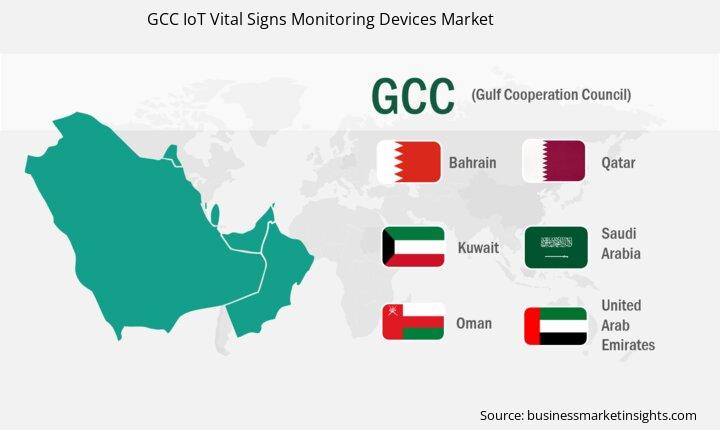
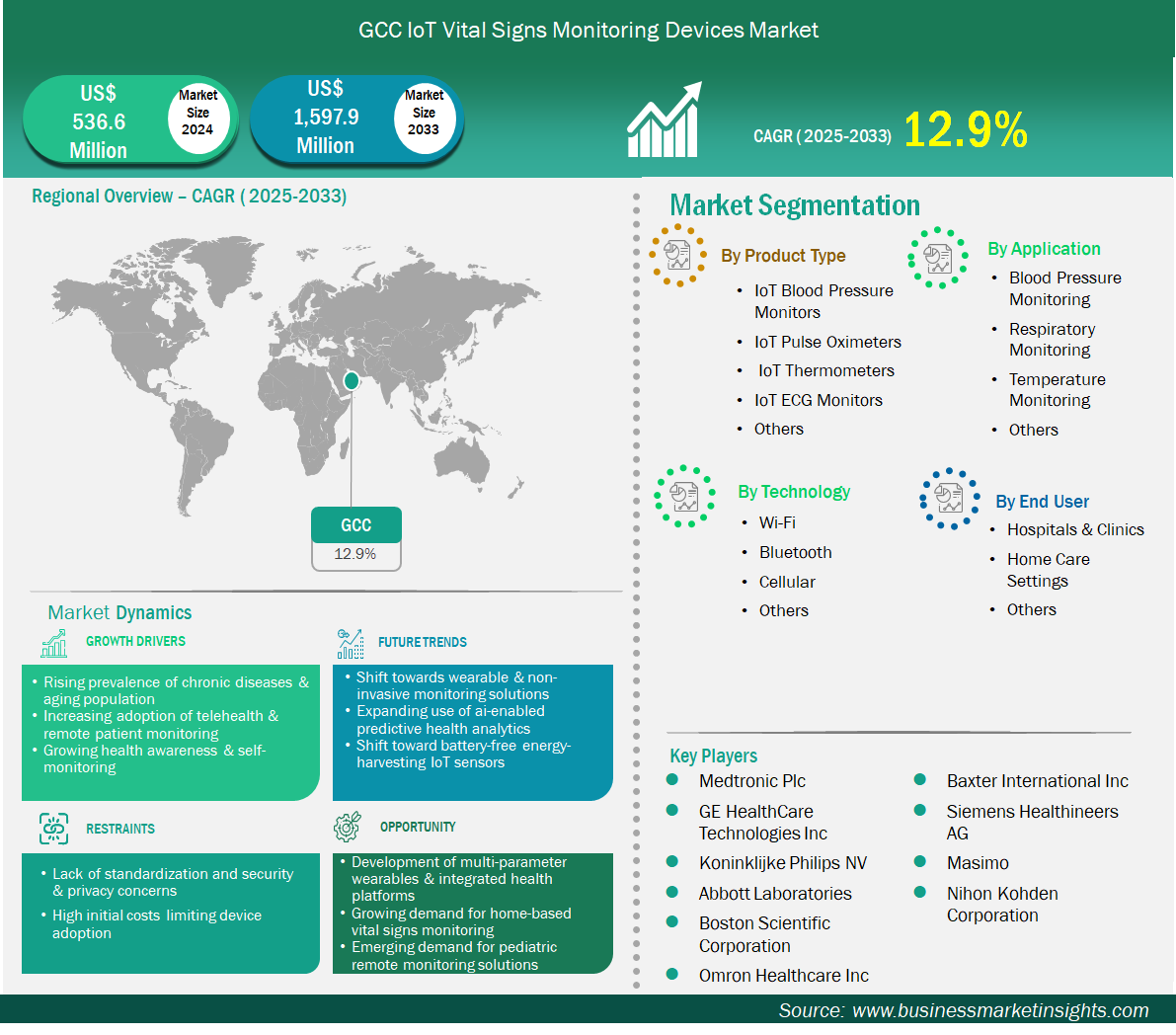
The GCC IoT vital signs monitoring devices market size is expected to reach US$ 1,597.9 million by 2033 from US$ 536.6 million in 2024. The market is estimated to record a CAGR of 12.9% from 2025 to 2033.
Executive Summary and GCC IoT Vital Signs Monitoring Devices Market Analysis:
The IoT vital signs monitoring devices market in GCC is experiencing significant growth driven by the rising prevalence of chronic diseases & aging population, increasing adoption of telehealth & remote patient monitoring, and growing health awareness & self-monitoring. The GCC IoT Vital Signs Monitoring Devices market is influenced by the region's sophisticated healthcare setup, the availability of government support, and the adoption of digital health technologies. Device-wise, the demand is largely driven by the blood pressure monitors, which are a direct reflection of the cardiovascular disease burden in the region. Hospitals and clinics, as the major end users, are employing IoT devices to enhance diagnostic accuracy and patient safety. In the technology segment, Wi‑Fi‑enabled devices are at the forefront, a trend that is being backed by strong broadband penetration and smart hospital initiatives. The competition scenario features multinational corporations that are introducing advanced IoT solutions while local companies are focusing on affordability and accessibility. The regulatory environment is being shaped by the governments that are placing a high emphasis on the integration of digital health as part of their national strategies, with Saudi Arabia and the UAE leading in the region. On the whole, the market is maintaining a balance between innovation and affordability, thus placing IoT vital-sign monitoring devices at the core of the healthcare modernization movement in the GCC.
GCC IoT Vital Signs Monitoring Devices Market Segmentation Analysis:
Key segments that contributed to the derivation of the IoT vital signs monitoring devices market analysis are product, technology, application, and end user.
- By product, the IoT vital signs monitoring devices market is segmented into IoT blood pressure monitors, IoT pulse oximeters, IoT thermometers, IoT ECG monitors, and others. IoT blood pressure monitors dominated the market in 2024, driven by the high incidence of lifestyle‑related diseases such as hypertension and diabetes.
- By technology, the IoT vital signs monitoring devices market is segmented into Wi-Fi, Bluetooth, cellular, and others. Wi-Fi dominated the market in 2024, driven by strong broadband penetration and smart hospital initiatives.
- In terms of application, the market is segmented into blood pressure monitoring, respiratory monitoring, temperature monitoring, and others. Blood pressure monitoring dominated the market in 2024, driven by the region’s emphasis on preventive cardiology.
- By end user, the market is segmented into hospitals & clinics, home care settings, and others. Hospitals & clinics dominated the market in 2024, driven by advanced infrastructure and integration with electronic health records.
GCC IoT Vital Signs Monitoring Devices Market Outlook
The GCC IoT vital signs monitoring devices market is segmented into the United Arab Emirates, Bahrain, Saudi Arabia, Oman, Qatar, and Kuwait. The outlook for the Gulf Cooperation Council (GCC) region remains bright, primarily due to structural reforms in healthcare delivery and a growing investment in digital health infrastructure. It is anticipated that hospitals will integrate healthcare through the use of the Internet of Things (IoT) devices that are linked with electronic health records (EHR) and telemedicine platforms, which in turn allow for patient monitoring from anywhere in the world. To differentiate their services and attract patients who are looking for better standards of care, private healthcare providers are heavily investing in cutting-edge IoT technologies. While Wi‑Fi will continue to dominate urban markets, connectivity solutions will be diversified with mobile‑enabled devices reaching the underprivileged rural areas. Overcoming infrastructure gaps will depend on the strategic collaborations between telecom operators and medical device companies. The healthcare industry in the region is also poised to transition to personalized Healthcare as IoT devices will facilitate predictive analytics, early intervention, and chronic disease management. However, a few challenges, such as fragmented regulatory environments, affordability issues, and uneven distribution of healthcare resources, still exist. Nevertheless, the forecast for the future is optimistic, with IoT vital signs monitoring devices seen as key factors in achieving universal healthcare access, thus narrowing the gap between resource-constrained systems and rising patient expectations.
GCC IoT Vital Signs Monitoring Devices Market Country Insights
Based on region, the GCC IoT vital signs monitoring devices market is further segmented into the United Arab Emirates, Bahrain, Saudi Arabia, Oman, Qatar, and Kuwait. Saudi Arabia held the largest share in 2024.
GCC country-level dynamics show a notable variety of differences in the patterns of adoption. With the help of the reforms of Vision 2030, a well-developed reimbursement framework, and an actively participating private sector, Saudi Arabia is leading the region. The UAE is showing a significant demand, which is mainly driven by the strong private sector participation and the advanced digital health policies. Qatar and Kuwait can be considered as two markets that are emerging, where the government is initiating the IoT adoption in rural areas. Oman and Bahrain, on the other hand, are utilizing IoT in their public-private partnerships; thus, hospital networks and national e-health strategies are being integrated. The different dynamics at a country level within the GCC highlight a different landscape of the working of the economies: the progression in the market is mainly powered by advanced economies, whereas emerging markets are improving gradually, thus there is need of locally tailored strategies.
GCC IoT Vital Signs Monitoring Devices Market Company Profiles
Medtronic Plc, GE HealthCare Technologies Inc, Koninklijke Philips NV, Abbott Laboratories, Boston Scientific Corporation, Omron Healthcare Inc, Baxter International Inc, Siemens Healthineers AG, Masimo, Nihon Cohden Corporation, are among the key players operating in the market. These players adopt strategies such as expansion, product innovation, and mergers and acquisitions to stay competitive in the market and offer innovative products to their consumers.
GCC IoT Vital Signs Monitoring Devices Market Research Methodology:
The following methodology has been followed for the collection and analysis of data presented in this report:
Secondary Research
The research process begins with comprehensive secondary research, utilizing both internal and external sources to gather qualitative and quantitative data for each market. Commonly referenced secondary research sources include, but are not limited to:
- Company websites, annual reports, financial statements, broker analyses, and investor presentations
- Industry trade journals and other relevant publications
- Government documents, statistical databases, and market reports
- News articles, press releases, and webcasts specific to companies operating in the market
Note: All financial data included in the Company Profiles section has been standardized to US$. For companies reporting in other currencies, figures have been converted to US$ using the relevant exchange rates for the corresponding year.
Primary Research
Business Market Insights conducts a significant number of primary interviews each year with industry stakeholders and experts to validate and analyze the data and gain valuable insights. These research interviews are designed to:
- Refine findings from secondary research
- Enhance the expertise and market understanding of the analysis team
- Gain insights into market size, trends, growth patterns, competitive dynamics, and future prospects
Primary research is conducted via email interactions and telephone interviews with industry experts across various markets, categories, segments, and sub-segments in different regions. Participants typically include:
- Industry stakeholders: Vice Presidents, business development managers, market intelligence managers, and national sales managers
- External experts: Valuation specialists, research analysts, and key opinion leaders with industry-specific expertise
Key Sources Referred:
- World Health Organization (WHO)
- Organisation for Economic Cooperation and Development (OECD)
- The World Bank Group
- Worldometer
- The Lancet
- International Bar association
- International Trade Administration
- Eurostat
GCC IoT Vital Signs Monitoring Devices Market Strategic Insights
GCC IoT Vital Signs Monitoring DevicesMarket Report Highlights
| Report Attribute | Details |
| Market size in 2024 | US$ 536.6 Million |
| Market Size by 2033 | US$ 1,597.9 Million |
| CAGR (2025 - 2033) | 12.9% |
| Historical Data | 2022-2023 |
| Forecast period | 2025-2033 |
| Segments Covered |
By Product
|
|
Regions and Countries Covered
|
|
| GCC | United Arab Emirates, Bahrain, Saudi Arabia, Oman, Qatar, Kuwait |
| Market leaders and key company profiles |
|
GCC IoT Vital Signs Monitoring Devices Market Country and Regional Insights