
Forestry Equipment Market Outlook: Size, Share, Trends, Growth Analysis, Competitive Landscape & Forecast, 2026-2033

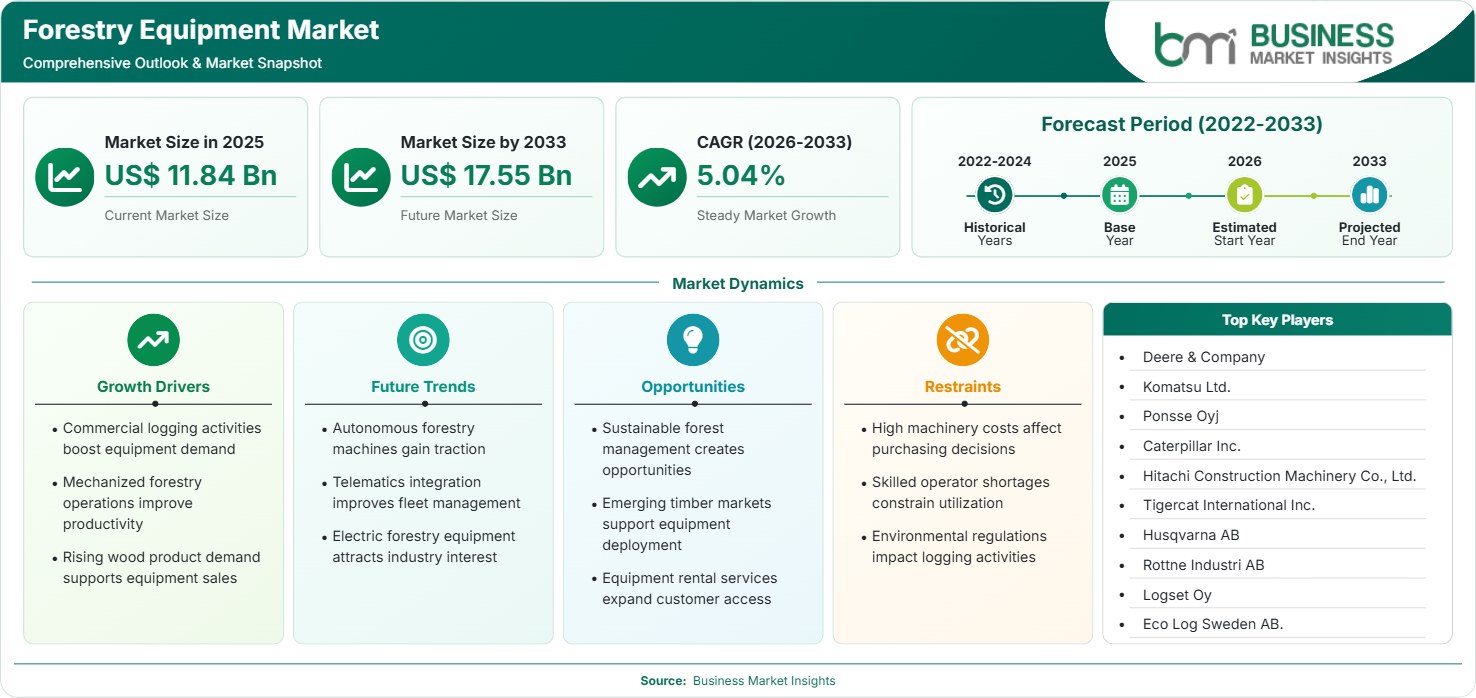
The Forestry Equipment Market size was valued at US$ 11.84 Billion in 2025 and is projected to reach US$ 17.55 Billion by 2033, growing at a CAGR of 5.04% during 2026–2033. Key growth drivers include mechanized harvesting adoption, biomass demand, labor shortages, digital forestry systems, and sustainability mandates. Opportunities are emerging through electrified equipment, smart fleet management, and expanding plantation forestry operations.

Report Coverage
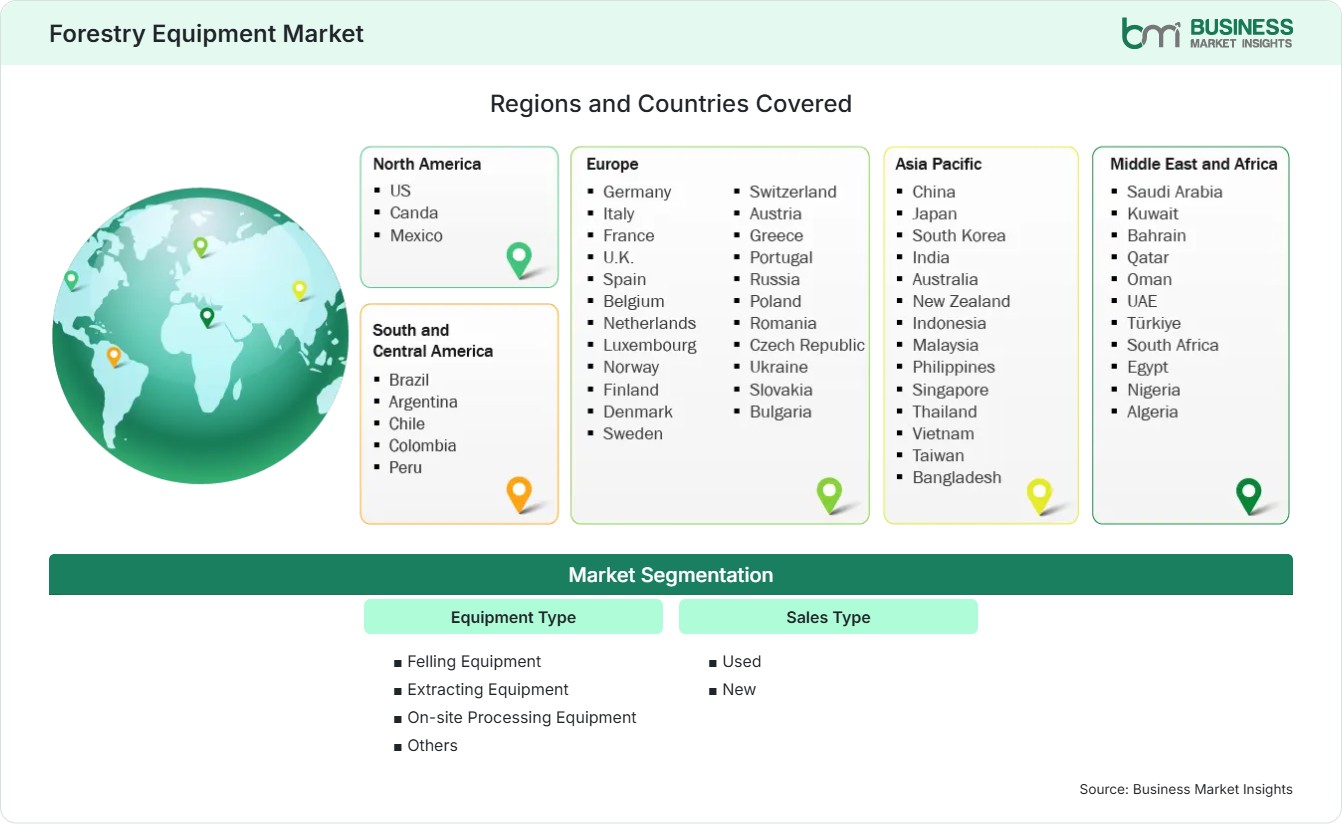
  • Equipment Type: Felling Equipment, Extracting Equipment, On-site Processing Equipment, Others
  • Sales Type: Used, New
US$ 11.84 Bn Market size in 2025
US$ 17.55 Bn Market Size by 2033
5.04% CAGR, 2026 - 2033
2026-2033 Forecast Period

AI Overview

Forestry Equipment Market Summary

  • North America Region: North America holds a market share of 34%–37% in 2025, growing with a CAGR of 4.4%–4.8% during 2026–2033. Demand is supported by mechanized logging, biomass utilization, contractor fleet modernization, safety compliance initiatives, and telematics-enabled productivity gains across commercial forestry operations. The U.S. remains the largest national market, supported by timber harvesting investments and fleet replacement cycles, advancing at 4.5%–4.9% CAGR.
  • Fastest Growing Region: Asia Pacific holds a market share of 24%–27% in 2025, growing with a CAGR of 6.2%–6.8% during 2026–2033. Plantation forestry expansion, infrastructure projects, mechanization initiatives, labor constraints, and government-backed environmental management programs are accelerating demand for advanced harvesting and extraction machinery.
  • Leading Segment: Felling Equipment holds market share of 31%–34% in 2025 and grows at 5.0%–5.4% CAGR. Rising timber production requirements, operator safety priorities, automation capabilities, and productivity-enhancing harvesting technologies continue supporting equipment replacement and new fleet investments.
  • High Growth Segment: New equipment accounts for 62%–66% share in 2025 and advances at 5.5%–5.9% CAGR. Digital integration, emissions compliance, financing availability, and growing preference for technologically advanced machinery encourage purchases across commercial forestry enterprises globally.
  • Key Market Opportunity: Expanding precision forestry ecosystems create opportunities for connected machinery, predictive maintenance, remote fleet monitoring, carbon-focused forest management, and productivity optimization solutions across large-scale timber harvesting operations.
  • Major Market Players: Deere & Company, Komatsu Ltd., Ponsse Oyj, Caterpillar Inc., Hitachi Construction Machinery Co., Ltd., Tigercat International Inc., Husqvarna AB, Rottne Industri AB, Logset Oy, Eco Log Sweden AB.
Strategic Insights

Forestry Equipment Market: Strategic Insights

Forestry Equipment Market Strategic Framework
FREE PDF
Request your free sample
Request free sample
Stakeholder View

Key Takeaways

  • The industry value chain increasingly integrates machine manufacturers, telematics providers, forestry contractors, timber companies, and sustainability certification agencies into a connected operating ecosystem.
  • Plantation forestry and mechanized harvesting applications present the strongest medium-term upside due to rising timber demand and ongoing labor availability constraints.
  • Product innovation is shifting toward autonomous functions, predictive maintenance, advanced sensors, fuel-efficient engines, and electrification-ready architectures.
  • Southeast Asia offers an attractive investment case due to expanding plantation resources, infrastructure development, and growing mechanization rates.
  • Strategic acquisitions increasingly focus on digital forestry capabilities, fleet intelligence platforms, and specialty harvesting technologies that improve operational productivity.
  • Aftermarket services, maintenance contracts, and equipment software upgrades are becoming major revenue contributors alongside machinery sales.
Geographic Outlook

Forestry Equipment Market Regional Highlights

North America Forestry Equipment Market

North America accounted for approximately 34%–37% of the Forestry Equipment Market share in 2025 and is projected to expand at 4.4%–4.8% CAGR through 2033. Strong timber production, high mechanization levels, extensive contractor networks, and advanced harvesting practices support regional leadership. Canada and the United States remain major demand centers for harvesters, skidders, and forwarders. Investment in telematics-enabled fleet management and sustainable forestry programs continues encouraging equipment upgrades while biomass harvesting applications create additional demand across managed forest operations.

  • Extensive mechanized harvesting adoption supports productivity improvements and reduces dependence on manual labor.
  • Growing biomass utilization creates demand for chipping, processing, and extraction equipment.
  • Fleet modernization emphasizes operator safety technologies and data-driven maintenance systems.
  • Sustainable forestry certifications encourage investment in precision harvesting equipment.
  • Replacement demand remains strong across aging contractor machine fleets.

US Forestry Equipment Market

The United States represents roughly 73%–77% of regional revenue and is expected to grow at 4.5%–4.9% CAGR. Commercial forestry activity across the South and Pacific Northwest supports consistent equipment demand. Large timberland owners increasingly deploy connected machinery to improve harvesting efficiency, cost visibility, and operational planning. Ongoing investment in forest restoration and wildfire mitigation activities also supports equipment utilization across multiple forestry applications.

  • Southern timber-producing states remain major purchasers of harvesting and extraction machinery.
  • Wildfire management programs support demand for mulching and site-preparation equipment.
  • Digital forestry adoption strengthens fleet visibility and maintenance planning.
  • Rising demand for wood products supports equipment replacement investment.

Europe Forestry Equipment Market

Europe accounted for a 27%-30% share in 2025 and is expected to register a CAGR of 4.8%-5.3%. Countries such as Sweden, Finland, and Germany are leading in equipment adoption, while Eastern European countries have high growth potential. Sophisticated machines find increasing demand due to advanced cut-to-length harvesting systems. Procurement decisions are being influenced by environmental norms, operator safety needs, and the use of digital forestry technology. Finland has been a leading market, whereas Poland and the Baltic economies represent higher-growth opportunities with CAGR exceeding the regional average.

  • Nordic countries remain technology leaders in automated harvesting.
  • Forest certification requirements encourage investment in precision machinery.
  • Electrification and low-emission initiatives influence procurement decisions.
  • Eastern Europe presents growing mechanization opportunities.
  • Data-enabled forestry management becomes increasingly important.

Asia Pacific Forestry Equipment Market

The Asia Pacific held a 24%-27% share in 2025 and is anticipated to have the highest CAGR of 6.2%-6.8%. Expansion of commercial plantations, development of the timber processing industry, and infrastructure development increase the requirement for equipment. China dominates regional revenue production, whereas Indonesia, Vietnam, and India show an increasing trend in their adoption. The region shows potential for equipment adoption due to limited mechanization in some countries. Government support for productivity enhancement and resource management further strengthens market prospects.

  • Plantation forestry expansion supports harvesting equipment demand.
  • China remains the leading regional market for forestry machinery deployment.
  • Indonesia and Vietnam exhibit strong mechanization momentum.
  • Growing labor costs encourage automated harvesting solutions.
  • Forest management modernization drives technology adoption.

Rest of World Forestry Equipment Market

Rest of World captured 10%–12% share in 2025 and is anticipated to expand at 5.4%–5.9% CAGR. South and Central America benefit from commercial eucalyptus and pine plantations supporting demand for harvesting equipment. In the Middle East and Africa, forestry management programs, land rehabilitation efforts, and selective commercial timber operations support fleet investments. Brazil leads regional revenue while Chile demonstrates robust mechanization growth. South Africa remains a key African market for commercial forestry equipment deployment.

  • Brazil represents the largest market across South and Central America.
  • Chile benefits from export-oriented plantation forestry investments.
  • African forestry modernization supports gradual equipment adoption.
  • Reforestation initiatives generate demand for site-preparation machinery.
  • Contractor-based operating models encourage versatile equipment utilization.
Global Market Geography
FREE PDF
Request your free sample
Request free sample
Segment Analysis

Forestry Equipment Market Segmentation

Equipment Type

The Equipment Category was the highest-revenue segment in the Forestry Equipment Market scope. This segment held around 68%–72% market share in 2025 and is projected to grow at a 5.0%–5.5% CAGR during the forecast period. Mechanization in forestry, productivity improvements, and operator safety standards continue to drive demand across harvesting, extraction, and processing.

  • Felling Equipment: Dominates harvest operations through high productivity, improved accuracy, and enhanced safety. Advanced harvesters integrate automation, telematics, and performance monitoring capabilities to improve operational efficiency.
  • Extracting Equipment: Essential for transporting felled timber from forests to collection points. Demand benefits from large-scale plantation operations and increased emphasis on optimizing logistics efficiency.
  • On-site Processing Equipment: Supports debarking, chipping, and processing activities directly within forestry sites. Growing biomass demand and transportation optimization strengthen adoption across commercial operators.

Sales Type

Sales Type continues to be affected by cost and financing factors, as well as fleet modernization. The segment represented about 28%-32% market share through the use of used machinery, and is forecast to grow at 4.8%-5.4% CAGR. The Forestry Equipment Market trends reveal the rising popularity of high-end new machinery in advanced economies and the continued importance of used equipment in price-sensitive economies.

  • Used: Preferred among smaller contractors seeking lower acquisition costs while maintaining operational capabilities. Refurbishment programs and equipment availability support continued market participation.
  • New: Benefits from advanced technology integration, improved fuel efficiency, regulatory compliance, and financing programs. Higher productivity and lifecycle performance continue encouraging investment among commercial operators.
Market Forces

Forestry Equipment Market Dynamics

Key Market Drivers

Mechanization Adoption Across Commercial Forestry Operations

Commercial forest companies are now focusing more on productivity, employee safety, and efficiency due to mechanization. According to industry studies, North America remains the largest market for forestry machinery, attributable to increased use of mechanized harvesting systems. The current harvesters and forwarders have decreased the need for labor and have provided more consistent production. The Forestry Equipment Market growth is also supported by contractors' demand for faster harvesting processes and higher fleet efficiency. With machine control technology, automated cutting systems, and performance analysis, operators can maximize their timber yield. These advantages continue driving investment in new equipment across mature and emerging forestry markets.

Rising Demand for Timber, Wood Products, and Biomass

Global demand for construction materials, engineered wood products, pulp, paper, and biomass energy continues to support harvesting activity. The International Energy Agency identifies bioenergy as a major renewable energy source, with woody biomass maintaining a significant contribution to renewable energy consumption. Greater harvesting demands lead to greater investment in equipment that cuts, extracts, and processes timber. The growing production of pellets and biomass also affects the Forestry Equipment Market Trends. Commercial forestry companies need better equipment to achieve sustainable harvesting goals, manage operating expenses, and minimize their environmental impact across the forest industry value chain.

Digital Forestry and Connected Equipment Expansion

The use of technology such as telematics, predictive maintenance, GPS guidance, machine analytics, and fleet management systems has increased. These technologies have helped improve machine efficiency and optimize operators' work. Industry studies have shown an increase in the use of artificial intelligence-assisted controls and predictive maintenance technologies in forestry machinery. These technologies help contractors measure their efficiency, optimize their fuel consumption, and prevent unplanned downtimes. Data-based forestry management has become a competitive advantage for large contractors. The resulting productivity benefits encourage investments in fleet modernization and increase the adoption of advanced harvesting and extraction equipment across major forestry regions.

Key Market Opportunities

Electrified and Hybrid Forestry Machinery Development

The growing focus on reducing emissions is creating room for equipment makers designing hybrids and electrified platforms for forestry applications. Equipment buyers are now factoring in lifecycle emissions alongside other metrics such as productivity. There are innovations in battery technologies, energy management systems, and electric drive trains that enable future commercialization of this equipment. The Forestry Equipment Market Forecasts report highlights growing interest among contractors in low-emission equipment within highly regulated environmental programs. Early adoption is anticipated in the mature forestry equipment markets. Manufacturers capable of balancing performance, durability, and energy efficiency are positioned to capture long-term competitive advantages.

Expansion of Plantation Forestry in Emerging Markets

The expansion of commercial plantations throughout Southeast Asia, Latin America, and certain African regions presents a compelling investment case. The plantation companies are becoming more interested in adopting technology that enables larger-scale harvesting in forests. The development of infrastructure, the export timber business, and increased domestic consumption of wood products make the need for machinery inevitable. With mechanization levels much lower than in North America and Northern Europe, there are many opportunities for replacement and first-time purchases. Manufacturers offering localized service support, financing solutions, and adaptable equipment configurations are well-positioned to benefit from the expansion of forestry activity.

Growth of Digital Forestry Ecosystems

An integrated platform for forestry operations, enabled by digitalization, creates possibilities that extend beyond equipment sales. Fleet analytics, remote diagnostics, operator training systems, and productivity software provide ongoing revenue streams. Commercial customers increasingly seek an all-encompassing solution that integrates hardware and software. Connectivity in the forestry industry also enables sustainability reporting, traceability of harvesting, and carbon management projects. Companies that integrate their hardware, software, and services can enhance customer loyalty and increase lifetime value. The change gradually leads to the shift of forestry equipment towards a technological platform model.

Market Restraints and Challenges

High Capital Costs and Financing Constraints

Factor: Modern harvesters, forwarders, and processing equipment require substantial upfront investment. Impact: Smaller contractors frequently delay modernization projects despite productivity benefits. Advanced machinery equipped with telematics and automation systems carries higher acquisition costs, creating barriers in cost-sensitive markets. Financing availability varies significantly across regions, limiting adoption among independent operators. Extended equipment replacement cycles may reduce new machinery demand during periods of economic uncertainty. While ownership costs can be offset through improved efficiency and lower downtime, capital accessibility remains a persistent challenge affecting purchasing decisions throughout the market.

Skilled Operator Shortages and Maintenance Complexity

Factor: Forestry equipment increasingly relies on sophisticated electronics, sensors, and software systems. Impact: Operators require specialized training, while maintenance demands become more complex. Labor shortages within forestry industries already encourage automation, yet insufficient technical skills can slow adoption rates. Remote operating environments further complicate servicing requirements and parts availability. Unplanned downtime can significantly affect contractor profitability. Manufacturers must therefore expand training programs, dealer networks, and digital support capabilities to ensure customers can effectively utilize advanced machinery throughout demanding forestry applications.

Company Analysis

Competitive Landscape

The competitive environment reflects ongoing Forestry Equipment Market analysis around automation, fuel efficiency, digital forestry integration, and contractor productivity requirements.

Company Name

Overview

Products and Services relevant to this market

Deere & Company

Global heavy equipment leader with extensive forestry presence and strong dealer network.

Harvesters, forwarders, feller bunchers, telematics solutions, maintenance services.

Komatsu Ltd.

Major forestry machinery supplier with advanced automation capabilities.

Harvesters, forwarders, machine intelligence systems, digital fleet tools.

Ponsse Oyj

Specialized forestry equipment manufacturer focused on cut-to-length systems.

Harvesters, forwarders, software platforms, aftermarket support services.

Caterpillar Inc.

Broad construction and resource equipment manufacturer serving forestry operators.

Forestry excavators, loaders, engines, connected equipment technologies.

Hitachi Construction Machinery Co., Ltd.

Provides specialized machinery with strong engineering capabilities.

Forestry excavators, processing equipment, fleet performance systems.

Tigercat International Inc.

Forestry-focused manufacturer with strong harvesting equipment portfolio.

Harvesters, skidders, forwarders, loaders, material handling systems.

Husqvarna AB

Global outdoor equipment specialist serving forestry professionals.

Chainsaws, forestry tools, maintenance solutions, digital support technologies.

Rottne Industri AB

Swedish forestry equipment producer with international presence.

Harvesters, forwarders, operator productivity solutions, service offerings.

Logset Oy

Specialized forestry machinery company emphasizing fuel efficiency.

Harvesters, forwarders, hybrid technologies, fleet management solutions.

Eco Log Sweden AB

Niche forestry machinery manufacturer focused on sustainable operations.

Harvesters, forwarders, forestry technology systems, support services.

Trust & Transparency

Research Methodology

The market analysis combines proprietary research with secondary data from government agencies, company disclosures, regulatory filings, industry databases and expert interviews. Market estimates are validated through data triangulation, cross-market benchmarking and analyst review.

View Full Research Methodology

Questions Answered

Frequently Asked Questions

What does a Forestry Equipment Market Report typically evaluate?

A Market Report typically assesses market size, competitive positioning, technology developments, regional demand patterns, segment performance, and future investment opportunities.

Why are new machines gaining share over used equipment?

New machinery provides regulatory compliance, advanced automation, better fuel efficiency, and integrated digital capabilities that improve lifecycle economics.

How is digitalization changing forestry operations?

Telematics, predictive maintenance, GPS guidance, and fleet analytics improve productivity, reduce downtime, and support data-driven operational planning.

Which region offers the strongest growth potential?

Asia Pacific presents the strongest growth outlook due to plantation expansion, increasing mechanization rates, and ongoing forestry modernization initiatives.

What factors most influence equipment purchasing decisions?

Productivity, ownership costs, fuel efficiency, dealer support, technology integration, financing availability, and machine durability are the primary evaluation criteria for commercial forestry operators.

Access the Full Forestry Equipment Market Report

Get segment-level forecasts, regional estimates, competitive benchmarking, company profiles and downloadable Excel datasets.

Access the full Forestry Equipment Market Report
350 pages PDF & Excel | 2026-08-31