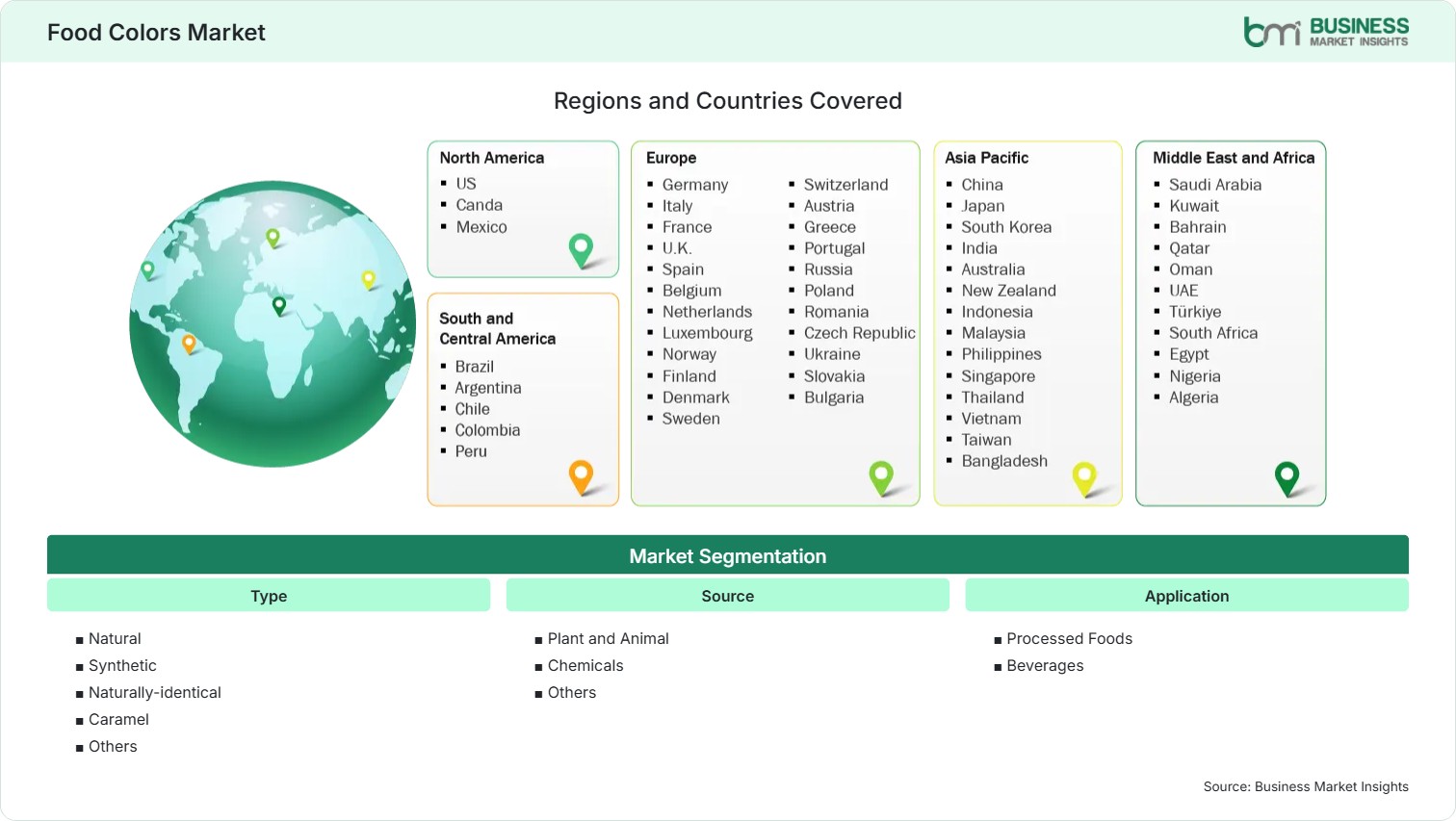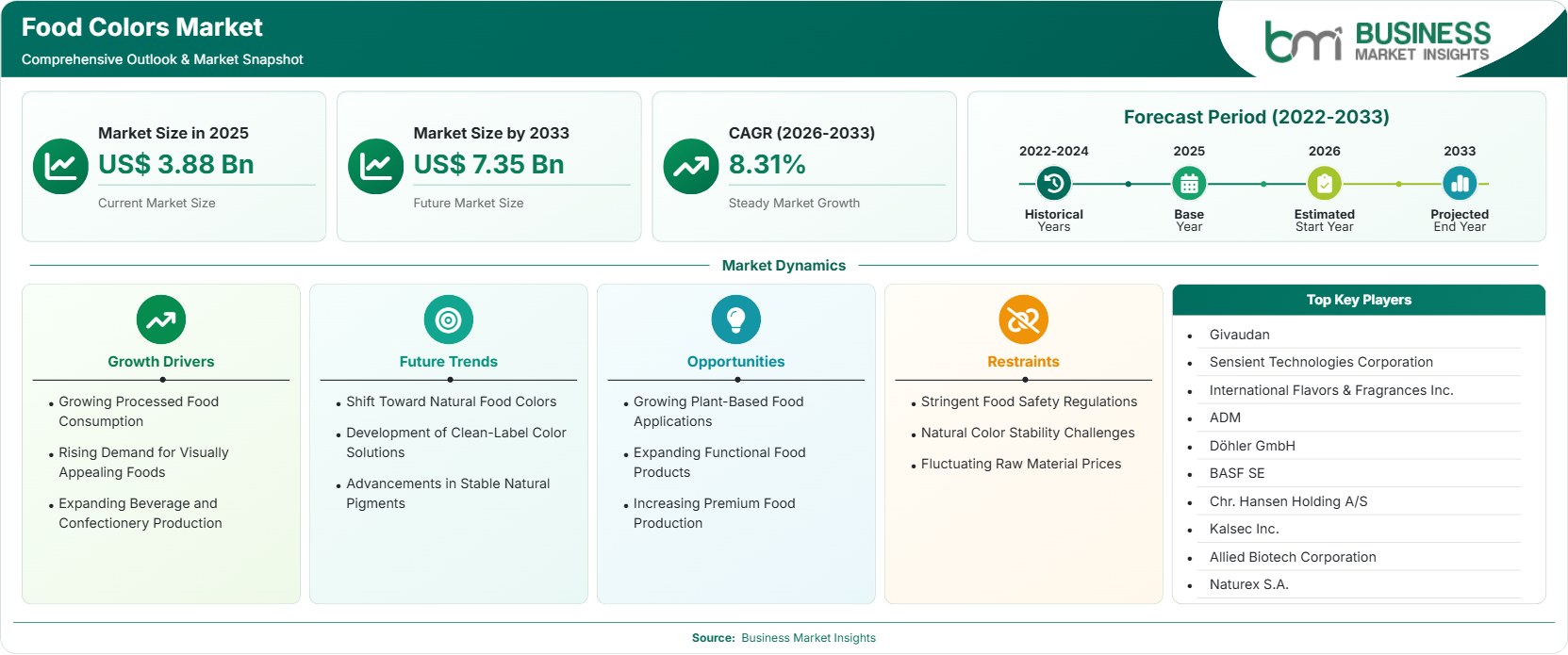
Food Colors Market Regional Highlights
North America Food Colors Market
North America holds a 27%–30% share in 2025 and is projected to expand at a 7.5%–8.3% CAGR during 2026–2033. The Food Colors Market share reflects a mature packaged-food ecosystem, strong beverage manufacturing, and rapid reformulation activity. The United States remains the principal demand center because manufacturers serve extensive processed-food portfolios. Regulatory scrutiny surrounding synthetic dyes is strengthening demand for alternative formulations, while technical development focuses on maintaining shade intensity and stability across challenging food matrices.
- Natural-color reformulation is accelerating as manufacturers seek alternatives that satisfy changing regulatory expectations without compromising recognizable product appearance or established brand identities.
- Beverage manufacturers are prioritizing stable color systems capable of performing across acidic formulations, extended shelf-life requirements, and increasingly complex combinations of sweeteners, flavors, and functional ingredients.
- Premium snacks and confectionery products are creating opportunities for customized shades, botanical extracts, and clean-label positioning that can differentiate products across crowded retail categories.
- Technical application centers are becoming strategically important because manufacturers require support with color matching, processing compatibility, dosage optimization, and shelf-life performance.
US Food Colors Market
The United States Food Colors Market represents the largest national market within North America, accounting for approximately 74%–78% of the regional share in 2025 and expanding at a 7.7%–8.4% CAGR during 2026–2033. The regulatory environment is an important demand catalyst, particularly as manufacturers reassess synthetic dyes.
- U.S. manufacturers increasingly require reformulation partners capable of reproducing familiar shades while accommodating differences in pH, processing temperatures, packaging, and ingredient interactions.
- Demand is strengthening for natural reds, blues, greens, yellows, and oranges, with suppliers investing in botanical sourcing and stabilization technologies to broaden application compatibility.
- Functional beverages and wellness-oriented foods are creating additional color opportunities because visual cues increasingly support product positioning around energy, immunity, nutrition, and lifestyle benefits.
Europe Food Colors Market
Europe represents a mature demand center with a 24%–27% of Food Colors Market share in 2025 and a 7.4%–8.2% CAGR during 2026–2033. Germany, France, Italy, and the United Kingdom remain important manufacturing markets, while Spain and Poland provide attractive growth opportunities. Givaudan reports that color influences purchase decisions for 55% of European consumers, reinforcing the commercial importance of visual presentation. The region also emphasizes ingredient transparency, sustainability, and clean-label positioning.
- Germany benefits from a broad processed-food manufacturing base and sophisticated ingredient-development ecosystem, supporting demand for application-specific natural color systems.
- France and Italy provide opportunities in premium foods, confectionery, beverages, bakery, and specialty products where color contributes strongly to product identity and sensory positioning.
- Poland and Spain offer comparatively faster expansion opportunities as modern food manufacturing, private-label production, and packaged-food consumption broaden.
- European suppliers increasingly combine sourcing, extraction, regulatory guidance, and application development to meet demanding customer specifications.
Asia Pacific Food Colors Market
Asia Pacific holds a 29%–32% Food Colors Market share in 2025, making it the largest regional demand pool, and is projected to record a 9.2%–10.1% CAGR during 2026–2033. China, Japan, India, South Korea, and Southeast Asian manufacturing centers support demand across beverages, confectionery, bakery, sauces, dairy alternatives, and convenience foods. India and Southeast Asia offer particularly strong growth opportunities as organized retail, packaged-food production, and branded food consumption expand.
- China remains a major manufacturing and consumption center, with large-scale food processing supporting demand for standardized color ingredients and customized formulation systems.
- India provides strong opportunities across beverages, confectionery, dairy products, snacks, and traditional-food modernization, while domestic processors increasingly emphasize consistent commercial presentation.
- Japan and South Korea favor high-performance formulations suited to sophisticated food processing, premium packaging, functional foods, and precise color specifications.
- Southeast Asia offers attractive expansion opportunities as multinational and regional food manufacturers increase localized product development and modern distribution.
Rest of World Food Colors Market
South and Central America collectively account for approximately 8%–10% of global demand in 2025, with a 8.5%–9.4% CAGR during 2026–2033. Brazil and Mexico lead regional consumption through established food-processing industries, beverage manufacturing, confectionery production, and expanding branded-food categories. Agricultural diversity also supports sourcing opportunities for naturally derived pigments.
The Middle East and Africa represent approximately 10%–12% of demand in 2025, expanding at a 8.0%–9.0% CAGR during 2026–2033. The United Arab Emirates, Saudi Arabia, South Africa, and other urbanizing markets provide opportunities through food manufacturing, imported packaged products, beverage innovation, and premium retail.
- Brazil combines strong agricultural resources with large-scale processed-food and beverage production, creating opportunities for locally sourced botanical color ingredients.
- Mexico benefits from extensive snack, beverage, bakery, and confectionery manufacturing, supporting demand for stable and cost-efficient color formulations.
- Saudi Arabia and the United Arab Emirates offer premiumization opportunities as foodservice, packaged-food manufacturing, and modern retail continue developing.
- South Africa provides a regional manufacturing base for food and beverage products, supporting demand for both natural and synthetic color systems.