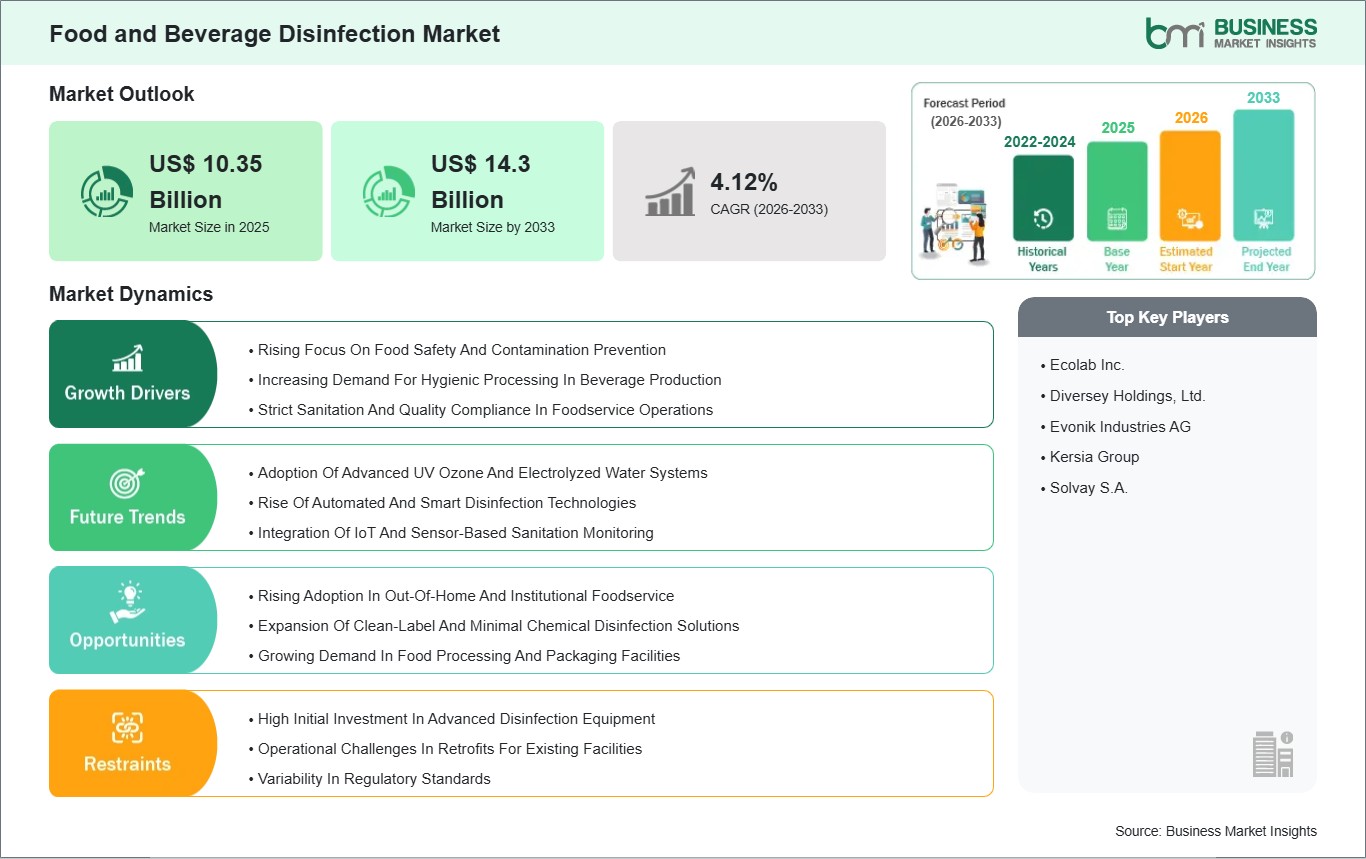
The Food and Beverage Disinfection Market size is expected to reach US$ 14.3 Billion by 2033 from US$ 10.35 Billion in 2025. The market is estimated to record a CAGR of 4.12% from 2026 to 2033.
The global food and beverage disinfection market includes various technologies and solutions that help in the removal of harmful microbes and other impurities from food and beverage products, processing equipment, and environments. The growth of the global food and beverage disinfection market is mainly influenced by the rising demand for safe and high-quality food and beverage products that are long-lasting, along with the regulatory requirements for the implementation of food safety standards in various countries across the world. The disinfection solutions that are implemented in various processing facilities, bottling plants, and packaging operations for the purpose of ensuring a high level of hygiene and preventing contamination are quite common in the market.
The awareness of various foodborne diseases has increased the demand for advanced disinfection solutions in the global market. The effectiveness of disinfection solutions can vary depending on the type of microorganisms, surface materials, and environmental conditions, which may require customized and high-maintenance solutions. Additionally, the use of chemical disinfectants may raise concerns related to residuals and environmental impact, prompting a push for eco-friendly alternatives. Cost considerations and integration complexity can also limit adoption, particularly among smaller producers. Nevertheless, the global market continues to expand as food safety regulations become more rigorous, manufacturers adopt automated and efficient disinfection technologies, and innovations in non-chemical and sustainable disinfection methods increase accessibility across the food and beverage sector.

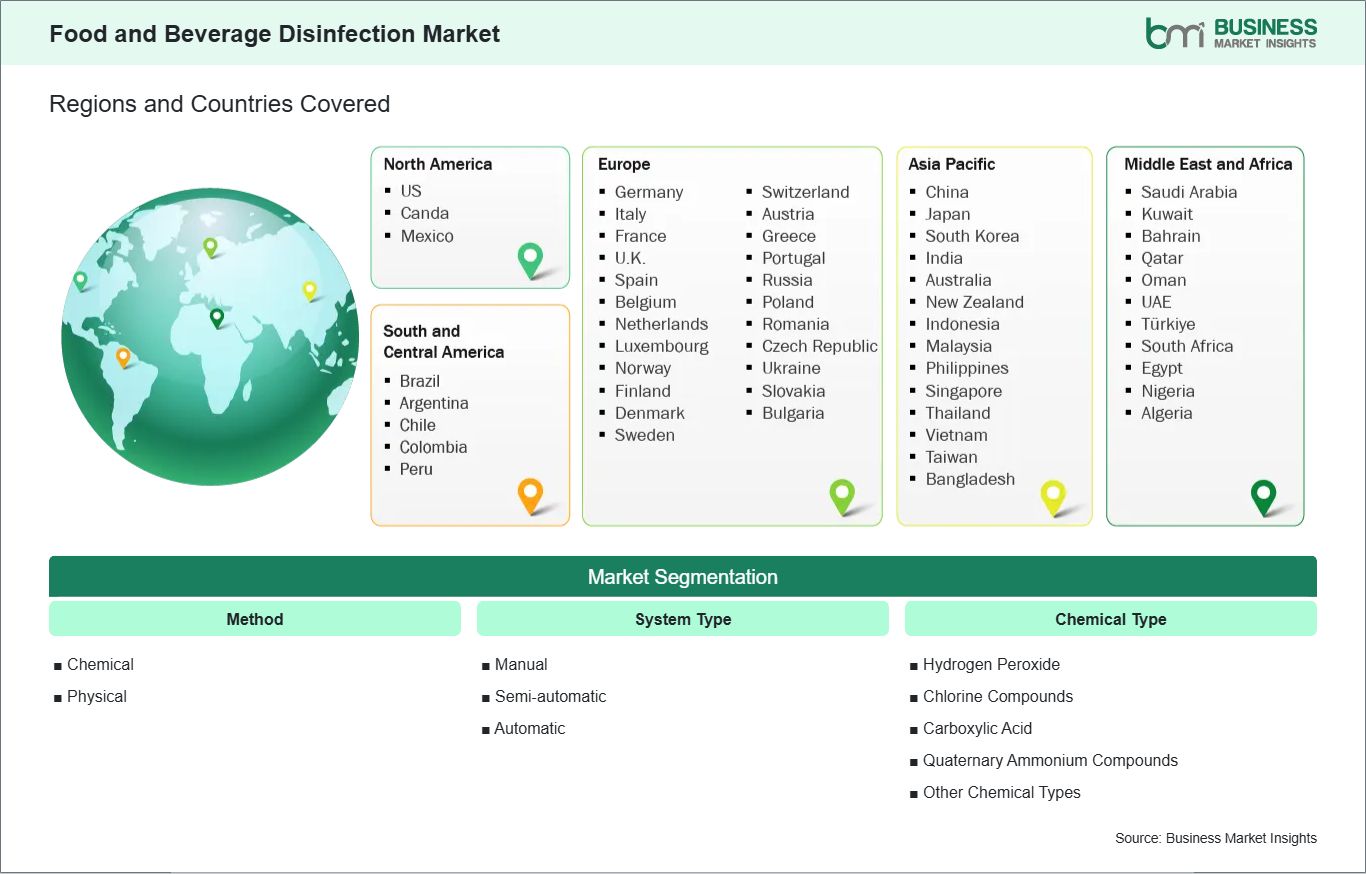
Key segments that contributed to the derivation of the food and beverage disinfection market analysis are method, system type, end‑use industry, and chemical type.
The global food and beverage disinfection market is increasingly shaped by the complexity of modern production lines and multi-tier supply chains, where microbial contamination can occur at multiple stages. Disinfection is no longer limited to surface cleaning but now involves in-line systems that treat conveyors, bottling lines, and storage tanks without interrupting operations. Advanced fogging systems, UV sterilization tunnels, and ozone-infused cleaning technologies are being adopted to target microbial hotspots, including hard-to-reach equipment crevices, packaging lines, and filling valves, ensuring consistent product quality. This approach helps prevent spoilage and preserves flavor and texture, which is critical for highly processed foods, beverages, and ready-to-eat products.
In regions with highly industrialized processing networks, large-scale automated disinfection systems are deployed to handle high throughput while minimizing manual labor and cross-contamination risks. In areas where production facilities are smaller or dispersed, modular and mobile disinfection units provide flexibility, allowing manufacturers to sanitize equipment between production batches. Additionally, regions with warm and humid climates prioritize technologies that prevent rapid microbial growth during storage and transport, while colder regions focus on in-line disinfection integrated into freezing or chilling operations.
Innovation is a key driver of market expansion, with a shift toward chemical-free and non-invasive disinfection methods. Technologies such as pulsed light, electrostatic spray systems, and plasma-based treatments allow operators to reduce chemical residues while maintaining microbial control, improving both sustainability and product safety. Real-time monitoring and automated cycle controls further enhance efficiency by ensuring consistent treatment of high-risk zones along the production line. As manufacturers face increasingly complex product formats and multi-stage processing requirements, food and beverage disinfection systems are becoming critical not just for regulatory compliance, but for maintaining product integrity and reducing operational losses across the global market.
The demand for food and beverage disinfection is rapidly growing in out-of-home and institutional settings, driven by operational complexity rather than just consumer safety. Facilities such as hotels, airlines, hospitals, and catering services handle high volumes of diverse food items, creating multiple points of potential contamination. Disinfection solutions are being integrated into preparation surfaces, storage units, and delivery containers to maintain product quality across extended service periods. Portable UV wands, automated dishwashing sanitation systems, and ozone-based air and surface treatments are increasingly utilized to ensure that food maintains its intended flavor, texture, and appearance from preparation to service.
Regional adoption reflects operational scale and infrastructure. In regions with large-scale institutional operations, such as hospitals or airline catering hubs, automated conveyor-based or robotic disinfection systems are implemented to process large volumes efficiently, reducing human error and exposure risk. In emerging regions where institutional foodservice is growing rapidly, smaller modular systems provide flexibility, allowing kitchens to sanitize prep areas and utensils without major workflow disruptions. These solutions are often combined with mobile monitoring technologies to verify sanitation effectiveness and streamline staff training.
Technological advances continue to expand applications within institutional environments. Cold-chain compatible disinfection units, non-chemical surface treatments, and smart sensors that track sanitation frequency allow facilities to maintain hygiene standards without affecting food quality. For example, bakery or beverage production in institutional kitchens benefits from in-line UV or ozone treatments that reduce microbial load while preserving freshness. As global institutional dining and foodservice volumes rise, disinfection technologies are increasingly recognized as operational necessities, enabling facilities to maintain efficiency, product consistency, and consumer confidence, while also addressing the unique challenges of large-scale, multi-product foodservice operations.

The food and beverage disinfection market is experiencing steady growth, with market size and share analysis reflecting evolving treatment preferences and competitive dynamics among key players. The report evaluates important subsegments categorized within method, system type, end‑use industry, and chemical type, highlighting their respective contributions to overall market performance.
By method, the chemical subsegment dominated the Food and Beverage Disinfection market in 2025. Chemical disinfection offers effective microbial control and broad-spectrum efficacy, making it highly suitable for ensuring food safety, which drives its widespread adoption.
Based on system type, the semi‑automatic subsegment dominated the Food and Beverage Disinfection market in 2025. Semi‑automatic systems provide a balance of operational efficiency and precision, making them highly suitable for consistent disinfection processes, which drives their widespread adoption.
In terms of end‑use industry, the meat, poultry & seafood subsegment dominated the Food and Beverage Disinfection market in 2025. Meat, poultry, and seafood applications demand stringent hygiene and microbial control, making this segment highly suitable for maintaining food safety standards, which drives its widespread adoption.
On the basis of chemical type, the chlorine compounds subsegment dominated the Food and Beverage Disinfection market in 2025. Chlorine compounds offer strong antimicrobial properties and cost-effectiveness, making them highly suitable for a wide range of food and beverage disinfection applications, which drives their widespread adoption.
| Report Attribute | Details |
|---|---|
| Market size in 2025 | US$ 10.35 Billion |
| Market Size by 2033 | US$ 14.3 Billion |
| Global CAGR (2026 - 2033) | 4.12% |
| Historical Data | 2022-2024 |
| Forecast period | 2026-2033 |
| Segments Covered | By Method
|
|
Regions and Countries Covered
| |
| North America | US, Canada, Mexico |
| Europe | Belgium, Austria, Finland, Denmark, Greece, Poland, Romania, Russia, Ukraine, Czech Republic, Slovakia, Bulgaria, Italy, Luxembourg, Germany, Switzerland, France, Netherlands, Norway, Portugal, Spain, Sweden, United Kingdom |
| Asia-Pacific | Australia, China, India, Japan, South Korea, Indonesia, Malaysia, Philippines, Singapore, Thailand, Vietnam, Bangladesh, New Zealand, Taiwan |
| South and Central America | Brazil, Argentina, Peru, Chile, Colombia |
| Middle East and Africa | Bahrain, Kuwait, Oman, Qatar, Saudi Arabia, United Arab Emirates, Turkiye, South Africa, Egypt, Algeria, Nigeria |
| Market leaders and key company profiles |
|
The "Food and Beverage Disinfection Market Size and Forecast (2022 - 2033)" report provides a detailed analysis of the market covering below areas:
The geographical scope of the Food and Beverage Disinfection market report is divided into five regions: North America, Asia Pacific, Europe, Middle East & Africa, and South & Central America. The Food and Beverage Disinfection market in North America is expected to grow during the forecast period.
North America dominates the global food and beverage disinfection market due to its highly regulated food industry, advanced processing infrastructure, and strong consumer focus on food safety. The region`s regulatory agencies enforce rigorous standards for microbial control, sanitation, and hygiene in food production, driving widespread adoption of advanced disinfection technologies. Major food and beverage manufacturers prioritize automated, efficient, and reliable disinfection solutions to ensure compliance, maintain brand reputation, and reduce the risk of contamination across processing, packaging, and distribution channels.
The role of technological innovation is significant in North America, where manufacturers are increasingly opting for UV systems, ozone treatment, and chemical disinfection, which are automated to increase efficiency and reduce human intervention in the process. Sustainability and environmental factors also contribute to the trends in the industry, where manufacturers are looking for eco-friendly disinfection methods without residues, which are not only effective but also environmentally friendly.
However, despite the challenges of high equipment costs, process complexity, and regulatory compliance, North America, being a mature industry, technologically ahead, and at the forefront of food safety, remains at the top of the industry globally. The region`s focus on hygiene, innovation, and regulatory compliance continues to drive the demand for effective disinfection technologies in the food and beverage industry.

The food and beverage disinfection market is evaluated by gathering qualitative and quantitative data post primary and secondary research, which includes important corporate publications, association data, and databases. A few of the key developments in the food and beverage disinfection market are:
The Food and Beverage Disinfection Market is valued at US$ 10.35 Billion in 2025, it is projected to reach US$ 14.3 Billion by 2033.
As per our report Food and Beverage Disinfection Market, the market size is valued at US$ 10.35 Billion in 2025, projecting it to reach US$ 14.3 Billion by 2033. This translates to a CAGR of approximately 4.12% during the forecast period.
The Food and Beverage Disinfection Market report typically cover these key segments-
The historic period, base year, and forecast period can vary slightly depending on the specific market research report. However, for the Food and Beverage Disinfection Market report:
The Food and Beverage Disinfection Market is populated by several key players, each contributing to its growth and innovation. Some of the major players include:
The Food and Beverage Disinfection Market report is valuable for diverse stakeholders, including:
Essentially, anyone involved in or considering involvement in the Food and Beverage Disinfection Market value chain can benefit from the information contained in a comprehensive market report.
Please tell us your area of interest
(Market Segments/ Regions and Countries/ Companies)