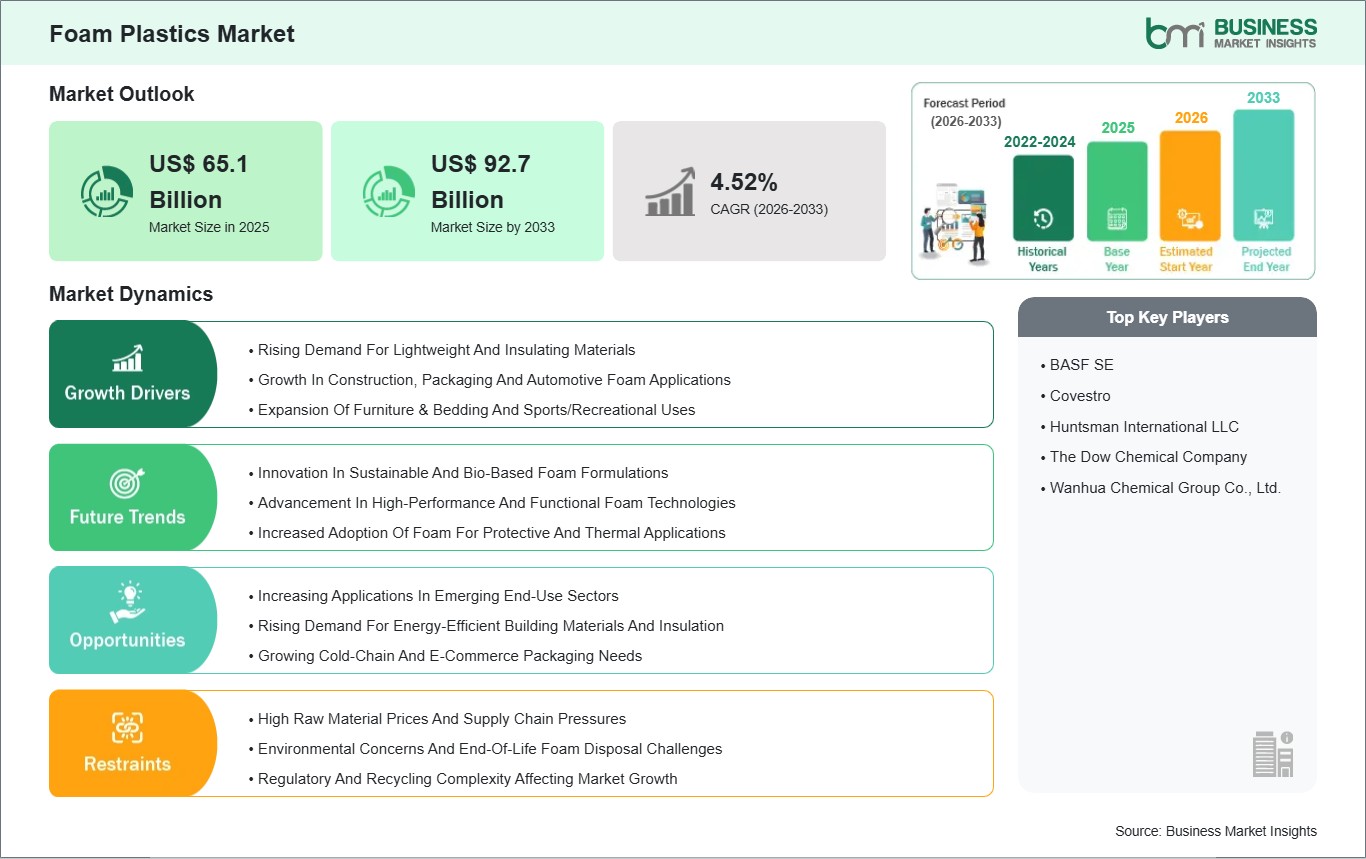
The Foam Plastics Market size is expected to reach US$ 92.7 Billion by 2033 from US$ 65.1 Billion in 2025. The market is estimated to record a CAGR of 4.52% from 2026 to 2033.
The global foam plastics market encompasses a diverse range of lightweight, cellular polymer materials used across construction, packaging, automotive, furniture, and consumer goods industries. Foam plastics, including polyurethane, polystyrene, polyethylene, and polyethylene terephthalate foams, are valued for their high strength-to-weight ratio, thermal insulation, cushioning properties, and versatility. The market is primarily driven by the increasing demand for energy-efficient building materials, protective packaging solutions, lightweight automotive components, and comfortable consumer products. Growing urbanization, industrialization, and the rise of e-commerce have further fueled the adoption of foam plastics, as they offer efficient material usage, cost-effective manufacturing, and design flexibility.
In addition, manufacturers are innovating with sustainable and recyclable foam materials to address environmental concerns and regulatory pressures, creating new growth avenues. Environmental sustainability is also a major challenge, as conventional foam plastics are made from non-renewable materials, which can also lead to waste management problems in the long run. There is also regulatory pressure on the chemical composition and recyclability of materials, which can affect the market in certain countries. There are also issues related to the fluctuating costs of raw materials and the high energy requirements of the manufacturing process, which can limit new entrants into the market. However, with the continuous developments in the industry, the rising demand for lightweight and insulating materials, and the quest for sustainable materials, the market for foam plastics is likely to grow steadily and expand into diverse applications.

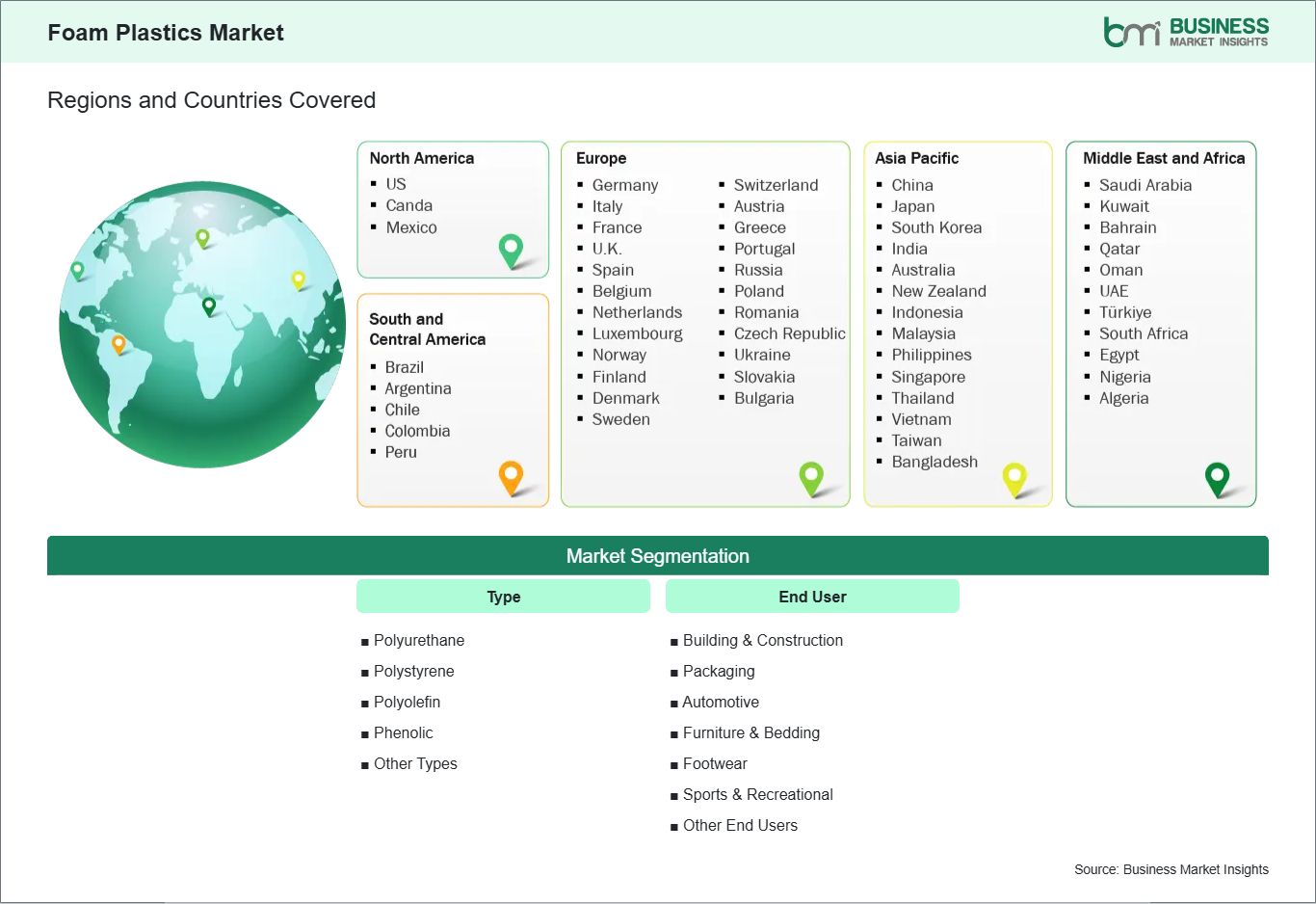
Key segments that contributed to the derivation of the foam plastics market analysis are type and end user.
The global foam plastics market is being driven by the rising demand for lightweight, high-performance materials that combine structural integrity with insulation capabilities. Foam plastics, including expanded and extruded polystyrene, polyurethane, and polyethylene foams, are increasingly preferred in industries where reducing weight is critical while maintaining mechanical strength. Their low density and customizable cellular structures allow manufacturers to design components that lower overall product weight, reduce transportation costs, and improve handling, making them ideal for automotive panels, packaging solutions, and construction elements that require both insulation and structural support.
For regions that have already established industrial and automotive industries, foam plastics are often employed in the development of lightweight vehicular parts, panels, and casings to enhance fuel efficiency and comply with vehicular emissions. In regions undergoing urbanization, foam plastics are integrated in building structures, roofs, floors, and prefabricated buildings, where their lightweight and thermal stability attributes facilitate faster building processes. In regions considered to be in the development stages, foam plastics are employed in the development of protective packages to reduce damage in transit while optimizing load capacity.
Innovation in material composition and processing techniques is also shaping market growth. Manufacturers are developing foams with enhanced fire resistance, chemical stability, and load-bearing capacity to suit specific applications, from insulated pipelines to specialized packaging and industrial components. Foam plastics’ versatility allows for custom densities, thicknesses, and formulations to match the performance requirements of each end-use sector. As demand for lighter, multifunctional materials grows, foam plastics are increasingly recognized as essential for applications where efficiency, durability, and cost-effectiveness are key, positioning them as a strategic material across diverse industries globally.
The global foam plastics market is expanding into emerging end-use sectors, including consumer electronics, medical devices, renewable energy systems, and specialty industrial equipment. In consumer electronics, foam plastics are used for lightweight structural housings, shock absorption, and thermal management, helping protect sensitive components while reducing overall device weight. In medical applications, foams are applied in protective packaging for delicate instruments, ergonomic supports, and cushioning materials, where their hygienic, lightweight, and resilient properties are critical. These specialized applications demonstrate the material`s adaptability beyond traditional construction and packaging uses.
In highly industrialized countries, the electronic and medical device industries, which require precision engineering of materials, increase the demand for foamed materials that not only conform to regulatory requirements but also offer design flexibility. In emerging countries, there is a trend towards using plastic foams in renewable energy systems, including battery pack insulation, wind turbine parts, and solar panel construction, where weight reduction and material longevity are significant factors. The material`s malleability to environmental conditions also makes it suitable for countries with extreme environmental requirements.
Technological advancements in foam plastic materials and manufacturing processes are helping to promote wider usage. High-density materials, flame-retardant materials, and chemical-resistant materials are helping to design and engineer applications involving foam plastics, which were not previously feasible. Modular and prefabricated components involving foam plastics are helping to achieve efficiency in manufacturing, transport, and construction processes. As industries continue to diversify and advance, foam plastics are being increasingly viewed as a multi-functional material offering support, insulation, and lightweight benefits, which are helping to promote growth in established as well as emerging end-use markets.

The foam plastics market is experiencing steady growth, with market size and share analysis reflecting evolving treatment preferences and competitive dynamics among key players. The report evaluates important subsegments categorized within type and end user, highlighting their respective contributions to overall market performance.
By type, the Polyurethane subsegment dominated the Foam Plastics market in 2025. Polyurethane offers excellent cushioning, insulation, and durability properties, making it highly suitable for a wide range of applications, which drives its widespread adoption.
Based on end user, the Building & Construction subsegment dominated the Foam Plastics market in 2025. Building and construction applications demand durable, lightweight, and energy-efficient materials, making this segment highly suitable for structural and insulation purposes, which drives its widespread adoption.
| Report Attribute | Details |
|---|---|
| Market size in 2025 | US$ 65.1 Billion |
| Market Size by 2033 | US$ 92.7 Billion |
| Global CAGR (2026 - 2033) | 4.52% |
| Historical Data | 2022-2024 |
| Forecast period | 2026-2033 |
| Segments Covered | By Type
|
|
Regions and Countries Covered
| |
| North America | US, Canada, Mexico |
| Europe | Belgium, Austria, Finland, Denmark, Greece, Poland, Romania, Russia, Ukraine, Czech Republic, Slovakia, Bulgaria, Italy, Luxembourg, Germany, Switzerland, France, Netherlands, Norway, Portugal, Spain, Sweden, United Kingdom |
| Asia-Pacific | Australia, China, India, Japan, South Korea, Indonesia, Malaysia, Philippines, Singapore, Thailand, Vietnam, Bangladesh, New Zealand, Taiwan |
| South and Central America | Brazil, Argentina, Peru, Chile, Colombia |
| Middle East and Africa | Bahrain, Kuwait, Oman, Qatar, Saudi Arabia, United Arab Emirates, Turkiye, South Africa, Egypt, Algeria, Nigeria |
| Market leaders and key company profiles |
|
The "Foam Plastics Market Size and Forecast (2022 - 2033)" report provides a detailed analysis of the market covering below areas:
The geographical scope of the Foam Plastics market report is divided into five regions: North America, Asia Pacific, Europe, Middle East & Africa, and South & Central America. The Foam Plastics market in North America is expected to grow during the forecast period.
North America is the largest market for foam plastics at the global level due to its well-developed industry, advanced technology, and increased adoption of new and innovative materials. The construction and automotive industries are actively using foam plastics in the region, mainly for insulation and energy-efficient building, as well as lightweight automotive parts to increase fuel efficiency. Furthermore, the packaging industry is also using foam plastics for shock absorption, mainly in e-commerce and electronic devices. The region is highly focused on sustainable practices, and manufacturers are designing recyclable and eco-friendly foam plastics to meet regulatory requirements and performance needs.
Technological advancements are also an important factor in North America, as manufacturers are focusing on better polymers, energy-saving technologies, and design-oriented foams for specific purposes. The region also benefits from the mutual support and cooperation between research organizations, industry players, and the construction and automotive industries, which are helping to develop products according to market requirements.
Although environmental concerns, regulatory requirements, and increased production costs are some of the challenges for the industry, the existing infrastructure, emphasis on innovation, and green technologies are helping North America to remain at the forefront in the global foam plastics market. The ability to combine green technologies with high-performance applications in the region continues to keep it at the top.

The foam plastics market is evaluated by gathering qualitative and quantitative data post primary and secondary research, which includes important corporate publications, association data, and databases. A few of the key developments in the foam plastics market are:
The Foam Plastics Market is valued at US$ 65.1 Billion in 2025, it is projected to reach US$ 92.7 Billion by 2033.
As per our report Foam Plastics Market, the market size is valued at US$ 65.1 Billion in 2025, projecting it to reach US$ 92.7 Billion by 2033. This translates to a CAGR of approximately 4.52% during the forecast period.
The Foam Plastics Market report typically cover these key segments-
The historic period, base year, and forecast period can vary slightly depending on the specific market research report. However, for the Foam Plastics Market report:
The Foam Plastics Market is populated by several key players, each contributing to its growth and innovation. Some of the major players include:
The Foam Plastics Market report is valuable for diverse stakeholders, including:
Essentially, anyone involved in or considering involvement in the Foam Plastics Market value chain can benefit from the information contained in a comprehensive market report.
Please tell us your area of interest
(Market Segments/ Regions and Countries/ Companies)