
Flavor Enhancer Market Outlook: Size, Share, Trends, Growth Analysis, Competitive Landscape & Forecast, 2026-2033

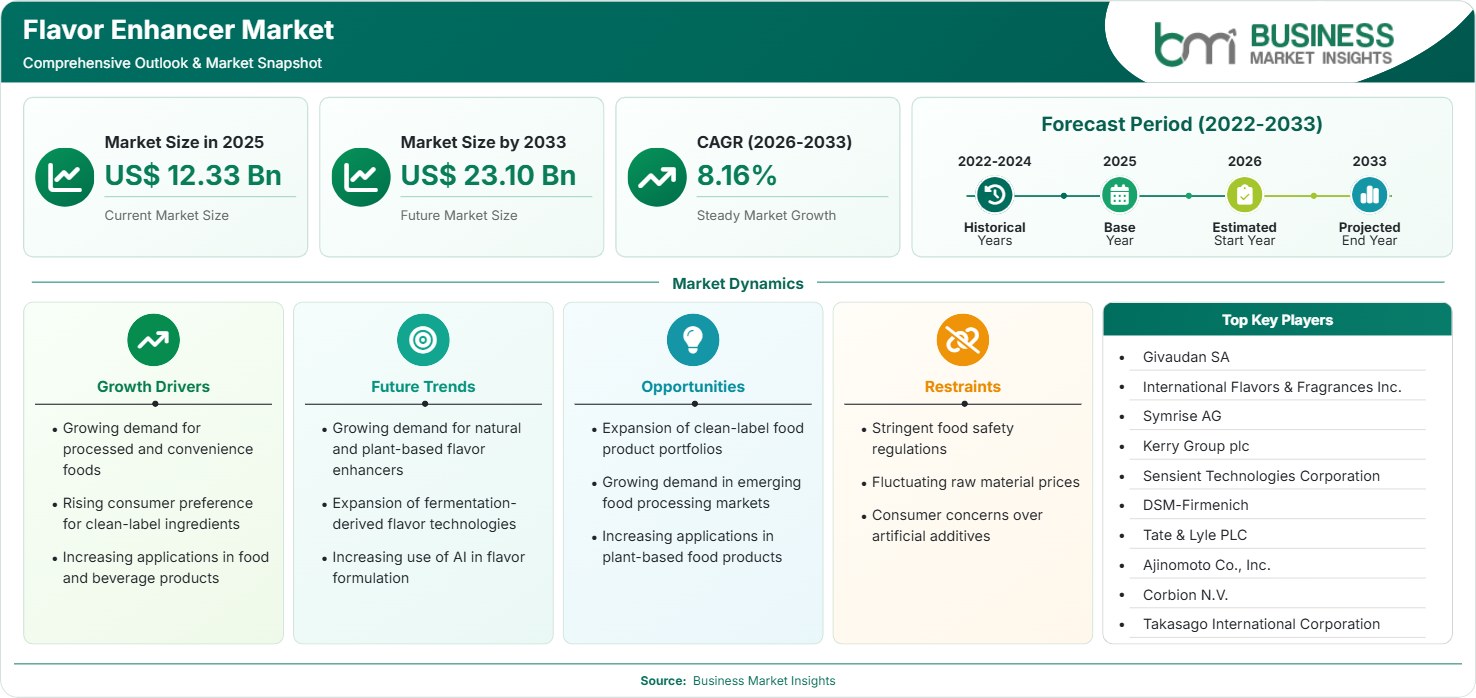
The Flavor Enhancer Market size was valued at US$ 12.33 Billion in 2025 and is projected to reach US$ 23.10 Billion by 2033, growing at a CAGR of 8.16% from 2026 to 2033, driven by processed food expansion, clean-label innovation, plant-based product demand, and rising applications across global food categories.

Report Coverage
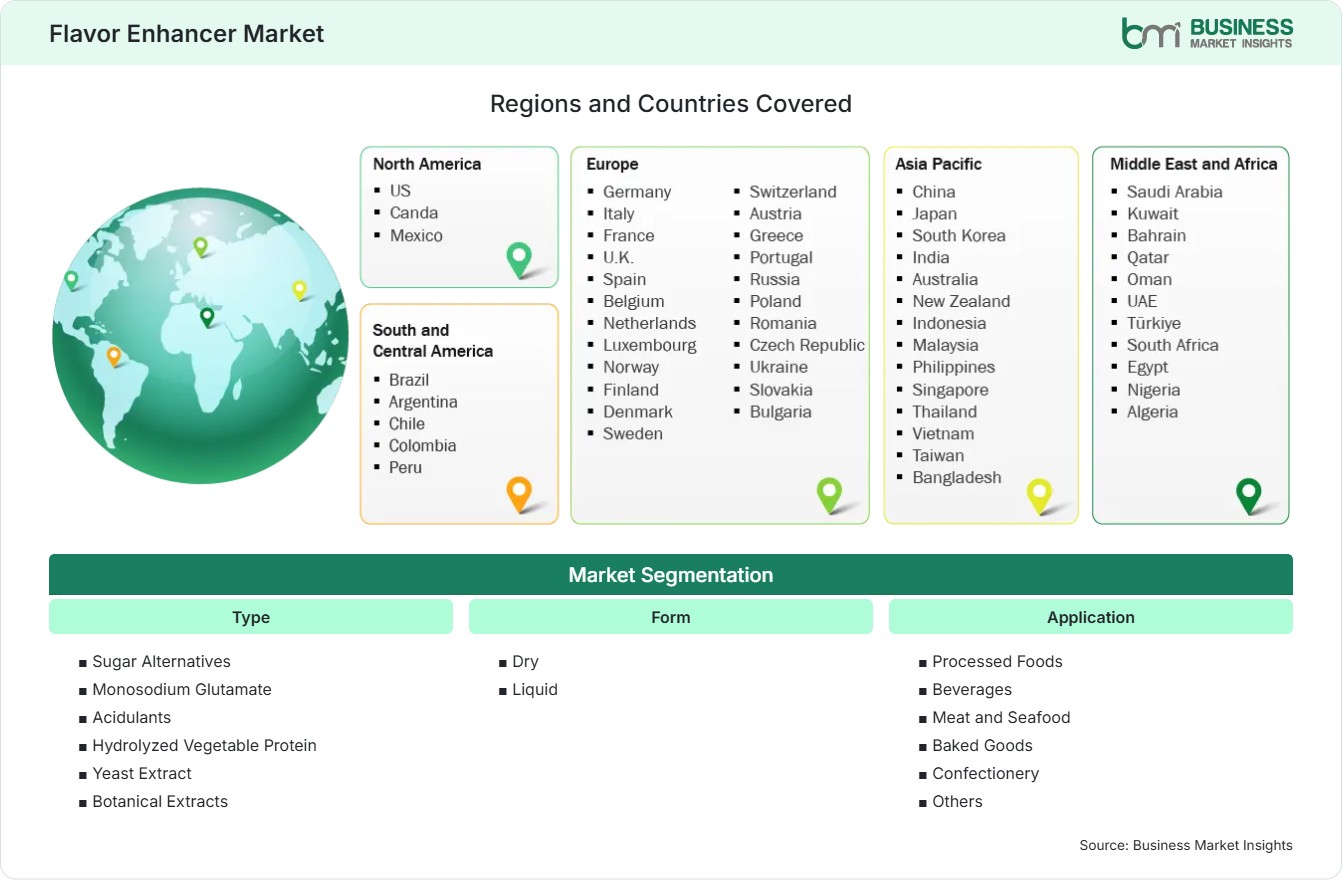
  • Type: Sugar Alternatives , Monosodium Glutamate , Acidulants , Hydrolyzed Vegetable Protein, Yeast Extract, Botanical Extracts
  • Form: Dry, Liquid
  • Application: Processed Foods, Beverages, Meat and Seafood, Baked Goods, Confectionery, Others
US$ 12.33 Bn Market size in 2025
US$ 23.10 Bn Market Size by 2033
8.16% CAGR, 2026 - 2033
2026-2033 Forecast Period

01 AI Overview

Flavor Enhancer Market Summary

  • North America Region: North America holds a market share of 30%–34% in 2025, growing with a CAGR of 7.80%–8.30% influenced by convenience food consumption, clean-label formulation, beverage innovation, and advanced food processing capabilities. The U.S. market analysis indicates a CAGR of 7.90%–8.40% from 2026 to 2033, supported by functional ingredients and product reformulation trends.
  • Fastest Growing Region: Asia Pacific holds a market share of 28%–32% in 2025, growing with a CAGR of 8.40%–8.90% influenced by expanding food processing industries, changing dietary patterns, urbanization, and increasing demand for packaged food products.
  • Leading Segment: Sugar Alternatives hold a market share of 34%–38% in 2025, growing with a CAGR of 8.10%–8.60% influenced by reduced sugar demand, health-focused formulations, and increasing adoption across beverages and confectionery applications.
  • High Growth Segment: Botanical Extracts hold a market share of 12%–16% in 2025, growing with a CAGR of 8.70%–9.20% influenced by natural ingredient preferences, clean-label products, and premium food innovation.
  • Key Market Opportunity: Expanding clean-label formulations, plant-based foods, and emerging food processing markets are creating opportunities for innovative flavor solutions and ingredient manufacturers.
  • Major Market Players: Givaudan SA, International Flavors & Fragrances Inc., Symrise AG, Kerry Group plc, Sensient Technologies Corporation, DSM-Firmenich, Tate & Lyle PLC, Ajinomoto Co., Inc., Corbion N.V., Takasago International Corporation.
02 Strategic Insights

Flavor Enhancer Market: Strategic Insights

Flavor Enhancer Market Strategic Framework
FREE PDF
Request your free sample
Request free sample
03 Stakeholder View

Key Takeaways

  • The market ecosystem is evolving toward advanced ingredient solutions combining sensory improvement, nutritional benefits, and clean-label positioning across food categories.
  • Sugar alternatives, botanical extracts, and yeast-based ingredients represent attractive growth areas due to increasing demand for healthier and natural formulation approaches.
  • Ingredient manufacturers are investing in research and development to create multifunctional enhancers supporting taste optimization, reduced sodium formulations, and plant-based food innovation.
  • Asia Pacific presents strong investment potential due to expanding food processing industries, urbanization, and increasing consumption of packaged and convenience foods.
  • Strategic partnerships and portfolio expansion are shaping competition as companies strengthen capabilities in natural ingredients, specialty formulations, and regional market penetration.
  • Sustainability-focused sourcing and transparent ingredient labeling are becoming important factors influencing purchasing decisions among food manufacturers and consumers.
04 Geographic Outlook

Flavor Enhancer Market Regional Highlights

North America Flavor Enhancer Market

North America accounted for 30%–34% share in 2025 and is projected to expand at a CAGR of 7.80%–8.30% during 2026–2033. The region maintains a strong position due to advanced food processing industries, high demand for convenience foods, and increasing adoption of clean-label ingredients. The Flavor Enhancer Market share in North America is supported by product reformulation activities, beverage innovation, and demand for reduced sodium and natural flavour solutions.

  • The United States represents the leading regional market due to strong processed food consumption and growing demand for healthier ingredient alternatives.
  • Canada is expanding adoption of natural flavour enhancers through increasing demand for clean-label foods and functional beverages.
  • Food manufacturers are investing in reformulation strategies to improve taste while reducing artificial ingredients and additives.
  • Beverage companies are adopting advanced flavour solutions to support innovation across functional and wellness-focused product categories.

US Flavor Enhancer Market

The United States represented 24%–28% share within North America in 2025 and is expected to grow at a CAGR of 7.90%–8.40% between 2026–2033. The country remains a major market due to high consumption of processed foods, expanding beverage applications, and strong presence of global ingredient suppliers. The Flavor Enhancer Market analysis highlights opportunities from product innovation, clean-label reformulation, and increasing adoption of specialty ingredients across food categories.

  • Food companies are introducing healthier formulations using sugar alternatives and natural flavor improvement solutions.
  • Beverage manufacturers are expanding product portfolios with functional drinks requiring improved taste profiles and ingredient optimization.
  • Consumer demand for transparent labeling is encouraging manufacturers to replace artificial additives with natural alternatives.

Europe Flavor Enhancer Market

Europe accounted for 22%–26% share in 2025 and is forecast to grow at a CAGR of 7.60%–8.10% from 2026–2033. Germany, France, the United Kingdom, Italy, and the Netherlands represent key markets due to developed food industries and strong demand for clean-label products. European consumers increasingly prefer natural and sustainable food products, encouraging manufacturers to develop improved flavor solutions with transparent sourcing and formulation practices.

  • Germany maintains market strength through advanced food manufacturing capabilities and demand for innovative ingredients.
  • France is expanding natural ingredient adoption through premium food products and clean-label consumer preferences.
  • The United Kingdom is increasing use of specialty flavor enhancers in processed foods and beverage applications.
  • Italy is supporting demand through bakery, confectionery, and traditional food product innovation.

Asia Pacific Flavor Enhancer Market

Asia Pacific represented 28%–32% share in 2025 and is expected to grow at a CAGR of 8.40%–8.90% during 2026–2033. China, India, Japan, South Korea, and Southeast Asian countries are key markets supported by changing lifestyles and expanding food manufacturing capabilities. The Flavor Enhancer Market trends in Asia Pacific are influenced by demand for convenient foods, beverage diversification, and growing interest in natural ingredient solutions.

  • China is increasing adoption through large-scale food manufacturing, beverage production, and ingredient innovation activities.
  • India is experiencing demand growth due to expanding processed food industries and changing consumer eating patterns.
  • Japan continues developing advanced flavor solutions for functional foods, beverages, and premium food categories.
  • Southeast Asian markets are benefiting from food processing investments and increasing packaged food consumption.

Rest of World Flavor Enhancer Market

Rest of World accounted for 10%–14% share in 2025 and is projected to grow at a CAGR of 8.00%–8.50% during 2026–2033. South America and Middle East and Africa regions are gradually expanding due to rising food processing activities, changing consumer preferences, and increasing demand for packaged products. Brazil, Mexico, Saudi Arabia, and South Africa represent emerging opportunities supported by growing beverage, bakery, and processed food industries.

  • Brazil is increasing adoption through food processing growth and rising demand for convenience food products.
  • Mexico is expanding flavor enhancer applications through beverage and processed food manufacturing development.
  • Middle Eastern countries are adopting specialty ingredients due to premium food product growth and diversification.
  • South Africa is developing opportunities through expanding food manufacturing and consumer product markets.
Global Market Geography
FREE PDF
Request your free sample
Request free sample
05 Segment Analysis

Flavor Enhancer Market Segmentation

Type

The type segment is driven by increasing demand for taste optimization, healthier formulations, and innovative food applications. Sugar Alternatives represented the leading category with 34%–38% share in 2025 and are expected to grow at a CAGR of 8.10%–8.60% during 2026–2033. Growing demand for reduced sugar products and changing consumer preferences are supporting adoption.

  • Sugar Alternatives: Sugar alternatives are gaining adoption due to increasing demand for reduced sugar formulations across beverages, confectionery, dairy, and bakery products.
    • Stevia: Stevia is widely used as a natural sweetener due to plant-based positioning and increasing demand for low-calorie food formulations.
    • Sorbitol: Sorbitol is utilized in confectionery, bakery, and pharmaceutical applications due to sweetness properties and functional benefits.
    • Xylitol: Xylitol adoption is increasing in oral care, confectionery, and reduced-sugar products due to consumer health preferences.
    • Mannitol: Mannitol supports pharmaceutical and food applications due to functional characteristics and suitability in specialized formulations.
    • Erythritol: Erythritol is gaining popularity in low-calorie products due to sugar reduction trends and clean-label demand.
  • Monosodium Glutamate (MSG): MSG continues supporting savory food applications due to its strong flavor-enhancing properties in processed foods, snacks, ready meals, and Asian cuisine products.
  • Acidulants: Acidulants are increasingly used to improve taste balance, acidity control, preservation, and sensory performance across beverages and food formulations.
    • Citric acid: Citric acid is widely adopted in beverages, confectionery, and processed foods due to acidity regulation and freshness enhancement properties.
    • Fumaric Acid: Fumaric acid supports food processing applications through acidity adjustment, preservation benefits, and improved stability in formulations.
    • Lactic Acid: Lactic acid is utilized in food preservation, dairy applications, and flavor modification due to functional and antimicrobial characteristics.
    • Tartaric Acid: Tartaric acid is used in beverages, confectionery, and bakery products for acidity control and sensory improvement.
  • Hydrolyzed Vegetable Protein: Hydrolyzed vegetable protein is adopted in savory applications due to its ability to enhance taste profiles in processed foods and ready-to-eat meals.
  • Yeast Extract: Yeast extract is gaining demand as a natural flavor enhancer for clean-label products requiring savory taste improvement and reduced artificial ingredients.
  • Botanical Extracts: Botanical extracts are expanding through demand for natural flavor solutions, premium formulations, and plant-derived ingredients across food and beverage categories.

Form

The form segment is categorized into dry and liquid formats based on application requirements, processing conditions, and manufacturer preferences. Dry flavor enhancers represented the leading category with 58%–62% share in 2025 and are expected to grow at a CAGR of 7.90%–8.30% during 2026–2033. Dry formulations are preferred due to storage stability, transportation advantages, and compatibility with processed food manufacturing. Liquid formats are gaining adoption in beverages and applications requiring rapid dispersion in Flavor Enhancer Market.

  • Dry: Dry flavor enhancers are widely adopted due to longer shelf life, easy handling, and suitability for large-scale food processing operations.
  • Liquid: Liquid flavor enhancers are increasingly used in beverages, sauces, and formulations requiring efficient blending and consistent flavor distribution.

Application

The application segment is expanding due to increasing utilization of flavor enhancers across processed foods, beverages, bakery products, and confectionery categories. Processed Foods represented the leading application category with 32%–36% share in 2025 and are projected to grow at a CAGR of 8.00%–8.50% during 2026–2033. Rising demand for convenience meals, ready-to-eat products, and improved sensory experiences is supporting application in Flavor Enhancer Market growth.

  • Processed Foods: Processed food manufacturers use flavor enhancers to improve taste consistency, product appeal, and sensory quality across packaged food categories.
  • Beverages: Beverage companies utilize flavor enhancers to develop differentiated products, functional drinks, and improved taste experiences for consumers.
  • Meat and Seafood: Meat and seafood processors adopt flavor enhancers to improve savory profiles, maintain quality, and optimize processed product formulations.
  • Baked Goods: Bakery manufacturers use flavor enhancers to strengthen taste profiles, improve product consistency, and support product innovation.
  • Confectionery: Confectionery producers incorporate flavor enhancers to create appealing taste experiences and develop diverse product offerings.
06 Market Forces

Flavor Enhancer Market Dynamics

Key Market Drivers

Growing demand for processed and convenience foods

The growing demand for processed and convenience foods is supporting expansion as consumers increasingly prefer ready-to-eat meals, packaged snacks, frozen foods, and prepared food products. Urbanization, changing lifestyles, and increasing workforce participation are encouraging demand for convenient meal solutions. Food manufacturers are using flavor enhancers to maintain taste consistency, improve sensory appeal, and differentiate products in competitive markets. The growth is supported by increasing investments in food processing capabilities and product innovation. The Flavor Enhancer Market trends indicate greater adoption of specialized ingredients that enhance taste while supporting reformulation efforts. Companies are developing solutions that align with changing consumer expectations regarding quality, nutrition, and ingredient transparency.

Rising consumer preference for clean-label ingredients

The rising consumer preference for clean-label ingredients is influencing food manufacturers to replace artificial additives with natural and recognizable flavor solutions. Consumers are increasingly examining ingredient lists and seeking products with transparent formulations. This shift is encouraging adoption of botanical extracts, yeast extracts, natural sweeteners, and other plant-derived enhancers. Food manufacturers are working on R&D to balance flavor functionality alongside compliance with clean label standards. Ingredient manufacturers are diversifying their offerings with natural ingredients that allow for reformulation of products in beverage, snack, dairy, and baked goods categories. Increased consumer interest in healthy foods with minimal processing is spurring technological advances in flavor modification.

Increasing applications in food and beverage products

The increasing applications in food and beverage products are creating broader opportunities as manufacturers seek improved sensory experiences across diverse categories. Flavor enhancers have been used in beverages, food processing, meats, baking products, and confectionery items to enhance the taste quality. The diversification of functional drinks, plant-based food products, and specialty foods is creating a need for more unique ingredients. Manufacturers are working on developing unique flavoring systems to cater to the formulation issues and regional tastes. Growth in food production globally and the rise in competition between brands are prompting companies to use advanced flavors in their food items.

Flavor Enhancer Market: Key Trends and Dynamics

Key Market Opportunities

Expansion of clean-label food product portfolios

The expansion of clean-label food product portfolios is creating opportunities for ingredient manufacturers as brands seek natural solutions that meet evolving consumer expectations. Food companies are reformulating products by replacing artificial additives with botanical extracts, yeast extracts, and naturally derived flavor enhancers. This transition is creating demand for innovative ingredient systems that maintain taste performance while improving label transparency. Manufacturers investing in natural extraction technologies and sustainable sourcing practices are positioned to benefit from premium food categories. The Flavor Enhancer Market Forecasts indicate continued opportunity as consumers increasingly prioritize recognizable ingredients, healthier formulations, and environmentally responsible food choices across processed foods, beverages, and wellness-oriented product segments.

Growing demand in emerging food processing markets

The growing demand in emerging food processing markets is creating expansion opportunities due to rising urban populations, increasing disposable income, and changing dietary patterns. Countries across Asia Pacific, Latin America, and the Middle East are experiencing growth in packaged food manufacturing and beverage production. These developments are increasing demand for flavor enhancement solutions that improve product quality and consumer acceptance. Ingredient suppliers are establishing regional production capabilities and distribution networks to serve expanding food industries. Investments in food processing infrastructure and modernization of manufacturing facilities are supporting adoption of advanced flavor ingredients. Emerging markets offer significant potential for companies developing affordable, scalable, and locally adapted flavor solutions.

Increasing applications in plant-based food products

The increasing applications in plant-based food products are creating opportunities as manufacturers address sensory challenges associated with alternative proteins and dairy substitutes. Plant-based products often require flavor enhancement technologies to improve taste, aroma, and consumer acceptance. Ingredient companies are developing specialized solutions using natural extracts, yeast-based ingredients, and advanced flavor systems for plant-based foods and beverages. Growing investment in alternative food categories is encouraging collaboration between food manufacturers and flavor developers. As consumers seek sustainable and health-focused dietary options, demand for improved plant-based product experiences continues increasing. Companies capable of delivering effective flavor solutions for these categories can capture opportunities in rapidly expanding food innovation segments.

Market Restraints and Challenges

Stringent food safety regulations

Factor: Stringent food safety regulations increase compliance requirements for flavor enhancer manufacturers because ingredients must meet strict standards related to safety, quality, labeling, and permitted usage levels. Impact: Complex regulatory procedures can increase development timelines, raise operational costs, and delay product commercialization across international markets. Companies must continuously monitor changing food regulations and maintain compliance with regional requirements. Regulatory differences between countries create additional challenges for global ingredient suppliers expanding into new markets. Manufacturers are investing in quality management systems, testing capabilities, and regulatory expertise to manage these challenges. Compliance remains essential for maintaining consumer trust and supporting long-term market participation.

Fluctuating raw material prices

Factor: Fluctuating raw material prices create challenges for flavor enhancer producers because ingredient costs depend on agricultural commodities, energy expenses, and supply chain conditions. Impact: Price volatility can reduce profit margins, increase production costs, and affect pricing strategies for manufacturers and food companies. Natural ingredients such as botanical extracts, sweeteners, and plant-based components are particularly influenced by seasonal availability and agricultural conditions. Companies are adopting diversified sourcing strategies, supplier partnerships, and inventory management approaches to reduce cost pressures. Efficient procurement and supply chain optimization are becoming important strategies for maintaining competitiveness while ensuring consistent ingredient availability for food manufacturers.

07 Company Analysis

Competitive Landscape

The Flavor Enhancer Market analysis highlights a competitive environment shaped by ingredient innovation, clean-label solutions, research capabilities, and expanding application portfolios. Leading companies are focusing on developing customized flavor systems, strengthening supply networks, and creating sustainable ingredient solutions for food and beverage manufacturers worldwide.

Company Name

Overview

Products and Services relevant to this market

Givaudan SA

Global flavor and fragrance company providing innovative ingredient solutions for food and beverage industries.

Offers flavor enhancers, natural ingredients, taste solutions, and customized formulation services for food applications.

International Flavors & Fragrances Inc.

Global ingredient company specializing in flavors, fragrances, and food innovation solutions.

Provides flavor systems, natural extracts, taste modulation technologies, and food ingredient solutions.

Symrise AG

International flavor and fragrance manufacturer serving food, beverage, and consumer product industries.

Develops flavor enhancers, botanical extracts, taste solutions, and customized ingredient formulations.

Kerry Group plc

Global nutrition and ingredient company focused on taste and food innovation.

Provides flavor technologies, taste solutions, functional ingredients, and clean-label formulation support.

Sensient Technologies Corporation

Ingredient manufacturer specializing in flavors, colors, and sensory solutions.

Offers flavor enhancers, natural ingredients, extracts, and customized sensory solutions for food products.

DSM-Firmenich

Global nutrition and ingredient company developing sustainable food and flavor solutions.

Provides taste solutions, natural flavor systems, food ingredients, and formulation expertise.

Tate & Lyle PLC

Ingredient solutions provider specializing in sweeteners and food technologies.

Offers sugar alternatives, sweetening solutions, texture ingredients, and flavor improvement technologies.

Ajinomoto Co., Inc.

Food ingredient company recognized for amino acid-based flavor enhancement solutions.

Provides monosodium glutamate, seasonings, savory ingredients, and food formulation solutions.

Corbion N.V.

Sustainable ingredient company serving food preservation and specialty ingredient markets.

Offers food acids, preservation solutions, and functional ingredients for food applications.

Takasago International Corporation

Flavor and fragrance company providing sensory solutions globally.

Develops flavor systems, natural extracts, and customized taste solutions for food manufacturers.

10 Trust & Transparency

Research Methodology

The market analysis combines proprietary research with secondary data from government agencies, company disclosures, regulatory filings, industry databases and expert interviews. Market estimates are validated through data triangulation, cross-market benchmarking and analyst review.

View Full Research Methodology

11 Questions Answered

Frequently Asked Questions

What does the Flavor Enhancer Market Report provide?

The report provides analysis of market valuation, regional trends, segmentation performance, competitive landscape, growth factors, challenges, and opportunities shaping the global flavor ingredient industry.

Which applications are driving flavor enhancer market adoption?

Processed foods, beverages, bakery products, confectionery, and plant-based foods are major applications driving adoption. Manufacturers use flavor enhancers to improve taste consistency, create product differentiation, and address evolving consumer preferences across food categories.

Why are sugar alternatives gaining importance in food manufacturing?

Sugar alternatives are gaining importance due to increasing demand for reduced-sugar products and changing consumer preferences toward healthier diets. They help manufacturers create lower-calorie foods and beverages while maintaining sweetness and consumer acceptance.

How are clean-label trends influencing flavor enhancer development?

Clean-label trends are encouraging companies to develop natural flavor solutions using botanical extracts, yeast extracts, and plant-derived ingredients. Manufacturers are focusing on recognizable ingredients, sustainable sourcing, and improved functionality to support food reformulation strategies.

What factors are increasing demand for flavor enhancers globally?

Demand is increasing due to expansion of processed foods, beverage innovation, clean-label product development, and rising preference for improved taste experiences. Food manufacturers are adopting advanced ingredients to enhance sensory quality while meeting consumer expectations for healthier and more transparent formulations.

Access the Full Flavor Enhancer Market Report

Get segment-level forecasts, regional estimates, competitive benchmarking, company profiles and downloadable Excel datasets.

Access the full Flavor Enhancer Market Report
350 pages PDF & Excel | 2026-08-12