Market Summary
Executive Summary and Global Market Analysis
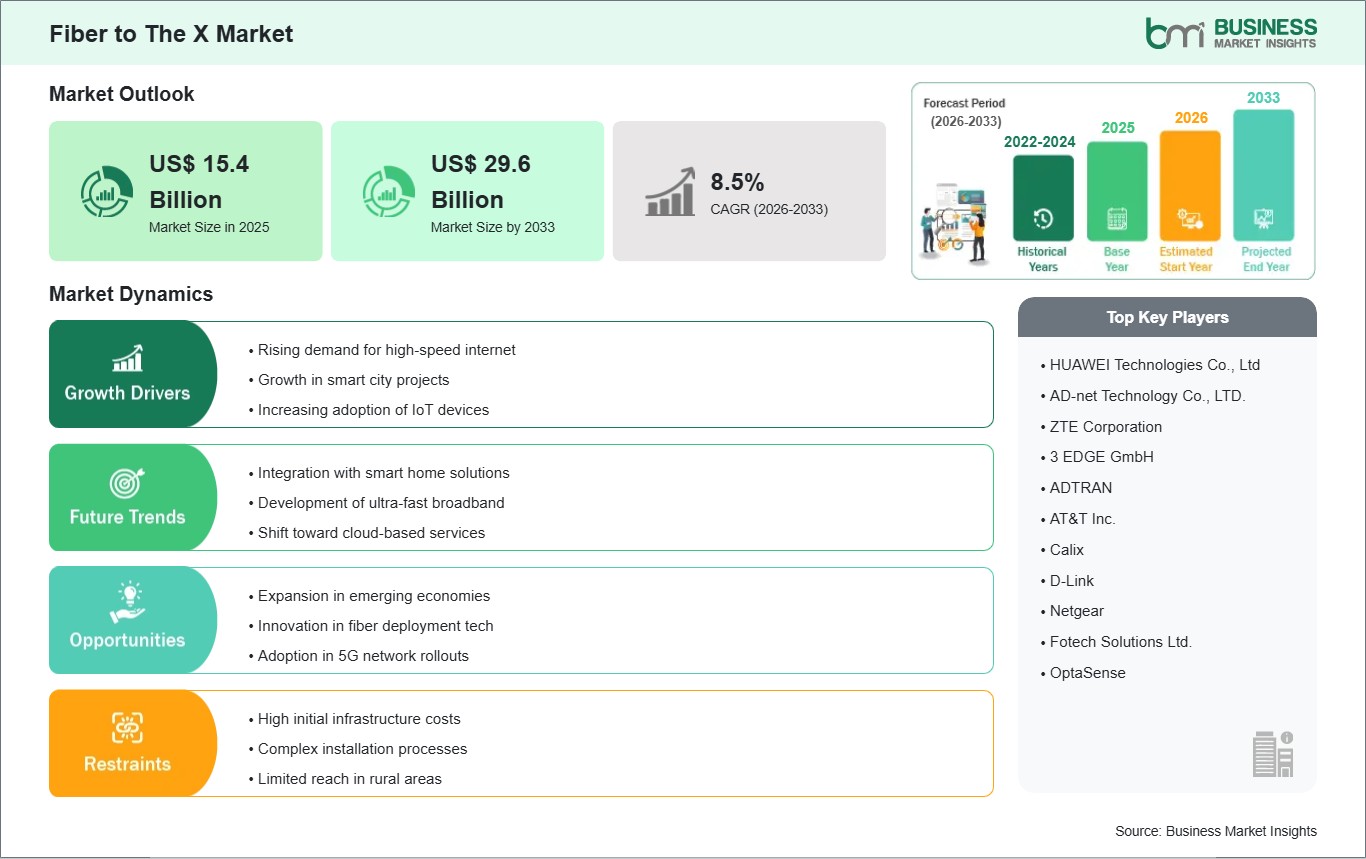
Fiber to the X (FTTX) represents the next-generation broadband network architecture where optical fiber is deployed closer to the end user, significantly improving speed, reliability, and bandwidth compared to older copper-based connections. FTTX encompasses various configurations such as Fiber to the Home (FTTH), Fiber to the Building (FTTB), and Fiber to the Curb (FTTC).
The FTTX market is experiencing robust expansion, largely driven by the exponential global demand for high-bandwidth applications, the shift toward remote work and e-learning, and strategic governmental initiatives focused on future-proof broadband infrastructure. Fiber-optic networks provide superior data transmission rates and low latency, which are critical for supporting the digital deluge from high-definition streaming, cloud gaming, and the proliferation of Internet of Things (IoT) devices.
Segment Analysis
Fiber to The X Market Segmentation
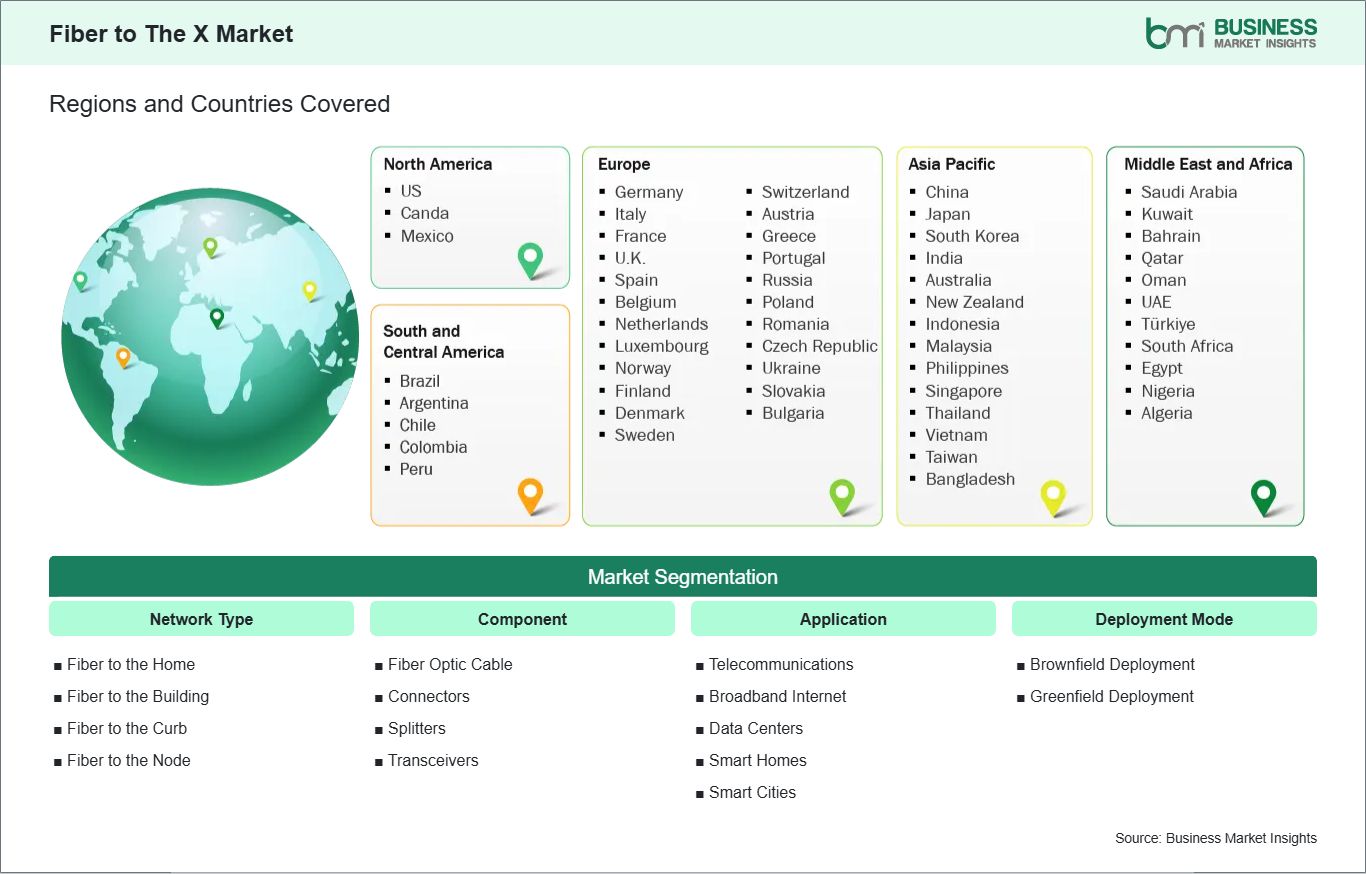
Key segments that contributed to the derivation of the Fiber To The X market analysis are network type, component, application, and deployment mode.
- By Network Type, the market is segmented into Fiber to the Home, Fiber to the Building, Fiber to the Curb, and Fiber to the Node.
- By Component, the market is segmented into Fiber Optic Cable, Connectors, Splitters, and Transceivers.
- By Application, the market is segmented into Telecommunications, Broadband Internet, Data Centers, Smart Homes, and Smart Cities.
- By Deployment Mode, the market is bifurcated into Brownfield Deployment and Greenfield Deployment.
Market Forces
Fiber to The X Market Drivers and Opportunities
Increasing Need for Ultra-Fast Broadband Connectivity
Traditional copper-based networks (like DSL and older Cable) basically cannot handle the sheer volume and the performance requirements of modern digital life, e.g., the increasing number of connected devices. Activities such as 4K/8K video streaming, cloud gaming, and the heavy use of cloud services (for backup, storage, and software access) require massive, continuous bandwidth that only fiber can provide symmetrically (equal upload and download speeds). Global data consumption is escalating annually, forcing network operators to upgrade to fiber to avoid gridlock.
FTTX, particularly Fiber to the Home (FTTH), is seen as the only truly future-proof access technology, capable of easily upgrading to multi-gigabit speeds without requiring a physical re-lay of the optical cable. This capability justifies the high upfront investment for service providers.
Demand for High-Speed Internet
The rollout of 5G mobile networks is not purely wireless; it requires a vast, dense network of fiber connections to function effectively. As mobile carriers intensify 5G coverage and deploy more small cells in urban areas, the demand for FTTX fiber deployment to these cell sites explodes.
Smart City initiatives, which include networked traffic management, smart public lighting, environmental monitoring, and connected public services, are entirely dependent on a resilient, high-speed fiber backbone. FTTX requires guaranteed symmetrical speeds and extremely low latency for real-time data processing and automated responses. Thus, the rising demand for high-speed internet extends beyond residential needs and creates a powerful structural opportunity for FTTX in the enterprise and municipal infrastructure spaces, primarily through 5G integration and Smart City rollouts.
Size and Share Analysis
Fiber to The X Market Size and Share Analysis
The Fiber to the X Market demonstrates robust growth, with size and share analysis revealing the strong competitive positioning of established players and the emergence of new technologies. The report further examines subsegments categorized within network type, component, application, and deployment mode, offering insights into their contribution to overall market performance.
For instance, among types, Fiber to the Home (FTTH) is the dominant sub-segment, driven by consumer demand for gigabit speeds and the phasing out of traditional cable and DSL. The Telecommunications segment remains the largest application, accounting for the highest volume of connections globally.
Report Coverage
Fiber to The X Market Report Coverage and Deliverables
The "Fiber To The X Market Size and Forecast (2022 - 2033)" report provides a detailed analysis of the market covering below areas.
- Fiber To The X market size and forecast at global, regional, and country levels for all the key market segments covered under the scope
- Fiber To The X market trends, as well as market dynamics such as drivers, restraints, and key opportunities
- Fiber To The X market analysis covering key market trends, global and regional framework, major players, regulations, and recent market developments
- Industry landscape and competition analysis covering market concentration, heat map analysis, prominent players, and recent developments for the Fiber To The X market
- Detailed company profiles, including SWOT analysis
Geographic Insights
Fiber to The X Market Geographic Insights
The geographical scope of the Fiber To The X market report is divided into five regions: North America, Asia Pacific, Europe, Middle East & Africa, and South & Central America.
Asia Pacific is the dominant region in the Fiber to the X Market, holding the largest revenue share. This dominance is attributed to early and aggressive government-led fiber rollouts in China, Japan, and South Korea. China alone accounts for a significant portion of the world's total fiber-optic cable kilometers.
North America holds a significant share, driven by a massive push to upgrade legacy cable infrastructure and the expansion of fiber networks into rural areas through government funding programs like the Broadband Equity, Access, and Deployment (BEAD) program.
Europe is projected to show substantial growth, with countries like Germany, the UK, and France accelerating their "full-fiber" initiatives to meet the EU's Digital Decade targets for 100% gigabit coverage by 2030.
Industry Activity
Recent Developments
The Fiber To The X market is evaluated by gathering qualitative and quantitative data post-primary and secondary research, which includes important corporate publications, association data, and databases. A few of the key developments in the Fiber To The X market are:
- In October 2025, ZTE Corporation, a global leading provider of integrated information and communication technology solutions, launched a comprehensive suite of innovative optical access, terminal products, and platforms at Network X 2025. These new offerings are designed to accelerate global FTTx deployment, empower smart homes, and advance all-optical campuses into the 10G era through compact devices, AI integration, and unified management capabilities.
- In March 2025, Huawei showcased its Fiber to the Room (FTTR) solution integrated with Wi-Fi 7, delivering unmatched speed, coverage, and cost efficiency for next-generation smart homes.
- In September 2024, CompaxDigital, a global leader in genuine SaaS business support systems (BSS), partnered with Calix, a leading platform, cloud, and managed services company. This collaboration brings together CompaxDigital’s cutting-edge BSS platform with the Calix Broadband Platform to offer an unparalleled service delivery experience for Fiber-to-the-Home (FTTH) providers across the U.S. market.
Trust & Transparency
Research Methodology
The market analysis combines proprietary research with secondary data from government agencies, company disclosures, regulatory filings, industry databases and expert interviews. Market estimates are validated through data triangulation, cross-market benchmarking and analyst
review.
View Full Research Methodology
Key Sources Referred:
World Bank - Global Trade IndicatorsWorld Trade Organization (WTO)International Monetary Fund (IMF)International Trade Administration (ITA)Company WebsitesCompany Annual ReportsCompany Investor Presentations