Market Summary
Executive Summary and Global Market Analysis
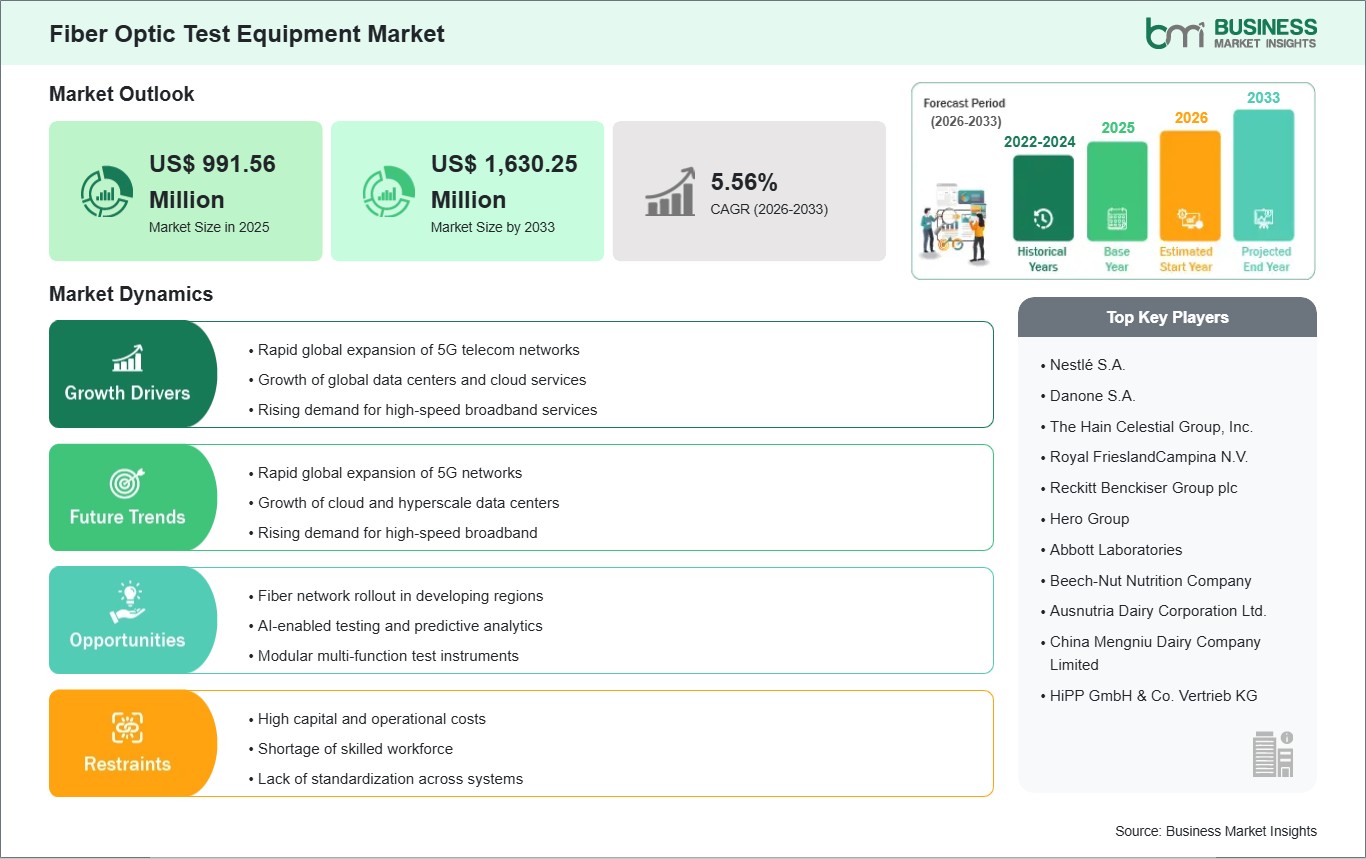
The global Fiber optic test equipment market growth is primarily driven by the rapid expansion of 5G networks, high-speed broadband, and hyperscale data centers, which require reliable and precise testing solutions to ensure network performance, minimize downtime, and maintain ultra-low latency. Key end-use sectors include telecommunications, aerospace, healthcare, and industrial automation, all of which increasingly rely on fiber optic infrastructure. Technological advancements, such as AI-powered testing, automated OTDR analysis, and IoT-enabled fiber monitoring, are further enhancing efficiency, predictive maintenance, and fault detection. Regulatory requirements and service-level agreements (SLAs) are pushing operators to adopt advanced testing solutions, ensuring high-quality and error-free communication.
From a global perspective, demand is particularly strong in regions investing heavily in 5G deployments and fiber-to-the-home (FTTH) broadband, including North America, Europe, and the Asia Pacific. Emerging markets in Latin America and the Middle East & Africa offer significant growth opportunities due to expanding telecom infrastructure. The integration of cloud-based analytics and next-generation passive optical networks (PON) is driving the adoption of high-precision equipment. Overall, the market is witnessing sustained growth fueled by the convergence of digital transformation, smart technologies, and stringent network reliability standards across industries worldwide.
Segment Analysis
Fiber Optic Test Equipment Market Segmentation
Key segments that contributed to the derivation of the Ethernet Connector Transformer market analysis are Product Type, End Use.
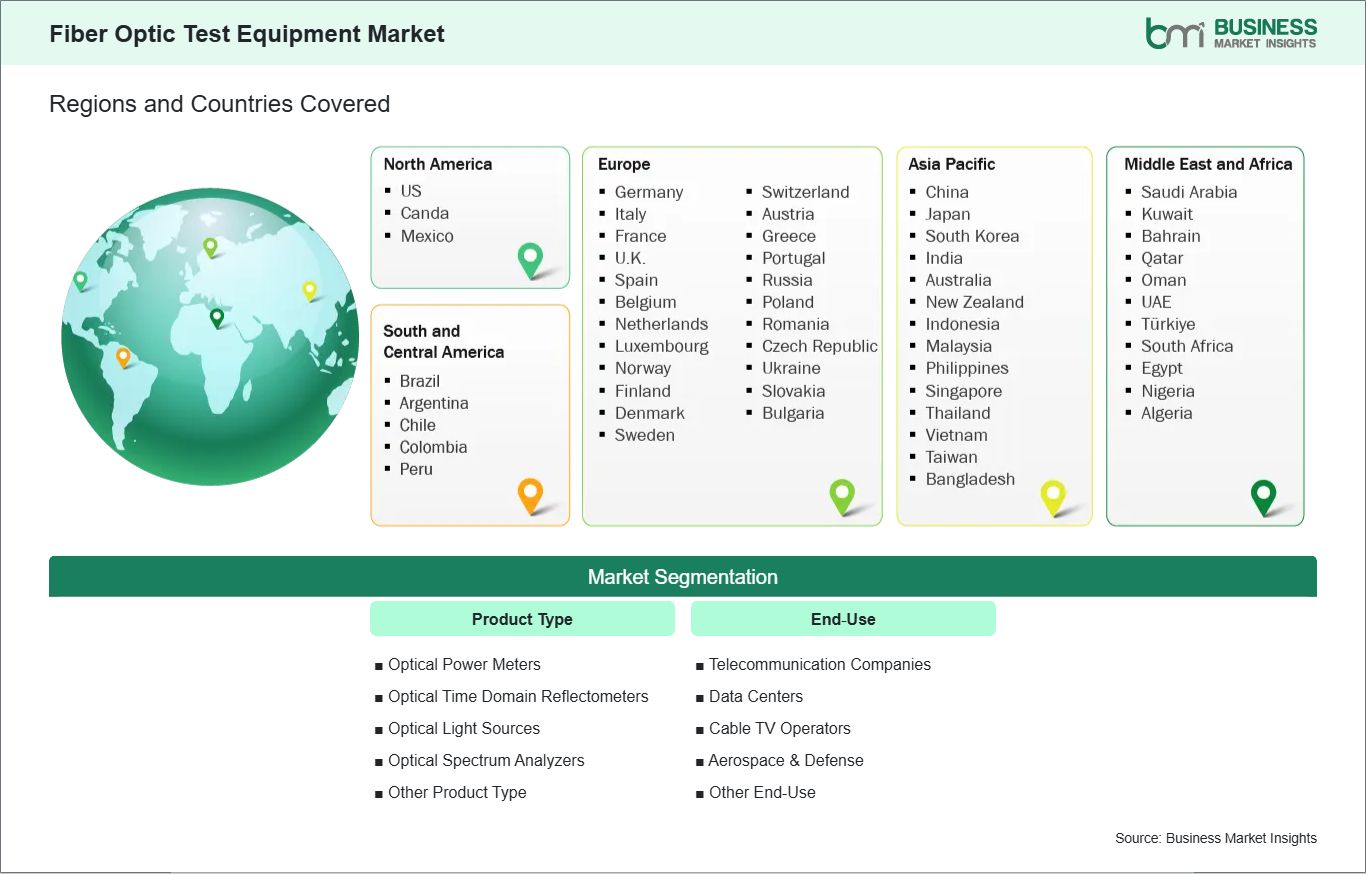
- By Product Type, the Fiber optic test equipment market is segmented into Optical Power Meters (OPM), Optical Time Domain Reflectometers (OTDR), Optical Light Sources (OLS), Optical Spectrum Analyzers (OSA), and Other Product Types. The Optical Time Domain Reflectometers (OTDR) segment dominated the market in 2025.
- By End‑Use, the Fiber optic test equipment market is segmented into I Telecommunication Companies, Data Centers, Cable TV Operators, Aerospace & Defense, and Other End-Use. The Telecommunication Companies segment dominated the market in 2025.
Market Forces
Fiber Optic Test Equipment Market Drivers and Opportunities
Rapid 5G Network Deployments
The global rollout of 5G networks is a major driver of the fiber optic test equipment market. 5G requires ultra-high-speed, low-latency connectivity, which heavily relies on fiber optic backhaul and fronthaul networks. Telecom operators must ensure minimal signal loss, high bandwidth, and network reliability, creating strong demand for precise testing instruments like OTDRs, optical power meters, and spectrum analyzers. Additionally, the dense fiber network deployment in urban areas increases the complexity of maintenance and fault detection, further boosting the need for advanced test equipment. As countries invest heavily in 5G infrastructure, the market for reliable fiber optic testing solutions continues to grow steadily.
Expansion in Emerging Economies
Emerging markets in the Asia Pacific, Latin America, and the Middle East & Africa present a significant growth opportunity for fiber optic test equipment. These regions are investing heavily in broadband expansion, fiber-to-the-home (FTTH) initiatives, and smart city projects to meet growing internet demand. Many areas still have underdeveloped network infrastructure, requiring extensive fiber deployment and continuous testing. Companies entering these markets can capitalize on the rising need for cost-effective, portable, and automated testing solutions while supporting telecom operators in maintaining high-quality network performance. This opportunity is amplified by government initiatives promoting digital connectivity and increasing the adoption of cloud and IoT technologies.
Size and Share Analysis
Fiber Optic Test Equipment Market Size and Share Analysis
By Product Type, the market is segmented into Optical Power Meters (OPM), Optical Time Domain Reflectometers (OTDR), Optical Light Sources (OLS), Optical Spectrum Analyzers (OSA), and Other Product Types. The Optical Time Domain Reflectometers (OTDR) segment dominated the market in 2025. OTDR devices led the market due to their critical role in fiber characterization, fault detection, and network maintenance. Their precision in measuring signal loss, distance, and connectivity issues made them indispensable for telecom operators and data centers, driving widespread adoption in expanding high-speed fiber optic networks globally.
By End‑Use, the market is segmented into Telecommunication Companies, Data Centers, Cable TV Operators, Aerospace & Defense, and Other End-Use. The Telecommunication Companies segment held the largest share of the market in 2025. Telecom operators accounted for the largest share, driven by massive 5G deployments, FTTH expansions, and network upgrades. The need for high-speed, reliable connectivity compelled providers to adopt advanced fiber optic testing solutions for fault detection, performance optimization, and compliance with stringent service-level agreements, ensuring uninterrupted communication services.
Report Coverage
Fiber Optic Test Equipment Market Report Coverage and Deliverables
The "Fiber Optic Test Equipment Market Size and Forecast (2022-2033)" report provides a detailed analysis of the market covering below areas:
- Fiber optic test equipment market size and forecast at global, regional, and country levels for all the key market segments covered under the scope
- Fiber optic test equipment market trends, as well as market dynamics such as drivers, restraints, and key opportunities
- Fiber optic test equipment market analysis covering key market trends, global and regional framework, major players, regulations, and recent market developments
- Industry landscape and competition analysis covering market concentration, heat map analysis, prominent players, and recent developments for the Fiber optic test equipment market
- Detailed company profiles, including SWOT analysis
Geographic Insights
Fiber Optic Test Equipment Market Geographic Insights
The geographical scope of the Fiber optic test equipment market report is divided into five regions: North America, Asia Pacific, Europe, Middle East & Africa, and South & Central America. The Fiber optic test equipment market in Asia Pacific is expected to grow significantly during the forecast period.
The Asia Pacific region is a key growth hub for the fiber optic test equipment market, driven by rapid 5G network rollouts, FTTH expansions, and growing data center infrastructure in countries like China, India, Japan, and South Korea. Rising internet penetration, government initiatives for digital connectivity, and increasing adoption of cloud and IoT technologies are fueling demand for reliable fiber testing solutions. Telecom operators and enterprises require high-precision OTDRs, power meters, and spectrum analyzers to maintain network performance and reduce downtime. The region’s large population, urbanization, and technological investments ensure sustained market growth over the forecast period.
Industry Activity
Recent Developments
The Fiber optic test equipment market is evaluated by gathering qualitative and quantitative data post primary and secondary research, which includes important corporate publications, association data, and databases. A few of the key developments in the Ethernet Connector Transformer market are:
- In September 2024, Keysight Technologies introduced the N7718C Optical Reference Transmitter, designed to support high-speed optical communications and comply with emerging standards such as IEEE 802.3dj. The solution provides versatile capabilities, including clean and stressed signal generation, flexible optical input options, and compatibility with multiple modulation formats. It enables accurate testing and validation of optical receivers, enhancing system performance while minimizing noise and jitter, thereby supporting reliable next-generation data transmission.
- In May 2025, EXFO Inc. announced the launch of its FTB-1 Pro Optical Time Domain Reflectometer (OTDR) platform, engineered for high-speed fiber network deployment and maintenance. The device supports testing of 400G and 800G optical networks, offering enhanced dynamic range, faster trace acquisition, and advanced fault-location accuracy. Equipped with cloud-connected reporting tools and automated analysis features, the solution enables field technicians to validate fiber links efficiently while ensuring compliance with next-generation broadband and data center standards.
Trust & Transparency
Research Methodology
The market analysis combines proprietary research with secondary data from government agencies, company disclosures, regulatory filings, industry databases and expert interviews. Market estimates are validated through data triangulation, cross-market benchmarking and analyst
review.
View Full Research Methodology
Key Sources Referred:
World Bank - Global Trade IndicatorsWorld Trade Organization (WTO)International Monetary Fund (IMF)International Trade Administration (ITA)Company websiteCompany annual reportsCompany investor presentations