Market Summary
Executive Summary and Global Market Analysis
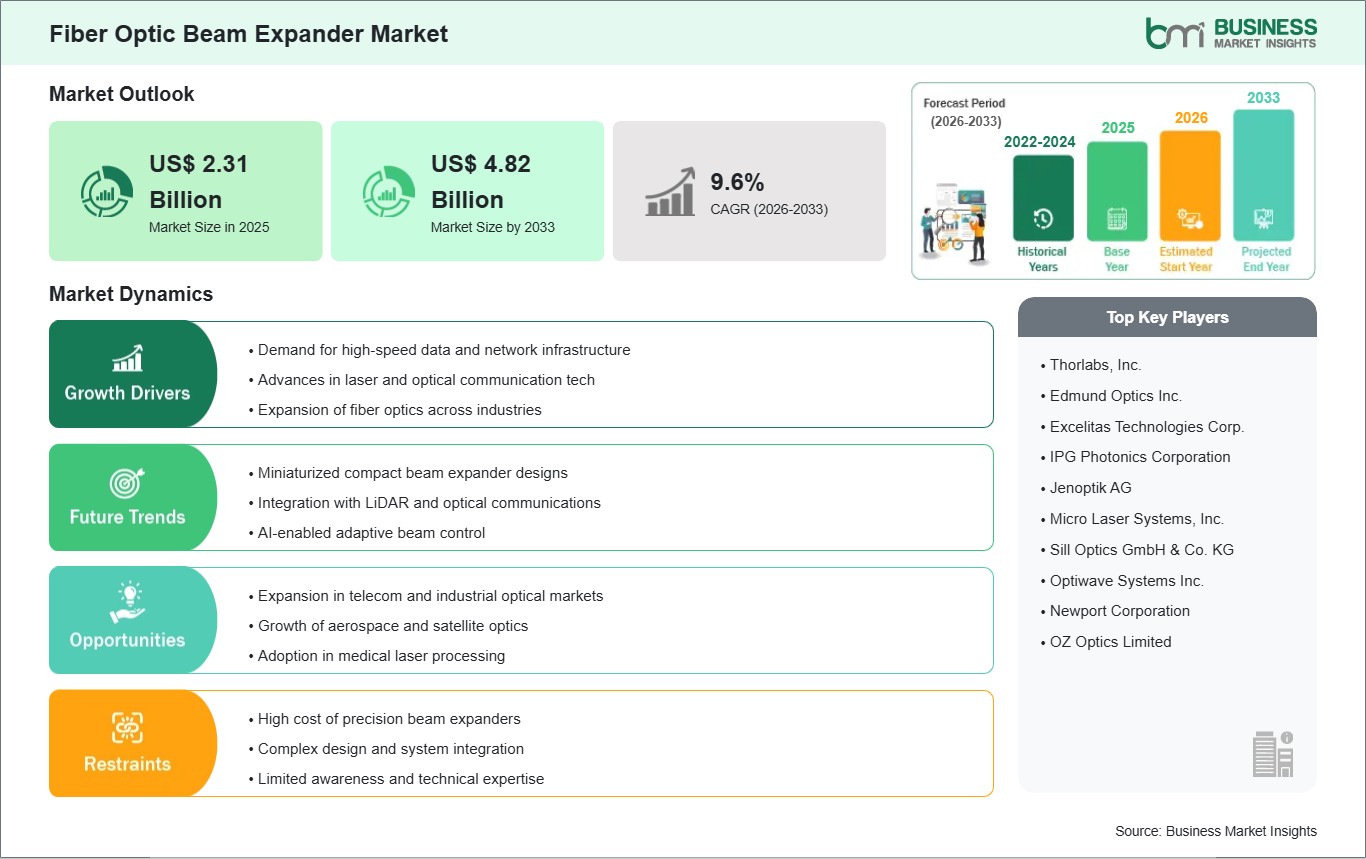
The global fiber optic beam expander market is a critical enabler of high-performance optical systems, providing essential components that manipulate and optimize laser beams for a wide spectrum of applications. These devices function by increasing the diameter of a light beam as it exits an optical fiber, thereby reducing divergence, improving focus, and enhancing transmission efficiency over distance. As industries worldwide demand faster data transmission, greater precision in manufacturing, and more advanced sensing capabilities, fiber optic beam expanders have become indispensable across telecommunications, industrial manufacturing, medical technology, and defense sectors. The market is experiencing robust growth propelled by the global rollout of 5G networks requiring high-bandwidth optical infrastructure, the proliferation of laser-based manufacturing in automotive and electronics industries, and the increasing adoption of LIDAR and remote sensing technologies in autonomous systems and environmental monitoring.
The integration of fiber optic beam expanders with advanced fiber laser systems is revolutionizing material processing, enabling faster cutting speeds, cleaner welds, and more precise micromachining operations. In telecommunications, these devices are essential for reducing signal loss and maintaining beam quality in long-haul fiber optic networks and dense wavelength division multiplexing (DWDM) systems. However, the market faces significant challenges, including the high cost of precision optical coatings and specialty glass materials, complex manufacturing requirements, and the need for specialized technical expertise for system integration and alignment. The stringent quality standards required for medical and defense applications further complicate production and increase development timelines. Despite these constraints, compelling opportunities are emerging from the miniaturization of optical components for portable devices, the development of adaptive and motorized beam expanders with AI-assisted alignment for Industry 4.0 applications, and the growing demand for ruggedized expanders in harsh environment applications such as downhole drilling, space-based communications, and military targeting systems.
Segment Analysis
Fiber Optic Beam Expander Market Segmentation
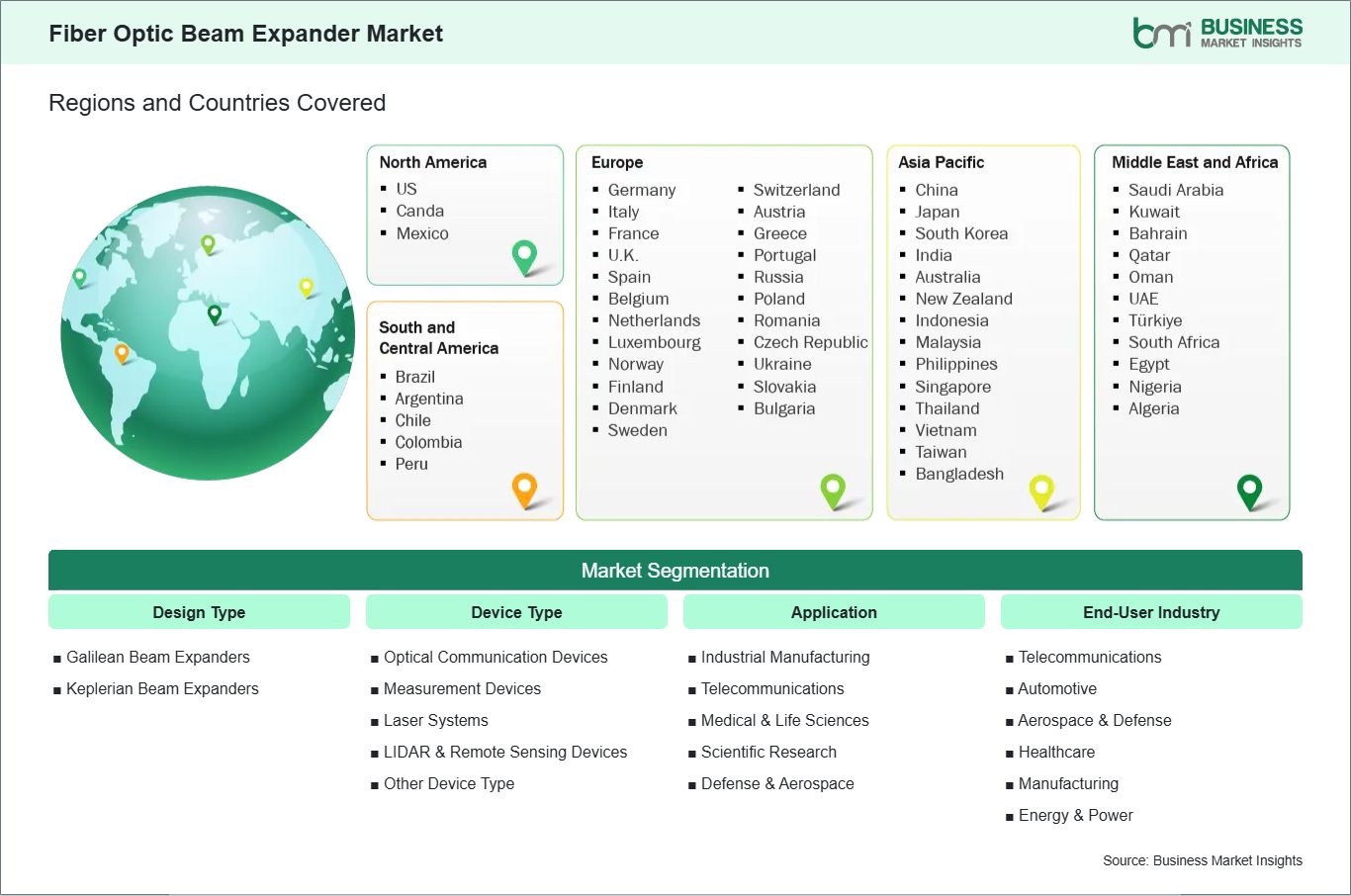
Key segments that contributed to the derivation of the fiber optic beam expander market analysis are design type, device type, application, and end-user industry.
- By design type, the market is segmented into Galilean and Keplerian beam expanders. The Galilean design segment dominated the market in 2025.
- By device type, the market is categorized into optical communication devices, measurement devices, laser systems, LIDAR & remote sensing devices, and other device type. The optical communication devices segment held the largest share in 2025.
- By application, the market is segmented into industrial manufacturing, telecommunications, medical & life sciences, scientific research, and defense & aerospace. The industrial manufacturing segment accounts for the largest revenue share in 2025.
- By end-user industry, the market is segmented into telecommunications, automotive, aerospace & defense, healthcare, manufacturing, and energy & power. The telecommunications and manufacturing sectors are the largest consumers in 2025.
Market Forces
Fiber Optic Beam Expander Market Drivers and Opportunities
Global Telecommunications Expansion and 5G Infrastructure Deployment
A primary driver for the fiber optic beam expander market is the unprecedented global expansion of telecommunications infrastructure, particularly the rollout of 5G networks and the construction of hyperscale data centers. As operators worldwide densify their networks to meet exploding bandwidth demand, coherent optical links operating at 400 Gbit/s and beyond require ultra-low loss beam shaping to maximize transmission distances and reduce bit error rates. Beam expanders increase coupling efficiency, stabilize mode fields over kilometer-long fiber runs, and minimize insertion losses in DWDM systems. The European Union's Gigabit Society targets and China's commitment to exceed 3 million 5G base stations by 2025 are creating sustained, multi-year demand for precision expansion optics. Additionally, the rapid growth of submarine cable systems and satellite-based optical communication networks is opening new frontiers for compact, radiation-hardened beam expanders capable of maintaining wavefront integrity in extreme environments.
Advancements in Laser-Based Manufacturing and Industrial Automation
The accelerating adoption of laser-based manufacturing processes across automotive, electronics, and heavy industries represents a transformative opportunity for fiber optic beam expanders. Modern manufacturing increasingly relies on ultrafast fiber lasers for battery welding, precision cutting of composite materials, and metal additive manufacturing, all of which require uniform energy distribution across widened apertures. Beam expanders eliminate hot spots, protect downstream optics, and enlarge processing fields without sacrificing beam quality, thereby maximizing return on investment for high-power laser systems. The automotive industry's shift toward electric vehicles (EVs) has intensified demand for high-reliability laser welding of battery components—including busbars, tab connections, and cell casings—where fiber optic beam expanders ensure consistent, defect-free welds. Furthermore, the integration of motorized, software-controlled beam expanders with Industry 4.0 platforms enables real-time adjustment of beam parameters based on sensor feedback, allowing single-station processing lines to handle multiple materials and thicknesses with minimal downtime.
Size and Share Analysis
Fiber Optic Beam Expander Market Size and Share Analysis
By design type, Galilean beam expanders maintain revenue leadership due to their cost-effectiveness and suitability for high-volume industrial and telecommunications applications. Their simpler optical train and shorter physical length make them ideal for integration into compact laser systems and fiber optic test equipment. Keplerian designs, featuring an internal focus for spatial filtering, command premium pricing in scientific research, semiconductor inspection, and high-resolution imaging applications where beam purity is paramount.
By device type, optical communication devices represent the largest segment, driven by continuous investment in fiber optic network infrastructure. Measurement devices, including beam profilers and interferometers, represent a stable niche serving metrology and quality assurance applications. The laser systems segment is the fastest-growing, as fiber lasers increasingly displace traditional CO₂ and solid-state lasers in industrial processing.
By application, industrial manufacturing leads in revenue, encompassing laser cutting, welding, cladding, and surface treatment operations across automotive, aerospace, and heavy equipment sectors. Telecommunications is the growth leader, with beam expanders enabling higher data rates and longer transmission distances in metro and long-haul networks. Medical applications, while smaller in volume, represent a high-value segment with stringent quality requirements and premium pricing.
By end-user industry, telecommunications companies and network equipment manufacturers are the largest customers, procuring beam expanders for both infrastructure deployment and network upgrades. The automotive industry, particularly EV manufacturers, is a rapidly growing adopter for battery production lines. Defense and aerospace customers, though smaller in unit volume, represent a significant revenue stream due to the high cost and specialized nature of ruggedized, military-grade optical components.
Report Coverage
Fiber Optic Beam Expander Market Report Coverage and Deliverables
The "Fiber Optic Beam Expander Market Size and Forecast (2022 - 2033)" report provides a detailed analysis of the market covering below areas:
- Fiber Optic Beam Expander Market size and forecast at global, regional, and country levels for all the key market segments covered under the scope
- Fiber Optic Beam Expander Market trends, as well as market dynamics such as drivers, restraints, and key opportunities
- Fiber Optic Beam Expander Market analysis covering key market trends, global and regional framework, major players, regulations, and recent market developments
- Industry landscape and competition analysis covering market concentration, heat map analysis, prominent players, and recent developments for the fiber optic beam expander market
- Detailed company profiles, including SWOT analysis
Geographic Insights
Fiber Optic Beam Expander Market Geographic Insights
The geographical scope of the fiber optic beam expander market report is divided into five regions: North America, Asia Pacific, Europe, Middle East & Africa, and South & Central America. Asia Pacific is both the largest market and the fastest-growing region.
Asia Pacific, led by China, Japan, South Korea, and India, dominates global production and consumption of fiber optic components. China's position as the world's manufacturing powerhouse, combined with massive government investments in telecommunications infrastructure under initiatives such as "Made in China 2025" and the Digital Silk Road, drives unprecedented demand for fiber optic beam expanders in both telecommunications and industrial applications. The region's booming electronics industry, particularly in semiconductor fabrication and consumer device assembly, fuels adoption of precision beam expanders for inspection and micromachining. Japan and South Korea contribute through their advanced robotics, automotive, and consumer electronics sectors, while India emerges as a high-growth market supported by government initiatives to improve digital connectivity and manufacturing capabilities.
North America, led by the United States, is a technologically advanced market characterized by strong investments in defense and aerospace applications, including directed-energy weapons, satellite communication systems, and advanced LIDAR for autonomous vehicles. The region's robust telecommunications infrastructure, with ongoing 5G deployment and data center expansion, drives steady demand for high-performance beam expanders. The presence of leading optical component manufacturers and significant R&D investments sustains North America's position as an innovation hub for advanced photonics technologies.
Europe maintains a strong market presence with Germany, France, and the United Kingdom at the forefront of industrial laser adoption and precision optical manufacturing. Germany's world-leading automotive industry drives demand for beam expanders in EV battery welding and lightweight component processing, while collaborative EU research initiatives foster innovation in next-generation optical technologies. The region's emphasis on scientific research and its strong photonics industry cluster support sustained demand for high-precision, custom-engineered beam expanders.
Industry Activity
Recent Developments
The fiber optic beam expander market is evaluated by gathering qualitative and quantitative data post primary and secondary research, which includes important corporate publications, association data, and databases. A few of the key developments in the fiber optic beam expander market are:
- In January 2026, GoPhotonics presents a versatile portfolio of beam expanders engineered for precise control of laser beam diameter, divergence, and spatial quality across a broad range of wavelengths and laser types. Designed to support solid-state, fiber, diode, and gas laser systems, these beam expanders enable reliable beam conditioning for both continuous-wave and pulsed laser operation in laboratory, research, and industrial environments.
- In January 2025, TECHSPEC Gemma Variable Beam Expanders unite industrial-grade performance with simplified laser beam expansion. The TECHSPEC Gemma Variable Beam Expanders are industrial-grade variable beam expanders built for laser system teams that need continuous magnification control, high optical performance, and reliable sourcing. Available in 2-8X and 1-3X magnification ranges, Gemma beam expanders support fast evaluation and straightforward integration for R&D, prototyping, and production programs.
Trust & Transparency
Research Methodology
The market analysis combines proprietary research with secondary data from government agencies, company disclosures, regulatory filings, industry databases and expert interviews. Market estimates are validated through data triangulation, cross-market benchmarking and analyst
review.
View Full Research Methodology
Key Sources Referred:
World Bank - Global Trade IndicatorsWorld Trade Organization (WTO)International Monetary Fund (IMF)International Trade Administration (ITA)Company websiteCompany annual reportsCompany investor presentations