Market Summary
Executive Summary and Global Market Analysis
Fall detection systems are electronic monitoring solutions designed to identify accidental falls and initiate emergency alerts for timely assistance. These systems use technologies like sensors, motion analysis, and communication devices in order to ensure user safety within the healthcare and residential settings. The main aim of these systems is to minimize response time after falls and to ensure that continuous surveillance is maintained. The emergence of this technology has come into existence because of the focus on preventive healthcare.
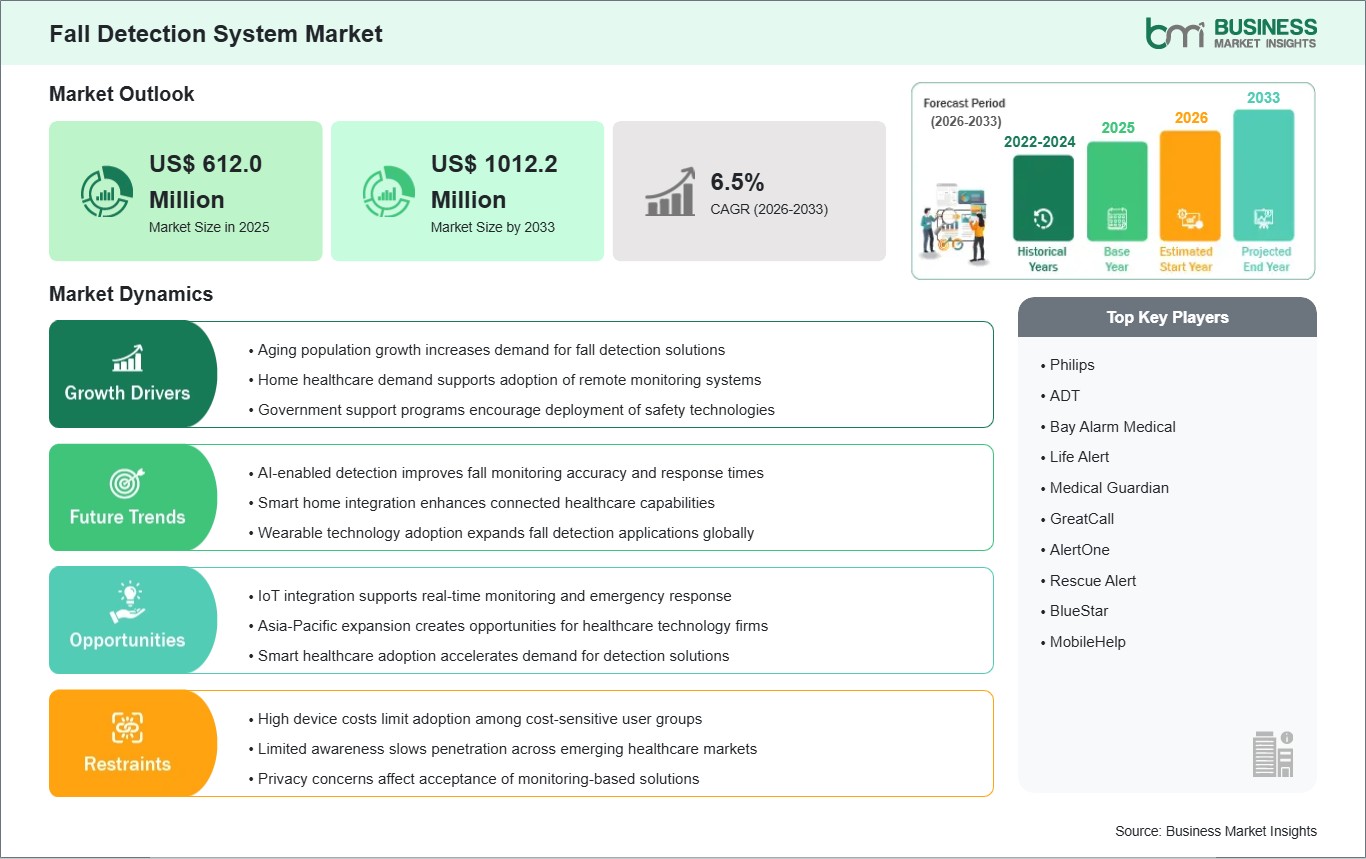
The market is experiencing positive effects due to increased use of home health care, growing concern regarding elderly health, and higher adoption of telehealth technology solutions. Both caregivers and organizations within the health industry are searching for methods that improve safety while improving independence of high-risk patients. Fall detection technology is a useful tool to support improved management of incidents, thus increasing trust of patients and caregivers involved in long-term health care delivery.
Market demand is distributed across wearable and non-wearable devices, each addressing distinct monitoring requirements and user preferences. Automatic detection technologies maintain strong appeal because they provide alerts without requiring user intervention, while manual systems continue serving individuals who prefer direct activation methods. Home care environments represent a major area of deployment, alongside hospitals and assisted living facilities where continuous monitoring and rapid emergency communication remain essential operational priorities.
Technological advancements continue to expand system functionality through improved sensors, artificial intelligence algorithms, wireless connectivity, and cloud-based monitoring capabilities. These innovations enhance detection accuracy while facilitating integration with broader digital healthcare ecosystems. Competitive activity focuses on device reliability, ease of use, and interoperability with connected care platforms. As healthcare systems increasingly adopt technology-enabled care models, fall detection solutions are becoming more sophisticated, responsive, and adaptable to evolving patient safety requirements.
Segment Analysis
Fall Detection System Market Segmentation
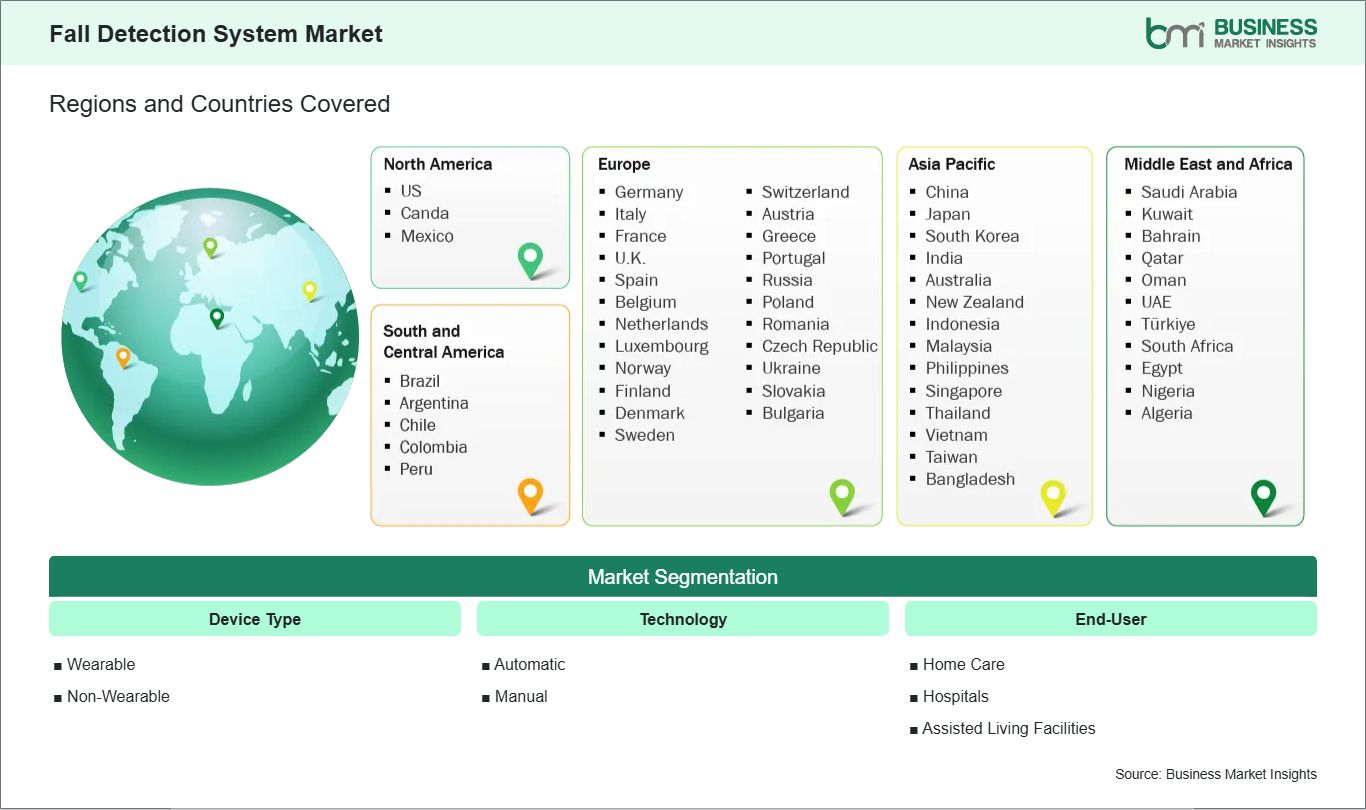
The fall detection system market is segmented based on device type, technology, and end-user, reflecting the growing focus on patient safety, remote health monitoring, and rapid emergency response across healthcare and residential care settings.
By Device Type
- Wearable - Widely utilized for continuous monitoring and immediate fall alert generation.
- Non-Wearable - Enables passive detection without requiring direct user interaction.
By Technology
- Automatic - Detects fall incidents independently through advanced sensors and algorithms.
- Manual - Allows users to initiate emergency notifications when assistance is needed.
By End-Use
- Home Care - Supports independent living through continuous safety monitoring solutions.
- Hospitals - Enhances patient supervision and improves incident response efficiency.
- Assisted Living Facilities - Strengthens resident protection through dedicated monitoring and alert systems.
Market Forces
Fall Detection System Market Drivers and Opportunities
Rising demand for home healthcare
The preference for home-based healthcare services continues to reshape patient monitoring requirements. Population aging and patients suffering from any kind of chronic disease are looking for ways to live independently without compromising on emergency services. These requirements have been addressed through fall detection systems, which provide round-the-clock surveillance with quick alert features, making their adoption much more prevalent.
With the growth in the home care sector, more importance is being accorded to technology that ensures improved outcomes for patients as well as boosting the confidence of their caregivers. Fall detection systems play a key role in ensuring a prompt response to any crisis and thus minimize the dangers that result from lack of timely assistance.
Integration with IoT
The emergence of connected healthcare ecosystems has accelerated interest in IoT-enabled fall detection solutions. The advanced equipment is able to connect to the caregivers, healthcare systems, and emergency facilities through a networked connection system. Such connectivity will aid in ensuring seamless tracking and facilitate the timely exchange of information.
The future possibilities will be tied to increased interoperability between fall detection devices and smart healthcare infrastructure. Increased use of interconnected sensors, cloud computing capabilities, and prediction analysis could enable better accuracy in monitoring and increased efficiencies. In light of continued advancements in digital healthcare, IoT-based technologies will have an important role to play.
Size and Share Analysis
Fall Detection System Market Size and Share Analysis
The fall detection system market size is expected to reach US$ 612.0 million by 2033 from US$ 1012.2 million in 2025. The market is estimated to record a CAGR of 6.5% during 2026 to 2033. Market expansion is supported by rising utilization of remote patient monitoring solutions, increasing attention toward elderly safety, and broader integration of connected healthcare technologies across home care and institutional healthcare environments. Continuous advancements in sensor accuracy and emergency communication capabilities further strengthen industry development.
By Device Type, wearable devices account for a dominant share due to their portability, continuous monitoring functionality, and widespread acceptance among elderly users and patients requiring regular supervision. Non-wearable devices maintain a significant position as they provide passive monitoring capabilities without requiring individuals to carry or wear dedicated equipment, making them suitable for residential and healthcare facility settings.
By Technology, automatic systems hold a major share supported by their ability to detect falls and initiate alerts without user intervention, improving emergency response efficiency. Manual systems continue to maintain relevance among users seeking direct control over emergency communication.
By End-Use, home care applications dominate the market owing to the preference for independent living and remote healthcare support. Hospitals and assisted living facilities continue expanding deployment to enhance patient safety, resident monitoring, and incident management capabilities.
Report Coverage
Fall Detection System Market Report Coverage and Deliverables
The "Fall Detection System Market Size and Forecast (2022 - 2033)" report provides a detailed analysis of the market covering below areas:
- Market size and forecast at global, regional, and country levels for all key market segments covered under the scope
- Market trends, along with market dynamics such as drivers, restraints, and key opportunities
- Market analysis covering key trends, global and regional frameworks, major players, regulations, and recent developments
- Industry landscape and competitive analysis covering market concentration, heat map analysis, prominent players, and recent developments
- Detailed company profiles, including SWOT analysis
Geographic Insights
Fall Detection System Market Geographic Insights
The fall detection system market shows diverse regional adoption patterns influenced by demographic trends, healthcare infrastructure maturity, digital health initiatives, and evolving patient safety requirements. Across global markets, healthcare providers and caregivers increasingly incorporate monitoring technologies into care delivery frameworks. The emphasis on remote supervision and timely emergency intervention continues to support broader deployment of fall detection solutions across multiple healthcare environments.
North America maintains a prominent position within the industry due to established healthcare systems and strong acceptance of connected health technologies. The region demonstrates sustained interest in solutions that support independent living while enhancing patient monitoring capabilities. Healthcare organizations and caregivers continue to explore technologies that improve emergency response effectiveness and long-term care management.
Asia Pacific presents significant opportunities supported by expanding healthcare access, rising elderly populations, and increasing awareness of remote monitoring technologies. Governments and healthcare providers are strengthening investments in digital healthcare infrastructure, creating favorable conditions for advanced monitoring solutions. The region also benefits from increasing integration of smart devices and connected healthcare ecosystems.
Europe emphasizes patient safety, healthcare modernization, and efficient long-term care delivery. Demand is supported by initiatives focused on aging populations and technology-enabled healthcare services. Emerging markets across the Middle East, Africa, and South and Central America are witnessing broader utilization of monitoring solutions as healthcare systems evolve and awareness regarding preventive care and emergency response technologies continues to advance.
Industry Activity
Recent Developments
The fall detection system market is evaluated by gathering qualitative and quantitative data post primary and secondary research, which includes important corporate publications, association data, and databases. Recent developments and news in the market include:
- In February 2025, LogicMark, Inc. announced the launch of its next-generation Guardian Alert 911 Plus, a personal emergency response device with integrated fall detection technology and 4G LTE connectivity, designed to directly alert emergency services and caregivers without requiring a call center intermediary.
- In October 2025, CarePredict announced a partnership with KamiCare to integrate AI-based fall detection alerts into its senior care platform, enabling centralized monitoring of incidents across senior living facilities.
Trust & Transparency
Research Methodology
The market analysis combines proprietary research with secondary data from government agencies, company disclosures, regulatory filings, industry databases and expert interviews. Market estimates are validated through data triangulation, cross-market benchmarking and analyst
review.
View Full Research Methodology
Key Sources Referred:
World Health OrganizationNational Institute on AgingCenters for Disease Control and PreventionNational Institutes of HealthInternational Telecommunication UnionEuropean CommissionAmerican Geriatrics SocietyInternational Society for Gerontechnology