
Facial Injectables Market Outlook: Size, Share, Trends, Growth Analysis, Competitive Landscape & Forecast, 2026-2033

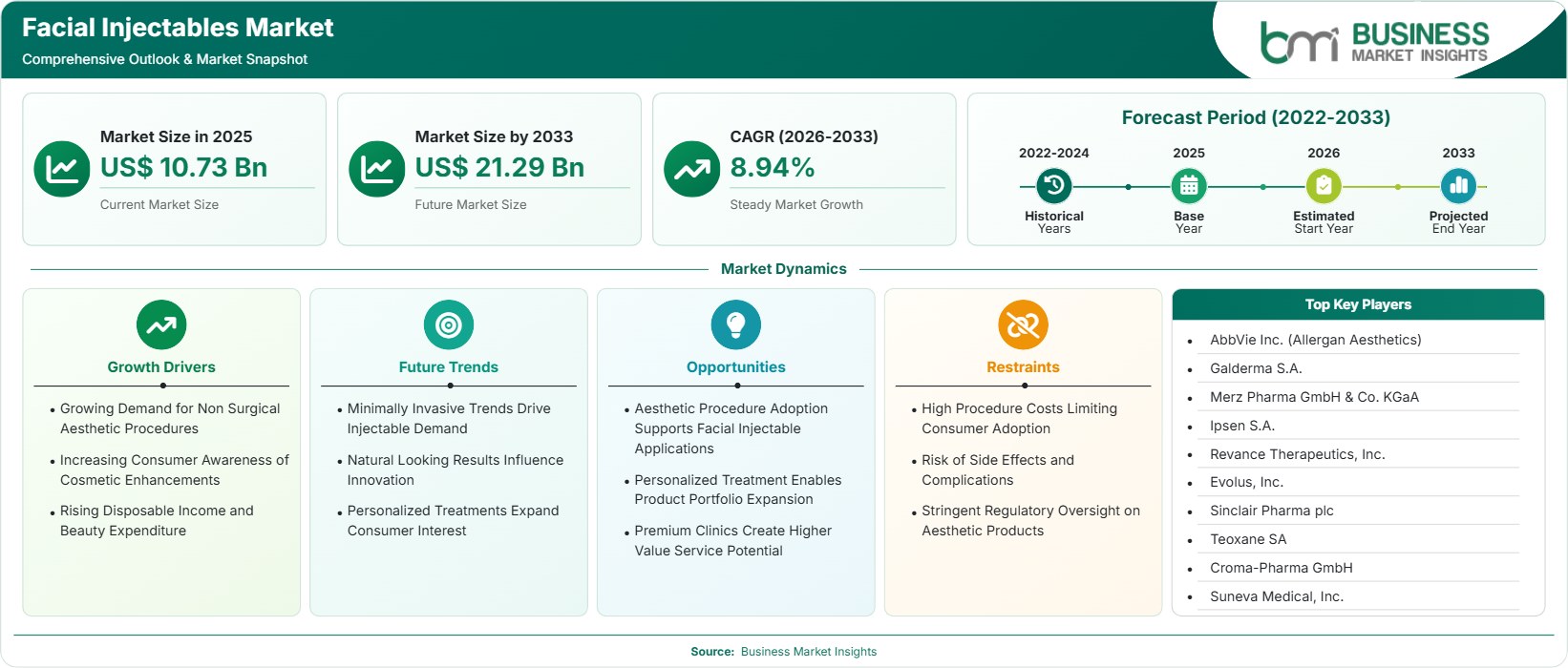
The Facial Injectables Market size was valued at US$ 10.73 Billion in 2025 and is projected to reach US$ 21.29 Billion by 2033, growing at a CAGR of 8.94% during 2026–2033. Growth is supported by rising demand for minimally invasive aesthetic procedures, increasing aging populations, product innovation, medical aesthetics awareness, and expanding cosmetic treatment accessibility across developed and emerging economies.

Report Coverage
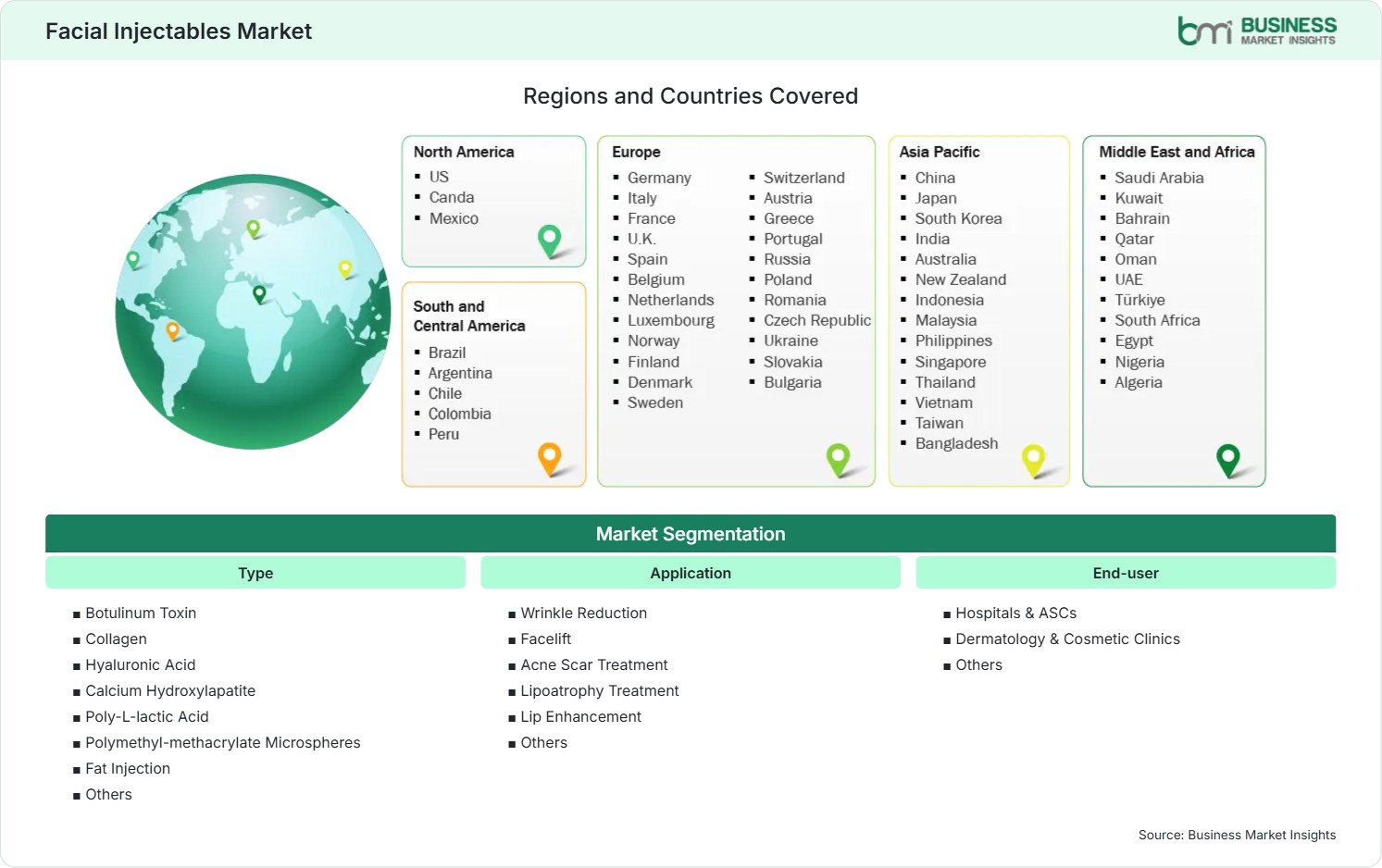
  • Type: Botulinum Toxin, Collagen, Hyaluronic Acid, Calcium Hydroxylapatite, Poly-L-lactic Acid , Polymethyl-methacrylate Microspheres , Fat Injection, Others
  • Application: Wrinkle Reduction, Facelift, Acne Scar Treatment, Lipoatrophy Treatment, Lip Enhancement, Others
  • End-user: Hospitals & ASCs, Dermatology & Cosmetic Clinics, Others
US$ 10.73 Bn Market size in 2025
US$ 21.29 Bn Market Size by 2033
8.94% CAGR, 2026 - 2033
2026-2033 Forecast Period

AI Overview

Facial Injectables Market Summary

  • North America Region: Holds a market share of 38%–41% in 2025, growing with a CAGR of 7.8%–8.4% during 2026–2033. Growth is driven by high procedure volumes, strong physician networks, premium aesthetic spending, product approvals, male aesthetics adoption, repeat treatment demand, digital consultation expansion, and clinics offering personalized facial rejuvenation therapies. Brief U.S. analysis: Strong consumer spending, premium brands, and established aesthetic infrastructure support a CAGR of 7.9%–8.5%.
  • Fastest Growing Region: Asia Pacific holds a market share of 25%–28% in 2025, growing with a CAGR of 10.2%–11.0% during 2026–2033. Expansion is supported by medical tourism, rising disposable incomes, growing middle-class populations, aesthetic awareness, social media influence, urban dermatology networks, and increasing availability of advanced injectable treatments.
  • Leading Segment: Botulinum Toxin accounts for 42%–45% share in 2025 and expands at 8.3%–9.0% CAGR. Demand benefits from repeat treatment cycles, strong clinical acceptance, facial line correction applications, physician familiarity, predictable outcomes, and increasing preventative aesthetic treatment adoption.
  • High Growth Segment: Lip Enhancement represents 14%–17% share in 2025 and expands at 10.5%–11.3% CAGR. Growing beauty consciousness, social media influence, customized facial contouring preferences, younger demographics, premium filler innovations, and natural-looking augmentation outcomes continue supporting segment expansion.
  • Key Market Opportunity: Growing adoption of regenerative and biostimulatory injectables creates opportunities for manufacturers developing longer-lasting aesthetic solutions, combination therapies, personalized treatment protocols, and digital patient engagement platforms across emerging markets.
  • Major Market Players: AbbVie Inc. (Allergan Aesthetics), Galderma S.A., Merz Pharma GmbH & Co. KGaA, Ipsen S.A., Revance Therapeutics, Inc., Evolus, Inc., Sinclair Pharma plc, Teoxane SA, Croma-Pharma GmbH, Suneva Medical, Inc.
Strategic Insights

Facial Injectables Market: Strategic Insights

Facial Injectables Market Strategic Framework
FREE PDF
Request your free sample
Request free sample
Stakeholder View

Key Takeaways

  • The value chain increasingly integrates manufacturers, distributors, physician training organizations, dermatology clinics, and digital consultation providers, creating stronger recurring-revenue ecosystems.
  • Lip enhancement, facial contouring, and biostimulatory treatment categories present attractive opportunities due to growing consumer demand for personalized aesthetic outcomes.
  • Innovation is shifting toward longer-lasting fillers, regenerative injectables, and advanced delivery techniques focused on safety, durability, and natural-looking results.
  • Asia Pacific offers the strongest expansion potential as China, India, South Korea, and Southeast Asian countries experience rising aesthetic procedure adoption.
  • Strategic acquisitions and portfolio expansion initiatives enable leading manufacturers to strengthen toxin and dermal filler offerings while widening global reach.
  • Growth in male aesthetics and preventative anti-aging treatments is expanding addressable patient populations beyond traditional consumer segments.
Geographic Outlook

Facial Injectables Market Regional Highlights

North America Facial Injectables Market

North America accounted for 38%–41% Facial Injectables Market share in 2025 and is projected to record a CAGR of 7.8%–8.4% through 2033. The aesthetic infrastructure is highly developed, with a large number of physicians, positive consumer spending trends, and strong brand awareness. The USA remains the largest contributor due to extensive awareness of minimally invasive procedures and numerous new product introductions. Independent reimbursement and premium cosmetic procedures preference are factors favoring a constant procedure demand.

  • Strong adoption of botulinum toxin and hyaluronic acid treatments supports recurring patient visits and premium pricing.
  • Consumer demand increasingly focuses on natural-looking enhancement and preventive anti-aging treatments.
  • Physician training programs improve treatment safety and broaden injectable procedure availability.
  • Digital consultation platforms enhance patient engagement and clinic conversion rates.
  • Premium aesthetic spending remains resilient among affluent demographics.

US Facial Injectables Market

The U.S. represented approximately 80%–84% of the North American Facial Injectables Market  revenue in 2025, while advancing at a CAGR of 7.9%–8.5%. The high volume of procedures, brand loyalty, and network of providers make the country the world leader. The demand is moving away from traditional anti-aging treatments to facial balance and preventative aesthetics. Regulatory control and medical supervision add to the credibility of the market.

  • High concentration of dermatology and cosmetic clinics accelerates treatment accessibility.
  • Male aesthetics participation continues increasing across metropolitan markets.
  • Product innovation supports premium treatment adoption and patient retention.
  • Personalized treatment planning drives higher-value procedure combinations.

Europe Facial Injectables Market

Europe captured 27%–30% share in 2025 and is expected to expand at 8.1%–8.8% CAGR. Germany, France, Italy, and the UK continue to be among the key markets due to well-developed aesthetics infrastructure and experienced professionals. Spain stands out through above-average growth due to aesthetic tourism. A preference for minimal intervention, along with product quality regulations, ensures that the trend will continue. The clinics are increasingly using fillers, toxins, and skin rejuvenation procedures.

  • Germany remains a leading revenue contributor with strong clinic infrastructure.
  • Spain is among the faster-growing aesthetic tourism destinations.
  • Premium filler procedures continue gaining physician acceptance.
  • Aging populations support demand for wrinkle reduction applications.
  • Combination therapy protocols are increasingly adopted.

Asia Pacific Facial Injectables Market

Asia Pacific held 25%–28% share in 2025 and is forecast to grow at 10.2%–11.0% CAGR, making it the fastest-growing region. China, South Korea, Japan, and India are contributing to growth due to rising disposable incomes and a beauty-obsessed population. Medical tourism is influencing treatment adoption, along with social media. Local companies continue to increase the number of clinics, while foreign companies are improving their distribution channels in the region.

  • China remains the largest regional contributor with expanding consumer adoption.
  • India records rapid demand growth supported by increasing urban disposable income.
  • South Korea benefits from advanced aesthetic medicine expertise.
  • Medical tourism fuels procedure volumes across multiple countries.
  • Younger demographics increasingly seek preventative treatments.

Rest of World Facial Injectables Market

The Rest of World region accounted for 8%–11% share in 2025 and is projected to expand at 8.8%–9.6% CAGR. Brazil and Mexico lead South and Central America while the UAE and Saudi Arabia represent key Middle East markets. According to the Facial Injectables Market Forecasts, growth is driven by improving healthcare infrastructure, rising cosmetic awareness, and expanding investment in private clinics. International aesthetic brands continue increasing their regional presence through partnerships and distributor agreements.

  • Brazil remains a leading aesthetic procedures market globally.
  • UAE demonstrates strong premium treatment demand among affluent consumers.
  • Saudi Arabia benefits from growing elective procedure acceptance.
  • Private investment continues supporting clinic expansion.
  • International brands strengthen regional availability and practitioner training.
Global Market Geography
FREE PDF
Request your free sample
Request free sample
Segment Analysis

Facial Injectables Market Segmentation

Type

Type segment remains the largest revenue category, with Botulinum Toxin leading and supporting overall Facial Injectables Market scope. The segment represented approximately 42%–45% market share in 2025 and is projected to expand at 8.3%–9.0% CAGR, driven by recurring demand, broad clinical acceptance, new formulations, and increasing utilization across aesthetic and corrective applications.

  • Botulinum Toxin: Market leader supported by repeat procedures, predictable outcomes, strong physician familiarity, and widespread wrinkle reduction applications.
  • Collagen: Demand persists within niche rejuvenation procedures emphasizing natural tissue support and facial volume restoration.
  • Hyaluronic Acid: Widely used for contouring, volumization, and enhancement owing to flexibility and reversibility advantages.
  • Calcium Hydroxylapatite: Gains adoption through structural support capabilities and collagen stimulation benefits.
  • Poly-L-lactic Acid (PLLA): Increasingly utilized in regenerative aesthetic procedures focused on progressive volume restoration.
  • Polymethyl-methacrylate Microspheres (PMMA): Selected for longer-lasting corrective procedures requiring durable volumization outcomes.
  • Fat Injection: Supported by autologous treatment preferences and natural-looking facial rejuvenation objectives.

Application

Application demand is shaped by changing beauty preferences and preventive treatment strategies. Wrinkle Reduction accounts for 35%–38% share in 2025 and is expected to grow at 8.2%–8.9% CAGR. Patients increasingly seek non-surgical solutions delivering effective aesthetic improvement with minimal downtime and predictable results.

  • Wrinkle Reduction: Largest application supported by aging demographics and preventative treatment adoption.
  • Facelift: Non-surgical facial contouring approaches gain popularity among consumers avoiding invasive procedures.
  • Acne Scar Treatment: Improving awareness and aesthetic correction demand support broader utilization.
  • Lipoatrophy Treatment: Used for restoring lost facial volume and improving structural balance.
  • Lip Enhancement: Fastest-growing application supported by personalization and beauty-focused demand.

End-user

Dermatology and Cosmetic Clinics dominate end-user demand, accounting for 48%–52% share in 2025 with a projected 9.0%–9.8% CAGR. Specialized expertise, extensive treatment portfolios, and consumer preference for dedicated aesthetic facilities continue strengthening leadership across developed and emerging markets.

  • Hospitals & ASCs: Benefit from procedural safety standards and multidisciplinary treatment capabilities.
  • Dermatology & Cosmetic Clinics: Lead adoption due to specialized practitioners, repeat visits, and broad aesthetic offerings.
Market Forces

Facial Injectables Market Dynamics

Key Market Drivers

Rising Demand for Minimally Invasive Cosmetic Procedures

The global shift toward minimally invasive aesthetics remains a primary growth catalyst. According to industry procedure data, injections are still far ahead of surgical procedures in terms of volume. There is now increased demand for quick procedures, less risky options, and natural results. With increased participation by young adults seeking preventive care and men seeking cosmetic procedures, addressable demand is increasing. The clinics benefit from patients returning repeatedly, since most injections require follow-up procedures.

Advancements in Injectable Formulations and Safety

Product innovation has improved durability, precision, and treatment outcomes. There are efforts to develop next-generation cross-linked hyaluronic acid fillers, long-lasting neuromodulators, and collagen inducers to prolong treatment effectiveness. Increased clinical knowledge and training programs for physicians boost confidence among practitioners. Safety-oriented regulatory standards also promote the use of FDA-approved treatments by trained professionals. These factors contribute to increased customer satisfaction while providing unique solutions. Improved results and customization ability will further justify high price levels and widespread acceptance.

Expansion of Medical Aesthetics Infrastructure

The number of dedicated aesthetics clinics, dermatology centers, and trained practitioners continues to increase globally. Factors such as urbanization, high disposable incomes, and private investment facilitate infrastructure expansion in developing nations. Modern consultation technologies and digital marketing campaigns aid in the recruitment of patients. The network of providers is becoming more adept at offering customized treatment plans that include several injectables. Infrastructure expansion allows access to more treatment locations, making it easier for new customers to enter the market.

Key Market Opportunities

Growth Potential for Regenerative Aesthetic Treatments

Biostimulatory aesthetic treatments, including poly-L-lactic acid (PLLA) and calcium hydroxylapatite (CaHA), are creating substantial growth opportunities within the Facial Injectables Market. These products, unlike conventional fillers, not only help to restore volume but also stimulate collagen production within the body, providing prolonged rejuvenation effects. The increasing consumer interest in more natural, longer-lasting results is the main reason behind the growing demand for regenerative products. Companies that use cutting-edge technology and focus on clinical research, and physician education will definitely benefit from it.

Expansion Across Emerging Consumer Markets

Rapid urbanization, growing middle-class populations, and rising disposable incomes are creating significant opportunities for aesthetic and cosmetic companies across Asia, Latin America, and the Middle East. Younger age groups, the greater social media effect, and the increasing importance of cosmetic tourism are some other factors that fuel the demand for aesthetic surgeries. Companies can develop their business by focusing on localized marketing campaigns, training programs for doctors, and increased distribution channels. The increased consumer acceptance of non-surgical aesthetic procedures allows companies to create market advantages through early market entry.

Digital Aesthetics Ecosystems and Personalization

AI-supported consultations, sophisticated imaging technology, and patient engagement applications have brought about a revolution in the way that aesthetic treatments are planned and provided. Through these technologies, doctors are able to make highly customized recommendations to each patient. Emerging Facial Injectables Market Trends indicate that constant monitoring via digital platforms leads to improved treatment efficacy, greater patient satisfaction, and higher patient engagement. Moreover, the incorporation of digital technology will improve workflow efficiency in clinics and patient retention. In addition, collaboration between manufacturers and digital health experts will enable the development of differentiated products, while data-driven, customized treatment will become an important value proposition.

Market Restraints and Challenges

Treatment Cost Burden and Limited Access

Factor: Procedural costs still present a major issue, especially in developing nations. This is because expensive branded items, the practitioner's professional fees, and repeated treatments add up to high costs for patients.

Impact: Pricing sensitivity hinders usage among middle-class consumers and could limit the procedure's popularity beyond cities. Economic instability may affect discretionary expenditure towards beauty services. Even though financing and marketing strategies address affordability, price will remain an important barrier in the market.

Regulatory and Safety Concerns and Adoption Risks

Factor: The hazards of improper use of products, fake drugs, and lack of expertise to administer injections are ever-present. The regulators have not stopped in their efforts to ensure stringent regulations.

Impact: Compliance requirements could extend the development and operational time frame for manufacturers and providers. Safety incidents can hurt consumer trust and tarnish the brand name. It is critical to retain high standards of training, accurate labeling, and post-market surveillance to ensure continued industry growth and patient safety.

Company Analysis

Competitive Landscape

The competitive environment remains concentrated around established aesthetics leaders. Current Facial Injectables Market analysis highlights strong competition across neurotoxins, dermal fillers, and regenerative injectable categories.

Company Name

Overview

Products and Services relevant to this market

AbbVie Inc. (Allergan Aesthetics)

Global aesthetics leader with extensive physician training and distribution networks.

BOTOX Cosmetic, JUVÉDERM fillers and facial rejuvenation solutions.

Galderma S.A.

Dermatology-focused innovator with strong global aesthetic presence.

Restylane portfolio, aesthetic injectables, training and support services.

Merz Pharma GmbH & Co. KGaA

Established aesthetics specialist emphasizing innovation and safety.

Xeomin, Radiesse and physician education programs.

Ipsen S.A.

International biopharmaceutical company with neurotoxin expertise.

Dysport and related aesthetic treatment solutions.

Revance Therapeutics, Inc.

Innovation-focused company specializing in advanced neuromodulators.

Daxxify and supporting aesthetic services.

Evolus, Inc.

Fast-growing aesthetics company targeting premium cosmetic segments.

Jeuveau and digital practice support solutions.

Sinclair Pharma plc

Medical aesthetics specialist serving global providers.

Injectable contouring and aesthetic treatment products.

Teoxane SA

Filler-focused company with advanced hyaluronic acid technologies.

Teosyal filler portfolio and practitioner support.

Croma-Pharma GmbH

European manufacturer expanding injectables capabilities.

Hyaluronic acid fillers and aesthetic solutions.

Suneva Medical, Inc.

Specialist company emphasizing regenerative aesthetic approaches.

Bellafill and long-duration facial correction products.

Trust & Transparency

Research Methodology

The market analysis combines proprietary research with secondary data from government agencies, company disclosures, regulatory filings, industry databases and expert interviews. Market estimates are validated through data triangulation, cross-market benchmarking and analyst review.

View Full Research Methodology

Questions Answered

Frequently Asked Questions

What does a Facial Injectables Market Report typically evaluate?

A comprehensive Facial Injectables Market Report assesses market size, competitive positioning, segment performance, regional trends, technology developments, regulations, and future growth opportunities.

How are regenerative injectables changing treatment strategies?

Regenerative injectables stimulate collagen production and support longer-lasting rejuvenation outcomes, helping providers move beyond simple volume replacement approaches.

What role do dermatology clinics play in market development?

Specialized clinics provide trained practitioners, personalized treatment plans, repeat patient relationships, and access to multiple injectable modalities, making them the dominant end-user segment.

Why is Asia Pacific expanding faster than other regions?

Rising disposable incomes, growing medical tourism, increasing aesthetic awareness, expanding clinic networks, and younger consumer demographics support faster regional adoption.

Which product category generates the largest revenue in the industry?

Botulinum toxin products generate the largest revenue contribution because of strong physician familiarity, broad wrinkle-reduction usage, and recurring treatment requirements.

Access the Full Facial Injectables Market Report

Get segment-level forecasts, regional estimates, competitive benchmarking, company profiles and downloadable Excel datasets.

Access the full Facial Injectables Market Report
350 pages PDF & Excel | 2026-09-07