Market Summary
Executive Summary and Global Market Analysis
Exterior wall systems are integrated façade assemblies designed to enclose buildings while ensuring structural protection, thermal regulation, and weather resistance. These systems combine framing structures, cladding layers, and insulation components to enhance overall building envelope efficiency. Their application spans high-rise towers, commercial complexes, and industrial facilities where durability, energy control, and architectural flexibility are critical design considerations in modern construction environments across diverse climatic conditions and urban development settings.
Increasing focus on energy-efficient construction practices and urban infrastructure expansion is shaping market adoption patterns. Developers are prioritizing façade solutions that reduce heat transfer, improve indoor comfort, and extend building lifespan without compromising design flexibility. Regulatory frameworks emphasizing building performance standards are encouraging the integration of advanced exterior wall systems. Demand is also supported by renovation activities and modernization of aging infrastructure across residential, commercial, and industrial construction segments globally.
The market comprises curtain wall, panel wall, and EIFS-based systems, each addressing specific architectural and functional requirements. Curtain walls are widely applied in high-rise buildings due to lightweight structural characteristics and modern aesthetics. Panel wall systems support modular construction efficiency and faster installation processes. EIFS solutions enhance insulation performance. Material usage includes glass for transparency, metal for strength, concrete for durability, and composites for balanced performance across structural and thermal needs.
Technological advancements in façade engineering are improving installation accuracy, energy efficiency, and system durability. Prefabrication techniques and digital modeling tools are streamlining construction workflows and reducing project timelines. Manufacturers are focusing on advanced material formulations that improve fire resistance, weather protection, and thermal insulation capabilities. Competitive dynamics are shaped by continuous product innovation, regulatory compliance, and growing emphasis on sustainable construction practices across global building infrastructure development.
Segment Analysis
Exterior Wall System Market Segmentation
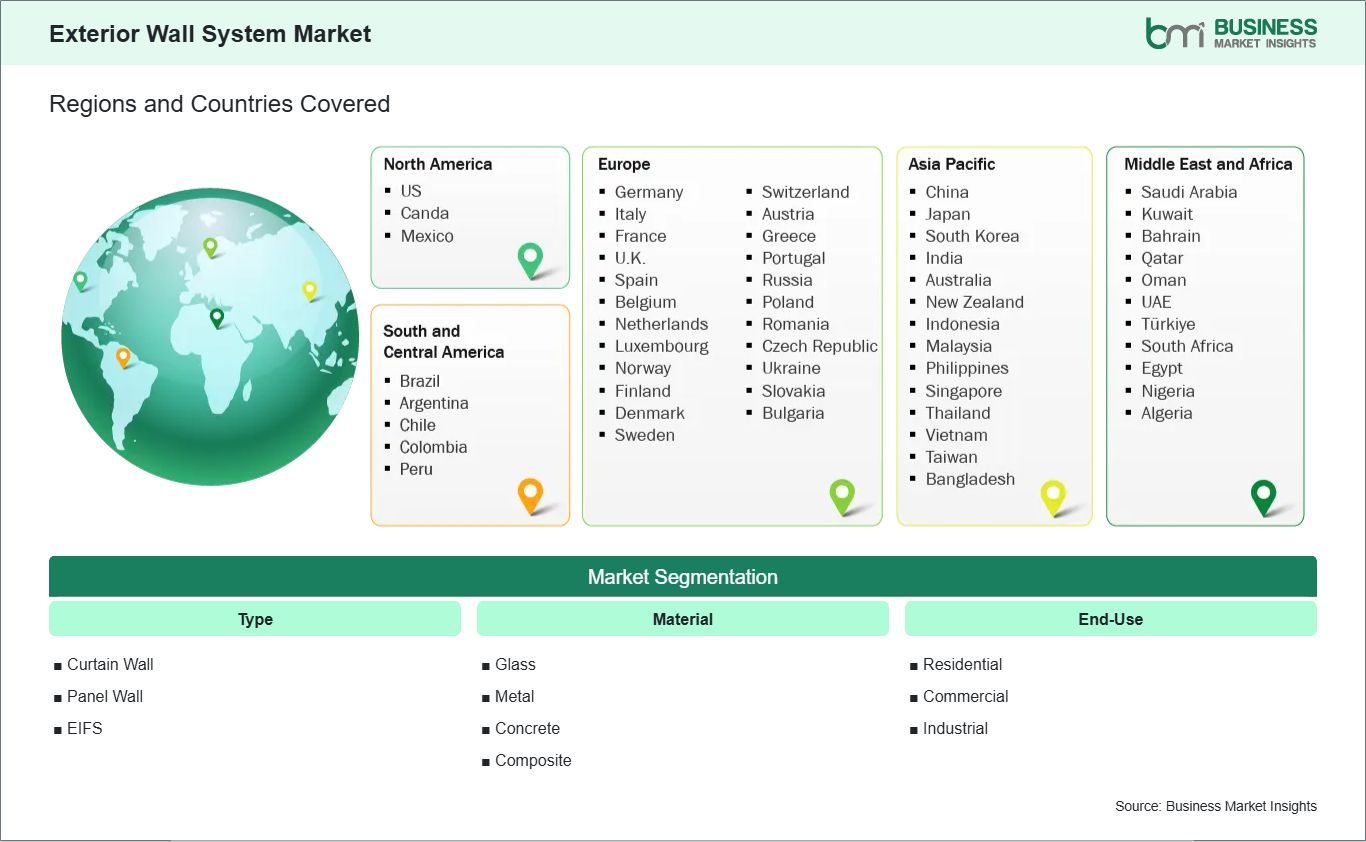
The exterior wall system market is segmented based on type, material, and end-use, reflecting the industry‘s focus on façade performance enhancement, structural efficiency improvement, and advanced building envelope solutions across residential, commercial, and industrial construction applications.
By Type
- Curtain Wall - Enables lightweight façade structures for high-rise and modern architectural designs.
- Panel Wall - Supports modular construction with faster installation and improved project efficiency.
- EIFS - Enhances thermal insulation and improves overall building energy performance.
By Material
- Glass - Provides transparency and supports contemporary architectural aesthetics in buildings.
- Metal - Delivers high structural strength and long-term façade durability performance.
- Concrete - Ensures robustness, stability, and resistance in demanding construction environments.
- Composite - Combines multiple materials to balance strength, insulation, and flexibility.
By End-Use
- Residential - Focuses on energy-efficient housing and exterior renovation applications.
- Commercial - Supports large-scale buildings requiring advanced façade performance systems.
- Industrial - Addresses durability, protection, and operational efficiency in facility structures.
Market Forces
Exterior Wall System Market Drivers and Opportunities
Rising Demand for Green Buildings
Increasing focus on energy conservation in construction is reshaping façade design priorities across residential and commercial projects. Developers are adopting exterior wall systems that improve insulation performance and reduce operational energy requirements. These systems help align building projects with environmental standards while maintaining structural reliability and architectural flexibility in diverse construction environments.
Sustainability-focused regulations are encouraging the use of high-performance building envelopes in both new developments and renovation projects. Exterior wall systems support reduced carbon impact through improved thermal regulation and material efficiency. Their integration into modern construction practices reflects growing emphasis on environmentally responsible design and long-term building performance optimization across global infrastructure development.
Smart Wall Systems Adoption
Advancements in building technologies are enabling the development of intelligent façade systems capable of supporting adaptive performance and environmental control. Smart wall solutions integrate sensors, responsive materials, and energy-efficient components that enhance building functionality. These systems are increasingly applied in commercial structures requiring real-time monitoring and optimized energy management capabilities.
Future expansion of smart façade technologies is expected to redefine exterior building design approaches. Integration of digital systems with wall assemblies allows improved energy regulation and operational efficiency. Exterior wall systems are evolving to support connected building ecosystems, enabling enhanced performance tracking and adaptive response features across modern construction environments and smart infrastructure developments.
Size and Share Analysis
Exterior Wall System Market Size and Share Analysis
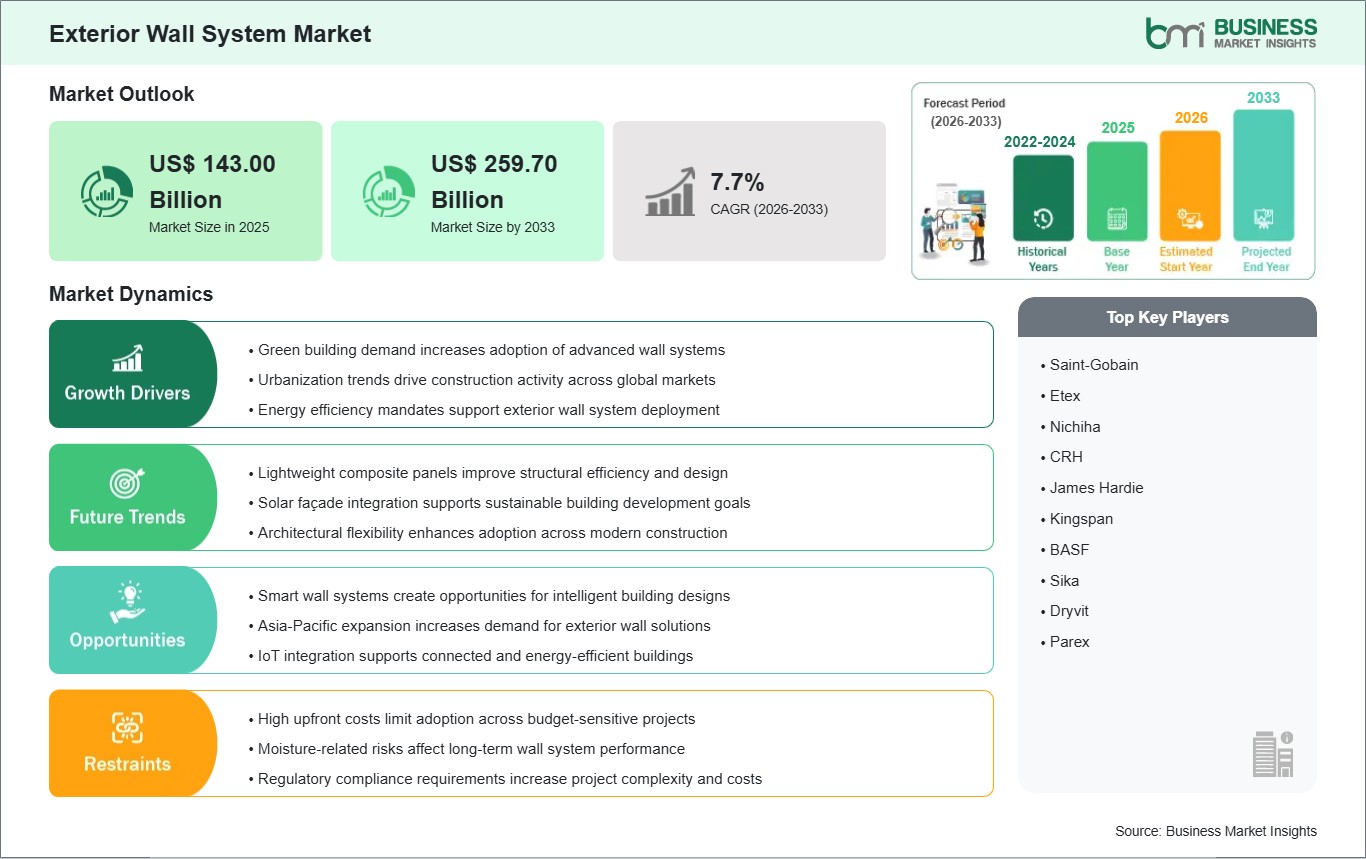
The exterior wall system market size is expected to reach US$ 143.00 billion by 2033 from US$ 259.70 billion by 2025. The market is estimated to record a CAGR of 7.7% during 2026 to 2033.
Market expansion is supported by increasing emphasis on energy-efficient building envelopes, stricter construction regulations, and rising adoption of high-performance façade systems across residential and commercial infrastructure projects. Developers are focusing on improving thermal efficiency, structural durability, and long-term building performance through advanced exterior wall solutions.
By Type, curtain wall systems account for a dominant share due to extensive use in high-rise and commercial buildings requiring lightweight structural façades and modern architectural designs. Panel wall systems maintain a steady share as they support modular construction approaches and faster project execution timelines. EIFS solutions represent a significant segment, supported by strong demand for improved thermal insulation and enhanced energy efficiency in building envelopes across diverse construction environments.
By Material, glass holds a major share driven by its widespread use in modern architectural façades emphasizing transparency and aesthetics. Metal systems maintain strong adoption due to structural strength and durability requirements in large-scale construction. Concrete continues to support stable demand in projects requiring high load-bearing capacity, while composite materials are gaining traction for their balanced performance characteristics combining strength, insulation, and design flexibility.
By End-Use, commercial applications dominate the market due to large-scale infrastructure development and demand for advanced façade systems in office complexes and institutional buildings. Residential construction holds a significant share supported by urban housing expansion and renovation activities focused on energy efficiency improvements. Industrial applications maintain steady demand where durability, protection, and operational reliability remain key priorities in facility construction and maintenance.
Report Coverage
Exterior Wall System Market Report Coverage and Deliverables
The "Exterior Wall System Market Size and Forecast (2022 - 2033)" report provides a detailed analysis of the market covering below areas:
- Market size and forecast at global, regional, and country levels for all key market segments covered under the scope
- Market trends, along with market dynamics such as drivers, restraints, and key opportunities
- Market analysis covering key trends, global and regional frameworks, major players, regulations, and recent developments
- Industry landscape and competitive analysis covering market concentration, heat map analysis, prominent players, and recent developments
- Detailed company profiles, including SWOT analysis
Geographic Insights
Exterior Wall System Market Geographic Insights
The Exterior Wall System Market shows diverse regional adoption patterns influenced by construction modernization trends, regulatory frameworks, and increasing emphasis on energy-efficient building envelopes. Global construction activity continues to evolve toward high-performance façade systems that enhance durability, thermal efficiency, and architectural flexibility across varied infrastructure projects.
North America demonstrates strong adoption supported by advanced construction technologies and emphasis on building efficiency standards. Developers increasingly integrate modern façade systems to enhance energy performance and structural reliability. Renovation projects and commercial building upgrades further support demand for exterior wall solutions across urban infrastructure development.
Asia Pacific reflects strong growth momentum driven by rapid urbanization and large-scale infrastructure expansion. Increasing residential and commercial construction activity supports wider adoption of modern façade systems. Growing focus on sustainable construction practices and improved building performance standards continues to shape market development across major regional economies.
Europe maintains a mature construction landscape with strong emphasis on energy efficiency regulations and sustainable building practices. Exterior wall systems are widely used in both new construction and renovation projects. Emerging regions across the Middle East, Africa, and South America are gradually increasing adoption as infrastructure development and urban expansion accelerate.
Industry Activity
Recent Developments
The exterior wall system market is evaluated by gathering qualitative and quantitative data post primary and secondary research, which includes important corporate publications, association data, and databases. Recent developments and news in the market include:
- In February 2026, FSi Promat announced the launch of Paraflam Ultra, a new slab-edge fire stop system for curtain wall façade interfaces, tested to EN 1364-4 and designed to provide up to 2 hours of fire resistance while maintaining movement capability in high-rise exterior wall systems, strengthening façade compartmentation safety in modern exterior wall construction.
- In April 2026, Vetrotech Saint-Gobain India announced the launch of CURTIVIA fire curtain systems, an automatic fire protection solution for open-plan buildings that integrates with large-span exterior façade openings and glazing-based exterior wall systems, tested to EN 1634-1 for fire resistance up to E120/E180 performance levels.
Trust & Transparency
Research Methodology
The market analysis combines proprietary research with secondary data from government agencies, company disclosures, regulatory filings, industry databases and expert interviews. Market estimates are validated through data triangulation, cross-market benchmarking and analyst
review.
View Full Research Methodology
Key Sources Referred:
International Energy Agency United Nations Environment Programme European Commission Directorate-General for Energy S. Department of Energy International Code Council World Green Building Council National Institute of Building Sciences American Society of Civil Engineers