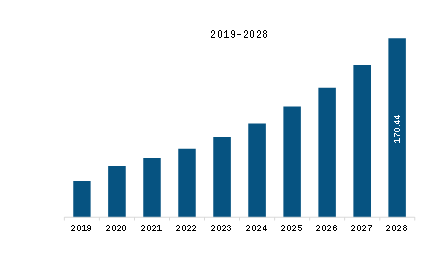
The ultra-wideband chipset market in Europe is expected to grow from US$ 56.44 million in 2021 to US$ 170.44 million by 2028; it is estimated to grow at a CAGR of 17.1% from 2021 to 2028.
UWB is the fastest-growing technology that is significantly improving consumers’ experience associated with home entertainment products, such as TV, laptop, and audio equipment. UWB enables the working of wireless connections at higher speeds, making it perfect for connecting television to home audio equipment. UWB supports less power-consuming and low-cost operations of devices. It is also being used in personal item tracking systems. For example, Apple designed a U1 chip enabled with the UWB technology for spatial awareness. It is integrated into iPhone 11, 12, and 13 series smartphones. Following Apple, various smartphone manufacturers have integrated UWB technology into their products. Moreover, in April 2021, Apple released AirTag supported by UWB, BLE, and NFC technologies, and post this, Samsung officially launched its Galaxy SmartTag+ tracker, comprising UWB and BLE technologies. SmartTag+ also enables artificial reality (AR) tracking as a part of its SmartThings service. Thus, the rising adoption of UWB technology in personal and consumer device tracking is bolstering the market growth.
The impact of COVID-19 varied from country to country across Europe, as selected countries witnessed a surge in number of confirmed cases and subsequently attracted stringent as well as longer lockdown periods or social isolation. However, western European countries such as Germany, France, Russia, and the UK witnessed a comparatively moderate decline in their production activities owing to their robust healthcare infrastructure. The European economy is expected to shrink by 0.1%, with a negative growth rate in the first half of the year 2020, followed by mild recovery in the second half of 2020. The imbalance in revenue generation of the companies and the lockdown phase in several European countries had a significant negative impact on the ultra-wideband chipset market in the first half of 2020. Factory shutdown, travel and trade bans, and border lockdown enacted by governments to combat and contain the outbreak hindered the growth of various markets in Europe. The automotive & transportation, healthcare, and consumer electronic sectors faced disruptions due to the shutdown of businesses. However, UWB is being projected highly for its high accuracy in contact tracing amid the COVID-19 outbreak. Thus, the overall impact of COVID-19 on the European region is low to moderate.
With the new features and technologies, vendors can attract new customers and expand their footprints in emerging markets. This factor is likely to drive the ultra-wideband chipset market in Europe during the forecast period.
Europe Ultra-Wideband Chipset Market Revenue and Forecast to 2028 (US$ Million)
Europe Ultra-Wideband Chipset Market Segmentation
Europe Ultra-Wideband Chipset Market – byApplication
RTLS
Imaging
Communication
Europe Ultra-Wideband Chipset Market – by End User
Manufacturing
Retail
Automotive
Healthcare
Consumer electronics
Europe Ultra-Wideband Chipset Market - by Country
Germany
France
Italy
UK
Rest of Europe
Europe Ultra-Wideband Chipset Market – Companies Mentioned
Apple Inc.
BeSpoon SAS
Decawave.
Johanson Technology
Novelda AS
NXP Semiconductors
Taiyo Yuden Co., Ltd.
Taoglas
Europe Ultra-Wideband Chipset Market Strategic Insights
Get more information on this report
Europe Ultra-Wideband Chipset Market Segmentation Analysis
Europe Ultra-Wideband Chipset Market Report Highlights
Europe Ultra-Wideband Chipset Report Scope
Report Attribute
Details
Market size in 2021
US$ 56.44 Million
Market Size by 2028
US$ 170.44 Million
CAGR (2021 - 2028)
17.1%
Historical Data
2019-2020
Forecast period
2022-2028
Segments Covered
By Application
RTLS
Imaging
Communication
By End User
Manufacturing
Retail
Automotive
Healthcare
Consumer Electronics
Regions and Countries Covered
Europe
UK, Germany, France, Russia, Italy, Rest of Europe
Market leaders and key company profiles
Apple Inc.
BeSpoon SAS
Decawave.
Johanson Technology
Novelda AS
NXP Semiconductors
Taiyo Yuden Co., Ltd.
Taoglas
Get more information on this report
Europe Ultra-Wideband Chipset Market Country and Regional Insights
Get more information on this report
Identical Market Reports with other Region/Countries
The List of Companies - Europe Ultra-Wideband Chipset Market
Apple Inc.BeSpoon SASDecawave.Johanson TechnologyNovelda ASNXP SemiconductorsTaiyo Yuden Co., Ltd.Taoglas
About Author— Electronics and Semiconductor Research Team
Siddhika is an experienced market research professional with over five years of expertise in delivering actionable market intelligence and strategic insights to support business growth and decision-making. She has strong experience in designing and managing end-to-end research engagements, including research planning, data collection, and insight generation.
Proficient in research methodologies, Siddhika synthesizes diverse information sources to deliver accurate, high-quality insights and strategic recommendations. She excels at translating complex market information into strategic narratives that support executive decision-making..
Show More
Frequently Asked Questions
How big is the Europe Ultra-Wideband Chipset Market?
The Europe Ultra-Wideband Chipset Market is valued at US$ 56.44 Million in 2021, it is projected to reach US$ 170.44 Million by 2028.
What is the CAGR for Europe Ultra-Wideband Chipset Market by (2021 - 2028)?
As per our report Europe Ultra-Wideband Chipset Market, the market size is valued at US$ 56.44 Million in 2021, projecting it to reach US$ 170.44 Million by 2028. This translates to a CAGR of approximately 17.1% during the forecast period.
What segments are covered in this report?
The Europe Ultra-Wideband Chipset Market report typically cover these key segments-
Application (RTLS, Imaging, Communication)
End User (Manufacturing, Retail, Automotive, Healthcare, Consumer Electronics)
What is the historic period, base year, and forecast period taken for Europe Ultra-Wideband Chipset Market?
The historic period, base year, and forecast period can vary slightly depending on the specific market research report. However, for the Europe Ultra-Wideband Chipset Market report:
Historic Period : 2019-2020
Base Year : 2021
Forecast Period : 2022-2028
Who are the major players in Europe Ultra-Wideband Chipset Market?
The Europe Ultra-Wideband Chipset Market is populated by several key players, each contributing to its growth and innovation. Some of the major players include:
Apple Inc.
BeSpoon SAS
Decawave.
Johanson Technology
Novelda AS
NXP Semiconductors
Taiyo Yuden Co., Ltd.
Taoglas
Who should buy this report?
The Europe Ultra-Wideband Chipset Market report is valuable for diverse stakeholders, including:
Investors: Provides insights for investment decisions pertaining to market growth, companies, or industry insights. Helps assess market attractiveness and potential returns.
Industry Players: Offers competitive intelligence, market sizing, and trend analysis to inform strategic planning, product development, and sales strategies.
Suppliers and Manufacturers: Helps understand market demand for components, materials, and services related to concerned industry.
Researchers and Consultants: Provides data and analysis for academic research, consulting projects, and market studies.
Financial Institutions: Helps assess risks and opportunities associated with financing or investing in the concerned market.
Essentially, anyone involved in or considering involvement in the Europe Ultra-Wideband Chipset Market value chain can benefit from the information contained in a comprehensive market report.






 Get Free Sample For Europe Ultra-Wideband Chipset Market