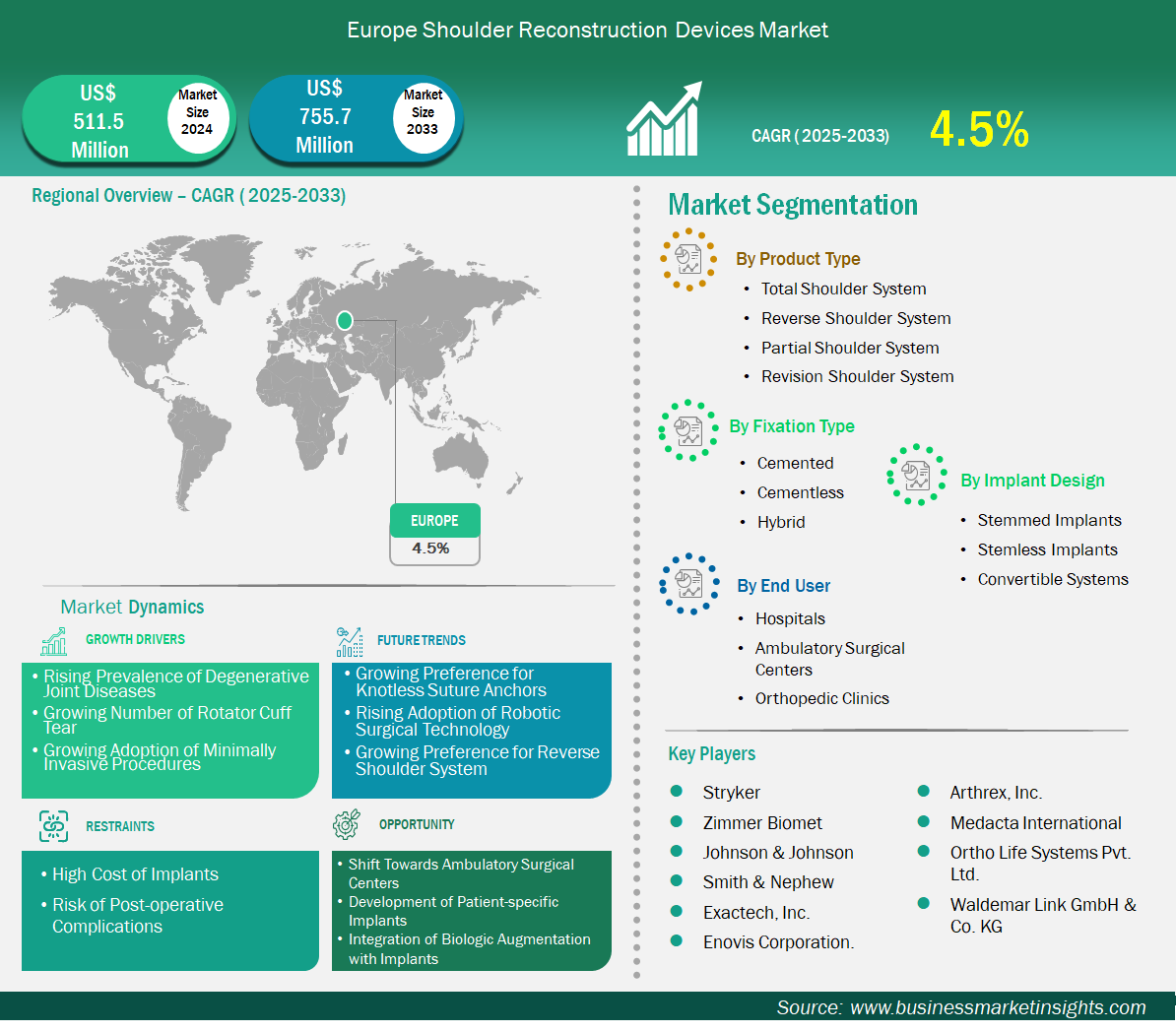
The Europe shoulder reconstruction devices market size is expected to reach US$ 755.7 million by 2033 from US$ 511.5 million in 2024. The market is estimated to record a CAGR of 4.5% from 2025 to 2033.
Executive Summary and Europe Shoulder Reconstruction Devices Market Analysis:
The Europe shoulder reconstruction devices market is steadily advancing as orthopedic care becomes more specialized across the region. Hospitals and clinics are adopting advanced implants to manage trauma, arthritis, and degenerative shoulder conditions. International manufacturers are expanding their presence through collaborations, while local firms emphasize affordability and accessibility. Patient awareness of surgical outcomes and rehabilitation benefits is steadily improving, encouraging more elective procedures. Training initiatives for surgeons and better hospital infrastructure are helping bridge gaps in specialized care. The market reflects a blend of imported expertise and localized adaptation, with demand driven by the need for reliable devices and supportive post-surgical services. Europe continues to position itself as a leading region for orthopedic innovation and long-term growth.
Europe Shoulder Reconstruction Devices Market Segmentation Analysis:
Key segments that contributed to the derivation of the shoulder reconstruction devices market analysis are product type, fixation type, implant design, and end user.
- By product type, the shoulder reconstruction devices market is segmented into total shoulder system, reverse shoulder system, partial shoulder system, and revision shoulder system. The reverse shoulder system segment dominated the market in 2024. Its ability to restore function in rotator cuff-deficient shoulders and growing elderly population made it the preferred choice. Surgeons favor it for complex cases due to better stability and outcomes.
- By fixation type, the shoulder reconstruction devices market is segmented into cemented, cementless, and hybrid. The cementless segment dominated the market in 2024. Rising demand for biologic integration and reduced surgical time contributed to its dominance. It also lowers the risk of cement-related complications.
- By implant design, the market is segmented into stemmed implants, stemless implants and convertible systems. The stemless implants segment dominated the market in 2024. Their bone-preserving design and ease of implantation led to increased adoption. They’re especially suitable for younger, active patients.
- By end user, the market is segmented into hospitals, ambulatory surgical centers, and orthopedic clinics. The hospitals segment held the largest share of the market in 2024. Equipped with advanced surgical facilities and specialized staff, hospitals handle the majority of shoulder reconstruction procedures. Their capacity for post-operative care also attracts more patients.
Europe Shoulder Reconstruction Devices Market Outlook
Europe's shoulder reconstruction industry is steadily evolving, driven primarily by demographic changes and a commitment to high standards of health care. With an increase in age-related joint issues - particularly osteoarthritis and fractures - along with increased life expectancy and active lifestyles, there is an increase in demand for shoulder solutions that are durable and effective. Hospitals throughout the region are equipped with the latest surgical technology, and there is a high level of training and professional expertise in orthopedic departments. The use of different types of implants, including cemented, cementless, and hybrid options, supports a variety of individual treatment options based on patient-specific needs. Germany remains a key contributor to regional trends, in particular with the introduction of new devices and professional training. Patients are becoming more educated and are opting for surgery earlier in the disease trajectory. The market is also supported by good reimbursement policies and collaboration between hospitals and different medical device companies looking to introduce new technologies to market and improve patient care. Overall, these factors have built Europe to be one of the dominant market and continue to leverage technology, professional expertise, and patient-centered care.
Europe Shoulder Reconstruction Devices Market Country Insights
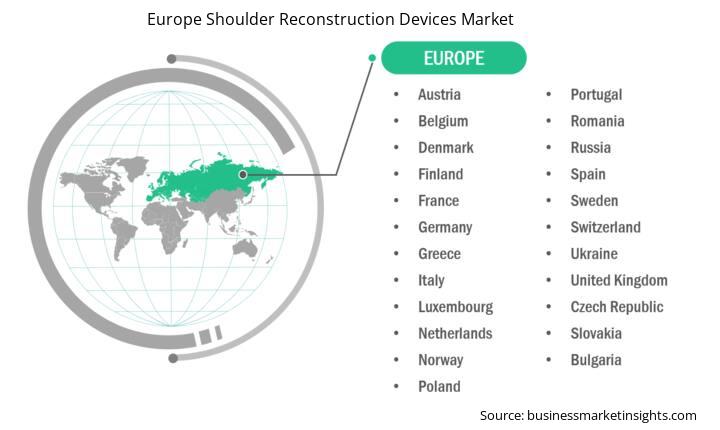
Based on country, the Europe shoulder reconstruction devices market is further segmented into the Germany, Italy, France, U.K., Spain, Belgium, the Netherlands, Luxembourg, Norway, Finland, Denmark, Sweden, Austria, Switzerland, Russia, Romania, Greece, Czech Republic, Portugal, Ukraine, Poland, Slovakia and Bulgaria. Germany held the largest share in 2024.
Germany leads the European shoulder reconstruction devices market largely due to its advanced orthopedic infrastructure, high number of shoulder replacement surgeries, and the overall quality of healthcare. The country has specialized orthopedic hospitals, which often become reference centers for clinical trials and technology evaluations. Surgeons in Germany are among the first to use robotic and computer-assisted reconstruction systems, thereby helping to set procedural standards throughout Europe. The country's solid reimbursement system enables patients to have access to top-class implants and post-operative care. Both local distributors and multinational manufacturers maintain close relationships with hospitals through the provision of education, maintenance, and research collaborations. Germany's leadership position is being supported continuously through investment in digital health and precision surgery tools. With an aging yet active population, demand for shoulder reconstruction remains stable, backed by a strong culture of medical excellence and patient-centered care.
Europe Shoulder Reconstruction Devices Market Company Profiles
Stryker, Zimmer Biomet, Johnson & Johnson, Smith & Nephew, Exactech, Inc., Enovis Corporation, Arthrex, Inc., Medacta International, Ortho Life Systems Pvt. Ltd. and Waldemar Link GmbH & Co. KG are among the key players operating in the market. These players adopt strategies such as expansion, product innovation, and mergers and acquisitions to stay competitive in the market and offer innovative products to their consumers.
Europe Shoulder Reconstruction Devices Market Research Methodology:
The following methodology has been followed for the collection and analysis of data presented in this report:
Secondary Research
The research process begins with comprehensive secondary research, utilizing both internal and external sources to gather qualitative and quantitative data for each market. Commonly referenced secondary research sources include, but are not limited to:
- Company websites, annual reports, financial statements, broker analyses, and investor presentations
- Industry trade journals and other relevant publications
- Government documents, statistical databases, and market reports
- News articles, press releases, and webcasts specific to companies operating in the market
Note: All financial data included in the Company Profiles section has been standardized to US$. For companies reporting in other currencies, figures have been converted to US$ using the relevant exchange rates for the corresponding year.
Primary Research
Business Market Insights conducts a significant number of primary interviews each year with industry stakeholders and experts to validate and analyze the data and gain valuable insights. These research interviews are designed to:
- Refine findings from secondary research
- Enhance the expertise and market understanding of the analysis team
- Gain insights into market size, trends, growth patterns, competitive dynamics, and future prospects
Primary research is conducted via email interactions and telephone interviews with industry experts across various markets, categories, segments, and sub-segments in different regions. Participants typically include:
- Industry stakeholders: Vice Presidents, business development managers, market intelligence managers, and national sales managers
- External experts: Valuation specialists, research analysts, and key opinion leaders with industry-specific expertise
Key Sources Referred:
- The World Bank
- World Health Organization (WHO)
- Center for Disease Control and Prevention (CDC)
- American Academy of Orthopedic Surgeons
- American Orthopedic Association
- The World Orthopedic Organization
- Company website
- Company annual reports
- Company investor presentations
Europe Shoulder Reconstruction Devices Market Strategic Insights
Europe Shoulder Reconstruction DevicesMarket Report Highlights
| Report Attribute | Details |
| Market size in 2024 | US$ 511.5 Million |
| Market Size by 2033 | US$ 755.7 Million |
| CAGR (2025 - 2033) | 4.5% |
| Historical Data | 2022-2023 |
| Forecast period | 2025-2033 |
| Segments Covered |
By Product Type
|
|
Regions and Countries Covered
|
|
| Europe | Germany, Italy, France, U.K., Spain, Belgium, Netherlands, Luxembourg, Norway, Finland, Denmark, Sweden, Switzerland, Austria, Greece, Portugal, Russia, Poland, Romania, Czech Republic, Ukraine, Slovakia, Bulgaria |
| Market leaders and key company profiles |
|
Europe Shoulder Reconstruction Devices Market Country and Regional Insights