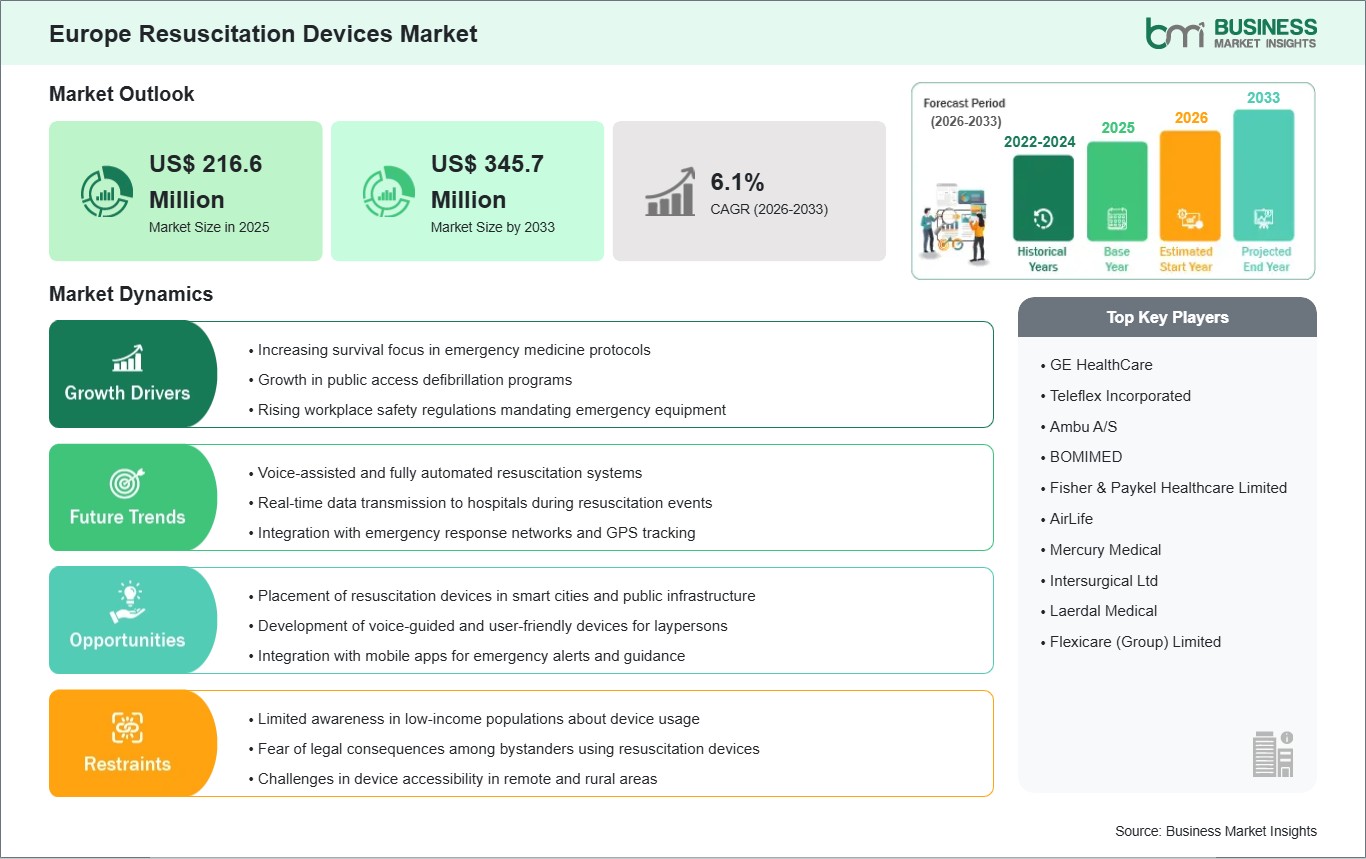
The Europe resuscitation devices market size is expected to reach US$ 345.7 million by 2033 from US$ 216.6 million in 2025. The market is estimated to record a CAGR of 6.1 % from 2026 to 2033.
The European market for resuscitation equipment includes very efficient healthcare systems, strict regulation, and an increasing interest in safety and emergency care. The leading countries of Europe in the use of resuscitation equipment are Germany, France, the UK, Italy, and Spain. In particular, Germany is the leader in this market because of the highly developed hospitals and use of modern medical equipment in it. The European market growth factors include heightened awareness about sudden cardiac arrests, the increase in surgical and urgent intervention operations, and an increased focus on integrating life-saving devices into hospitals and pre-hospital settings. In recent years, a rise in the use of sophisticated resuscitation devices has been observed across Europe. These include automatic external defibrillators (AEDs), manual defibrillators, CPR mechanical devices, and advanced monitoring devices with feedback options. The market restraints have been identified, which include the high cost of devices, strict regulatory requirements, and need for continuous training of healthcare personnel. Smaller hospitals or rural clinics might be unable to invest in such solutions owing to financial limitations. However, Europe is a mature and technologically driven market, with several government and private initiatives promoting such devices.

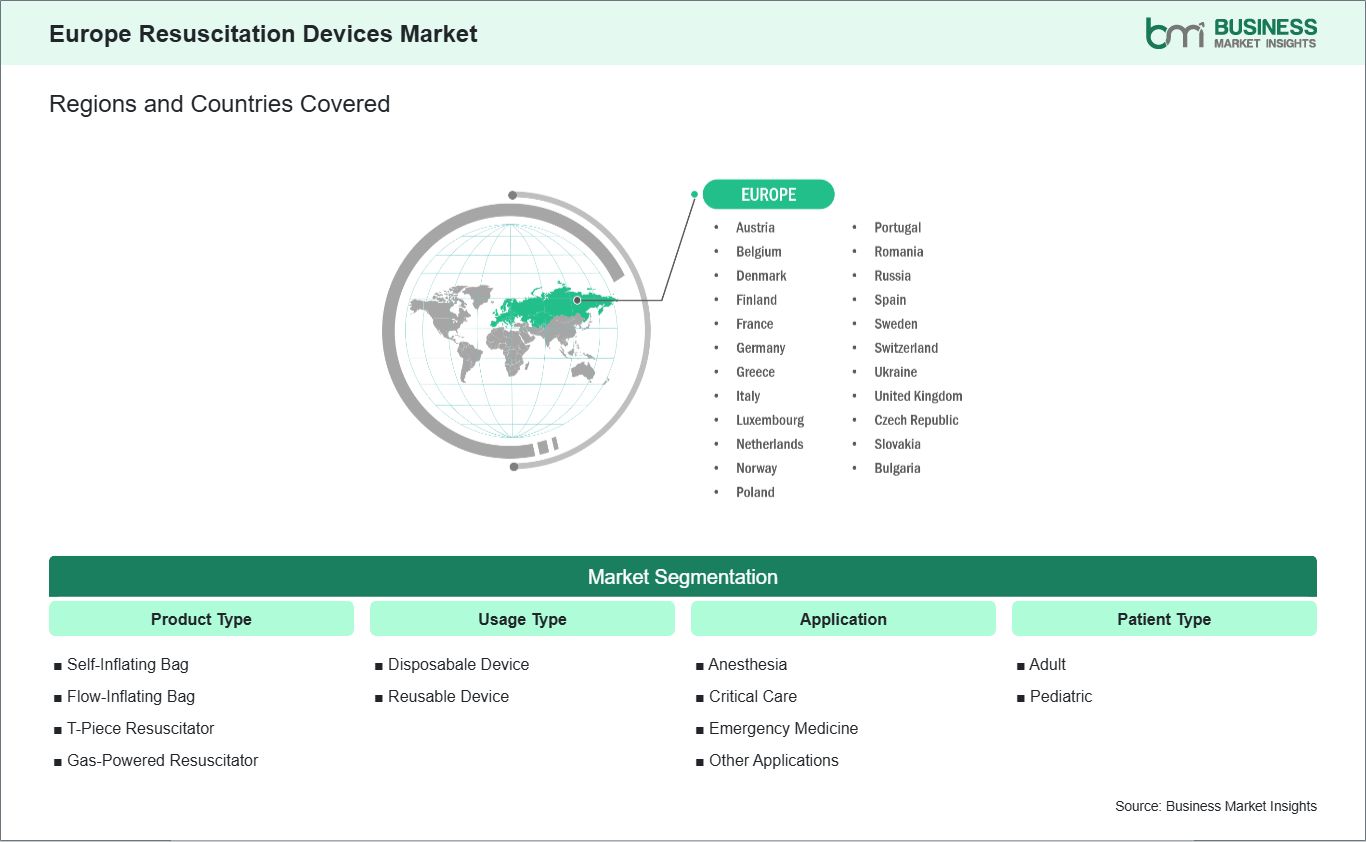
Key segments that contributed to the derivation of the Europe resuscitation devices marketanalysis are product type, usage type, application, patient type, and end user.
There are several factors stimulating growth in the market for resuscitation devices in Europe. For example, there has been an increasing recognition of the importance of protocols for survival-oriented emergency medicine. Nations like Germany, France, and Sweden have begun to update their pre-hospital and hospital-based cardiac arrest guidelines to emphasize the need for rapid response and effective resuscitation techniques. Resuscitation equipment must include advanced resuscitation devices, which include automatic external defibrillators, feedback devices, and even portable ventilators.
The United Kingdom has seen increasing emphasis on resuscitation in national campaigns such as “The Chain of Survival” concept. Urban regions in London and Manchester have increased their use of portable, multipurpose devices for delivering defibrillation and ventilation in pre-hospital care situations. Meanwhile, hospitals are supplementing this by offering ongoing training sessions to first aiders, with the aim of early identification and effective deployment of the resuscitation kit to improve survival rates.
Similarly, Southern European nations like Italy and Spain have implemented strategic plans following an increase in cardiac arrest cases, which have been attributed to demographic changes in the region as well as associated medical conditions due to a sedentary lifestyle. Coordination between post-resuscitation care and high dependency units has been achieved to ensure proper follow-up treatment for patients. Devices able to monitor patient feedback and record data play an important role in decision-making for medical practitioners. Generally, the region’s emphasis on survival rates is likely to boost demand for resuscitation equipment.
It can be observed that there is a growing phenomenon of strategic placement of resuscitation kits in Europe’s public utility infrastructure. In cities like Copenhagen, Amsterdam, and Berlin, AEDs are being placed in busy spots such as train stations, airports, stadiums, and city halls. There is usually a connection of such machines with digital interfaces that trigger alerts to nearby personnel trained in first aid in case of sudden heart failure. Thus, a network is built for emergency response to heart attacks outside hospitals.
The governments of Nordic nations are testing smart AED systems involving GPS-enabled equipment combined with mobile applications. In the event of cardiac arrest, the application alerts first responders and helps them locate the closest device. Thanks to such integration, the need for devices that can be integrated with IoT technology and deployed in public spaces has grown.
Similarly, Southern European cities such as Barcelona and Milan have started deploying such public programs for AED equipment as part of their public health efforts. Municipal authorities not only deploy devices; they train citizens, students, and staff of public institutions in using this equipment. In addition to increasing community involvement in the issue, such an approach allows creating a stable market for resuscitation devices designed for use in public spaces. Due to the growing popularity of smart city initiatives throughout Europe, the introduction of resuscitation technology is becoming a key market driver.

The Europe resuscitation devices marketis experiencing steady growth, with market size and share analysis reflecting evolving treatment preferences and competitive dynamics among key players. The report evaluates important subsegments categorized within product type, usage type, application, patient type, and end user, highlighting their respective contributions to overall market performance.
By product type, the self-inflating Bag subsegment dominated the market in 2025, as they are easy to use and do not require external gas or power sources, making them ideal for emergencies. They allow precise manual control of ventilation, which is crucial in critical care. Their portability makes them suitable for both hospital wards and transport situations.
Based on usage type, the disposable devices subsegment dominated the market in 2025 due to their ability to prevent cross-contamination and infection. They eliminate the need for complex sterilization processes, saving time and reducing operational costs. In high-volume hospital settings, disposables improve workflow efficiency. This makes them highly preferred in emergency rooms, ICUs, and surgical units.
On the basis of application, the anesthesia subsegment dominated the market in 2025, as resuscitation devices are essential for safe ventilation during induction and recovery. They provide backup support if mechanical ventilators fail. Their precise control helps manage patients with varying lung compliances. Hospitals rely on these devices to prevent hypoxia and ensure patient safety during surgeries.
In terms of patient type, the adult subsegment dominated the market in 2025, as they experience more surgical procedures and critical emergencies than pediatric populations. Their larger lung capacity requires devices designed for adult ventilation. High prevalence of cardiac and respiratory conditions in adults increases usage frequency.
Based on end user, the hospitals subsegment dominated the market in 2025 due to constant emergency and surgical care needs. ICUs, operating rooms, and emergency departments require rapid access to resuscitation devices. High patient volume and stringent safety protocols make hospitals the key market driver. Their centralized procurement and standardized protocols ensure widespread device adoption.
| Report Attribute | Details |
|---|---|
| Market size in 2025 | US$ 216.6 Million |
| Market Size by 2033 | US$ 345.7 Million |
| CAGR (2026 - 2033) | 6.1% |
| Historical Data | 2022-2024 |
| Forecast period | 2026-2033 |
| Segments Covered | By Product Type
|
|
Regions and Countries Covered
| |
| Europe | Germany, Italy, France, U.K., Spain, Belgium, Netherlands, Luxembourg, Norway, Finland, Denmark, Sweden, Switzerland, Austria, Greece, Portugal, Russia, Poland, Romania, Czech Republic, Ukraine, Slovakia, Bulgaria |
| Market leaders and key company profiles |
|
The "Europe Resuscitation Devices Market Size And Forecast (2022–2033)" report provides a detailed analysis of the market covering below areas:
The geographical scope of the Europe Resuscitation devices marketreport is divided into: Germany, Italy, France, the UK, Spain, Belgium, the Netherlands, Luxembourg, Norway, Finland, Denmark, Sweden, Austria, Switzerland, Russia, Romania, Greece, the Czech Republic, Portugal, Ukraine, Poland, Slovakia, and Bulgaria. Germany held the largest share in 2025.
Germany is the leading in Europe region for resuscitation devices owing to its advanced healthcare system, emphasis on clinical accuracy, and readiness in terms of emergencies. The hospitals located in big cities like Berlin, Munich, and Frankfurt boast several varieties of resuscitation tools, including smart defibrillators, CPR machines, and portable resuscitation devices which can be used both in and out of hospitals. One factor that enables Germany to have a competitive advantage in the market is the combination of technological advancements and continuous professional training. Medical professionals such as anesthesiologists, ICU staff members, and emergency responders attend simulation sessions to enhance their knowledge of resuscitation techniques and devices. Furthermore, pre-hospital emergency services are well-coordinated, with ambulances having high-end resuscitation devices to address patients’ cardiovascular and pulmonary emergencies prior to arriving at the hospitals. The presence of robust domestic production capacity and international collaboration with medical device manufacturers guarantees Germany a steady supply of cutting-edge resuscitation devices. The country, therefore, takes center stage in Europe’s resuscitation devices market due to standardized clinical guidelines, extensive public awareness initiatives, and innovations in emergency care technologies.

The Europe Resuscitation devices marketis evaluated by gathering qualitative and quantitative data post primary and secondary research, which includes important corporate publications, association data, and databases. A few of the key developments in the Europe Resuscitation devices marketare:
The Europe Resuscitation Devices Market is valued at US$ 216.6 Million in 2025, it is projected to reach US$ 345.7 Million by 2033.
As per our report Europe Resuscitation Devices Market, the market size is valued at US$ 216.6 Million in 2025, projecting it to reach US$ 345.7 Million by 2033. This translates to a CAGR of approximately 6.1% during the forecast period.
The Europe Resuscitation Devices Market report typically cover these key segments-
The historic period, base year, and forecast period can vary slightly depending on the specific market research report. However, for the Europe Resuscitation Devices Market report:
The Europe Resuscitation Devices Market is populated by several key players, each contributing to its growth and innovation. Some of the major players include:
The Europe Resuscitation Devices Market report is valuable for diverse stakeholders, including:
Essentially, anyone involved in or considering involvement in the Europe Resuscitation Devices Market value chain can benefit from the information contained in a comprehensive market report.
Please tell us your area of interest
(Market Segments/ Regions and Countries/ Companies)