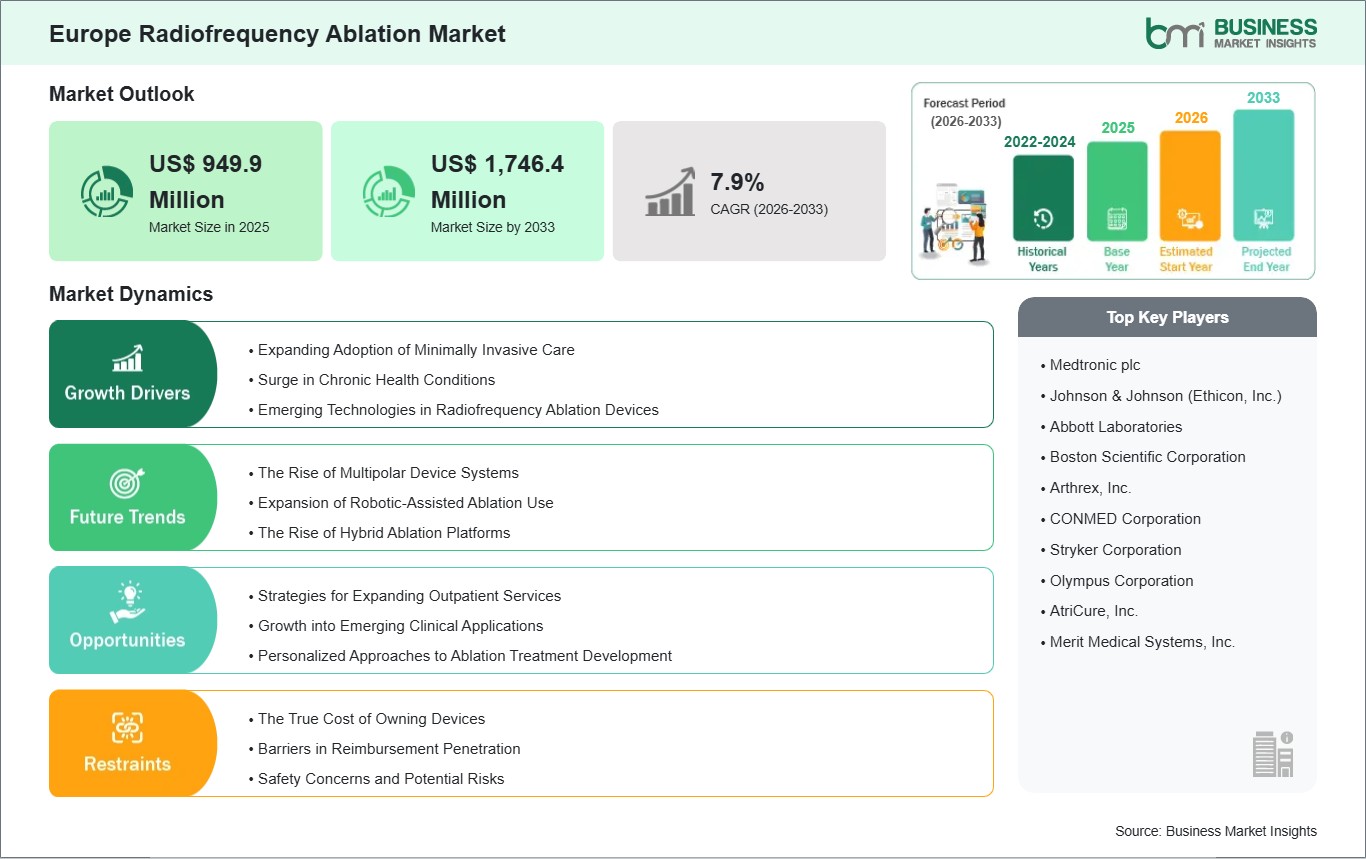
The Europe radiofrequency ablation market size is expected to reach US$ 1,746.4 million by 2033 from US$ 949.9 million in 2025. The market is estimated to record a CAGR of 7.9% from 2026 to 2033.
The Europe radiofrequency ablation (RFA) market represents a mature and innovation-driven landscape, supported by advanced healthcare systems and strong clinical adoption of minimally invasive technologies. Across the region, RFA is utilized in cardiology for arrhythmia management, in oncology for liver, lung, and kidney tumor ablation, and in pain management for chronic musculoskeletal and neuropathic conditions. The region’s emphasis on evidence-based medicine and structured clinical guidelines has facilitated the integration of RFA into standardized treatment pathways. Additionally, strong collaboration between academic institutions, research centers, and medical device manufacturers fosters continuous technological refinement and procedural improvements.
Key drivers include an aging population, rising prevalence of cardiovascular diseases and cancer, and increasing preference for outpatient or short-stay procedures. Several European healthcare systems are focused on optimizing hospital efficiency, and RFA aligns well with this objective due to reduced recovery times compared to open surgery. However, market expansion is moderated by strict regulatory requirements under regional medical device frameworks and cost-containment pressures within public healthcare systems. Reimbursement variations among countries and careful health technology assessments can delay the uptake of newer ablation platforms. Despite these constraints, Europe remains an advanced and clinically sophisticated market for radiofrequency ablation.

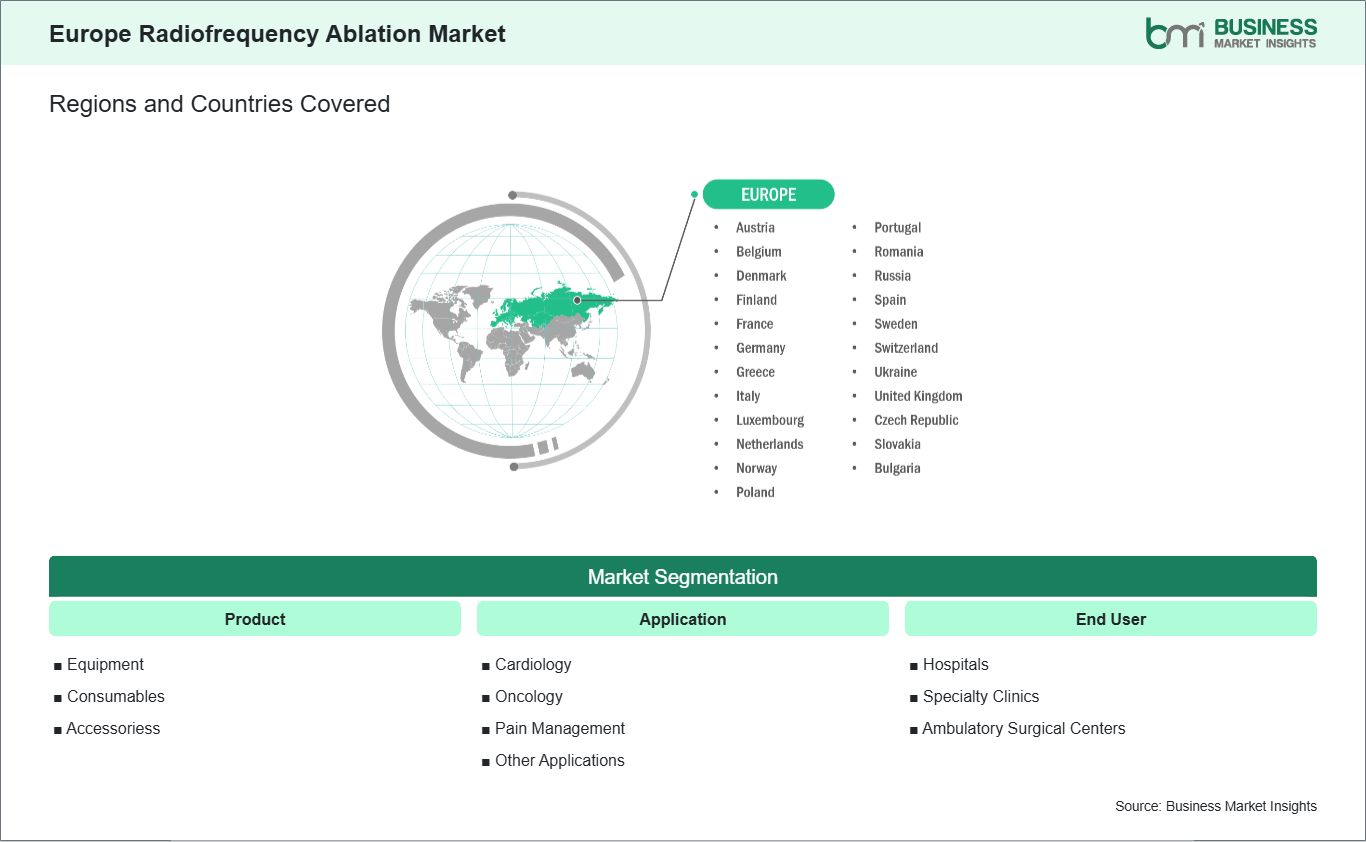
Key segments that contributed to the derivation of the Europe radiofrequency ablation market analysis are product type, application, and end user.
Europe represents one of the more mature markets for radiofrequency ablation (RFA), driven by strong clinical acceptance of minimally invasive therapies across cardiology, oncology, and pain management. The region’s aging population and high prevalence of chronic diseases, including atrial fibrillation and solid tumors, are accelerating the demand for targeted ablation procedures. Healthcare systems are emphasizing early intervention and reduced surgical burden, positioning RFA as a preferred alternative to conventional open surgery in appropriate cases.
Advanced hospital infrastructure and widespread availability of electrophysiology laboratories have supported consistent growth in catheter-based cardiac ablation procedures across Western and Northern Europe. In addition, oncology centers are incorporating image-guided RFA for liver, lung, and renal tumors as part of multimodal cancer treatment strategies. Clinical guideline endorsements and strong participation in cross-border research initiatives have reinforced physician confidence in minimally invasive techniques, promoting standardized adoption across member states.
Patients seek procedures that minimize hospitalization time and lower complication risks, particularly within publicly funded healthcare systems, aiming to improve efficiency. While cost-containment policies remain influential, the long-term health economic benefits of reduced readmission rates and shorter recovery periods are supporting sustained uptake of RFA technologies across the region.
The expansion of outpatient services is a central strategy shaping the Europe radiofrequency ablation market. Healthcare policymakers and providers are prioritizing ambulatory care models to reduce inpatient bed occupancy and optimize resource allocation. As a minimally invasive procedure with short recovery times, RFA is well-suited for outpatient and day-case settings, particularly for cardiac arrhythmia management and chronic pain interventions.
Several European healthcare systems are investing in integrated care pathways that streamline patient referral, procedure scheduling, and post-operative monitoring within outpatient frameworks. Dedicated ambulatory surgical centers and hospital-based day units are equipped to perform RFA procedures safely and efficiently. Reimbursement models in several countries encourage same-day discharge where clinically appropriate, incentivizing the shift from inpatient to outpatient environments.
Despite strong infrastructure in much of the region, disparities persist between Western and parts of Central and Southern Europe regarding access to advanced ablation technologies. Workforce shortages in certain specialties may also affect outpatient expansion in specific markets. Nevertheless, ongoing investments in digital health integration, remote monitoring, and specialist training are expected to strengthen outpatient capabilities, supporting continued growth of the Europe radiofrequency ablation market over the coming years.

The Europe radiofrequency ablation market demonstrates steady growth, with size and share analysis highlighting evolving trends and competitive dynamics among key players. The report evaluates important subsegments categorized within product type, application type, and end user, highlighting their respective contributions to overall market performance.
By product type, the consumables subsegment dominated the market in 2025. This is driven by the recurring need for disposable catheters, electrodes, and other consumable components during RFA procedures, making them a key revenue driver for manufacturers and ensuring consistent demand in clinical settings.
In terms of application, the cardiology subsegment dominated the market in 2025. The leadership of cardiology applications is attributed to the rising prevalence of arrhythmias and other cardiac conditions, growing adoption of minimally invasive ablation procedures, and increasing awareness among healthcare providers about the effectiveness of RFA in managing heart rhythm disorders.
Based on end user, the hospitals subsegment dominated the market in 2025. Hospitals maintain a stronghold due to their well-established surgical and electrophysiology departments, access to advanced RFA equipment, trained cardiologists and staff, and the capability to manage complex procedures with comprehensive patient care.
| Report Attribute | Details |
|---|---|
| Market size in 2025 | US$ 949.9 Million |
| Market Size by 2033 | US$ 1,746.4 Million |
| CAGR (2026 - 2033) | 7.9% |
| Historical Data | 2022-2024 |
| Forecast period | 2026-2033 |
| Segments Covered | By Product
|
|
Regions and Countries Covered
| |
| Europe | Germany, Italy, France, U.K., Spain, Belgium, Netherlands, Luxembourg, Norway, Finland, Denmark, Sweden, Switzerland, Austria, Greece, Portugal, Russia, Poland, Romania, Czech Republic, Ukraine, Slovakia, Bulgaria |
| Market leaders and key company profiles |
|
The "Europe Radiofrequency Ablation Market Size and Forecast (2022–2033)" report provides a detailed analysis of the market covering below areas:
The geographical scope of the Europe Radiofrequency Ablation market report is divided into: Germany, Italy, France, the UK, Spain, Belgium, the Netherlands, Luxembourg, Norway, Finland, Denmark, Sweden, Austria, Switzerland, Russia, Romania, Greece, the Czech Republic, Portugal, Ukraine, Poland, Slovakia, and Bulgaria. Germany held the largest share in 2025.
Germany dominates the European RFA market, supported by its strong hospital infrastructure, extensive network of specialized cardiac and oncology centers, and robust medical device ecosystem. The country has a well-established electrophysiology landscape, with numerous centers performing catheter-based ablation for atrial fibrillation and other complex arrhythmias. In oncology, image-guided tumor ablation procedures are available in tertiary hospitals and academic medical centers, reflecting strong integration of interventional radiology into cancer care pathways. Germany’s leadership is reinforced by close collaboration between clinicians and medical technology companies, facilitating early adoption of advanced ablation systems and continuous procedural innovation. Structured physician training programs and professional societies contribute to high procedural standards and widespread clinical confidence in RFA therapies. Furthermore, the country’s decentralized hospital system allows both public and private institutions to invest in modern interventional suites, supporting broad accessibility in urban regions.
However, cost-efficiency considerations and detailed reimbursement evaluations influence procurement decisions, particularly in publicly funded facilities. While urban hospitals are well-equipped, smaller regional facilities may adopt advanced RFA systems more gradually. Germany’s strong clinical expertise, technological integration, and established reimbursement pathways position it as the leading market for radiofrequency ablation in Europe.

The Europe radiofrequency ablation market is evaluated by gathering qualitative and quantitative data post primary and secondary research, which includes important corporate publications, association data, and databases. A few of the key developments in the Europe radiofrequency ablation market are:
The Europe Radiofrequency Ablation Market is valued at US$ 949.9 Million in 2025, it is projected to reach US$ 1,746.4 Million by 2033.
As per our report Europe Radiofrequency Ablation Market, the market size is valued at US$ 949.9 Million in 2025, projecting it to reach US$ 1,746.4 Million by 2033. This translates to a CAGR of approximately 7.9% during the forecast period.
The Europe Radiofrequency Ablation Market report typically cover these key segments-
The historic period, base year, and forecast period can vary slightly depending on the specific market research report. However, for the Europe Radiofrequency Ablation Market report:
The Europe Radiofrequency Ablation Market is populated by several key players, each contributing to its growth and innovation. Some of the major players include:
The Europe Radiofrequency Ablation Market report is valuable for diverse stakeholders, including:
Essentially, anyone involved in or considering involvement in the Europe Radiofrequency Ablation Market value chain can benefit from the information contained in a comprehensive market report.
Please tell us your area of interest
(Market Segments/ Regions and Countries/ Companies)