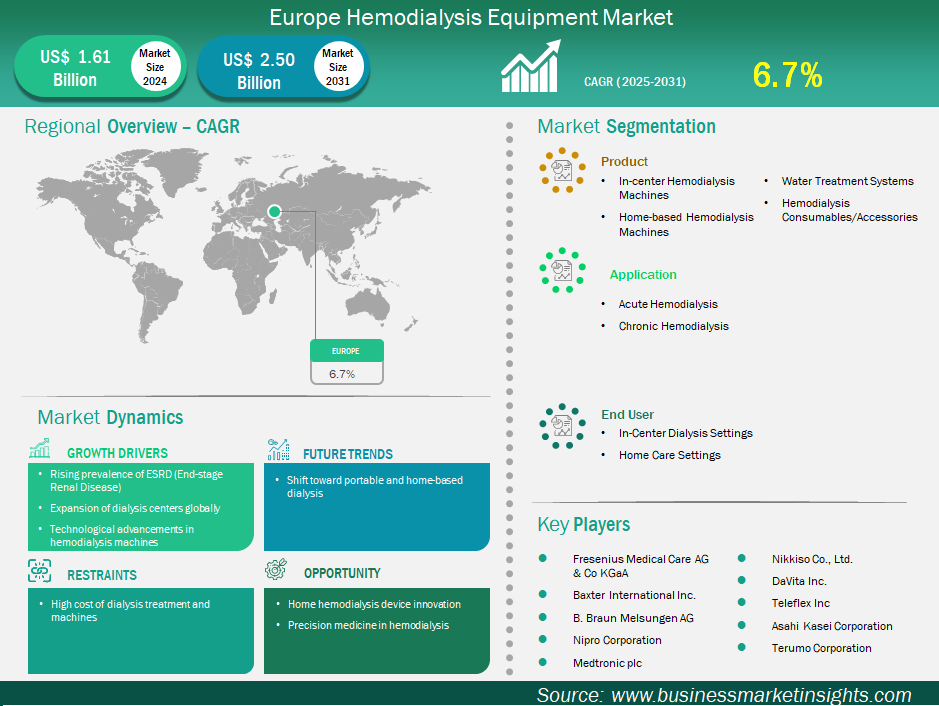
Europe hemodialysis equipment market size is expected to reach US$ 2,502.8 million by 2031 from US$ 1,605.0 million in 2024. The market is estimated to record a CAGR of 6.7% from 2025 to 2031.
Executive Summary and Europe Hemodialysis Equipment Market Analysis:
The hemodialysis equipment market in Europe is experiencing significant growth driven by rising prevalence of ESRD (End-Stage Renal Disease), expansion of dialysis centers globally, and technological advancements in hemodialysis machines. The Europe hemodialysis equipment market is a mature and highly sophisticated sector, distinguished by its robust healthcare infrastructure and strong emphasis on quality of care. The market is primarily driven by a significant and growing elderly population, which contributes to a high prevalence of chronic kidney disease (CKD) and end-stage renal disease (ESRD). The publicly funded universal healthcare systems in many European nations ensure that dialysis services are widely accessible and often free of charge for citizens, creating a stable and predictable demand for equipment. This favorable policy environment and a focus on long-term patient outcomes push the market toward adopting advanced technologies, such as high-volume hemodiafiltration (HDF) and integrated digital solutions. However, the market also faces challenges, including the high cost of advanced equipment and a shortage of skilled healthcare professionals in some countries.
Europe Hemodialysis Equipment Market Segmentation Analysis:
Key segments that contributed to the derivation of the hemodialysis equipment market analysis are product, application, and end user.
- By product, hemodialysis equipment market is segmented into in-center hemodialysis machines, home-based hemodialysis machines, water treatment systems, and hemodialysis consumables/accessories. The in-center hemodialysis machines segment dominated the market in 2024. This is the largest segment due to the widespread and well-established clinical infrastructure of hospitals and specialized clinics, which serves as the primary treatment location for the majority of patients.
- In terms of application, the market is segmented into acute hemodialysis and chronic hemodialysis. The chronic hemodialysis segment held a larger share of the market in 2024. This is a larger segment due to the high and growing prevalence of end-stage renal disease (ESRD) in Europe's aging population, which necessitates routine, long-term dialysis treatment.
- By end user, the market is segmented into in-center dialysis settings and home care settings. The in-center dialysis settings segment held a larger share of the market in 2024. This is a larger segment due to the presence of advanced equipment, professional medical supervision, and the safety and comfort offered by a controlled clinical environment.
Europe Hemodialysis Equipment Market Outlook
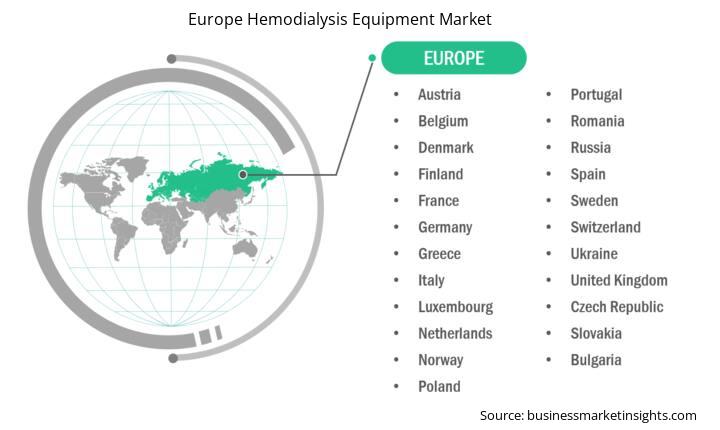
The Europe hemodialysis equipment market is segmented into Belgium, Austria, Finland, Denmark, Greece, Poland, Romania, Russia, Ukraine, Czech Republic, Slovakia, Bulgaria, Italy, Luxembourg, Germany, Switzerland, France, the Netherlands, Norway, Portugal, Spain, Sweden, and the United Kingdom. The outlook for the Europe hemodialysis equipment market is one of steady growth and a fundamental shift toward more sustainable and patient-centric care models. A key trend for the coming years is the accelerating adoption of home hemodialysis, driven by government and healthcare provider initiatives to improve patient quality of life and reduce the long-term cost burden on health systems. For instance, in March 2025, Fresenius Medical Care expanded its home hemodialysis program across Germany and the UK, offering upgraded portable machines and enhanced telemonitoring capabilities to support patient autonomy. The market will also see an increased focus on "green nephrology," with a drive to reduce the environmental impact of dialysis, which is a resource-intensive procedure. This will lead to a demand for more water- and energy-efficient machines. Furthermore, the integration of artificial intelligence and digital health platforms for predictive analytics and remote patient monitoring will become a standard, helping to optimize treatment delivery and improve patient outcomes.
Europe Hemodialysis Equipment Market Country Insights
Based on country, the Europe hemodialysis equipment market is segmented into Belgium, Austria, Finland, Denmark, Greece, Poland, Romania, Russia, Ukraine, Czech Republic, Slovakia, Bulgaria, Italy, Luxembourg, Germany, Switzerland, France, the Netherlands, Norway, Portugal, Spain, Sweden, and the United Kingdom. Germany held the largest share in 2024.
The hemodialysis equipment market in Europe encompasses different country-level dynamics. Germany is the largest and a dominant force in the European market, characterized by its advanced healthcare infrastructure and a high number of both in-center and home dialysis patients. Its market is driven by a strong focus on innovation and the presence of major global manufacturers' headquarters. In France, the market is shaped by a robust public healthcare system and a growing focus on personalized medicine and quality of life for patients. A key development in January 2025 was Diaverum’s introduction of its d. HOLISTIC digital platform in French clinics, aimed at enhancing CKD management through predictive analytics. Meanwhile, the UK market is experiencing significant pressure to reduce costs and improve efficiency, which is a major driver behind the push for home-based dialysis solutions. This has led to collaborative initiatives, such as the September 2024 pilot program between Medtronic and the national health services in Sweden and Denmark to test cloud-based monitoring for peritoneal dialysis systems.
Europe Hemodialysis Equipment Market Company Profiles
Fresenius Medical Care AG & Co KGaA, Baxter International Inc., B. Braun SE, Nipro Corp, Medtronic Plc, Nikkiso Co Ltd, Teleflex Inc, Asahi Kasei Medical Co., Ltd., Terumo Corp, and DaVita Inc., are among the key players operating in the market. These players adopt strategies such as expansion, product innovation, and mergers and acquisitions to stay competitive in the market and offer innovative products to their consumers.
Europe Hemodialysis Equipment Market Research Methodology:
The following methodology has been followed for the collection and analysis of data presented in this report:
- Secondary Research
The research process begins with comprehensive secondary research, utilizing both internal and external sources to gather qualitative and quantitative data for each market. Commonly referenced secondary research sources include, but are not limited to:
- Company websites, annual reports, financial statements, broker analyses, and investor presentations
- Industry trade journals and other relevant publications
- Government documents, statistical databases, and market reports
- News articles, press releases, and webcasts specific to companies operating in the market
Note: All financial data included in the Company Profiles section has been standardized to US$. For companies reporting in other currencies, figures have been converted to US$ using the relevant exchange rates for the corresponding year.
- Primary Research
Business Market Insights conducts a significant number of primary interviews each year with industry stakeholders and experts to validate and analyze the data and gain valuable insights. These research interviews are designed to:
- Refine findings from secondary research
- Enhance the expertise and market understanding of the analysis team
- Gain insights into market size, trends, growth patterns, competitive dynamics, and future prospects
Primary research is conducted via email interactions and telephone interviews with industry experts across various markets, categories, segments, and sub-segments in different regions. Participants typically include:
- Industry stakeholders: Vice Presidents, business development managers, market intelligence managers, and national sales managers
- External experts: Valuation specialists, research analysts, and key opinion leaders with industry-specific expertise
Key Sources Referred:
- World Health Organization (WHO)
- United States Renal Data System (USRDS)
- The World Bank Group
- Worldometer
- The Lancet
- International Trade Administration
Europe Hemodialysis Equipment Market Strategic Insights
Europe Hemodialysis EquipmentMarket Report Highlights
| Report Attribute | Details |
| Market size in 2024 | US$ 1,605.0 Million |
| Market Size by 2031 | US$ 2,502.8 Million |
| CAGR (2025 - 2031) | 6.7% |
| Historical Data | 2021-2023 |
| Forecast period | 2025-2031 |
| Segments Covered |
By Product
|
|
Regions and Countries Covered
|
|
| Europe | Germany, Italy, France, United Kingdom, Spain, Belgium, Netherlands, Luxembourg, Norway, Finland, Denmark, Sweden, Switzerland, Austria, Greece, Portugal, Russia, Poland, Romania, Czech Republic, Ukraine, Slovakia, Bulgaria |
| Market leaders and key company profiles |
|
Europe Hemodialysis Equipment Market Country and Regional Insights