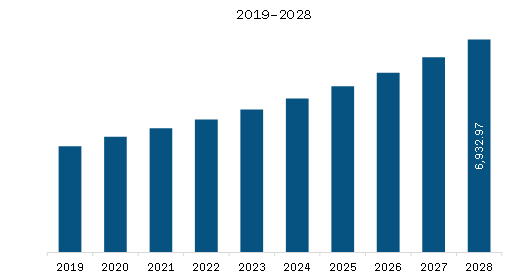
The endpoint security market in Europe is expected to grow from US$ 4,333.08 million in 2022 to US$ 6,932.97 million by 2028. It is estimated to grow at a CAGR of 8.1% from 2022 to 2028.
Widening adoption of BYOD model
The information technology infrastructure has grown more complicated and heterogeneous over the past five years due to the introduction of new platforms, BYOD (bring your own device) regulations, CYOD (choose your own device) trends, business apps, and other technologies. The trends of BYOD and CYOD are becoming common in business settings due to the rapid developments in mobile computing. As a result of these developments that are implemented by different organizations, employees can access organizational data through mobile devices from anywhere, 24/7. As customers become more tech-savvy and their lifestyles become more mobile, it is no wonder new technologies are making their way into the office. The BYOD movement is gaining popularity among both large and small enterprises. Due to the flexibility of devices, employees have a great deal of control and convenience over when and how they carry out and complete their work. A BYOD strategy can enhance not only employee morale but also productivity, creativity, communication, and cooperation. For years, even before the COVID-19 outbreak, businesses began shifting to BYOD policies. This made practical and interpersonal sense to some extent. On the practical side, users/employees operate more efficiently on their personal devices, such as laptops and mobile devices. On the interpersonal level, users feel more at ease using those technologies, which fosters positive attitudes about their work. However, as organizations adopted this more open-ended and free-form endpoint policy, they began to face additional issues. First, keeping a close eye on all of the devices connected to the network proved difficult; second, delivering a consistent layer of cybersecurity across all of the countless connecting devices was a new issue. As a result of increased cases of cyberattacks due to the adoption of BYOD models, businesses are purchasing endpoint security services to secure devices, such as smartphones, tablets, desktop computers, and laptops, that are present on office premises and those with remote access to the corporate network. The market for endpoint security is anticipated to rise due to the large increase in expenditure on endpoint security solutions and services.
Market Overview
Germany, France, the UK, Russia, and Italy are among the major economies in Europe. With the growing competitive rivalry in the regional marketplace, increasing incidence of sophisticated endpoint attacks and breaches, and proportionally surging demand for high-security solutions to combat endpoint attacks, European businesses are increasingly adopting security solutions to secure the exponentially rising number of endpoint devices. The European data strategy aims to make the European Union (EU) a leading data-driven society by creating a single market for data that allows the free flow of data among businesses, researchers, and public administrations across sectors such as healthcare, government & defense, IT & Telecom, BFSI, healthcare, education, and energy & utilities in the EU. Further, individuals and organizations will be empowered to make better decisions based on insights from non-personal data that does not contain personal identity information as the connection of endpoint devices such as mobile phones, Internet-of-things devices, laptops, tablets, and other devices to corporate networks which creates attack paths for security threats. The endpoint security solution and services also help ensure that vulnerable devices follow a definite level of compliance with standards as they have the protection software in it. Further, the Data Governance Act adopted by the European Commission in November 2020 boosts data-sharing across sectors and member states in Europe. The act also provides support for the set-up and development of common European data spaces in strategic domains of private and public companies in the healthcare, energy, environment, agriculture, finance, mobility, manufacturing, and public administration sectors, among others.
Europe Endpoint Security Market Revenue and Forecast to 2028 (US$ Million)
Based on solution, the market is segmented into antivirus, antispyware, antimalware; firewall; endpoint device control; intrusion prevention; and endpoint application control. The antivirus, antispyware, antimalware segment registered the largest market share in 2022.
Based on services, the market is segmented into consulting, training & support, and managed services. The managed services segment registered the largest market share in 2022.
Based on deployment, the market is bifurcated into cloud and on-premise. The on-premise segment registered the largest market share in 2022
Based on vertical, the market is categorized into government and defense, BFSI, retail, IT & telecom, healthcare, energy & utilities, education, and others. The IT & telecom segment held the largest market share in 2022.
Based on country, the market is segmented into France, Germany, the UK, Italy, Russia, and Rest of Europe. Germany dominated the market share in 2022.
AO Kaspersky Lab; Avast Software s.r.o.; Cisco Systems, Inc.; ESET, spol. s r.o.; Fortinet, Inc.; McAfee, LLC; Microsoft Corporation; Palo Alto Networks, Inc.; Bitdefender; and F-Secure are the leading companies operating in the endpoint security market in the region.
Europe Endpoint Security Market Strategic Insights
Get more information on this report
Europe Endpoint Security Market Segmentation Analysis
Europe Endpoint Security Market Report Highlights
Europe Endpoint Security Report Scope
Report Attribute
Details
Market size in 2022
US$ 4,333.08 Million
Market Size by 2028
US$ 6,932.97 Million
CAGR (2022 - 2028)
8.1%
Historical Data
2020-2021
Forecast period
2023-2028
Segments Covered
By Solution
Antivirus
Antispyware
Antimalware
Firewall
Endpoint Device Control
Intrusion Prevention
Endpoint Application Control
By Services
Consulting
Training & Support
Managed Services
By Deployment
Cloud
On-premise
By Vertical
Government and Defense
BFSI
Retail
IT & Telecom
Healthcare
Energy & Utilities
Education
Regions and Countries Covered
Europe
UK, Germany, France, Russia, Italy, Rest of Europe
Market leaders and key company profiles
AO Kaspersky Lab
Avast Software s.r.o.
Bitdefender
Cisco Systems, Inc.
ESET, spol. s r.o.
Fortinet, Inc.
F-Secure
McAfee, LLC
F-Secure
Microsoft Corporation
Palo Alto Networks, Inc.
Get more information on this report
Europe Endpoint Security Market Country and Regional Insights
Get more information on this report
Identical Market Reports with other Region/Countries
The List of Companies - Europe Endpoint Security Market
AO Kaspersky LabAvast Software s.r.o. Bitdefender Cisco Systems, Inc.ESET, spol. s r.o.Fortinet, Inc.F-Secure McAfee, LLCF-Secure Microsoft CorporationPalo Alto Networks, Inc.
Frequently Asked Questions
How big is the Europe Endpoint Security Market?
The Europe Endpoint Security Market is valued at US$ 4,333.08 Million in 2022, it is projected to reach US$ 6,932.97 Million by 2028.
What is the CAGR for Europe Endpoint Security Market by (2022 - 2028)?
As per our report Europe Endpoint Security Market, the market size is valued at US$ 4,333.08 Million in 2022, projecting it to reach US$ 6,932.97 Million by 2028. This translates to a CAGR of approximately 8.1% during the forecast period.
What segments are covered in this report?
The Europe Endpoint Security Market report typically cover these key segments-
Services (Consulting, Training & Support, Managed Services)
Deployment (Cloud, On-premise)
Vertical (Government and Defense, BFSI, Retail, IT & Telecom, Healthcare, Energy & Utilities, Education)
What is the historic period, base year, and forecast period taken for Europe Endpoint Security Market?
The historic period, base year, and forecast period can vary slightly depending on the specific market research report. However, for the Europe Endpoint Security Market report:
Historic Period : 2020-2021
Base Year : 2022
Forecast Period : 2023-2028
Who are the major players in Europe Endpoint Security Market?
The Europe Endpoint Security Market is populated by several key players, each contributing to its growth and innovation. Some of the major players include:
AO Kaspersky Lab
Avast Software s.r.o.
Bitdefender
Cisco Systems, Inc.
ESET, spol. s r.o.
Fortinet, Inc.
F-Secure
McAfee, LLC
F-Secure
Microsoft Corporation
Palo Alto Networks, Inc.
Who should buy this report?
The Europe Endpoint Security Market report is valuable for diverse stakeholders, including:
Investors: Provides insights for investment decisions pertaining to market growth, companies, or industry insights. Helps assess market attractiveness and potential returns.
Industry Players: Offers competitive intelligence, market sizing, and trend analysis to inform strategic planning, product development, and sales strategies.
Suppliers and Manufacturers: Helps understand market demand for components, materials, and services related to concerned industry.
Researchers and Consultants: Provides data and analysis for academic research, consulting projects, and market studies.
Financial Institutions: Helps assess risks and opportunities associated with financing or investing in the concerned market.
Essentially, anyone involved in or considering involvement in the Europe Endpoint Security Market value chain can benefit from the information contained in a comprehensive market report.





 Get Free Sample For Europe Endpoint Security Market