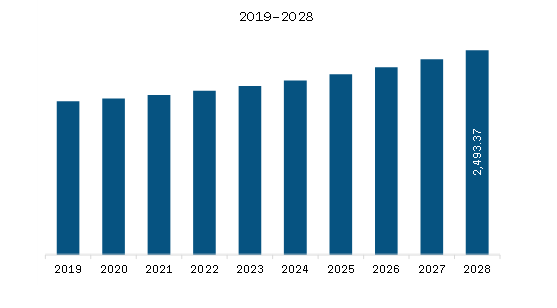
The diagnostic imaging market in Europe is expected to grow from US$ 11,168.77 million in 2021 to US$ 15,311.23 million by 2028; it is estimated to grow at a CAGR of 5.4% from 2021 to 2028.
According to the World Health Organization (WHO) report, diagnostic imaging has developed rapidly and plays a central role in healthcare by supporting the diagnosis and treatment of diseases. Diagnostic imaging services include confirming, assessing, and documenting the course of many conditions for ultimately drawing the response to treatment. The WHO collaborates with partners and manufacturers to develop a technical solution for improving the diagnostic imaging services for patients' safety. In March 2018, GE Healthcare announced launching a new diagnostic imaging product supported by AI technology and involved in quickly capturing data and reconstructing images as the product was fast approved by the FDA. The newly launched product is efficient for fast connectivity and advanced algorithm, ensuring 48 times more data throughput and ten times the processing power of the previous system. On the other hand, through the support of technological advancements, diagnostic imaging has played a crucial role in cancer diagnosis. For example, diagnostic imaging takes pictures inside of the body and has a pivotal role in diagnosing and managing cancer patients. The first method is the utilization of CT and MRI, which offers detailed information on the location, size, morphology, and structural changes of the surrounding tissues of the tumor. The second method is the utility of PET and SPECT, which offers insights related to tumor physiology with anatomical details. Combining these two methods enables the integration of anatomy and function in a single approach, and applying such "hybrid" imaging techniques allows the characterization of tumors at all stages. Additionally, integration of various diagnostic imaging techniques such as X-ray spectrometry-related techniques and methodologies can be deployed more efficiently intended for different interdisciplinary uses. With the advent of such advanced technologies, the diagnostic imaging market will grow exponentially during the forecast period.
With new features and technologies, vendors can attract new customers and expand their footprints in emerging markets. This factor is likely to drive the Europe diagnostic imaging market at a substantial CAGR during the forecast period.
Europe Diagnostic Imaging Market Revenue and Forecast to 2028 (US$ Million)
Europe Diagnostic Imaging Market Segmentation
The Europe diagnostic imaging market is segmented based on modality, application, end user, and country. Based on modality, the market is segmented into X-ray, computed tomography, endoscopy, ultrasound, magnetic resonance imaging (MRI), nuclear, imaging, mammography, and others. In 2021, the computed tomography segment held a larger share of the market. And it is also expected to register a higher CAGR during the forecast period. Based on application, the Europe diagnostic imaging market is segmented into cardiology, oncology, neurology, orthopedics, gastroenterology, obstetrics/gynecology, and others. The cardiology segment held the largest market share in 2021 and oncology is expected to register the highest CAGR in the market during the forecast period. Based on end user, the market is segmented into hospitals and clinics, diagnostic imaging centers, ambulatory surgical centers (ASCs), others. In 2021, the hospitals and clinics segment held the largest market share. However, the diagnostic imaging centers segment is expected to register the highest CAGR during the forecast period. Based on country, the Europe diagnostic imaging market is segmented into Germany, the UK, France, Italy, Spain, and the Rest of Europe. In 2021, Germany held the largest market share. It is also expected to register the highest CAGR during the forecast period.
General Electric Company; Siemens Healthineers; Koninklijke Philips N.V.; KARL STORZ SE & Co. KG; FUJIFILM Holdings Corporation; Canon Inc.; Hologic, Inc.; Carestream Health Inc.; Stryker Corporation; and Olympus Corporation are among the leading companies in the Europe diagnostic imaging market.
Europe Diagnostic Imaging Market Strategic Insights
Get more information on this report
Europe Diagnostic Imaging Market Segmentation Analysis
Europe Diagnostic Imaging Market Report Highlights
Europe Diagnostic Imaging Report Scope
Report Attribute
Details
Market size in 2021
US$ 11,168.77 Million
Market Size by 2028
US$ 15,311.23 Million
CAGR (2021 - 2028)
5.4%
Historical Data
2019-2020
Forecast period
2022-2028
Segments Covered
By Device
Electrocardiography
Pacemaker
Stent
Defibrillator
Cardiac Catheter
Guidewire
Heart Valve
Event Monitor
By Application
Coronary Heart Disease
Sudden Cardiac Arrest
Stroke
Cerebrovascular Heart Disease
By End-User
Hospitals
Ambulatory Surgery Centers
Cardiac Centers
Regions and Countries Covered
Europe
UK, Germany, France, Russia, Italy, Rest of Europe
Market leaders and key company profiles
General Electric Company
Siemens Healthineers
Koninklijke Philips N.V.
KARL STORZ SE & Co. KG
FUJIFILM Holdings Corporation
Canon Inc.
Hologic, Inc.
Carestream Health Inc.
Stryker Corporation
Olympus Corporation
Get more information on this report
Europe Diagnostic Imaging Market Country and Regional Insights
Get more information on this report
Identical Market Reports with other Region/Countries
The List of Companies - Europe Diagnostic Imaging Market
General Electric CompanySiemens HealthineersKoninklijke Philips N.V.KARL STORZ SE & Co. KGFUJIFILM Holdings CorporationCanon Inc.Hologic, Inc.Carestream Health Inc.Stryker CorporationOlympus Corporation
Frequently Asked Questions
How big is the Europe Diagnostic Imaging Market?
The Europe Diagnostic Imaging Market is valued at US$ 11,168.77 Million in 2021, it is projected to reach US$ 15,311.23 Million by 2028.
What is the CAGR for Europe Diagnostic Imaging Market by (2021 - 2028)?
As per our report Europe Diagnostic Imaging Market, the market size is valued at US$ 11,168.77 Million in 2021, projecting it to reach US$ 15,311.23 Million by 2028. This translates to a CAGR of approximately 5.4% during the forecast period.
What segments are covered in this report?
The Europe Diagnostic Imaging Market report typically cover these key segments-
End-User (Hospitals, Ambulatory Surgery Centers, Cardiac Centers)
What is the historic period, base year, and forecast period taken for Europe Diagnostic Imaging Market?
The historic period, base year, and forecast period can vary slightly depending on the specific market research report. However, for the Europe Diagnostic Imaging Market report:
Historic Period : 2019-2020
Base Year : 2021
Forecast Period : 2022-2028
Who are the major players in Europe Diagnostic Imaging Market?
The Europe Diagnostic Imaging Market is populated by several key players, each contributing to its growth and innovation. Some of the major players include:
General Electric Company
Siemens Healthineers
Koninklijke Philips N.V.
KARL STORZ SE & Co. KG
FUJIFILM Holdings Corporation
Canon Inc.
Hologic, Inc.
Carestream Health Inc.
Stryker Corporation
Olympus Corporation
Who should buy this report?
The Europe Diagnostic Imaging Market report is valuable for diverse stakeholders, including:
Investors: Provides insights for investment decisions pertaining to market growth, companies, or industry insights. Helps assess market attractiveness and potential returns.
Industry Players: Offers competitive intelligence, market sizing, and trend analysis to inform strategic planning, product development, and sales strategies.
Suppliers and Manufacturers: Helps understand market demand for components, materials, and services related to concerned industry.
Researchers and Consultants: Provides data and analysis for academic research, consulting projects, and market studies.
Financial Institutions: Helps assess risks and opportunities associated with financing or investing in the concerned market.
Essentially, anyone involved in or considering involvement in the Europe Diagnostic Imaging Market value chain can benefit from the information contained in a comprehensive market report.





 Get Free Sample For Europe Diagnostic Imaging Market