Analysis - by Product (Single Channel Deep Brain Stimulator, Dual Channel Deep Brain Stimulator, and Software and Accessories), Application (Parkinson's Disease, Tremor, Dystonia, Epilepsy, Alzheimer's Disease, and Others), and End User (Hospitals, Neurology Clinics, Ambulatory Surgical Centers, and Others)
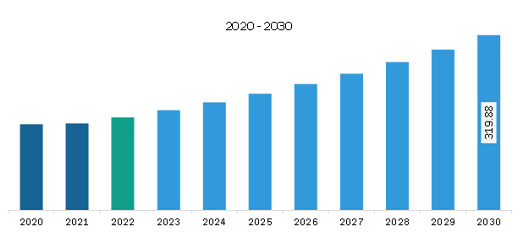
The Europe deep brain simulation market is expected to grow from US$ 169.14 million in 2022 to US$ 319.88 million by 2030. It is estimated to grow at a CAGR of 8.3% from 2022 to 2030.
Increasing Demand for Minimally Invasive Surgery Drive Europe Deep Brain Simulation Market
Deep brain stimulation is a minimally invasive targeted surgery used to treat movement disorders in dystonia, Parkinson's disease, and essential tremor. Minimally invasive surgeries (MIS) offer several advantages over traditional surgical techniques. MIS minimizes trauma to the body, reduces postoperative pain, increases recovery speed, and improves outcomes. Robotic procedures represent the latest evolution in minimally invasive procedures, providing surgeons with precision equipment that uses the same small incisions used in traditional laparoscopy. MIS leads to less blood loss, less analgesic use, and shorter postoperative hospital stay than open surgery. In addition, minimally invasive surgery indicates a higher accuracy rate than traditional surgical methods. Also, these procedures require tiny incisions large enough to insert thin tubes and cameras. These benefits of MIS are increasing inpatients and have encouraged older patients who face high operative morbidity and mortality to seek surgery. Thus, the rising demand for minimally invasive surgeries due to their advantages bolsters the Europe deep brain stimulation (DBS) market growth.
Europe Deep Brain Simulation Market Overview
In the medical field, neurosurgery requires advanced equipment and highly qualified medical professionals. German neurosurgeons are highly qualified specialists; they follow the latest protocols and surgical procedures. Neurology centers in Germany have the most modern diagnostic and minimally invasive surgical devices that meet international quality standards. According to a study published at Charité—Universitätsmedizin Berlin entitled “Deep brain stimulation in Parkinson's: A new algorithm to adjust stimulation settings has been developed,” Parkinson's disease is the second most common neurodegenerative disease after Alzheimer's. Approximately 400,000 people were affected with the disease in Germany in December 2022, and the numbers are increasing due to demographic aging. More and more people, including younger people, suffer from neurodegenerative diseases; in Germany, more than 2 million people have dementia or Parkinson's. According to the German Association for Alzheimer's Patients, in 2020, 9,450 people died from Alzheimer's, recording the highest figure. The increase in hospitalizations and deaths with Alzheimer's diagnosis is highly dependent on the aging population in Germany. People aged 65 and above increased by ~33% between and reached 18.3 million in 2020. Therefore, the aging population results in growing neurological disorders, which is expected to boost the market growth in the coming years.
Europe Deep Brain Simulation Market Revenue and Forecast to 2030 (US$ Million)
Based on product, the Europe deep brain simulation market is segmented into single channel deep brain stimulator, dual channel deep brain stimulator, and software and accessories. In 2022, the dual channel deep brain stimulator segment registered the largest share in the Europe deep brain simulation market.
Based on application, the Europe deep brain simulation market is segmented into Parkinson’s disease, tremor, dystonia, epilepsy, Alzheimer’s disease, and others. In 2022, the Parkinson’s disease segment registered the largest share in the Europe deep brain simulation market.
Based on end user, the Europe deep brain simulation market is segmented into hospitals, neurology clinics, ambulatory surgical centers, and others. In 2022, the hospitals segment registered the largest share in the Europe deep brain simulation market.
Based on country, the Europe deep brain simulation market is segmented into Germany, the UK, France, Italy, Spain, and the Rest of Europe. In 2022, Germany segment registered the largest share in the Europe deep brain simulation market.
Abbott Laboratories, Aleva Neurotherapeutics SA, Boston Scientific Corp, Medtronic Plc, and Newronika SpA are some of the leading companies operating in the Europe deep brain simulation market.
Europe Deep Brain Simulation Market Strategic Insights
Get more information on this report
Europe Deep Brain Simulation Market Segmentation Analysis
Europe Deep Brain Simulation Market Report Highlights
Europe Deep Brain Simulation Report Scope
Report Attribute
Details
Market size in 2022
US$ 169.14 Million
Market Size by 2030
US$ 319.88 Million
CAGR (2022 - 2030)
8.3%
Historical Data
2020-2021
Forecast period
2023-2030
Segments Covered
By Product
Single Channel Deep Brain Stimulator
Dual Channel Deep Brain Stimulator
Software and Accessories
By Application
Parkinson's Disease
Tremor
Dystonia
Epilepsy
Alzheimer's Disease
By End User
Hospitals
Neurology Clinics
Ambulatory Surgical Centers
Regions and Countries Covered
Europe
UK, Germany, France, Russia, Italy, Rest of Europe
Market leaders and key company profiles
Abbott Laboratories
Aleva Neurotherapeutics SA
Boston Scientific Corp
Medtronic Plc
Newronika SpA
Get more information on this report
Europe Deep Brain Simulation Market Country and Regional Insights
Get more information on this report
Identical Market Reports with other Region/Countries
The List of Companies - Europe Deep Brain Simulation Market
Abbott Laboratories Aleva Neurotherapeutics SA Boston Scientific Corp Medtronic Plc Newronika SpA
Frequently Asked Questions
How big is the Europe Deep Brain Simulation Market?
The Europe Deep Brain Simulation Market is valued at US$ 169.14 Million in 2022, it is projected to reach US$ 319.88 Million by 2030.
What is the CAGR for Europe Deep Brain Simulation Market by (2022 - 2030)?
As per our report Europe Deep Brain Simulation Market, the market size is valued at US$ 169.14 Million in 2022, projecting it to reach US$ 319.88 Million by 2030. This translates to a CAGR of approximately 8.3% during the forecast period.
What segments are covered in this report?
The Europe Deep Brain Simulation Market report typically cover these key segments-
Product (Single Channel Deep Brain Stimulator, Dual Channel Deep Brain Stimulator, Software and Accessories)
End User (Hospitals, Neurology Clinics, Ambulatory Surgical Centers)
What is the historic period, base year, and forecast period taken for Europe Deep Brain Simulation Market?
The historic period, base year, and forecast period can vary slightly depending on the specific market research report. However, for the Europe Deep Brain Simulation Market report:
Historic Period : 2020-2021
Base Year : 2022
Forecast Period : 2023-2030
Who are the major players in Europe Deep Brain Simulation Market?
The Europe Deep Brain Simulation Market is populated by several key players, each contributing to its growth and innovation. Some of the major players include:
Abbott Laboratories
Aleva Neurotherapeutics SA
Boston Scientific Corp
Medtronic Plc
Newronika SpA
Who should buy this report?
The Europe Deep Brain Simulation Market report is valuable for diverse stakeholders, including:
Investors: Provides insights for investment decisions pertaining to market growth, companies, or industry insights. Helps assess market attractiveness and potential returns.
Industry Players: Offers competitive intelligence, market sizing, and trend analysis to inform strategic planning, product development, and sales strategies.
Suppliers and Manufacturers: Helps understand market demand for components, materials, and services related to concerned industry.
Researchers and Consultants: Provides data and analysis for academic research, consulting projects, and market studies.
Financial Institutions: Helps assess risks and opportunities associated with financing or investing in the concerned market.
Essentially, anyone involved in or considering involvement in the Europe Deep Brain Simulation Market value chain can benefit from the information contained in a comprehensive market report.





 Get Free Sample For Europe Deep Brain Simulation Market