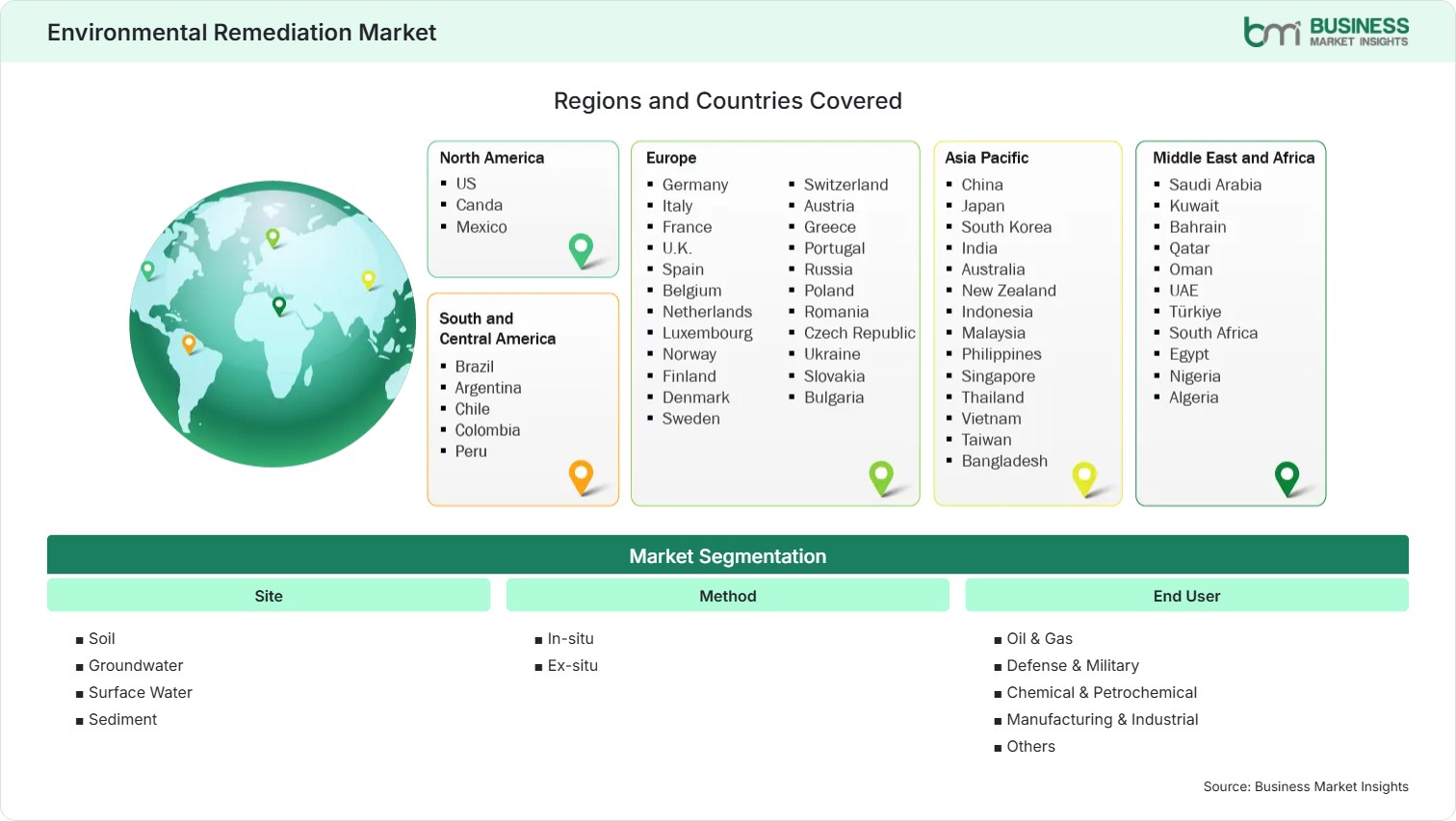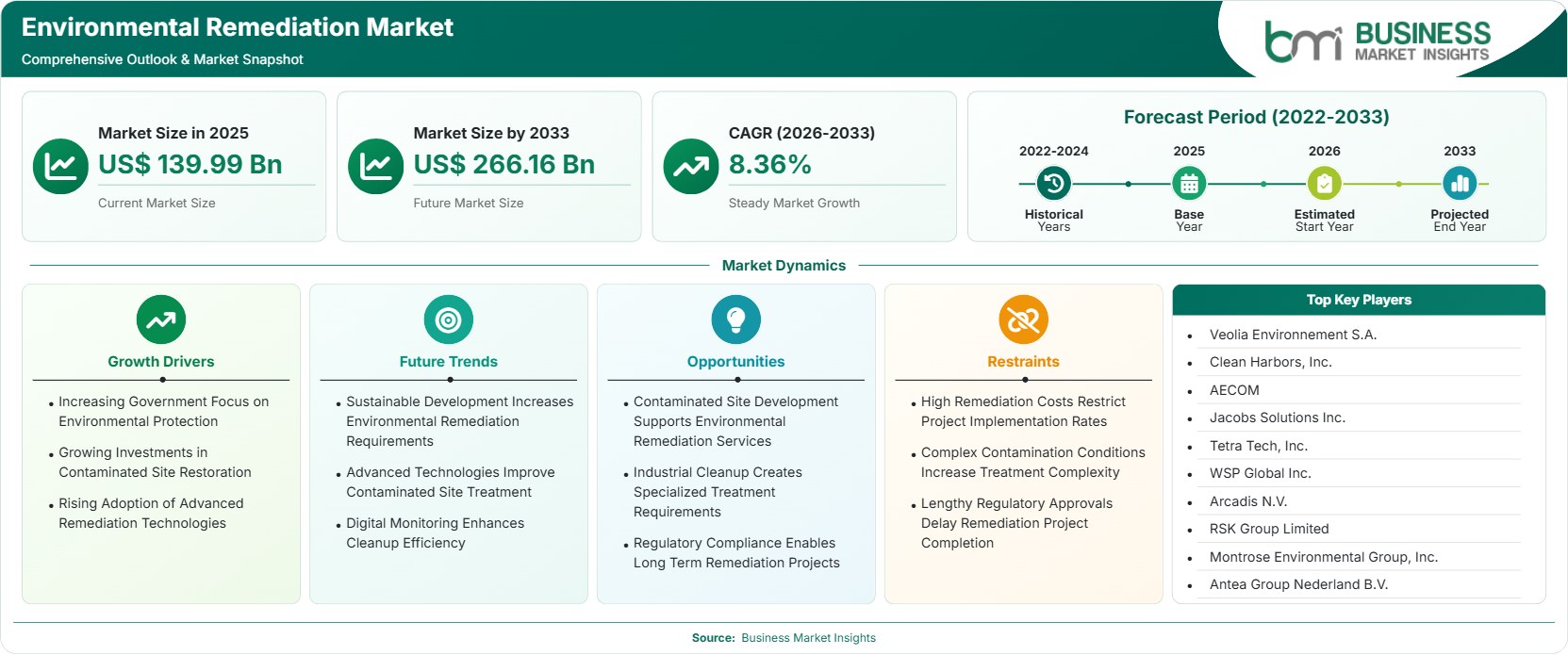
Environmental Remediation Market Regional Highlights
North America Environmental Remediation Market
North America represented a 34%–37% share in 2025 and is projected to expand at a 7.6%–8.1% CAGR during 2026–2033. Environmental Remediation Market share will be driven by Superfund responsibilities, defense site remediation, PFAS remediation, industrial brownfield redevelopment, and mature engineering ecosystems. The US is the dominant region, whereas Canada has an advantage due to mining site remediation, infrastructure development, and provincial environmental regulations. Public procurement and responsible party enforcement create consistent visibility for projects. According to the EPA, there were 195 removals in fiscal year 2025 and 1,505 Superfund sites with human exposures under control.
- Federal remediation programmes still issue contracts for engineering, investigation, monitoring, and treatment at military, industrial, and hazardous-waste sites.
- The technical requirements regarding PFAS are growing since the choice of treatment now involves destruction, separation, monitoring, and the assessment of long-term liability.
- The redevelopment of brownfields links the money spent on remediation with commercial redevelopment, infrastructure expansion, and the recovery of property values.
- Canada meets the demand by means of the use of contaminated industrial land, mining restoration, the protection of groundwater, and the implementation of environmental assessment requirements.
US Environmental Remediation Market
The US accounted for approximately 68%–72% of North American demand in 2025, with a 7.8%–8.3% CAGR during 2026–2033. The Environmental Remediation Market is supported by CERCLA enforcement, federal facility programs, state cleanup standards, PFAS obligations, and redevelopment initiatives. EPA recorded approximately $714.3 million in fiscal 2025 responsible-party and third-party cleanup commitments, while 870 sites were being cleaned under 1,467 enforcement agreements and orders.
- Defense remediation remains strategically important, particularly for PFAS, solvents, fuels, unexploded-contamination risks, and groundwater plumes requiring long-duration management.
- The need is growing for quick methods of site investigation and treatment as a result of industrial redevelopment, with the aim of reducing disruption to the reuse of the property.
- Evidence-based selection of remedies and the verification of their performance are being improved through the use of advanced monitoring, predictive modelling, and digital reporting.
Europe Environmental Remediation Market
Europe held a 24%–27% share in 2025, with a projected 7.9%–8.5% CAGR during 2026–2033. Germany, the UK, France, and the Netherlands continue to dominate as leading markets due to their well-developed contaminated-land frameworks and industrial histories. Poland, Spain, and Italy offer excellent high-growth prospects owing to the process of modernizing industries, infrastructure, and recycling of land. Growth of the market is underpinned by circular economy goals, soil protection, water quality management, and industrial heritage sites redevelopment.
- Germany benefits from extensive industrial land management requirements, groundwater protection programs, and remediation expertise supporting complex brownfield projects.
- France carries out the restoration of industrial sites together with the management of hazardous waste and the treatment of water, and promotes integrated environmental service contracts.
- The United Kingdom is still creating opportunities as a result of contaminated-land assessments, the redevelopment of infrastructure, and the management of environmental risk.
- There is a special demand in the Netherlands for groundwater remediation, sustainable remediation, and the redevelopment of urban areas on a complex scale.
Asia Pacific Environmental Remediation Market
Asia Pacific held a 21%–24% share in 2025 and is projected to register the fastest 9.0%–9.8% CAGR during 2026–2033. China, Japan, South Korea, Australia, and India represent leading demand centers, while India, Southeast Asia, and selected Chinese industrial regions offer higher-growth opportunities. Environmental Remediation Market share is increasing as industrialization, urban redevelopment, water pollution controls, mining restoration, and environmental enforcement create larger remediation requirements.
- The country is increasing its abilities in the investigation and remediation of contaminated sites in areas surrounding industrial zones, manufacturing clusters, mining regions, and corridors involved in urban redevelopment.
- India has great growth potential since the rise in industrial expansion, the need for groundwater protection, adherence to environmental regulations, and the redevelopment of brownfield sites is increasing the demand for specialist remediation services.
- Australia has to benefit from mining rehabilitation, groundwater management, its programmes for contaminated land, and the environmental responsibilities connected with resource-intensive industries.
- Japan and South Korea have a demand which is technologically advanced for precision monitoring, solvent treatment, soil management, and the restoration of industrial sites.
Rest of World Environmental Remediation Market
South and Central America represented a combined portion of the global market within the 14%–17% Rest of World share in 2025, while the broader region is projected to grow at 7.4%–8.0% CAGR during 2026–2033. Brazil, Mexico, Chile, and Colombia lead regional activity through mining, oil, chemicals, manufacturing, and urban redevelopment. Mining liabilities and water-quality requirements remain important demand catalysts.
Middle East and Africa contribute through oil-field restoration, industrial contamination control, infrastructure development, and water-security programs. Saudi Arabia, the UAE, and South Africa are leading markets, while Gulf redevelopment and African mining projects provide high-growth opportunities. Environmental Remediation Market growth is increasingly connected to industrial diversification and environmental compliance.
- Brazil and Chile have the opportunity to benefit from activities in the fields of mining, hydrocarbons, the management of industrial waste and that relating to contaminated water, this requiring specialized site investigation and treatment.
- The development of manufacturing in Mexico and the creation of industrial corridors are leading to greater demand for the assessment of contaminated land and for environmental compliance.
- Saudi Arabia and the UAE are advancing their environmental capabilities as they pursue industrial diversification, large infrastructure projects, and the redevelopment of brownfield sites.
- South Africa is still relevant with regard to mining rehabilitation, the protection of groundwater, industrial contamination, and the restoration of former sites.