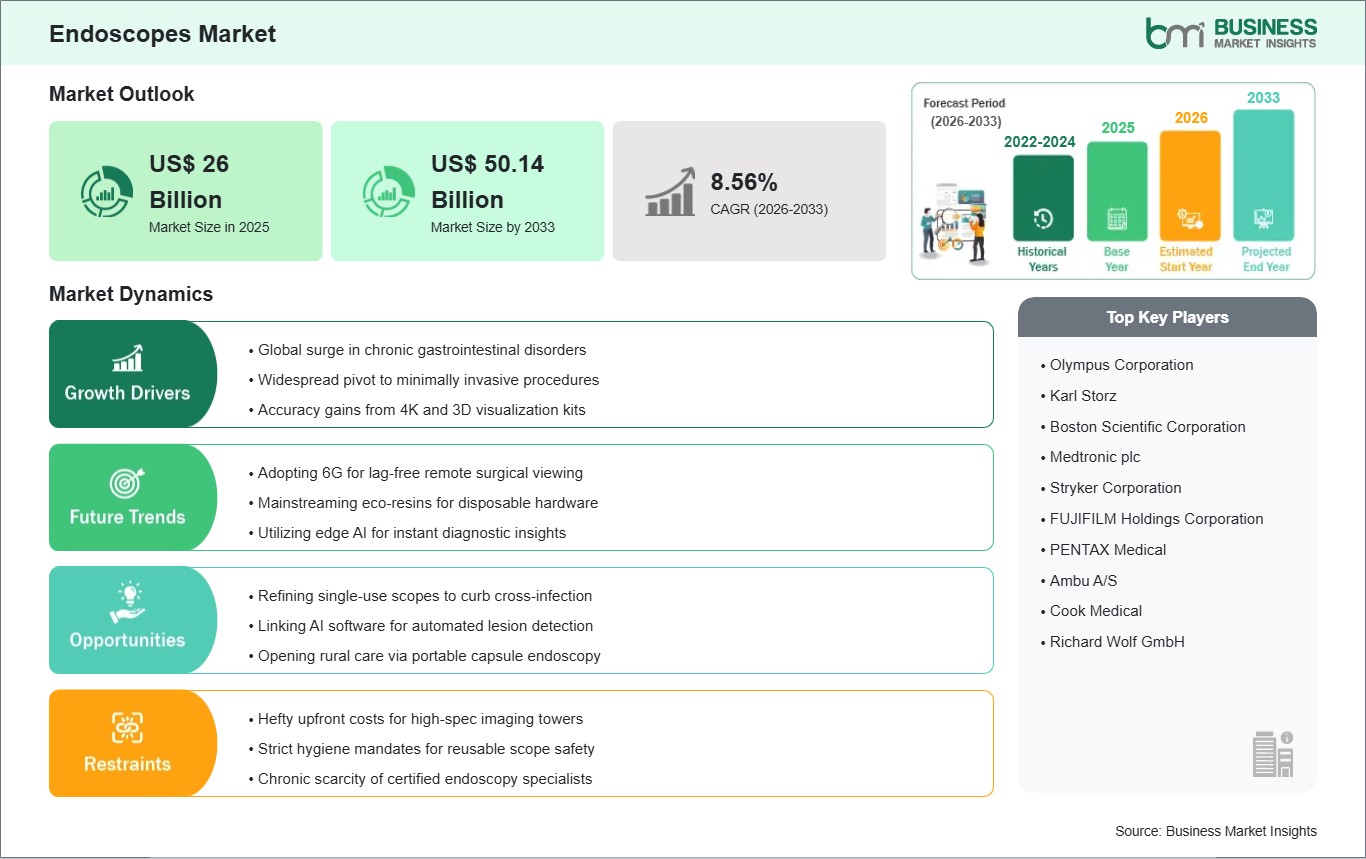
The Endoscopes market size is expected to reach US$ 50.14 billion by 2033 from US$ 26 billion in 2025. The market is estimated to record a CAGR of 8.56% from 2026 to 2033.
Endoscopes provide the essential visualization and operative infrastructure for minimally invasive medicine, encompassing flexible, rigid, capsule, and robot-assisted systems. These devices offer distinct advantages, including accelerated patient recovery, reduced infection risks, and enhanced diagnostic precision for early-stage malignancies. Growth is driven by the surging demand for outpatient surgeries, the rising prevalence of gastrointestinal and respiratory conditions, and an aging global population. Furthermore, the integration of AI-powered diagnostic modules for real-time lesion detection significantly optimizing clinical outcomes and procedural efficiency.
However, several challenges can restrain market growth: high capital expenditure for advanced 4K and 3D systems remains a barrier for mid-tier facilities. Rigorous reprocessing requirements and persistent infection-control hurdles for reusable scopes pose constant regulatory and safety challenges. Additionally, the industry is constrained by stringent re-certification mandates and a notable technical talent gap in operating advanced robotic-assisted platforms. Despite these hurdles, the market holds immense opportunities due to the global shift toward value-based healthcare and the rapid adoption of single-use (disposable) endoscopes to eliminate cross-contamination. The expansion of capsule endoscopy and the transition toward cloud-connected surgical suites and AI-driven navigation are expected to create significant opportunities for market growth.

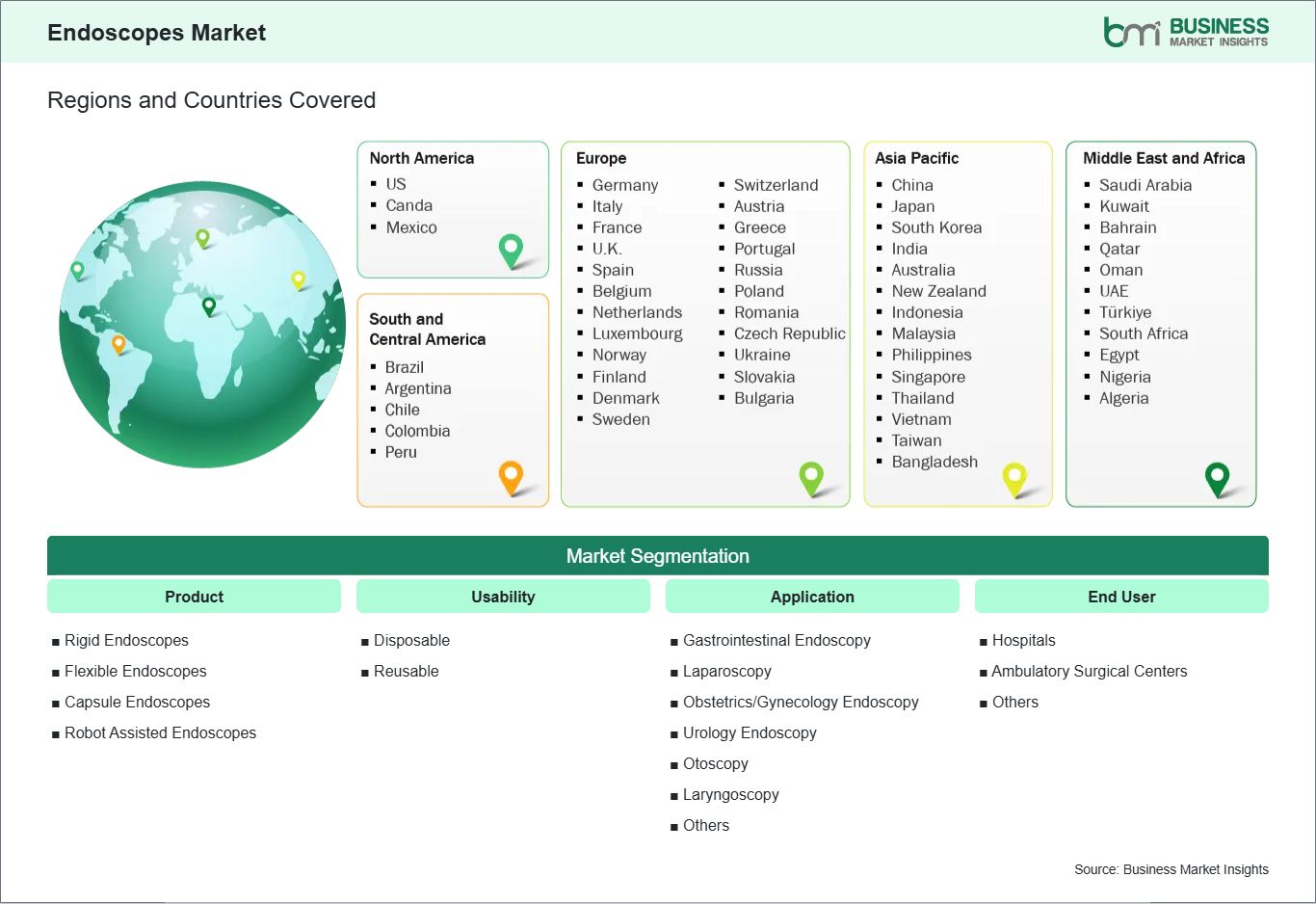
Key segments that contributed to the derivation of the Endoscopes market analysis are product, usability, application, and end user.
Endoscopy continues to be regarded as the gold standard for early disease detection because it allows clinicians to directly visualize internal organs and identify abnormalities at their earliest stages. Unlike imaging alone, endoscopy provides the ability to biopsy suspicious tissues immediately, enabling faster diagnosis and timely treatment before conditions progress into more serious or invasive forms. This capability is crucial for diseases such as colorectal cancer, gastric ulcers, inflammatory bowel disease, and esophageal disorders, where early intervention significantly improves patient outcomes.
The overall need for endoscopic procedures is rising steadily, driven in large part by nationwide screening initiatives and public-health programs that promote early detection as a cornerstone of preventive care. Governments across many regions are implementing or expanding colorectal cancer screening guidelines for individuals above the age of 50, sometimes even earlier for high-risk groups, which has increased the demand for routine colonoscopies and gastroscopies.
This trend is further amplified by the aging global population, which requires more frequent monitoring due to higher susceptibility to gastrointestinal disorders. As healthcare systems shift toward preventive models to reduce long-term treatment costs, the number of routine endoscopic examinations continues to grow. Consequently, endoscopes have become indispensable tools in modern diagnostics, supporting faster, safer, and more cost-effective patient management.
A major high-value opportunity in the endoscopy market lies in the rapid commercialization of single-use (disposable) endoscopes and the integration of advanced Artificial Intelligence (AI) for real-time diagnostic support. The industry is experiencing a decisive shift toward disposable platforms, particularly in high-risk specialties such as bronchoscopy, urology, and critical care. These procedures traditionally rely on reusable scopes, which require labor-intensive reprocessing, strict sterilization protocols, and continuous monitoring to prevent device-related infections. By eliminating the need for complex cleaning workflows, disposable endoscopes significantly reduce the risk of cross-contamination while also lowering operational costs for hospitals that struggle with staffing shortages and rising sterilization expenses.
At the same time, the adoption of AI-enabled “Computer-Aided Detection” (CADe) systems is transforming how clinicians interpret endoscopic images. These intelligent modules automatically highlight subtle mucosal irregularities, early polyps, or precancerous lesions that may be missed during fast-paced procedures, thereby improving diagnostic accuracy and consistency across users.
When combined with the rapid expansion of Ambulatory Surgical Centers (ASCs), these technological advancements empower manufacturers to offer high-resolution, portable, and increasingly “smart” imaging solutions. Together, they enhance diagnostic yield, boost patient safety, streamline procedural workflows, and support the broader industry shift toward preventive, value-based healthcare.

The Endoscopes market demonstrates steady growth, with size and share analysis revealing evolving trends and competitive positioning among key players. The report further examines subsegments categorized within product, usability, application, and end user, offering insights into their contribution to overall market performance.
For instance, the Rigid Endoscopes and Flexible Endoscopes segments continue hold a significant market share, particularly in Gastrointestinal Endoscopy and Laparoscopy. While flexible endoscopes are dominant in GI procedures due to their maneuverability, rigid endoscopes are highly valued in laparoscopy and orthopedics for their superior optical clarity and stability. A significant high-growth trend is the emergence of Robot-Assisted Endoscopes, which are increasingly utilized in complex urological and gynecological surgeries to provide surgeons with enhanced precision and a greater range of motion compared to traditional manual instruments.
| Report Attribute | Details |
|---|---|
| Market size in 2025 | US$ 26 Billion |
| Market Size by 2033 | US$ 50.14 Billion |
| Global CAGR (2026 - 2033) | 8.56% |
| Historical Data | 2022-2024 |
| Forecast period | 2026-2033 |
| Segments Covered | By Product
|
|
Regions and Countries Covered
| |
| North America | US, Canada, Mexico |
| Europe | Belgium, Austria, Finland, Denmark, Greece, Poland, Romania, Russia, Ukraine, Czech Republic, Slovakia, Bulgaria, Italy, Luxembourg, Germany, Switzerland, France, Netherlands, Norway, Portugal, Spain, Sweden, United Kingdom |
| Asia-Pacific | Australia, China, India, Japan, South Korea, Indonesia, Malaysia, Philippines, Singapore, Thailand, Vietnam, Bangladesh, New Zealand, Taiwan |
| South and Central America | Brazil, Argentina, Peru, Chile, Colombia |
| Middle East and Africa | Bahrain, Kuwait, Oman, Qatar, Saudi Arabia, United Arab Emirates, Turkiye, South Africa, Egypt, Algeria, Nigeria |
| Market leaders and key company profiles |
|
The "Endoscopes Market Size and Forecast (2022–2033)" report provides a detailed analysis of the market covering below areas:
The geographical scope of the Endoscopes market report is divided into five regions: North America, Asia Pacific, Europe, the Middle East & Africa, and South & Central America.
The Asia-Pacific Endoscopes Market is segmented into China, Japan, South Korea, India, Australia, New Zealand, Indonesia, Malaysia, the Philippines, Singapore, Thailand, Vietnam, Taiwan, Bangladesh, and the Rest of Asia. The market is primarily driven by the region's massive geriatric population and the high incidence of gastrointestinal (GI) cancers and colorectal diseases.
Growth is further bolstered by a shift toward disposable (single-use) endoscopes to mitigate hospital-acquired infections and the integration of AI-assisted diagnostic software for real-time lesion detection. The expansion of Ambulatory Surgical Centers (ASCs) and rising medical tourism in countries including Thailand and South Korea secures Asia Pacific’s position as a global hub for endoscopy innovation.

The Endoscopes market is evaluated by gathering qualitative and quantitative data post primary and secondary research, which includes important corporate publications, association data, and databases. A few of the key developments in the Endoscopes market are:
The Endoscopes Market is valued at US$ 26 Billion in 2025, it is projected to reach US$ 50.14 Billion by 2033.
As per our report Endoscopes Market, the market size is valued at US$ 26 Billion in 2025, projecting it to reach US$ 50.14 Billion by 2033. This translates to a CAGR of approximately 8.56% during the forecast period.
The Endoscopes Market report typically cover these key segments-
The historic period, base year, and forecast period can vary slightly depending on the specific market research report. However, for the Endoscopes Market report:
The Endoscopes Market is populated by several key players, each contributing to its growth and innovation. Some of the major players include:
The Endoscopes Market report is valuable for diverse stakeholders, including:
Essentially, anyone involved in or considering involvement in the Endoscopes Market value chain can benefit from the information contained in a comprehensive market report.
Please tell us your area of interest
(Market Segments/ Regions and Countries/ Companies)