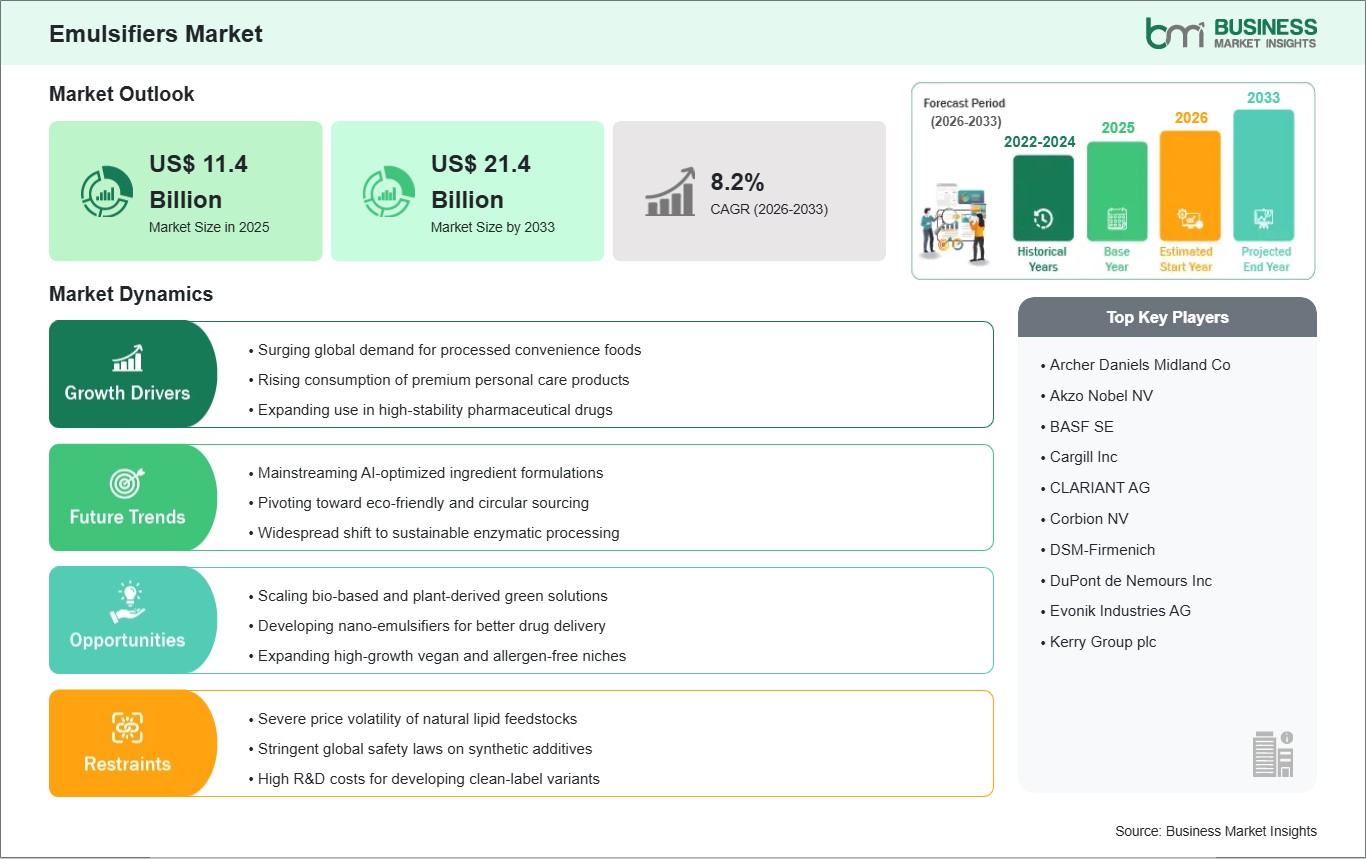
Market Summary
Executive Summary and Global Market Analysis
Emulsifiers are fundamental to modern manufacturing, acting as the essential bridge that stabilizes mixtures of traditionally immiscible liquids such as oil and water. These functional agents are vital across high-growth sectors: Food & Beverages, Cosmetics & Personal Care, Pharmaceuticals, and Industrial Applications. Emulsifiers offer critical advantages, including the prevention of phase separation, enhancement of sensory textures (creaminess and mouthfeel), and the extension of product shelf life. The market is fueled by the soaring global demand for convenience and processed foods, the rapid expansion of the premium skincare and beauty industry, and a significant shift toward multifunctional ingredients that offer both stabilization and health benefits (e.g., fat reduction in foods).
However, several challenges restrain market growth: extreme price volatility of bio-based feedstocks (such as palm, soy, and sunflower oils) creates significant cost pressures and supply chain uncertainty. Stringent and evolving global regulations regarding food additives and chemical safety necessitate expensive reformulation and testing. Furthermore, the industry faces constraints due to growing consumer scrutiny of synthetic ingredients, which can lead to negative brand perception for products containing traditional chemical emulsifiers. Despite these hurdles, opportunities arise driven by the massive "clean-label" movement, prompting the development of natural and organic emulsifiers (like lecithin and plant proteins), the expansion into plant-based dairy and meat alternatives, and robust growth in the Asia-Pacific region, fueled by rising middle-class consumption. The integration of advanced enzymatic modification to improve the efficiency of natural emulsifiers is expected to open new avenues for market expansion.
Segment Analysis
Emulsifiers Market Segmentation
Key segments that contributed to the derivation of the Emulsifiers Market analysis are source, form, and application.
- By Source, the market is segmented into Bio-Based (Plant-Based and Animal-Based) and Synthetic (Sorbitan Esters, Mono and Di-glycerides, Stearoyl Lactylates, Polyglycerol Esters, Polyethylene glycol, and Others)
- By Form, the market is segmented into Liquid, Powder, and Granular
- By Application, the market is segmented into Food Bakery and Confectionery, Dairy and Frozen Desserts, Meat, Poultry and Seafood, and Others, Cosmetics and Personal Care, Oilfield Chemicals, Pharmaceutical, Agrochemicals, Cleaning Products, and OthersEmulsifiers Market Drivers and Opportunities:
Market Forces
Emulsifiers Market Drivers and Opportunities
Demand for Stability in Convenience and Clean-Label Products
The primary driver for the Emulsifiers Market is the global surge in processed and convenience food consumption, combined with a radical shift toward clean-label transparency. Emulsifiers are functionally indispensable in the food industry; they prevent oil-water separation in sauces, maintain the fluffiness of bakery products, and ensure the smooth mouthfeel of dairy alternatives and low-fat spreads. As urban lifestyles increase the demand for shelf-stable, ready-to-eat meals, the necessity for emulsifiers that preserve texture over long storage periods remains high. However, the market is being fundamentally reshaped by health and wellness trends. Consumers are increasingly scrutinizing ingredient lists, driving a transition away from synthetic chemical additives toward natural, non-GMO, and allergen-free options. This dual pressure, maintaining the structural integrity of convenience foods while using recognizable, plant-derived ingredients like sunflower or rapeseed lecithin, is powering the industry growth.
Innovation in Bio-Based and Upcycled Ingredients
A transformative opportunity lies in the development of next-generation bio-based emulsifiers and the utilization of upcycled agricultural side-streams to meet the needs of a circular economy. As traditional synthetic and palm-based emulsifiers face regulatory scrutiny and sustainability concerns, the industry is pivoting toward high-performance alternatives derived from renewable sources. Emerging opportunities include the extraction of emulsifying agents from food waste, such as fruit peels, grain husks, or spent coffee grounds, which appeals to eco-conscious consumers in the cosmetic and personal care sectors. Additionally, the rise of plant-based meat and dairy alternatives provides a fertile ground for innovation; these products require sophisticated, enzyme-modified emulsification systems to mimic the complex textures of animal-based fats. These advancements allow manufacturers to develop specialized, high-functionality ingredients that align with global sustainability targets while capturing higher-margin segments in the specialized food and pharmaceutical markets.
Size and Share Analysis
Emulsifiers Market Size and Share Analysis
The Emulsifiers Market demonstrates steady growth, with size and share analysis revealing evolving trends and competitive positioning among key players. The report further examines subsegments categorized within source, form, and application, offering insights into their contribution to overall market performance.
For instance, Bio-Based emulsifiers, particularly Plant-Based varieties such as lecithin, are increasingly utilized in Liquid for the Cosmetics and Personal Care (application) industry. Thus, the Bio-Based Emulsifier subsegment is growing rapidly as consumer preference shifts toward "clean label" products and natural ingredients that offer both stabilization and skin-conditioning benefits.
Report Coverage
Emulsifiers Market Report Coverage and Deliverables
The "Emulsifiers Market Size and Forecast (2022 - 2033)" report provides a detailed analysis of the market covering below areas:
- Emulsifiers Market size and forecast at global, regional, and country levels for all the key market segments covered under the scope
- Emulsifiers Market trends, as well as market dynamics such as drivers, restraints, and key opportunities
- Emulsifiers Market analysis covering key market trends, global and regional framework, major players, regulations, and recent market developments
- Industry landscape and competition analysis covering market concentration, heat map analysis, prominent players, and recent developments for the Emulsifiers Market
- Detailed company profiles, including SWOT analysis
Geographic Insights
Emulsifiers Market Geographic Insights
The geographical scope of the Emulsifiers Market report is divided into five regions: North America, Asia Pacific, Europe, the Middle East & Africa, and South & Central America.
The Asia-Pacific Emulsifiers Market is segmented into China, Japan, South Korea, India, Australia, New Zealand, Indonesia, Malaysia, the Philippines, Singapore, Thailand, Vietnam, Taiwan, Bangladesh, and the Rest of Asia. The market is primarily driven by the region's massive Food & Beverage sector, where emulsifiers are essential for improving the texture and shelf life of processed and convenience foods.
Growth is further bolstered by the booming Personal Care and Cosmetics industry, particularly the popularity of K-beauty and J-beauty trends that utilize high-performance emulsifiers for skincare formulations. Additionally, the increasing demand for clean-label and plant-based emulsifiers (like soy and sunflower lecithin) and the expansion of the pharmaceutical and oilfield chemical sectors secure Asia-Pacific as the dominant global hub for emulsifier consumption and innovation.
Industry Activity
Recent Developments
The Emulsifiers Market is evaluated by gathering qualitative and quantitative data post-primary and secondary research, which includes important corporate publications, association data, and databases. A few of the key developments in the Emulsifiers Market are:
- In February 2025, LBB Specialties (LBBS), a leader in specialty chemicals and ingredient distribution in North America, announced its partnership with Kerry Group, a world-leading taste and nutrition partner for the food, beverage, and pharmaceutical markets with innovative, sustainable specialty ingredients for the Personal Care industry. With this agreement, LBB Specialties will be Kerry's distribution partner in the United States and Canada for its new line of emollients, emulsifiers, and fermentation-derived actives specifically designed for skin care, personal care, and cosmetics.
- In June 2025, Indovinya, the specialty chemicals division of Indorama Ventures, launched a line of Sorbitan esters. The company’s Alkest Sp 80 K and Alkest Sp 60 K product lines are intended for bread, confectionery, oils, dairy, and beverage applications. The ingredients can enhance application stability, extend shelf life, and improve both taste and appearance, according to the company.
Trust & Transparency
Research Methodology
The market analysis combines proprietary research with secondary data from government agencies, company disclosures, regulatory filings, industry databases and expert interviews. Market estimates are validated through data triangulation, cross-market benchmarking and analyst
review.
View Full Research Methodology
Key Sources Referred:
World Bank - Global Trade IndicatorsWorld Trade Organization (WTO)International Monetary Fund (IMF)International Trade Administration (ITA)Company WebsitesCompany Annual ReportsCompany Investor Presentations