Elevator Market Outlook (2022-2033)

Historic Data: 2022-2024   |   Base Year: 2025   |   Forecast Period: 2026-2033
Report Content: Market Scope, Market Segmentation, Market Dynamics, and Competitive Analysis

Report Coverage:
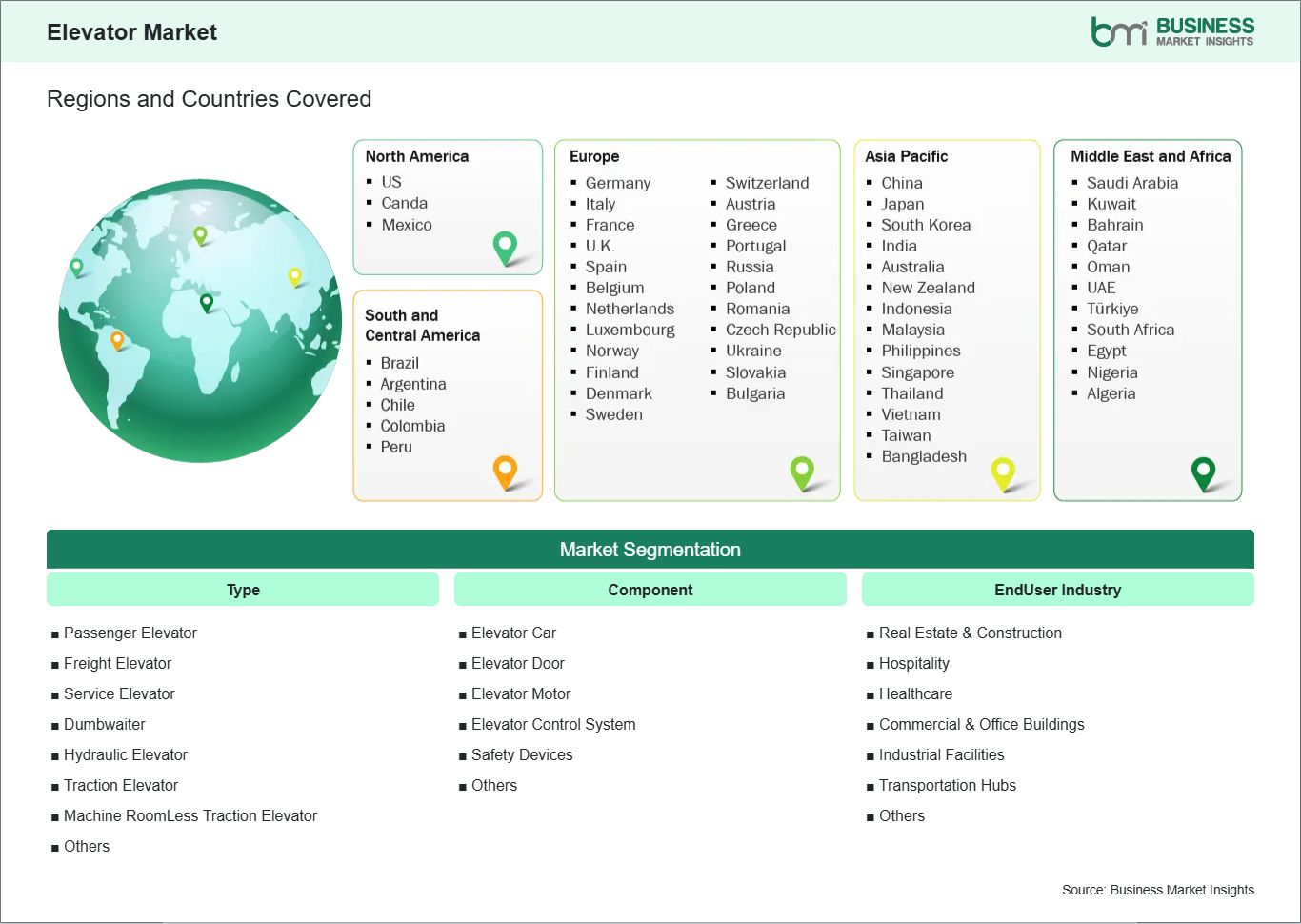
  • Type (Passenger Elevator, Freight Elevator, Service Elevator, Dumbwaiter, Hydraulic Elevator, Traction Elevator, Machine RoomLess (MRL) Traction Elevator, Others)
  • Component (Elevator Car, Elevator Door, Elevator Motor, Elevator Control System, Safety Devices, Others)
  • EndUser Industry (Real Estate & Construction, Hospitality, Healthcare, Commercial & Office Buildings, Industrial Facilities, Transportation Hubs, Others)

No. of Pages: 400
Report Code: BMIPUB00032692
Category: Electronics and Semiconductor
Elevator Market

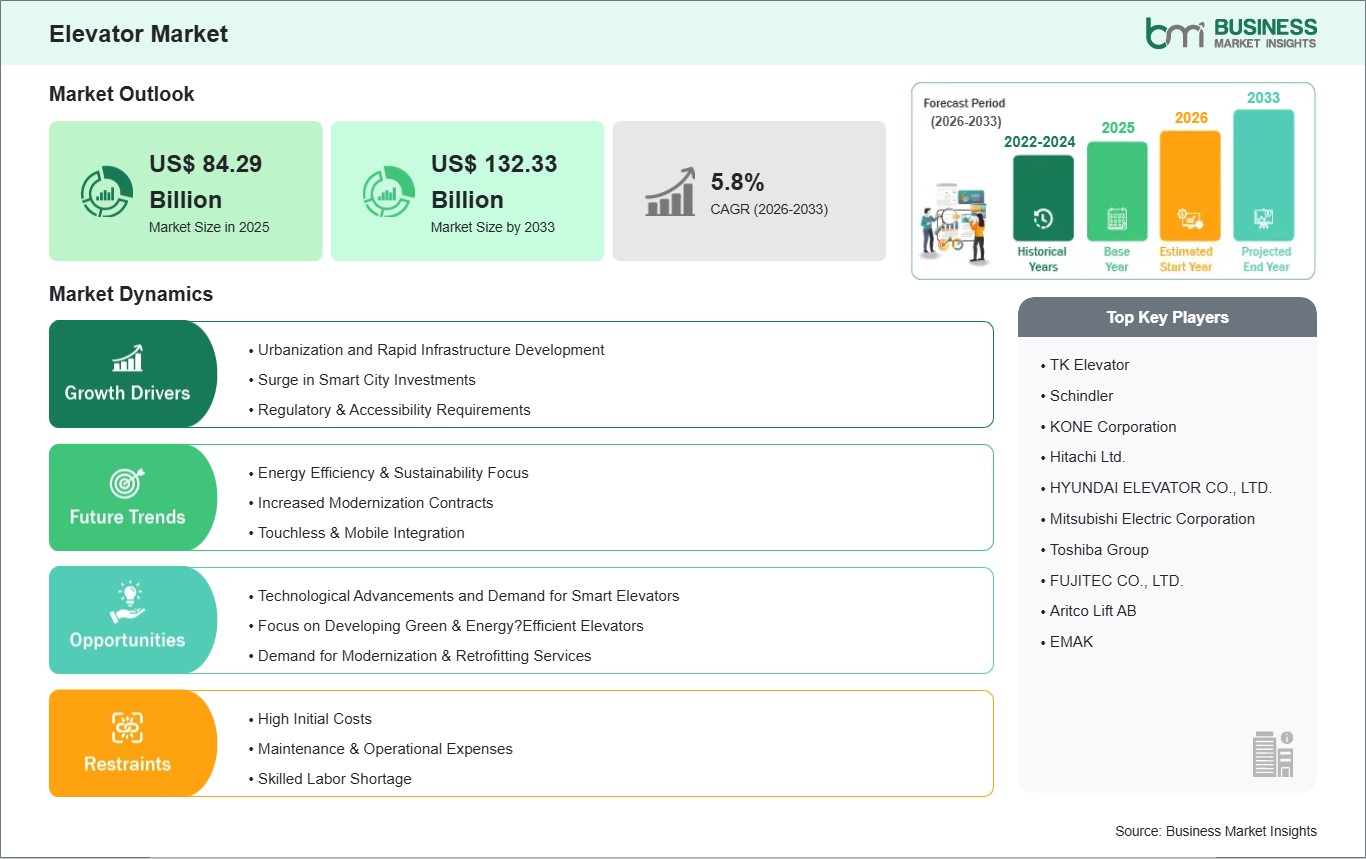
The elevator market size is expected to reach US$ 132.33 billion by 2033 from US$ 84.29 billion in 2025. The market is estimated to record a CAGR of 5.8% from 2026 to 2033.

Executive Summary and Global Market Analysis:

An elevator is a vertical transportation system designed to move people or goods efficiently between different floors of a building, playing a vital role in modern urban infrastructure. Elevators are widely used in residential buildings, commercial complexes, hospitals, hotels, shopping malls, and industrial facilities, where they enhance accessibility, convenience, and mobility, especially in high-rise structures. The key benefits of elevators include time efficiency, reduced physical effort, improved safety, and inclusivity for elderly people and individuals with disabilities. In densely populated cities, elevators enable optimal use of vertical space, supporting sustainable urban development.

The global elevator market is driven by several factors, including rapid urbanization, growth in high-rise construction, rising population, and increasing demand for smart and energy-efficient building solutions. Technological advancements such as smart elevators, destination control systems, and IoT-enabled monitoring further act as major drivers by improving performance, safety, and energy efficiency. However, the market also faces restraints, including high installation and maintenance costs, strict safety regulations, and challenges related to modernization in older buildings. Despite these limitations, significant opportunities exist, particularly in emerging economies where infrastructure development and smart city projects are accelerating. The growing focus on green buildings has created demand for eco-friendly and energy-efficient elevators. Key trends shaping the elevator market include the adoption of digitalization, predictive maintenance, machine-room-less elevators, and touchless control systems, driven by safety and hygiene concerns. Overall, elevators are essential to modern living, and continuous innovation is expected to support steady market growth in the coming years.

Elevator Market - Strategic Insights:

global-market-strategic-framework
Get more information on this report

Elevator Market Segmentation Analysis:

Key segments that contributed to the derivation of the elevator market analysis are type, component, and end-use industry.

  • By type, the market is segmented into passenger elevator, freight elevator, service elevator, dumbwaiter, hydraulic elevator, traction elevator, machine room-less (MRL) traction elevator, and others. The traction elevator segment held the largest share of the market in 2025.
  • By component, the market is segmented into elevator car, elevator door, elevator motor, elevator control system, safety devices, and others. The elevator car segment held the largest share of the market in 2025.
  • By end-use industry, the market is segmented into real estate & construction, hospitality, healthcare, commercial & office buildings, industrial facilities, transportation hubs, and others. The commercial & office buildings segment held the largest share of the market in 2025.

Elevator Market Drivers and Opportunities:

Urbanization and Rapid Infrastructure Development

One of the primary drivers propelling the elevator market is the accelerating rate of urbanization combined with large-scale infrastructure development across the globe. As cities expand vertically to accommodate growing populations and limited land availability, there is an increasing demand for multi-story residential, commercial, and mixed-use buildings. Elevators are no longer a luxury but a necessity for efficient vertical transportation, particularly in high-rise constructions. Urbanization also spurs modernization of existing infrastructure; older buildings require retrofitting or modernization to meet current safety and efficiency standards, further driving elevator adoption. Additionally, emerging economies are witnessing massive investments in smart city projects, government-backed housing schemes, and commercial hubs, which directly boosts demand for elevators. Innovations such as energy-efficient elevators, regenerative drives, and smart elevator systems that optimize traffic flow are gaining prominence in these urban environments, making elevator systems not only functional but also integral to sustainability goals. Moreover, the rise of skyscrapers and urban commercial complexes in metropolitan regions necessitates high-speed, reliable, and technologically advanced elevator solutions. As construction activities expand in both residential and commercial segments, elevator manufacturers and service providers are experiencing a consistent rise in both new installations and maintenance contracts, solidifying the role of urbanization and infrastructure development as a major growth driver in the global elevator market.

Technological Advancements and Demand for Smart Elevators

The evolution of smart building technologies presents a significant opportunity for the elevator market, transforming it from a mere transportation tool to an integrated, intelligent system within modern infrastructure. Smart elevators leverage IoT, AI, and data analytics to improve operational efficiency, passenger safety, and energy consumption. For instance, destination dispatch systems reduce waiting times by grouping passengers traveling to similar floors, while predictive maintenance sensors identify potential malfunctions before they occur, minimizing downtime and reducing service costs. Additionally, the growing emphasis on sustainability has created opportunities for energy-efficient elevator solutions. Regenerative drives, LED lighting, and standby modes not only reduce electricity consumption but also align with global green building certifications like LEED and BREEAM. Integration with building management systems enables elevators to communicate with HVAC, lighting, and security systems, enhancing overall building intelligence.

The trend toward digitalization also opens avenues for remote monitoring and predictive analytics, allowing service providers to offer subscription-based maintenance services, thereby creating recurring revenue streams. Moreover, as urban populations increasingly demand convenience and personalized experiences, features such as contactless controls, smartphone integration, and accessibility-focused designs are becoming differentiators in competitive markets. Overall, technological advancements represent a multi-faceted opportunity for elevator manufacturers and service providers to innovate, enhance user experience, and capture a larger share of a rapidly evolving market.

Elevator Market Size and Share Analysis:

By type, the market is segmented into passenger elevator, freight elevator, service elevator, dumbwaiter, hydraulic elevator, traction elevator, machine room-less (MRL) traction elevator, and others. The traction elevator segment held the largest share of the market in 2025. A traction elevator is a type of lift that uses ropes or belts over a pulley system, driven by an electric motor, to move the cabin smoothly between floors. Its growing global demand is driven by energy efficiency, faster speeds, space-saving designs, and suitability for high-rise buildings, making it ideal for urban infrastructure.

By component, the market is segmented into elevator car, elevator door, elevator motor, elevator control system, safety devices, and others. The GNSS segment held the largest share of the market in 2025. The global demand for elevator cars is rising due to rapid urbanization, increasing high-rise construction, and the need for efficient vertical transportation in densely populated cities. Modern elevators offer energy efficiency, advanced safety features, and smart technologies, attracting commercial, residential, and public infrastructure projects, driving continuous growth worldwide.

By end-use industry, the market is segmented into real estate & construction, hospitality, healthcare, commercial & office buildings, industrial facilities, transportation hubs, and others. The commercial & office buildings segment held the largest share of the market in 2025. The demand and adoption of elevators in commercial and office buildings are driven by factors such as increasing building height, urbanization, and space optimization. Efficient vertical transportation improves accessibility, reduces waiting times, and enhances user convenience. Growing workforce populations, modern architectural designs, and regulatory requirements for safety and accessibility further boost elevator installations.

Elevator Market Report Highlights:

Report Attribute Details
Market size in 2025 US$ 84.29 Billion
Market Size by 2033 US$ 132.33 Billion
Global CAGR (2026 - 2033)5.8%
Historical Data 2022-2024
Forecast period 2026-2033
Segments Covered By Type
  • Passenger Elevator
  • Freight Elevator
  • Service Elevator
  • Dumbwaiter
  • Hydraulic Elevator
  • Traction Elevator
  • Machine RoomLess Traction Elevator
  • Others
By Component
  • Elevator Car
  • Elevator Door
  • Elevator Motor
  • Elevator Control System
  • Safety Devices
  • Others
By EndUser Industry
  • Real Estate & Construction
  • Hospitality
  • Healthcare
  • Commercial & Office Buildings
  • Industrial Facilities
  • Transportation Hubs
  • Others
Regions and Countries Covered
North America US, Canada, Mexico
Europe Belgium, Austria, Finland, Denmark, Greece, Poland, Romania, Russia, Ukraine, Czech Republic, Slovakia, Bulgaria, Italy, Luxembourg, Germany, Switzerland, France, Netherlands, Norway, Portugal, Spain, Sweden, United Kingdom
Asia-Pacific Australia, China, India, Japan, South Korea, Indonesia, Malaysia, Philippines, Singapore, Thailand, Vietnam, Bangladesh, New Zealand, Taiwan
South and Central America Brazil, Argentina, Peru, Chile, Colombia
Middle East and Africa Bahrain, Kuwait, Oman, Qatar, Saudi Arabia, United Arab Emirates, Turkiye, South Africa, Egypt, Algeria, Nigeria
Market leaders and key company profiles
  • TK Elevator
  • Schindler
  • KONE Corporation
  • Hitachi Ltd.
  • HYUNDAI ELEVATOR CO., LTD.
  • Mitsubishi Electric Corporation
  • Toshiba Group
  • FUJITEC CO., LTD.
  • Aritco Lift AB
Get more information on this report

Elevator Market Report Coverage and Deliverables:

The Elevator Market Size and Forecast (2022–2033) report provides a detailed analysis of the market covering below areas:

  • Elevator market size and forecast at global, regional, and country levels for all the key market segments covered under the scope
  • Elevator market trends, as well as market dynamics such as drivers, restraints, and key opportunities
  • Elevator market analysis covering key market trends, global and regional framework, major players, regulations, and recent market developments
  • Industry landscape and competition analysis covering market concentration, heat map analysis, prominent players, and recent developments for the wearable camera market
  • Detailed company profiles, including SWOT analysis

Elevator Market Geographic Insights:

The geographical scope of the elevator market report is divided into five regions: North America, Asia Pacific, Europe, Middle East & Africa, and South & Central America. The elevator market in Asia Pacific is expected to grow significantly during the forecast period.

The Asia Pacific elevator market is segmented into China, Japan, South Korea, India, Australia, New Zealand, Indonesia, Malaysia, the Philippines, Singapore, Thailand, Vietnam, Taiwan, Bangladesh, and the Rest of Asia. The demand for elevators in the Asia-Pacific region is driven by a combination of rapid urbanization, population growth, economic development, and increasing infrastructural investments. As countries like China, India, Japan, and Southeast Asian nations experience accelerated urban expansion, the construction of high-rise residential, commercial, and mixed-use buildings has surged, directly fueling the need for vertical transportation solutions. Rising disposable incomes and a growing middle class have also heightened the demand for modern, convenient, and safe building amenities, making elevators an essential feature in both residential and commercial properties. Furthermore, government initiatives focused on smart cities, urban modernization, and public infrastructure development, including airports, metro stations, and hospitals, have intensified elevator installation requirements.

Technological advancements, such as energy-efficient and IoT-enabled elevators, are increasingly influencing purchasing decisions, as building developers prioritize sustainability and operational efficiency. Additionally, the region’s aging population, particularly in countries like Japan, has created a significant demand for elevators and escalators in residential complexes and healthcare facilities to enhance accessibility and mobility for the elderly. Competitive real estate markets in major metropolitan areas, combined with stricter safety and building regulations, further necessitate the adoption of advanced elevator systems to meet regulatory compliance. The interplay of these demographic, economic, and technological factors positions the Asia-Pacific elevator market as one of the fastest-growing globally, with consistent demand expected in both urban centers and emerging secondary cities as governments and private developers continue to invest heavily in vertical infrastructure.

global-market-geography
Get more information on this report

Elevator Market Research Report Guidance:

  • The report includes qualitative and quantitative data in the elevator market across type, component, end-use industry, and geography.
  • The report starts with the key takeaways (chapter 2), highlighting the key trends and outlook of the elevator market.
  • Chapter 3 includes the research methodology of the study.
  • Chapter 4 further includes ecosystem analysis.
  • Chapter 5 highlights the major industry dynamics in the elevator market, including factors that are driving the market, prevailing deterrents, potential opportunities, as well as future trends. Impact analysis of these drivers and restraints is also covered in this section.
  • Chapter 6 discusses the elevator market scenario, in terms of historical market revenues, and forecast till the year 2031.
  • Chapters 7 to 10 cover elevator market segments by type, component, end-use industry, and geography across North America, Europe, Asia Pacific, Middle East and Africa, and South and Central America. They cover the market volume revenue forecast and factors driving the market.
  • Chapter 11 describes the competitive analysis along with the heat map analysis for the key players operating in the market.
  • Chapter 12 describes the industry landscape analysis. It provides detailed descriptions of business activities such as market initiatives, new developments, mergers, and joint ventures globally, along with a competitive landscape.
  • Chapter 13 provides detailed profiles of the major companies operating in the elevator market. Companies have been profiled on the basis of their key facts, business descriptions, products and services, financial overview, SWOT analysis, and key developments.
  • Chapter 14, i.e., the appendix is inclusive of a brief overview of the company, list of abbreviations, and disclaimer.

Elevator Market News and Key Development:

The elevator market is evaluated by gathering qualitative and quantitative data post primary and secondary research, which includes important corporate publications, association data, and databases. A few of the key developments in the elevator market are:

  • In September 2025, Otis is introducing its new flexible Arise MOD Prime and Arise MOD Plus solutions in Europe to modernise low- to mid-rise residential and commercial buildings. These are now available in Spain, the UK, France, and Benelux (Belgium, the Netherlands and Luxembourg), with more countries to follow soon.
  • In April 2025, Schindler Elevator Corporation, a leading provider of elevators, escalators, and moving walks, announces the launch of the Schindler 5000 – a machine-room-less (MRL) elevator designed for low- to mid-rise offices, hotels, hospitals, apartment complexes, and more.

Key Sources Referred:

  • World Bank – Global Trade Indicators
  • World Trade Organization (WTO)
  • (International Monetary Fund )IMF
  • International Trade Administration (ITA)
  • Company website
  • Company annual reports
  • Company investor presentations
The List of Companies - Elevator Market
  • TK Elevator
  • Schindler
  • KONE Corporation
  • Hitachi Ltd.
  • HYUNDAI ELEVATOR CO., LTD.
  • Mitsubishi Electric Corporation
  • Toshiba Group
  • FUJITEC CO., LTD.
  • Aritco Lift AB
  • EMAK
Frequently Asked Questions
How big is the Elevator Market?

The Elevator Market is valued at US$ 84.29 Billion in 2025, it is projected to reach US$ 132.33 Billion by 2033.

What is the CAGR for Elevator Market by (2026 - 2033)?

As per our report Elevator Market, the market size is valued at US$ 84.29 Billion in 2025, projecting it to reach US$ 132.33 Billion by 2033. This translates to a CAGR of approximately 5.8% during the forecast period.

What segments are covered in this report?

The Elevator Market report typically cover these key segments-

  • Type (Passenger Elevator, Freight Elevator, Service Elevator, Dumbwaiter, Hydraulic Elevator, Traction Elevator, Machine RoomLess (MRL) Traction Elevator, Others)
  • Component (Elevator Car, Elevator Door, Elevator Motor, Elevator Control System, Safety Devices, Others)
  • EndUser Industry (Real Estate & Construction, Hospitality, Healthcare, Commercial & Office Buildings, Industrial Facilities, Transportation Hubs, Others)

What is the historic period, base year, and forecast period taken for Elevator Market?

The historic period, base year, and forecast period can vary slightly depending on the specific market research report. However, for the Elevator Market report:

  • Historic Period : 2022-2024
  • Base Year : 2025
  • Forecast Period : 2026-2033
  • Who are the major players in Elevator Market?

    The Elevator Market is populated by several key players, each contributing to its growth and innovation. Some of the major players include:

  • TK Elevator
  • Schindler
  • KONE Corporation
  • Hitachi Ltd.
  • HYUNDAI ELEVATOR CO., LTD.
  • Mitsubishi Electric Corporation
  • Toshiba Group
  • FUJITEC CO., LTD.
  • Aritco Lift AB
  • EMAK
  • Who should buy this report?

    The Elevator Market report is valuable for diverse stakeholders, including:

    • Investors: Provides insights for investment decisions pertaining to market growth, companies, or industry insights. Helps assess market attractiveness and potential returns.
    • Industry Players: Offers competitive intelligence, market sizing, and trend analysis to inform strategic planning, product development, and sales strategies.
    • Suppliers and Manufacturers: Helps understand market demand for components, materials, and services related to concerned industry.
    • Researchers and Consultants: Provides data and analysis for academic research, consulting projects, and market studies.
    • Financial Institutions: Helps assess risks and opportunities associated with financing or investing in the concerned market.

    Essentially, anyone involved in or considering involvement in the Elevator Market value chain can benefit from the information contained in a comprehensive market report.

    Available Report Formats

    pdf-format excel-format pptx-format
    Buy Now
    Sales Assistance
    +1 646 791 7070 (US & UK)
    Customization Form

    Please tell us your area of interest
    (Market Segments/ Regions and Countries/ Companies)