Electronically Scanned Array Market Outlook: Size, Share, Trends, Growth Analysis, Competitive Landscape & Forecast, 2026-2033

Historic Data: 2022-2024   |   Base Year: 2025   |   Forecast Period: 2026-2033
Report Content: Market Scope, Market Segmentation, Market Dynamics, and Competitive Analysis

Report Coverage:
  • Type (Active ESA, Passive ESA)
  • Platform (Airborne, Naval, Land-based)
  • Application (Radar, Communication, Electronic Warfare)

No. of Pages: 400
Report Code: BMIPUB00035607
Category: Aerospace and Defense
Electronically Scanned Array Market

The electronically scanned array market size is expected to reach US$ 18.43 billion by 2033 from US$ 10.99 billion in 2025. The market is estimated to record a CAGR of 6.6% during 2026 to 2033.

Executive Summary and Global Market Analysis:

An electronically scanned array (ESA) is an advanced antenna system that uses electronically controlled radio frequency (RF) beams. These advanced antennas allow for rapid target acquisition with the ability to track multiple targets at once and give the end user more operational flexibility over their mission whether it be for defense or communications. With ESA antennas, the ability to use software to control and define what kind of RF beam is to be transmitted allows for improved methods of collecting data (sensing), monitoring those items in real-time (surveillance), and managing the touchscreen devices used. All of these are very critically important for the plans and design of the new electronic and radar systems being used today in the defense industry.

The market has been positively impacted by the growing focus on situational awareness and integrated battlefield operations, as well as emphasis on network-centric defense strategies. In order to support the ever-changing face of security today, military leaders are upgrading their technologies and methods for providing surveillance and monitoring capabilities around the world, as well as through the increased use of ESA antennas from the airborne, naval, and ground platforms that will be in operation in the future. ESA antennas have been used to provide highly accurate tracking, have less maintenance than traditional antenna systems, and have far quicker response times for mission operators, all of which support how ESA antennas will continue to grow in popularity within critical operational environments.

There are several areas where people are currently using different types of technologies or platforms to meet their needs. One of these areas is ESA systems, which are currently receiving a lot of interest due to their unique architecture. An ESA system consists of multiple antennas that transmit and receive signals in multiple locations, increasing system reliability and improving operational performance. On the other hand, passive ESA systems can be found in situations where there is already established infrastructure and costs are a primary concern for the buyer (great for procurement). The marketplace also has many applications for ESA technology, with the biggest application area currently being radar systems, but the public is seeing this technology being used for communication and electronic warfare functions.

Investments in new materials, processing, and system integration have led to vast increases in the capabilities of electronically scanned arrays (ESA), making them more suitable for many different applications as a result of improvements in beam agility, electronic resistance, and energy efficiency. In order for ESA systems to meet their users' needs, the major areas of competition becoming apparent now appear to be focused on improving current products through innovation, developing and integrating systems onto platforms, and producing expandable systems to allow for future growth. Most companies are marketing ESA solutions as interoperable systems that will help meet their users' long-term modernization plans and mission development.

Electronically Scanned Array Market - Strategic Insights:

global-market-strategic-framework
Get more information on this report

Electronically Scanned Array Market Segmentation Analysis:

The electronically scanned array market is segmented by type, platform, and application, reflecting diverse operational requirements across defense and communication ecosystems.

By Type

  • Active ESA - Supports agile beam steering with distributed transmit-receive functionality.
  • Passive ESA - Utilizes centralized transmission architecture for established deployment environments.

By Platform

  • Airborne - Enhances surveillance coverage and mission responsiveness in dynamic conditions.
  • Naval - Strengthens maritime detection capabilities across complex operating environments.
  • Land-based - Delivers persistent monitoring for border security and defense operation.

By Application

  • Radar - Dominates deployment through advanced detection and tracking requirements.
  • Communication - Enables directional connectivity across mission-critical networks.
  • Electronic Warfare - Facilitates spectrum management and electronic threat mitigation.

Electronically Scanned Array Market Drivers and Opportunities:

Rising demand for advanced radar

Modern defense operations are increasingly focused on achieving faster target detection, higher tracking precision, and improved situational awareness in complex and contested environments. Conventional mechanically scanned radar systems often face limitations when required to track multiple fast-moving airborne and surface threats simultaneously. These systems can struggle with slower beam steering, higher maintenance needs, and reduced adaptability in dynamic operational scenarios. In contrast, electronically scanned array (ESA) radars provide rapid, software-controlled beam steering, allowing near-instantaneous direction changes and continuous multi-target tracking. This makes them highly suitable for modern warfare environments where speed and accuracy are critical for mission success.

Besides the increased detection capabilities enabled by ESA radar, they play a significant role in integrated defense networks by providing support for engagement coordination, fire control, and electronic warfare capabilities. ESA radars are an important part of the modernization of contemporary military forces due to their capability to operate on air, land and sea platforms; their increased reliability; and low level of mechanical complexity. ESA radar technologies provide improved resilience against electronic countermeasures and, therefore, increase the chance of survival in hostile environments. Moreover, as many nations' defense forces are shifting from traditional defense to networked, multi-domain operations, demand for advanced radar technology is rising. Additionally, current investments in surveillance infrastructure and the changing nature of threats (hypersonic weapons, swarming drones) only reinforce the need for high-performance radar systems, thereby assuring continued use of electronically scanned array technology in future defense procurement.

Civil aviation radar adoption

The civil aviation sector is witnessing a steady shift toward advanced radar technologies as air traffic volumes continue to rise and operational environments become more complex. Traditional radar systems, while reliable, often face challenges in managing dense traffic scenarios efficiently. Electronically scanned array (ESA) radars offer a significant upgrade by enabling faster scanning speeds, improved tracking accuracy, and the ability to monitor multiple aircraft simultaneously without mechanical rotation. This makes them highly suitable for modern airport surveillance, en-route monitoring, and terminal airspace management where precision and responsiveness are critical for maintaining safety.

Additionally, the ESA radar technology and the ongoing digital transformation of Air Traffic Management (ATM) is closely aligned. Thanks to their capacity to interface with automated systems and real-time data platforms, ESA radar systems will enable improved coordination between aircraft, airports and Air Navigation Service Providers. The result will be enhanced situational awareness and decreased risks associated with runway incursions and mid-air collisions. Less mechanical complexity in ESA systems will produce lower maintenance needs, increased operational reliability, and is critical to enable continuous airport operations. As the industry moves forward, the increased adoption of ESA radar capabilities will be driven by the commitment of aviation authorities to invest in smart airport initiatives and next-generation ATM frameworks. Such investments will help make aviation ecosystems safer, more efficient and scalable across the globe.

Electronically Scanned Array Market Size and Share Analysis:

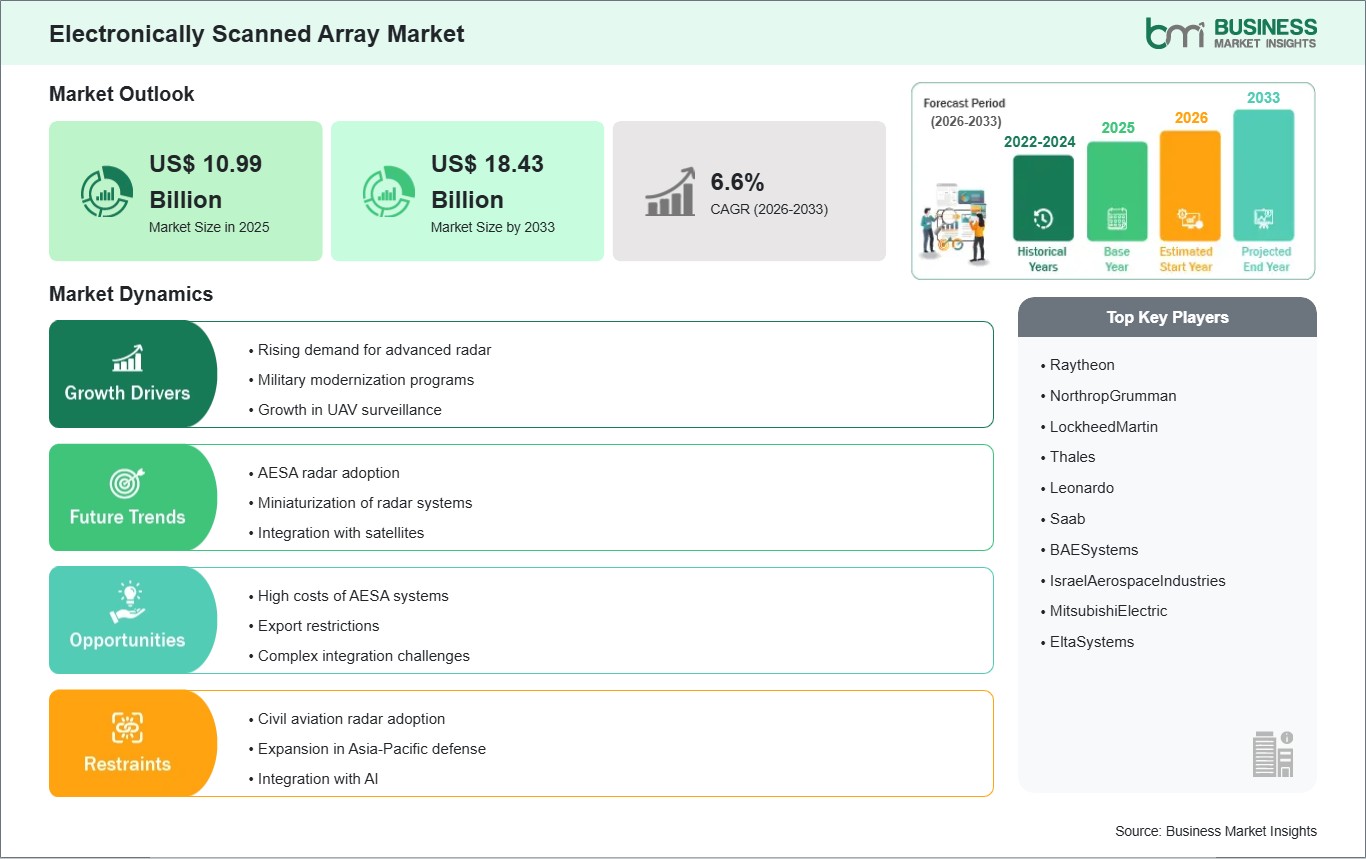
The electronically scanned array market is projected to grow from US$ 10.99 billion in 2025 to US$ 18.43 billion by 2033, registering a CAGR of 6.6% from 2026 to 2033.

By type, the market is segmented into active ESA and passive ESA. Active ESA holds a dominant position owing to its distributed transmit-receive module architecture, which enhances beam agility, reliability, and operational flexibility in complex environments. These systems support simultaneous tracking and multi-mission functionality while maintaining resilience against electronic interference. Passive ESA remains relevant in established defense infrastructures where centralized transmission architectures continue to meet operational requirements and cost considerations.

By platform, the market is categorized into airborne, naval, and land-based systems. Airborne platforms account for a significant share due to their extensive use in fighter aircraft, surveillance aircraft, and airborne early warning systems that require rapid target detection and tracking capabilities. Naval deployments strengthen maritime situational awareness and threat monitoring functions, while land-based platforms support border surveillance, air defense networks, and critical infrastructure protection through persistent monitoring capabilities.

By application, the market is segmented into radar, communication, and electronic warfare. Radar represents the leading application segment due to widespread deployment for surveillance, target acquisition, tracking, and air defense operations. Communication applications utilize electronically scanned arrays to enable high-performance directional connectivity and secure data transmission across defense networks. Electronic warfare applications continue to expand as defense organizations prioritize spectrum dominance, signal intelligence, and advanced countermeasure capabilities within integrated mission architectures.

Electronically Scanned Array Market Report Highlights:

Report Attribute Details
Market size in 2025 US$ 10.99 Billion
Market Size by 2033 US$ 18.43 Billion
Global CAGR (2026 - 2033)6.6%
Historical Data 2022-2024
Forecast period 2026-2033
Segments Covered By Type
  • Active ESA
  • Passive ESA
By Platform
  • Airborne
  • Naval
  • Land-based
By Application
  • Radar
  • Communication
  • Electronic Warfare
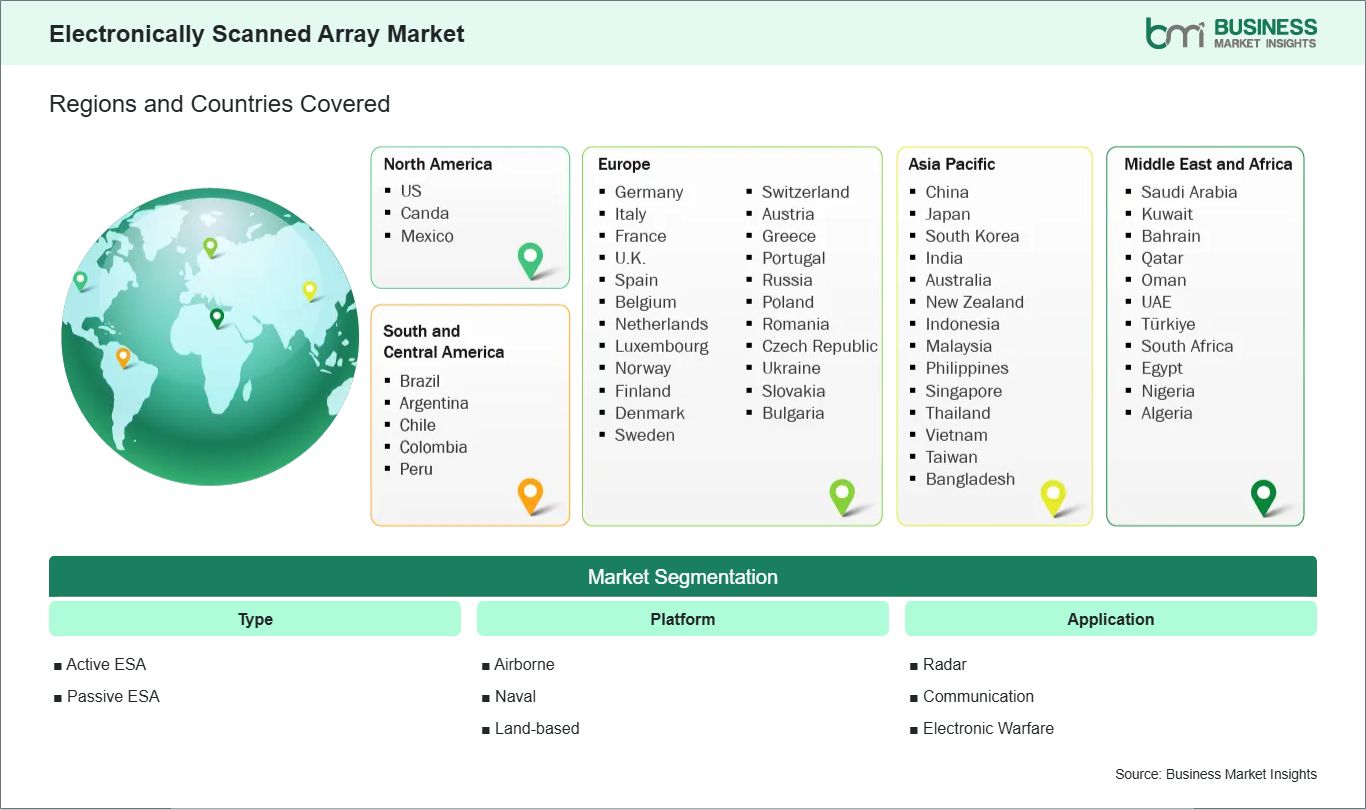
Regions and Countries Covered
North America US, Canada, Mexico
Europe Germany, Italy, France, U.K., Spain, Belgium, Netherlands, Luxembourg, Norway, Finland, Denmark, Sweden, Switzerland, Austria, Greece, Portugal, Russia, Poland, Romania, Czech Republic, Ukraine, Slovakia, Bulgaria
Asia-Pacific China, Japan, South Korea, India, Australia, New Zealand, Indonesia, Malaysia, Philippines, Singapore, Thailand, Vietnam, Taiwan, Bangladesh
South and Central America Brazil, Argentina, Chile, Colombia, Peru
Middle East and Africa Saudi Arabia, United Arab Emirates, Kuwait, Bahrain, Qatar, Oman, Turkiye, South Africa, Egypt, Nigeria, Algeria
Market leaders and key company profiles
  • Raytheon
  • NorthropGrumman
  • LockheedMartin
  • Thales
  • Leonardo
  • Saab
  • BAESystems
  • IsraelAerospaceIndustries
  • MitsubishiElectric
  • EltaSystems
Get more information on this report

Electronically Scanned Array Market Report Coverage and Deliverables:

The "Electronically Scanned Array Market Size and Forecast (2022-2033)" report provides a detailed analysis of the market covering below areas:

  • Market size and forecast at global, regional, and country levels for all key market segments covered under the scope
  • Market trends, along with market dynamics such as drivers, restraints, and key opportunities
  • Market analysis covering key trends, global and regional frameworks, major players, regulations, and recent developments
  • Industry landscape and competitive analysis covering market concentration, heat map analysis, prominent players, and recent developments
  • Detailed company profiles, including SWOT analysis

Electronically Scanned Array Market Geographic Insights:

The electronically scanned array market shows diverse regional adoption patterns influenced by defense modernization priorities, technological capabilities, procurement frameworks, and evolving operational requirements. Across global markets, attention remains focused on enhancing surveillance effectiveness, electronic protection measures, and integrated mission performance. These priorities continue to shape investment strategies and technology development programs involving electronically steered antenna systems.

North America maintains a prominent position due to sustained investment in advanced defense technologies and long-term modernization initiatives. The region benefits from established aerospace and defense ecosystems, extensive research capabilities, and ongoing platform upgrades. Procurement programs frequently emphasize multi-function radar, communication, and electronic warfare capabilities, supporting continued deployment across airborne, naval, and land-based environments.

As the governments of APAC expand their defense capabilities and invest in local technology development, the region as a whole seems to be gaining momentum. Concerns about security, military modernization and an emphasis on advanced surveillance systems are all key factors contributing to the increase in overall implementation. Countries such as Australia, New Zealand, Japan, Singapore, and South Korea are all investing heavily in next-generation radar architectures that will allow them to have greater situational awareness and operational readiness across multiple mission environments.

Europe continues to focus on collaborative technology initiatives and interoperability of systems, while enhancing its defense capabilities through investment in new technologies related to sensing and electronic warfare. Continued demand for electronically scanned arrays is driving investment in these technologies. Additionally, developing markets (the Middle East, Africa and South and Central America) are continuing to develop advanced surveillance capabilities as part of their efforts to enhance the security of their infrastructure. The opportunity for these regions presents itself through modernizing programs, upgrading platforms and developing new operational requirements.

global-market-geography
Get more information on this report

Electronically Scanned Array Market Research Report Guidance:

  • The report includes qualitative and quantitative data in the Electronically Scanned Array Market across type, platform, application, and geography.
  • The report starts with the key takeaways (chapter 2), highlighting key trends and outlook of the market.
  • Chapter 3 focuses on the research methodology of the study.
  • Chapter 4 includes ecosystem analysis.
  • Chapter 5 highlights the major industry dynamics in the market, including factors that are driving the market, prevailing deterrents, potential opportunities, as well as future trends. Impact analysis of these drivers and restraints is also covered in this section.
  • Chapter 6 discusses the market scenario, in terms of historical market revenues, and forecast till the year 2033.
  • Chapters 7 to 10 cover market segments by type, platform, application, and geography across North America, Asia Pacific, Europe, Middle East & Africa, and South & Central America. They cover the market revenue forecast and factors driving the market.
  • Chapter 11 describes the competitive analysis along with the heat map analysis for the key players operating in the market.
  • Chapter 12 describes the industry landscape analysis. It provides detailed descriptions of business activities such as market initiatives, new developments, mergers, and joint ventures globally, along with a competitive landscape.
  • Chapter 13 provides detailed profiles of the major companies operating in the market. Companies have been profiled on the basis of their key facts, business descriptions, products, financial overview, SWOT analysis, and key developments.
  • Chapter 14, i.e., the appendix, is inclusive of a brief overview of the company, a list of abbreviations, and a disclaimer.

Electronically Scanned Array Market News and Key Development:

The electronically scanned array market is evaluated by gathering qualitative and quantitative data post primary and secondary research, which includes important corporate publications, association data, and databases. Recent developments and news in the market include:

  • In June 2025, Hanwha Systems and Milkor Aerospace & Defence signed a strategic memorandum of understanding (MoU) at the Paris Air Show to integrate Hanwha’s AESA Synthetic Aperture Radar (SAR) onto the Milkor 380 MALE UAV, targeting global surveillance and reconnaissance markets.
  • In September 2025, RTX’s Raytheon business unveiled the APG-82(V)X AESA radar, an upgraded radar system utilizing Gallium Nitride technology to provide enhanced detection range, faster processing speeds, and advanced electronic warfare capabilities for combat aircraft.

Key Sources Referred:

Industry reports and market intelligence publications Government defense procurement data and policy documents Aerospace and defense regulatory publications Peer-reviewed engineering and radar technology journals Company annual reports and regulatory filings Academic studies on phased array and beamforming technologies Defense technology conference proceedings Technical white papers and industry association publications
The List of Companies - Electronically Scanned Array Market
  • Raytheon
  • NorthropGrumman
  • LockheedMartin
  • Thales
  • Leonardo
  • Saab
  • BAESystems
  • IsraelAerospaceIndustries
  • MitsubishiElectric
  • EltaSystems
Frequently Asked Questions
How big is the Electronically Scanned Array Market?

The Electronically Scanned Array Market is valued at US$ 10.99 Billion in 2025, it is projected to reach US$ 18.43 Billion by 2033.

What is the CAGR for Electronically Scanned Array Market by (2026 - 2033)?

As per our report Electronically Scanned Array Market, the market size is valued at US$ 10.99 Billion in 2025, projecting it to reach US$ 18.43 Billion by 2033. This translates to a CAGR of approximately 6.6% during the forecast period.

What segments are covered in this report?

The Electronically Scanned Array Market report typically cover these key segments-

  • Type (Active ESA, Passive ESA)
  • Platform (Airborne, Naval, Land-based)
  • Application (Radar, Communication, Electronic Warfare)

What is the historic period, base year, and forecast period taken for Electronically Scanned Array Market?

The historic period, base year, and forecast period can vary slightly depending on the specific market research report. However, for the Electronically Scanned Array Market report:

  • Historic Period : 2022-2024
  • Base Year : 2025
  • Forecast Period : 2026-2033
  • Who are the major players in Electronically Scanned Array Market?

    The Electronically Scanned Array Market is populated by several key players, each contributing to its growth and innovation. Some of the major players include:

  • Raytheon
  • NorthropGrumman
  • LockheedMartin
  • Thales
  • Leonardo
  • Saab
  • BAESystems
  • IsraelAerospaceIndustries
  • MitsubishiElectric
  • EltaSystems
  • Who should buy this report?

    The Electronically Scanned Array Market report is valuable for diverse stakeholders, including:

    • Investors: Provides insights for investment decisions pertaining to market growth, companies, or industry insights. Helps assess market attractiveness and potential returns.
    • Industry Players: Offers competitive intelligence, market sizing, and trend analysis to inform strategic planning, product development, and sales strategies.
    • Suppliers and Manufacturers: Helps understand market demand for components, materials, and services related to concerned industry.
    • Researchers and Consultants: Provides data and analysis for academic research, consulting projects, and market studies.
    • Financial Institutions: Helps assess risks and opportunities associated with financing or investing in the concerned market.

    Essentially, anyone involved in or considering involvement in the Electronically Scanned Array Market value chain can benefit from the information contained in a comprehensive market report.

    Available Report Formats

    pdf-format excel-format pptx-format
    Buy Now
    Sales Assistance
    +1 646 791 7070 (US & UK)
    Customization Form

    Please tell us your area of interest
    (Market Segments/ Regions and Countries/ Companies)