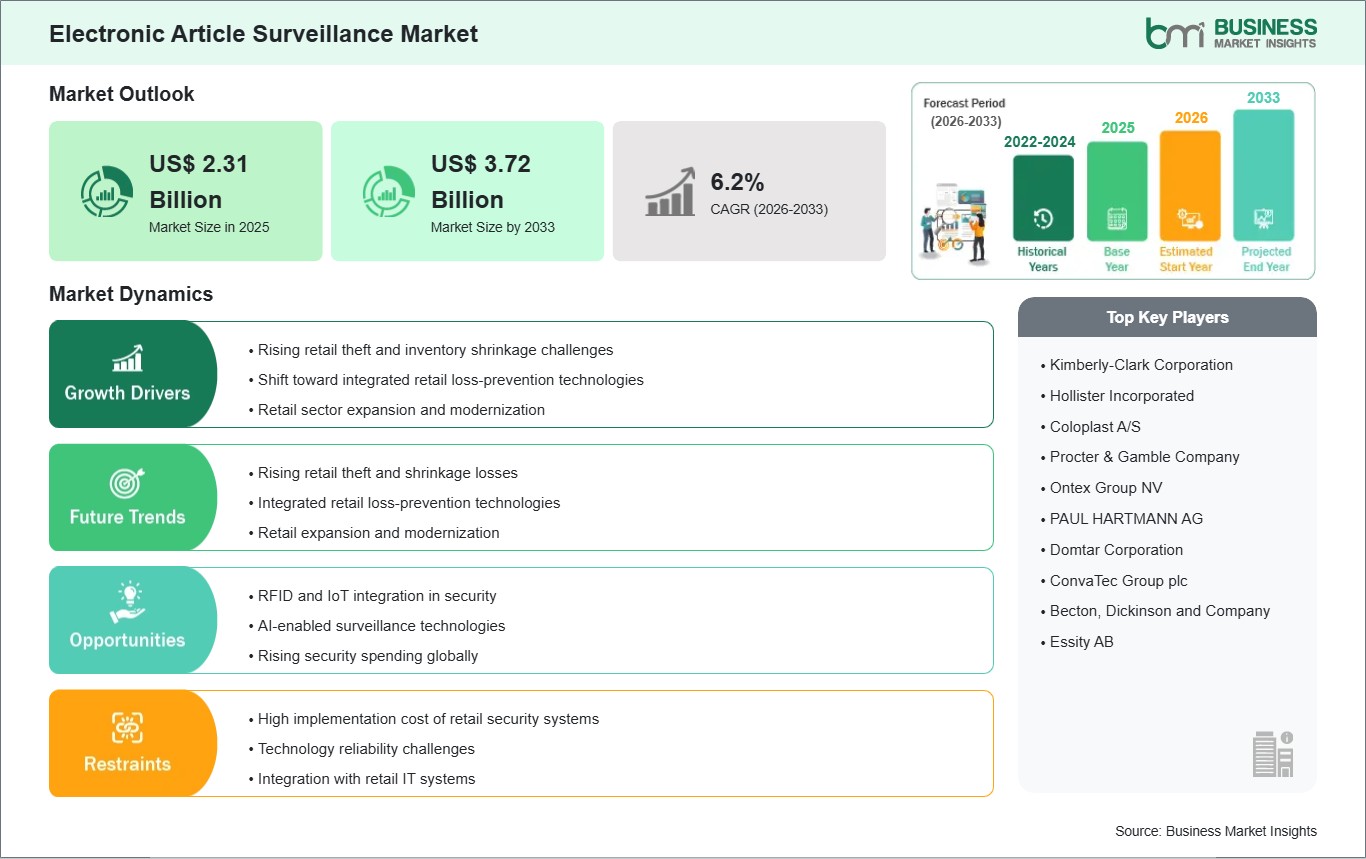
Market Summary
Executive Summary and Global Market Analysis
The global electronic article surveillance (EAS) market is a cornerstone of loss prevention and asset protection strategies, primarily focused on deterring and detecting theft of merchandise. EAS systems utilize tags and labels attached to products that interact with detection gates positioned at store exits, triggering an alarm if an unpaid item passes through. The market is underpinned by the persistent challenge of retail shrinkage—which includes shoplifting, employee theft, and administrative errors—driving continuous investment from retailers worldwide. While the retail sector is the dominant user, adoption is expanding into libraries, healthcare facilities, and other enterprises for securing high-value or sensitive assets. Market growth is fueled by the rise of organized retail crime (ORC), the expansion of large-format retail stores and shopping malls, and the integration of EAS with broader retail technology ecosystems like video analytics, point-of-sale (POS) systems, and inventory management software. The transition from purely deterrent systems to source-tagging solutions—where tags are applied at the manufacturing or distribution point—represents a significant efficiency gain and a key market trend.
Despite steady demand, the market faces challenges including the high cost of tagging for low-margin items, consumer privacy concerns, and the constant technological arms race with theft methods. Furthermore, the growth of e-commerce shifts some focus away from in-store security. However, significant opportunities are emerging from the development of RFID-based EAS which offers dual functionality for theft prevention and inventory visibility, the increasing adoption in emerging retail markets in Asia-Pacific and Latin America, and the rising need for asset protection in non-retail sectors such as manufacturing tool cribs and corporate IT asset management.
Segment Analysis
Electronic Article Surveillance Market Segmentation
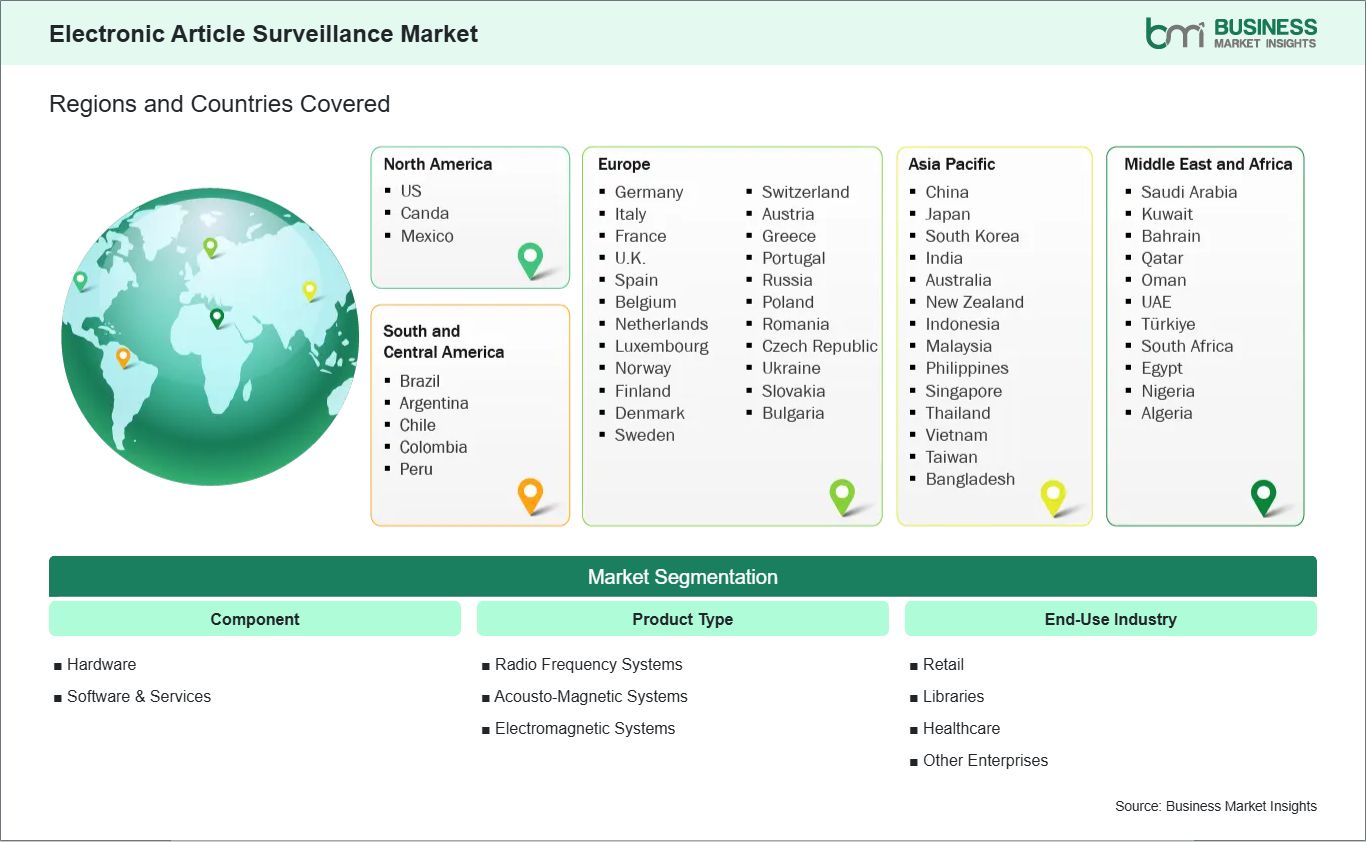
Key segments that contributed to the derivation of the electronic article surveillance market analysis are component, product type, and end-use industry.
- By component, the market is segmented into hardware, and software & services. The hardware segment, which includes detection gates, deactivators/detachers, and various tags/labels, dominated the market in 2025, constituting the essential physical infrastructure of any EAS deployment.
- By product type, the market is categorized into Radio Frequency (RF) Systems, Acousto-Magnetic (AM) Systems, and Electromagnetic (EM) Systems. Acousto-Magnetic (AM) systems held the largest market share in 2025, favored for their high detection rate, good range, and ability to work near metal.
- By end-use industry, the market is segmented into retail, libraries, healthcare, and other enterprises (including offices, manufacturing). The retail sector accounted for the overwhelming majority of the market share in 2025, spanning apparel and fashion, supermarkets, department stores, and specialty retailers. This segment's sheer scale and ongoing shrinkage challenges make it the primary driver of global demand.
Market Forces
Electronic Article Surveillance Market Drivers and Opportunities
Combating Retail Shrinkage and Organized Retail Crime
The foremost driver for the EAS market is the relentless economic pressure of retail shrinkage, estimated to cost the global retail industry hundreds of billions annually. Shoplifting, particularly by organized retail crime (ORC) rings, has become more sophisticated and brazen, compelling retailers to invest in robust, visible loss prevention technologies. EAS systems serve as both a psychological deterrent and a physical detection barrier, directly protecting profitability. This driver is intensifying as profit margins compress and retailers seek every advantage to protect bottom-line results. The integration of EAS with video surveillance and data analytics to create intelligent, evidence-based loss prevention ecosystems further strengthens its value proposition and drives replacement and upgrade cycles.
Convergence with RFID and Smart Retail Solutions
A transformative opportunity for the market lies in the convergence of EAS with Radio-Frequency Identification (RFID) technology. Modern RFID-based EAS systems use the same tag for both theft prevention and real-time inventory management. This provides a powerful dual benefit: securing merchandise while also giving retailers unparalleled visibility into stock levels, location, and movement throughout the supply chain and store. This supports omnichannel strategies like "buy online, pick up in-store" (BOPIS) and efficient replenishment. Additionally, the rise of smart retail and data-driven store operations is creating opportunities for EAS systems to generate valuable traffic and conversion data, moving beyond pure security to become a component of operational intelligence and customer experience analytics.
Size and Share Analysis
Electronic Article Surveillance Market Size and Share Analysis
By component, hardware sales, particularly of detection gates and consumable tags/labels, drive the majority of revenue. However, the ongoing shift towards solution-based sales—where software, analytics, and services are bundled—is increasing the value of the software & services segment and creating more recurring revenue streams for vendors.
By product type, AM systems lead in revenue due to their performance and reliability in high-theft-risk environments like apparel stores. RF systems are strong in volume, especially in markets with high adoption of source tagging for soft lines. EM systems hold a smaller, specialized niche, often used in libraries for book security.
By end-use industry, retail's dominance is absolute. Within retail, the apparel & fashion segment is the largest adopter, followed by supermarkets and mass merchandisers. The non-retail segments, while smaller, represent steady, high-margin niches. Libraries are mature users, while healthcare is a growing sector for securing pharmaceuticals, medical equipment, and patient files.
Report Coverage
Electronic Article Surveillance Market Report Coverage and Deliverables
The "Electronic Article Surveillance Market Size and Forecast (2022-2033)" report provides a detailed analysis of the market covering below areas:
- Electronic Article Surveillance Market size and forecast at global, regional, and country levels for all the key market segments covered under the scope
- Electronic Article Surveillance Market trends, as well as market dynamics such as drivers, restraints, and key opportunities
- Electronic Article Surveillance Market analysis covering key market trends, global and regional framework, major players, regulations, and recent market developments
- Industry landscape and competition analysis covering market concentration, heat map analysis, prominent players, and recent developments for the electronic article surveillance market
- Detailed company profiles, including SWOT analysis
Geographic Insights
Electronic Article Surveillance Market Geographic Insights
The geographical scope of the electronic article surveillance market report is divided into five regions: North America, Europe, Asia Pacific, Middle East & Africa, and South & Central America. North America is the largest established market, while Asia Pacific is anticipated to register the highest growth rate, driven by retail expansion.
North America, led by the United States, has a mature and highly penetrated market. High levels of organized retail crime, a dense network of large-format retailers, and early adoption of advanced loss prevention technologies sustain significant demand for both new installations and system upgrades.
Europe is another mature market with strong adoption across Western Europe. Stringent occupational safety and security standards, along with a high density of retail stores, support steady demand. Eastern Europe presents growth potential as modern retail formats continue to expand.
Asia Pacific is the clear growth frontier. The rapid expansion of organized retail, the construction of new shopping malls, and the growing awareness of loss prevention in countries like China, India, Japan, and Southeast Asia are driving robust demand for new EAS installations. The region's manufacturing base also supports the production of EAS components.
Industry Activity
Recent Developments
The electronic article surveillance market is evaluated by gathering qualitative and quantitative data post primary and secondary research, which includes important corporate publications, association data, and databases. A few of the key developments in the electronic article surveillance market are:
- In February 2026, SuperCom (NASDAQ: SPCB), a global provider of secure solutions for the e-Government, IoT, and Cybersecurity sectors, today announced the expansion of its electronic monitoring footprint into an additional county in Wisconsin. This latest win marks SuperCom's third project in the state, underscoring the company's ability to scale rapidly following initial deployments.
- In November 2025, NAPCO Security Technologies, Inc. (NASDAQ: NSSC), one of the leading designers and manufacturers of high-tech electronic security devices, and wireless communication services for intrusion, commercial fire alarm, access control and locking applications, as well as a leading provider of school safety solutions, today announced that it will be showcasing its latest innovations at the International Security Conference & Exposition (ISC East 2025).
Trust & Transparency
Research Methodology
The market analysis combines proprietary research with secondary data from government agencies, company disclosures, regulatory filings, industry databases and expert interviews. Market estimates are validated through data triangulation, cross-market benchmarking and analyst
review.
View Full Research Methodology
Key Sources Referred:
World Bank - Global Trade IndicatorsWorld Trade Organization (WTO)International Monetary Fund (IMF)International Trade Administration (ITA)Company websiteCompany annual reportsCompany investor presentations