Electronic and Electrical Ceramics Market Outlook (2022-2033)

Historic Data: 2022-2024   |   Base Year: 2025   |   Forecast Period: 2026-2033
Report Content: Market Scope, Market Segmentation, Market Dynamics, and Competitive Analysis

Report Coverage:
  • Material Type (Alumina Ceramics, Zirconia Ceramics, Silica, Titanate, and Others)
  • Product Type (Monolithic Ceramics, Ceramic Matrix Composites, Ceramic Coatings, and Others)
  • End User (Home Appliances, Power Grid, Medical Devices, Mobile Phones, and Others)

No. of Pages: 400
Report Code: BMIPUB00033914
Category: Chemicals and Materials
Electronic and Electrical Ceramics Market

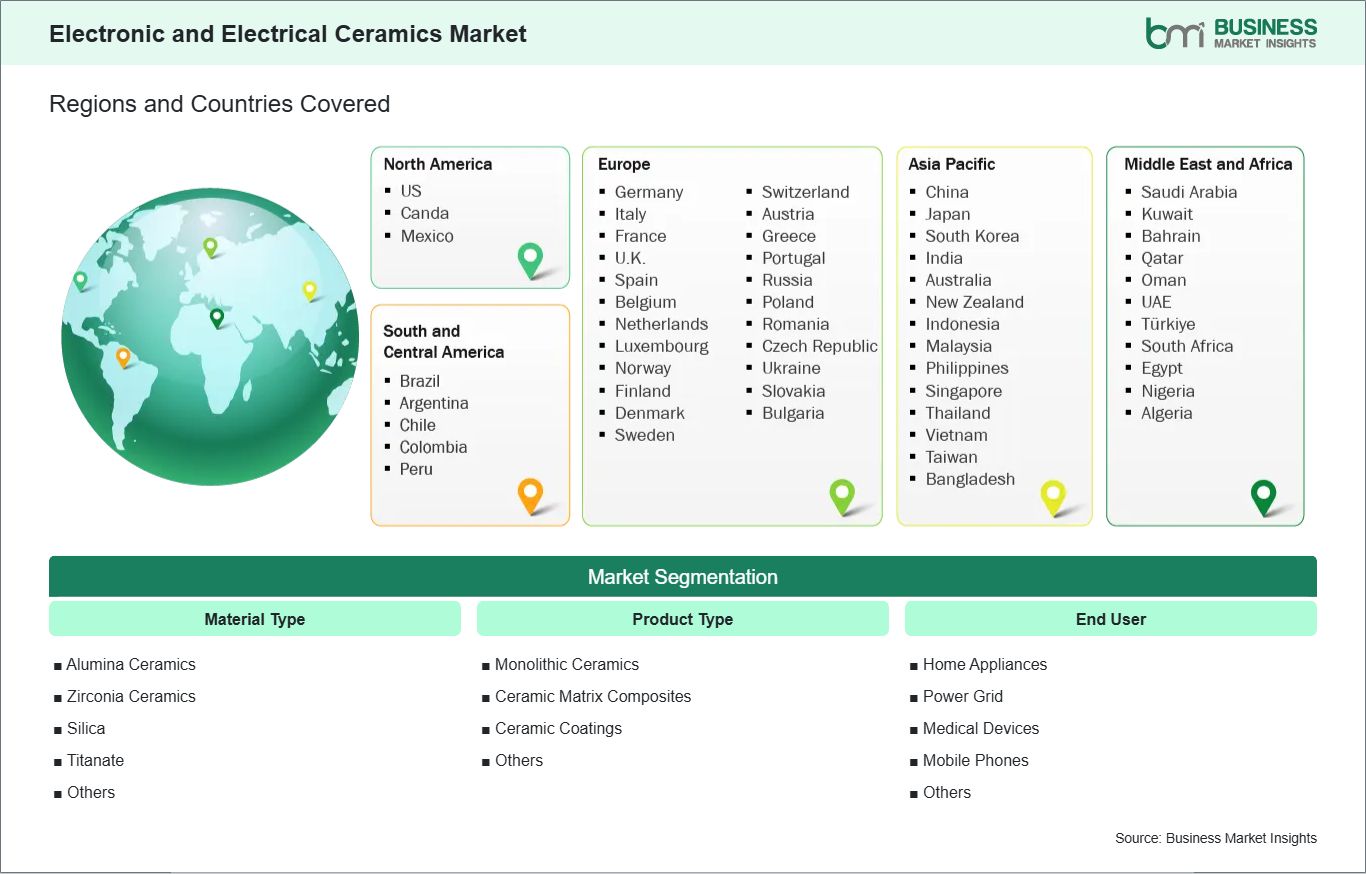
The Electronic and Electrical Ceramics Market size is expected to reach US$ 21.27 billion by 2033 from US$ 14.51 billion in 2025. The market is estimated to record a CAGR of 4.90% from 2026 to 2033.

Executive Summary and Global Market Analysis:

The global market for electronic and electrical ceramics is an important part of the larger materials and electronics industry. These ceramics provide key electrical, thermal, and mechanical properties that enhance the performance and reliability of today's electronic systems. They are designed to work as insulators, conductors, semiconductors, or dielectric materials based on the application. Electronic and electrical ceramics are commonly found in components like capacitors, insulators, substrates, sensors, actuators, and semiconductor devices. These materials are crucial for achieving miniaturization, high efficiency, and durability across various industries. Fields like consumer electronics, automotive, telecommunications, healthcare, and energy increasingly rely on these ceramics to improve functionality, safety, and design flexibility. Common types of electronic and electrical ceramics include alumina ceramics, titanates, zirconia ceramics, ferrites, and silicon carbide. Each type is designed for specific electrical and thermal needs. The manufacturing process requires careful powder preparation, shaping, and sintering techniques to get the right microstructure and performance. Processing methods like tape casting, injection molding, and 3D printing create complex shapes and high-performance parts. Additives and dopants are added deliberately to manage conductivity, dielectric properties, and thermal resistance. Recent innovations aim to develop high-purity materials, lead-free ceramics, and nanostructured options that boost efficiency and are better for the environment. There is also a growing focus on energy-efficient production methods and materials that meet environmental standards. Electronic and electrical ceramics are vital for next-generation technologies that require high reliability and performance. In the automotive sector, especially in electric vehicles, these materials are used in power electronics, battery systems, and sensors to ensure efficiency and safety. In telecommunications, they support high-frequency applications, including advanced communication networks and infrastructure. Aerospace and defense sectors depend on ceramics for their ability to endure extreme conditions, mechanical stress, and harsh environments. Renewable energy systems also use ceramic components in power generation, storage, and transmission to improve durability and efficiency. Furthermore, medical devices and industrial automation systems rely on these materials for precision, stability, and long-lasting performance. Market growth is fueled by the increasing need for smaller electronic devices, the rapid growth of electric vehicles, and the ongoing development of high-speed communication technologies like 5G. The push for energy efficiency and the rise of renewable energy systems also boost demand. Government support for environmentally friendly and lead-free materials is encouraging innovation and market growth. However, challenges such as high production costs, complex manufacturing processes, and supply chain issues for raw materials may limit expansion. Technical difficulties in maintaining quality and performance at smaller scales also pose challenges for manufacturers. Despite these hurdles, ongoing advancements in material science, along with rising investments in the electronics, automotive, and energy sectors, are likely to drive market growth. Overall, the electronic and electrical ceramics market is well-positioned to support the progress of modern technologies by providing high-performance, reliable, and sustainable material solutions that meet the changing needs of global industries.

Electronic and Electrical Ceramics Market - Strategic Insights:

global-market-strategic-framework
Get more information on this report

Electronic and Electrical Ceramics Market Segmentation Analysis:

Key segments that contributed to the derivation of the Electronic and Electrical Ceramics market analysis are material type, product type, and end user.

  • By material type, the Electronic and Electrical Ceramics market is segmented into alumina ceramics, zirconia ceramics, silica, titanate, and others. The alumina ceramics segment dominated the market in 2025.
  • By product type, the Electronic and Electrical Ceramics market is segmented into monolithic ceramics, ceramic matrix composites, ceramic coatings, and others. The monolithic ceramics segment dominated the market in 2025.
  • By end user, the Electronic and Electrical Ceramics market is segmented into home appliances, power grid, medical devices, mobile phones, and others. The mobile phones segment dominated the market in 2025.

Electronic and Electrical Ceramics Market Drivers and Opportunities:

Rising Demand from Advanced Electronics, Electric Vehicles, and Renewable Energy Systems

The global market for electronic and electrical ceramics is steadily growing. This growth comes from rising demand in advanced electronics, automotive, and renewable energy sectors. The rapid growth of consumer electronics, like smartphones, laptops, and wearable devices, has significantly increased the need for high-performance ceramic components such as capacitors, substrates, and insulators. These materials help miniaturize devices, improve thermal management, and boost electrical efficiency. The growing adoption of electric vehicles also contributes to market growth. Electronic and electrical ceramics are commonly used in power electronics, battery management systems, sensors, and charging infrastructure. They ensure reliability, safety, and efficiency. Additionally, expanding renewable energy systems, such as solar and wind power, drive the demand for durable ceramic components that can handle high temperatures and harsh conditions. Industrial automation and smart manufacturing technologies depend on these ceramics for precision, insulation, and long-term performance stability. Government initiatives that promote electrification, clean energy, and advanced manufacturing further support market growth. As electronic systems become more compact, energy-efficient, and interconnected, the demand for electronic and electrical ceramics is expected to grow in both developed and emerging economies.

Technological Advancements and Shift Toward Eco-Friendly, High-Performance, and Miniaturized Ceramic Solutions

Technological advancements are crucial in shaping the global market for electronic and electrical ceramics. Continuous innovation focuses on improving dielectric properties, thermal conductivity, mechanical strength, and overall reliability of ceramic materials. Developing advanced ceramics such as alumina, zirconia, titanates, and silicon carbide leads to better performance in various applications. These materials increasingly replace conventional components in high-temperature and high-frequency environments that require stability and durability. The industry is also seeing a strong shift toward eco-friendly and lead-free ceramic materials due to strict environmental regulations and sustainability goals. Manufacturers are investing in energy-efficient production processes and reducing hazardous substances in ceramic formulations. Advancements in nanotechnology and material engineering are enhancing the microstructure, which improves electrical performance, strength, and resistance to wear and thermal stress. Additionally, modern manufacturing methods like additive manufacturing, tape casting, and precision sintering are boosting product consistency while cutting material waste and production costs. Ongoing research aims to improve compatibility with next-generation electronic designs, extend component lifespan, and support further miniaturization. As industries focus on sustainability, efficiency, and high-performance materials, technological innovation is expected to be a key driver of long-term market growth.

Electronic and Electrical Ceramics Market Size and Share Analysis:

The popularity of alumina ceramics comes from their strong electrical insulation, high thermal conductivity, and mechanical strength. These features make them perfect for capacitors, substrates, and electronic packaging in consumer electronics and industrial devices.

Monolithic ceramics lead the market due to their reliability, simple manufacturing process, and versatility. They are used in many applications like electronic components, sensors, and power modules, which help support miniaturization and meet high-performance needs.

Mobile phones are the biggest end-user segment. The demand for small, high-performance, and thermally stable ceramic components helps create compact circuitry, improve signal quality, and ensure reliable operation in smartphones and wearable devices.

Electronic and Electrical Ceramics Market Report Highlights:

Report Attribute Details
Market size in 2025 US$ 14.51 billion
Market Size by 2033 US$ 21.27 billion
Global CAGR (2026 - 2033)4.90%
Historical Data 2022-2024
Forecast period 2026-2033
Segments Covered By Material Type
  • Alumina Ceramics
  • Zirconia Ceramics
  • Silica
  • Titanate
  • Others
By Product Type
  • Monolithic Ceramics
  • Ceramic Matrix Composites
  • Ceramic Coatings
  • Others
By End User
  • Home Appliances
  • Power Grid
  • Medical Devices
  • Mobile Phones
  • Others
Regions and Countries Covered
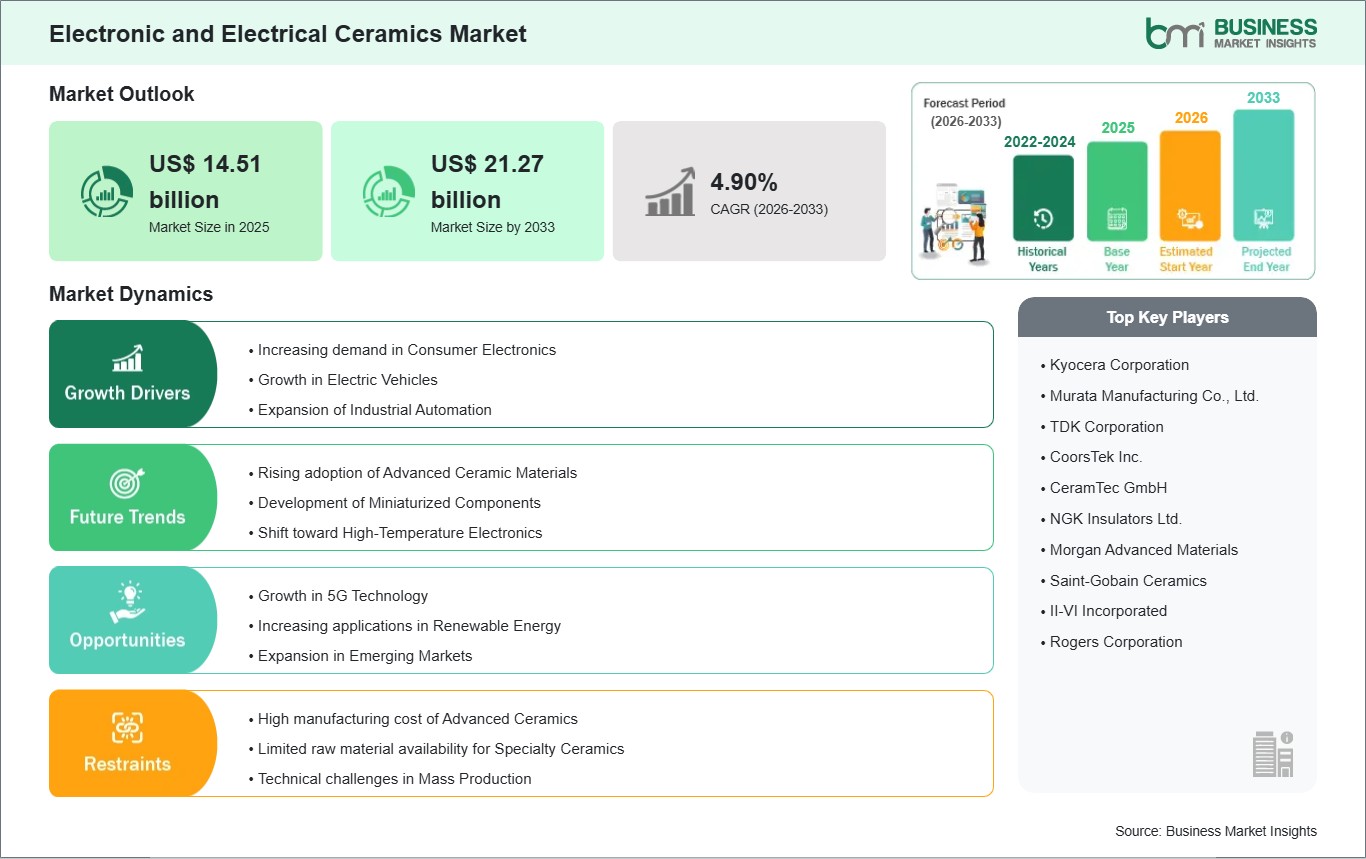
North America US, Canada, Mexico
Europe Belgium, Austria, Finland, Denmark, Greece, Poland, Romania, Russia, Ukraine, Czech Republic, Slovakia, Bulgaria, Italy, Luxembourg, Germany, Switzerland, France, Netherlands, Norway, Portugal, Spain, Sweden, United Kingdom
Asia-Pacific Australia, China, India, Japan, South Korea, Indonesia, Malaysia, Philippines, Singapore, Thailand, Vietnam, Bangladesh, New Zealand, Taiwan
South and Central America Brazil, Argentina, Peru, Chile, Colombia
Middle East and Africa Bahrain, Kuwait, Oman, Qatar, Saudi Arabia, United Arab Emirates, Turkiye, South Africa, Egypt, Algeria, Nigeria
Market leaders and key company profiles
  • Kyocera Corporation
  • Murata Manufacturing Co., Ltd.
  • TDK Corporation
  • CoorsTek Inc.
  • CeramTec GmbH
  • NGK Insulators Ltd.
  • Morgan Advanced Materials
  • Saint-Gobain Ceramics
  • II-VI Incorporated
  • Rogers Corporation
Get more information on this report

Electronic and Electrical Ceramics Market Report Coverage and Deliverables:

The "Electronic and Electrical Ceramics Market Size and Forecast (2022 - 2033)" report provides a detailed analysis of the market covering below areas:

  • Electronic and Electrical Ceramics market size and forecast at global, regional, and country levels for all the key market segments covered under the scope
  • Electronic and Electrical Ceramics market trends, as well as market dynamics such as drivers, restraints, and key opportunities
  • Electronic and Electrical Ceramics market analysis covering key market trends, global and regional framework, major players, regulations, and recent market developments
  • Industry landscape and competition analysis covering market concentration, heat map analysis, prominent players, and recent developments for the Electronic and Electrical Ceramics market
  • Detailed company profiles, including SWOT analysis

Electronic and Electrical Ceramics Market Geographic Insights:

The geographical scope of the Electronic and Electrical Ceramics market report is divided into five regions: North America, Asia Pacific, Europe, Middle East & Africa, and South & Central America. The Electronic and Electrical Ceramics market in the Asia Pacific is expected to grow significantly during the forecast period.

The Asia-Pacific Electronic and Electrical Ceramics market is segmented into China, Japan, South Korea, India, Australia, New Zealand, Indonesia, Malaysia, the Philippines, Singapore, Thailand, Vietnam, Taiwan, Bangladesh, and the Rest of Asia.

The Asia-Pacific region is the fastest-growing market for electronic and electrical ceramics. This growth comes from rapid industrialization, expanding electronics manufacturing, and a rising demand for high-performance components. Countries like China, Japan, India, and South Korea are seeing strong growth in consumer electronics, automotive production, and the semiconductor industries. These sectors rely heavily on ceramic components such as capacitors, insulators, substrates, and sensors. The growing popularity of electric vehicles significantly drives the demand for ceramic materials used in power electronics, battery management systems, and electronic control units. These materials ensure safety, efficiency, and reliability. Investments in semiconductor manufacturing, electronics assembly, and high-speed communication networks are speeding up the use of ceramic materials as lightweight, high-performance alternatives to traditional metal components. Urbanization, higher disposable incomes, and the rise of smart devices are increasing electronics consumption and the need for miniaturized, thermally stable, and reliable ceramic solutions. The growth of renewable energy projects, such as solar and wind power, is also boosting the demand for durable ceramic materials that can withstand extreme environmental and thermal conditions. The region`s established manufacturing base, integrated supply chains, and cost-effective production capabilities enable large-scale output of electronic and electrical ceramics for both local markets and export. Governments are putting initiatives in place to promote electrification, clean energy adoption, digitalization, and modern manufacturing technologies, which supports the use of high-performance and sustainable ceramic solutions. Environmental regulations encourage the development of lead-free and eco-friendly ceramics, which help to reduce the impact of industrial processes. Technological advancements, including high-purity materials, nanostructured ceramics, and better sintering and additive manufacturing techniques, are improving electrical performance, mechanical strength, and thermal stability. The availability of skilled labor, access to raw materials, and substantial investments in research and development further enhance the region`s competitive position. With ongoing industrial growth, policy support, and a focus on innovation and sustainability, the Asia-Pacific region is expected to remain a key hub for production, consumption, and technological progress in the global electronic and electrical ceramics market.

global-market-geography
Get more information on this report

Electronic and Electrical Ceramics Market Research Report Guidance:

  • The report includes qualitative and quantitative data in the Electronic and Electrical Ceramics market across material type, product type, end user, and geography.
  • The report starts with the key takeaways (chapter 2), highlighting the key trends and outlook of the Electronic and Electrical Ceramics market.
  • Chapter 3 includes the research methodology of the study.
  • Chapter 4 further includes ecosystem analysis.
  • Chapter 5 highlights the major industry dynamics in the Electronic and Electrical Ceramics market, including factors that are driving the market, prevailing deterrents, potential opportunities, as well as future trends. Impact analysis of these drivers and restraints is also covered in this section.
  • Chapter 6 discusses the Electronic and Electrical Ceramics market scenario, in terms of historical market revenues, and forecast till the year 2031.
  • Chapters 7 to 10 cover Electronic and Electrical Ceramics market segments by material type, product type, and end user across North America, Europe, Asia Pacific, Middle East and Africa, and South and Central America. They cover the market revenue and forecast and factors driving the market.
  • Chapter 11 describes the competitive analysis along with the heat map analysis for the key players operating in the market.
  • Chapter 12 describes the industry landscape analysis. It provides detailed descriptions of business activities such as market initiatives, new developments, mergers, and joint ventures globally, along with a competitive landscape.
  • Chapter 13 provides detailed profiles of the major companies operating in the Electronic and Electrical Ceramics market. Companies have been profiled on the basis of their key facts, business descriptions, products and services, financial overview, SWOT analysis, and key developments.
  • Chapter 14, i.e., the appendix is inclusive of a brief overview of the company, a list of abbreviations, and a disclaimer.

Electronic and Electrical Ceramics Market News and Key Development:

The Electronic and Electrical Ceramics market is evaluated by gathering qualitative and quantitative data post primary and secondary research, which includes important corporate publications, association data, and databases. A few of the key developments in the Electronic and Electrical Ceramics market are:

  • In January 2026, Kyocera Corporation announced the integration of its current Kagoshima Kokubu Plant (Kokubuyamashita-cho, Kirishima, Kagoshima) and Kagoshima Hayato Plant (Hayato-chouchi, Kirishima, Kagoshima) into a renamed "Kagoshima Kirishima Plant" to enhance operational efficiency. The plant will begin operations on April 1, 2026, under the new name without any location changes.
  • In February 2024, Indian Ceramics Asia 2024 presented targeted initiatives for an enhanced business experience by introducing many new experiences such as the Italian and German pavilions, demo zone, and startup pavilion, in keeping with the needs and demands of the bricks and ceramics industry. These new initiatives are in addition to the highly popular existing spaces such as the Innovation Exchange Forum, Buyer-Seller Lounge, and Ceramics Job Fair.

Key Sources Referred:

  • World Bank - Global Trade Indicators
  • World Trade Organization (WTO)
  • International Trade Administration (ITA)
  • Company website
  • Company annual reports
  • Company investor presentations
The List of Companies - Electronic and Electrical Ceramics Market
  • Kyocera Corporation
  • Murata Manufacturing Co., Ltd.
  • TDK Corporation
  • CoorsTek Inc.
  • CeramTec GmbH
  • NGK Insulators Ltd.
  • Morgan Advanced Materials
  • Saint-Gobain Ceramics
  • II-VI Incorporated
  • Rogers Corporation
Frequently Asked Questions
How big is the Electronic and Electrical Ceramics Market?

The Electronic and Electrical Ceramics Market is valued at US$ 14.51 billion in 2025, it is projected to reach US$ 21.27 billion by 2033.

What is the CAGR for Electronic and Electrical Ceramics Market by (2026 - 2033)?

As per our report Electronic and Electrical Ceramics Market, the market size is valued at US$ 14.51 billion in 2025, projecting it to reach US$ 21.27 billion by 2033. This translates to a CAGR of approximately 4.90% during the forecast period.

What segments are covered in this report?

The Electronic and Electrical Ceramics Market report typically cover these key segments-

  • Material Type (Alumina Ceramics, Zirconia Ceramics, Silica, Titanate, and Others)
  • Product Type (Monolithic Ceramics, Ceramic Matrix Composites, Ceramic Coatings, and Others)
  • End User (Home Appliances, Power Grid, Medical Devices, Mobile Phones, and Others)

What is the historic period, base year, and forecast period taken for Electronic and Electrical Ceramics Market?

The historic period, base year, and forecast period can vary slightly depending on the specific market research report. However, for the Electronic and Electrical Ceramics Market report:

  • Historic Period : 2022-2024
  • Base Year : 2025
  • Forecast Period : 2026-2033
  • Who are the major players in Electronic and Electrical Ceramics Market?

    The Electronic and Electrical Ceramics Market is populated by several key players, each contributing to its growth and innovation. Some of the major players include:

  • Kyocera Corporation
  • Murata Manufacturing Co., Ltd.
  • TDK Corporation
  • CoorsTek Inc.
  • CeramTec GmbH
  • NGK Insulators Ltd.
  • Morgan Advanced Materials
  • Saint-Gobain Ceramics
  • II-VI Incorporated
  • Rogers Corporation
  • Who should buy this report?

    The Electronic and Electrical Ceramics Market report is valuable for diverse stakeholders, including:

    • Investors: Provides insights for investment decisions pertaining to market growth, companies, or industry insights. Helps assess market attractiveness and potential returns.
    • Industry Players: Offers competitive intelligence, market sizing, and trend analysis to inform strategic planning, product development, and sales strategies.
    • Suppliers and Manufacturers: Helps understand market demand for components, materials, and services related to concerned industry.
    • Researchers and Consultants: Provides data and analysis for academic research, consulting projects, and market studies.
    • Financial Institutions: Helps assess risks and opportunities associated with financing or investing in the concerned market.

    Essentially, anyone involved in or considering involvement in the Electronic and Electrical Ceramics Market value chain can benefit from the information contained in a comprehensive market report.

    Available Report Formats

    pdf-format excel-format pptx-format
    Buy Now
    Sales Assistance
    +1 646 791 7070 (US & UK)
    Customization Form

    Please tell us your area of interest
    (Market Segments/ Regions and Countries/ Companies)