Market Summary
Executive Summary and Global Market Analysis
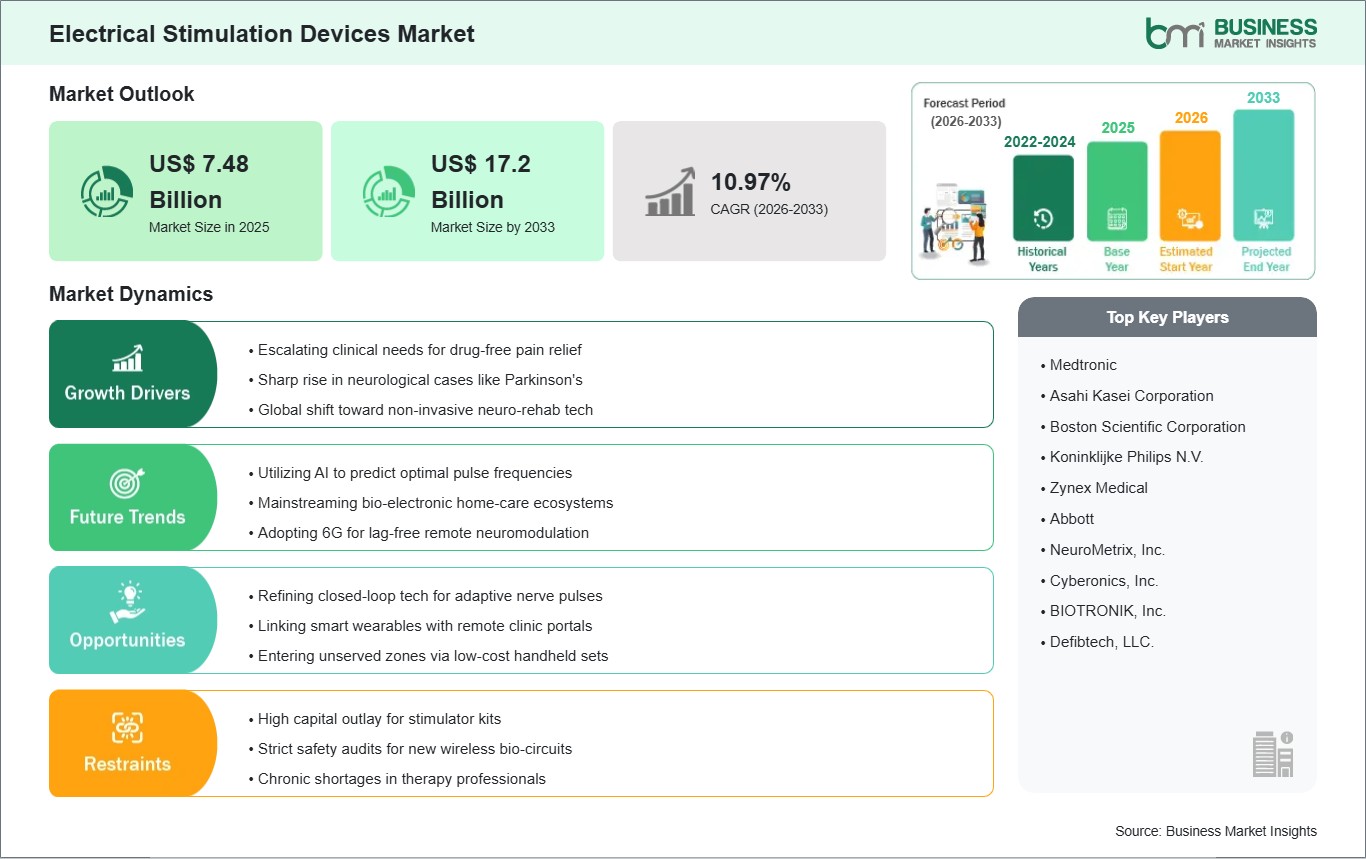
The Electrical Stimulation Devices market encompasses the essential neuro-modulation and rehabilitation infrastructure for modern therapeutic care, including spinal cord stimulators (SCS), deep brain stimulators (DBS), TENS units, and neuromuscular stimulators (NMES). Electrical stimulation devices offer distinct advantages, including highly targeted pain relief, reduced reliance on opioid pharmaceuticals, and the restoration of motor function in patients with spinal injuries or stroke. Growth is driven by the rising global burden of neurological disorders, the growing size of aging population, and the increasing demand for non-invasive rehabilitation therapies. Additionally, the shift toward AI-integrated closed-loop systems, which adjust stimulation in real-time based on patient biometrics, is fundamentally enhancing clinical efficacy.
However, several challenges can restrain market growth: high procedural and device costs remain a significant barrier, particularly for complex implantable systems in cost-sensitive regions. Stringent regulatory pathways and the threat of cybersecurity vulnerabilities in wirelessly connected stimulators pose constant compliance and safety hurdles. Furthermore, the industry is constrained by inconsistent reimbursement policies and a persistent shortage of specialized clinicians trained in advanced neuro-modulation techniques. Despite these hurdles, the market holds immense opportunities due to the universal mandate for non-pharmacological pain management and the accelerating adoption of wearable, smartphone-controlled devices for home use. The expansion into new clinical indications, such as treatment-resistant depression and gastrointestinal disorders, and the development of miniaturized, wireless leads are expected to create significant opportunities for market growth.
Segment Analysis
Electrical Stimulation Devices Market Segmentation
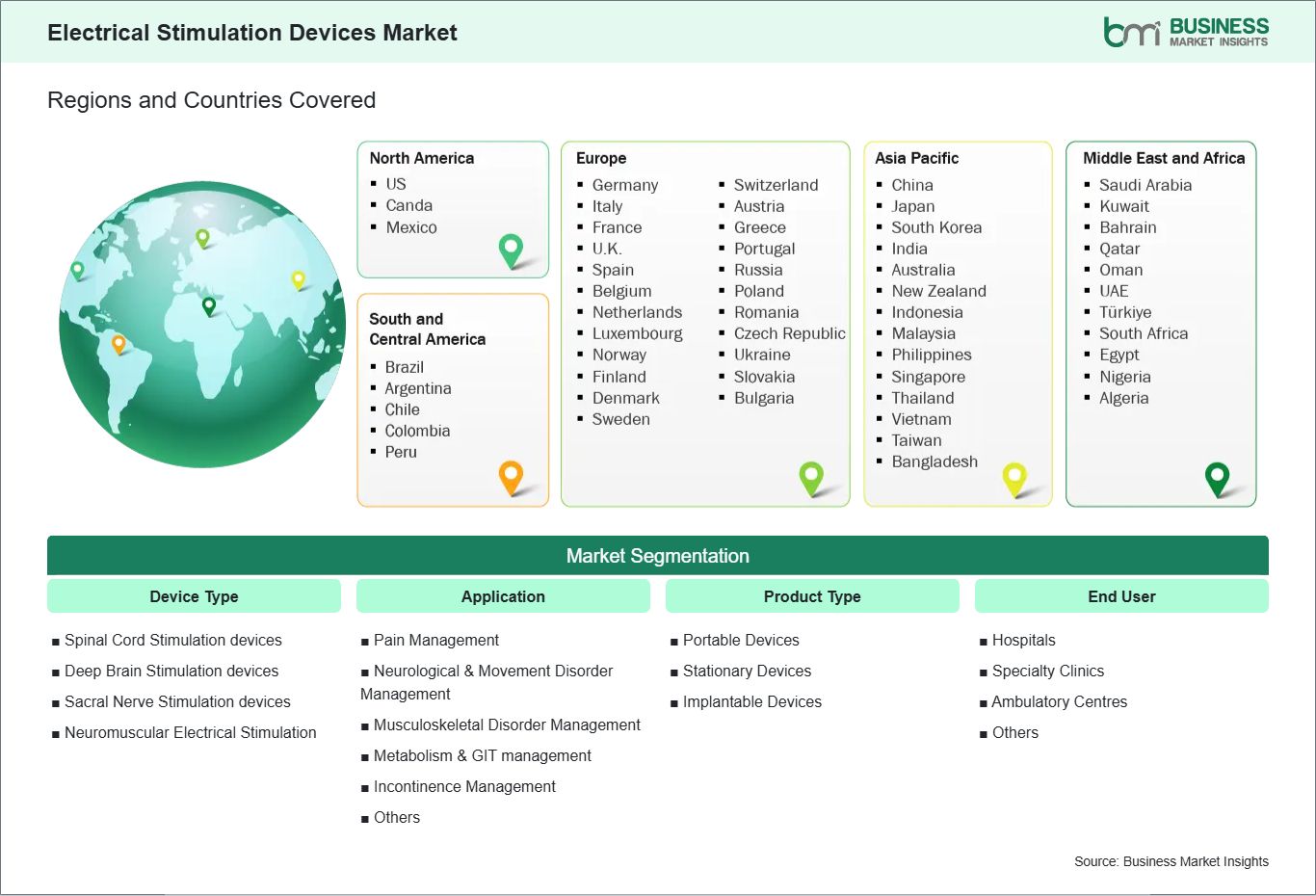
Key segments that contributed to the derivation of the Electrical Stimulation Devices market analysis are device type, application, product type, and end user.
- By Device Type, the market is segmented into Spinal Cord Stimulation Devices, Deep Brain Stimulation Devices, Sacral Nerve Stimulation Devices, Neuromuscular Electrical Stimulation, Transcutaneous Electrical Nerve Stimulation, Functional Electrical Stimulation Devices, and Others.
- By Application, the market is segmented into Pain Management, Neurological & Movement Disorder Management, Musculoskeletal Disorder Management, Metabolism & GIT management, Incontinence Management, and Others.
- By Product Type, the market is segmented into Portable Devices, Stationary Devices, and Implantable Devices.
- By End User, the market is segmented into Hospitals, Specialty Clinics, Ambulatory Centres, and Others.
Market Forces
Electrical Stimulation Devices Market Drivers and Opportunities
Rising Prevalence of Chronic Conditions
The primary driver for the Electrical Stimulation Devices market is the global escalation of chronic pain conditions, musculoskeletal disorders, and neurological diseases. With millions of patients suffering from treatment-resistant lower back pain, arthritis, and diabetic neuropathy, there is a powerful movement toward non-pharmacological alternatives to opioid-based pain management. Electrical stimulation technologies, such as Transcutaneous Electrical Nerve Stimulation (TENS) and Spinal Cord Stimulation (SCS), provide an effective, drug-free method of modulating pain signals.
This demand is further amplified by an increasing geriatric population size that is more prone to degenerative disc diseases and movement disorders like Parkinson’s. As clinical evidence continues to validate the efficacy of these devices in reducing inflammation and preventing muscle atrophy, they have transitioned from specialized clinical tools to mainstream therapeutic standards in both hospitals and physiotherapy centers.
Wearable Tech, AI, and Miniaturized Innovation
A major high-value opportunity lies in the technological evolution of miniaturized, wearable, and implantable bioelectronic devices that integrate with digital health platforms. The market is shifting away from bulky, wired stationary equipment toward wireless, "barely-there" patches and ultra-small implants that offer continuous, personalized therapy. These next-generation devices leverage Artificial Intelligence (AI) to create "closed-loop" systems, where sensors monitor physiological feedback in real time and automatically adjust stimulation parameters to suit the patient’s immediate needs.
Furthermore, the expansion of home-based rehabilitation and telehealth provides a significant opportunity for manufacturers to develop user-friendly, consumer-grade devices for muscle re-education and sports recovery. By combining advanced materials, such as bio-absorbable and stretchable electronics, with cloud-based monitoring, companies can offer holistic, long-term care solutions that improve patient adherence and outcomes outside of traditional clinical settings.
Size and Share Analysis
Electrical Stimulation Devices Market Size and Share Analysis
The Electrical Stimulation Devices market demonstrates steady growth, with size and share analysis revealing evolving trends and competitive positioning among key players. The report further examines subsegments categorized within device type, application, product type, and end user, offering insights into their contribution to overall market performance.
For instance, the Spinal Cord Stimulation devices segment holds a significant market share. These devices are often utilized as Implantable Devices to manage chronic, intractable pain that has not responded to traditional therapies. A significant trend in this segment is the development of rechargeable systems and AI-driven closed-loop algorithms, which allow for real-time adjustment of electrical pulses to match patient activity, thereby improving clinical outcomes and reducing the need for revision surgeries in hospitals.
Report Coverage
Electrical Stimulation Devices Market Report Coverage and Deliverables
The Electrical Stimulation Devices Market Size and Forecast (2022–2033) report provides a detailed analysis of the market covering below areas:
- Electrical Stimulation Devices market size and forecast at global, regional, and country levels for all the key market segments covered under the scope
- Electrical Stimulation Devices market trends, as well as market dynamics such as drivers, restraints, and key opportunities
- Electrical Stimulation Devices market analysis covering key market trends, global and regional framework, major players, regulations, and recent market developments
- Industry landscape and competition analysis covering market concentration, heat map analysis, prominent players, and recent developments for the Electrical Stimulation Devices market
- Detailed company profiles, including SWOT analysis
Geographic Insights
Electrical Stimulation Devices Market Geographic Insights
The geographical scope of the Electrical Stimulation Devices market report is divided into five regions: North America, Asia Pacific, Europe, Middle East & Africa, and South & Central America.
The Asia-Pacific Electrical Stimulation Devices Market is segmented into China, Japan, South Korea, India, Australia, New Zealand, Indonesia, Malaysia, the Philippines, Singapore, Thailand, Vietnam, Taiwan, Bangladesh, and the Rest of Asia. The market in Asia Pacific is primarily driven by the increasing aging population base and the increasing prevalence of chronic pain and neurological disorders such as Parkinson’s and epilepsy.
Growth is further bolstered by the rising demand for non-invasive electrotherapy and the high adoption of wireless, wearable stimulators for home-based care. The shift toward minimally invasive neuromodulation and the emergence of localized manufacturing for devices like TENS and spinal cord stimulators (SCS) secures Asia Pacific’s position as a primary hub for future innovation and volume growth.
Industry Activity
Recent Developments
The Electrical Stimulation Devices market is evaluated by gathering qualitative and quantitative data post primary and secondary research, which includes important corporate publications, association data, and databases. A few of the key developments in the Electrical Stimulation Devices market are:
- In October 2025, Boston Scientific Corporation announced it had entered into a definitive agreement to acquire Nalu Medical, Inc., a privately held medical technology company focused on developing and commercializing innovative and minimally invasive solutions for patients with chronic pain. Boston Scientific has been a strategic investor in Nalu Medical since 2017. The transaction consists of an upfront cash payment of approximately $533 million for the remaining equity not owned by Boston Scientific.
- In February 2025, Medtronic plc, a global leader in healthcare technology, proudly announced U.S. Food and Drug Administration (FDA) approval of BrainSense™ Adaptive deep brain stimulation (aDBS) and BrainSense™ Electrode Identifier (EI). Now Medtronic has enhanced its Percept™ DBS neurostimulators with exclusive BrainSense™ Adaptive technology, introducing aDBS for people living with Parkinson's. This feature personalizes therapy based on a patient's brain activity in real time, both in clinical settings and in daily life. It provides enhanced therapy personalization for symptom control that automatically adjusts, minimizing the need for patients to manually adjust stimulation.
Trust & Transparency
Research Methodology
The market analysis combines proprietary research with secondary data from government agencies, company disclosures, regulatory filings, industry databases and expert interviews. Market estimates are validated through data triangulation, cross-market benchmarking and analyst
review.
View Full Research Methodology
Key Sources Referred:
World Bank – Global Trade IndicatorsWorld Trade Organization (WTO)International Monetary Fund (IMF)International Trade Administration (ITA)Company WebsitesCompany Annual ReportsCompany Investor Presentations