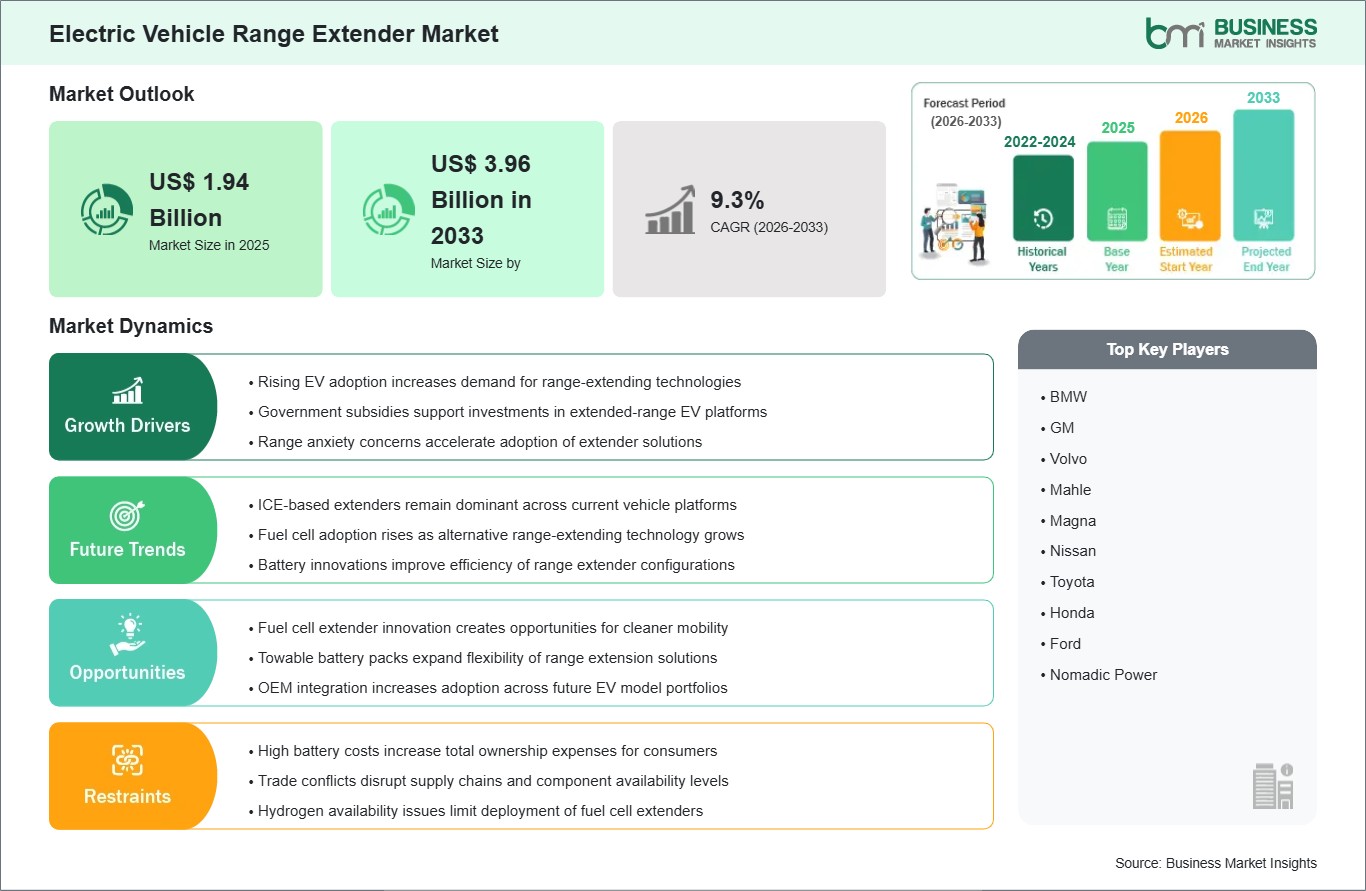
The electric vehicle range extender market size is expected to reach US$ 3.96 billion by 2033 from US$ 1.94 billion in 2025. The market is estimated to record a CAGR of 9.3% from 2026 to 2033.
Electric Vehicle (EV) Range Extender is gaining momentum as automakers seek practical solutions to address range anxiety and improve the usability of electric vehicles across diverse driving conditions. Range extenders such as internal combustion engines or auxiliary power units in small sizes become components of electric vehicles that help in recharging the batteries when their capacity is depleted. Hybrid technology makes electric vehicles more flexible for usage and encourages their wider use in areas where charging infrastructure is poor.
A key driver of this market is the persistent limitation of charging infrastructure development in several global regions, which continues to hinder full battery electric vehicle adoption. The range extender system can be considered a form of transitional technology between traditional and full-fledged electric vehicles. Moreover, the development of efficient powertrains as well as light-weight technologies is contributing to the effective use of range extenders in vehicles without causing much of an increase in weight or complexity of design.
Another important factor supporting market growth is the increasing demand from commercial fleets and long-distance transport applications. Efficiency and availability are highly regarded by logistics providers and vehicle fleet owners, which makes range-extended vehicles suitable options when there is a constant need to use them. Another trend pursued by auto manufacturers includes creating platform architectures flexible enough to support both all-electric and range-extended versions.
However, the market faces challenges related to regulatory uncertainty and the long-term shift toward fully battery electric vehicles. As governments tighten emissions regulations, the role of combustion-based range extenders may face restrictions in certain markets. Additionally, high system integration costs and added mechanical complexity can limit adoption. Despite these constraints, range extenders continue to serve as an important transitional technology supporting the global shift toward electrified mobility.

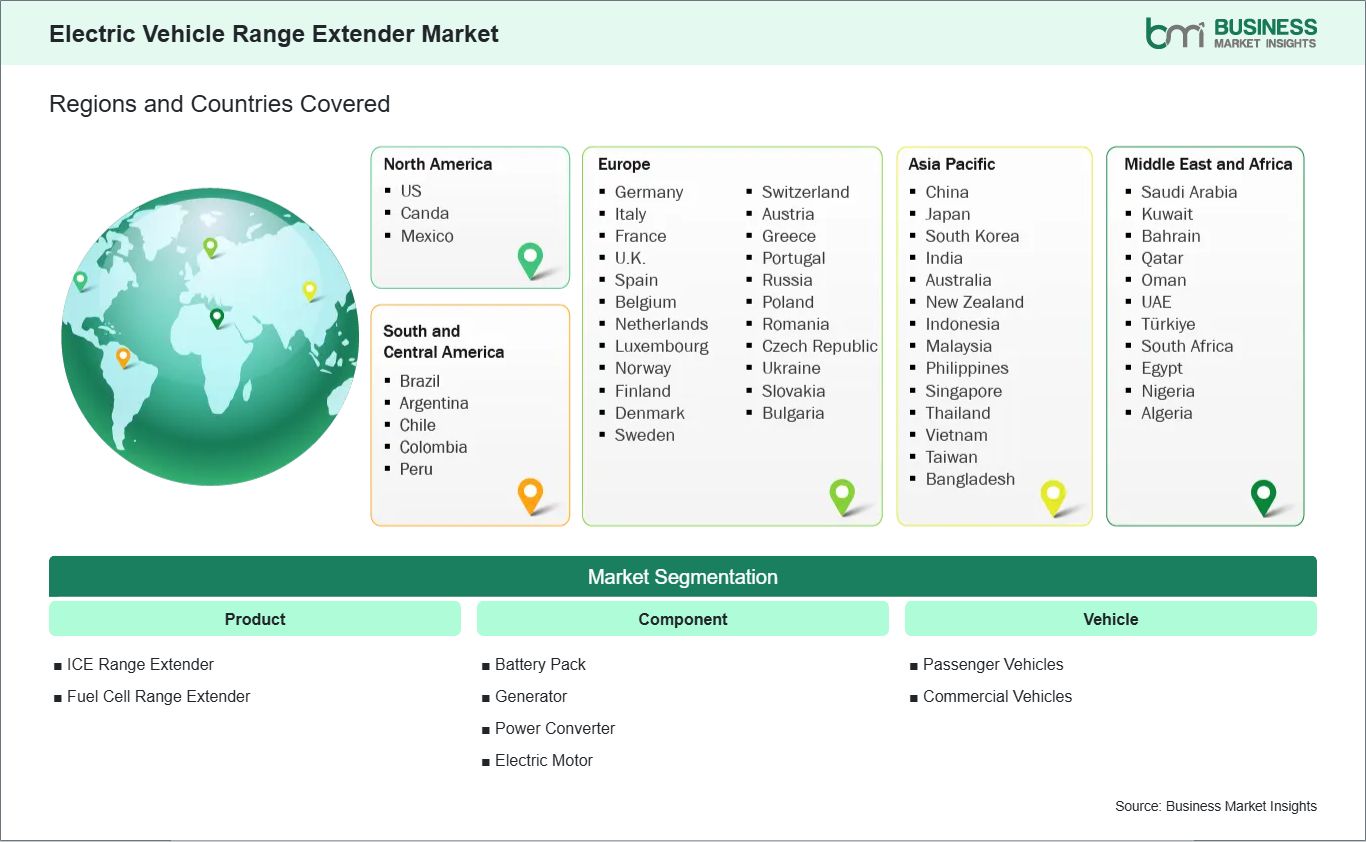
The electric vehicle (EV) range extender market is segmented based on product, component, and vehicle type, driven by the need to overcome limited battery range, improve driving flexibility, and enhance overall electric mobility adoption.
The electric vehicle range extender market is being strongly influenced by the accelerating global shift toward electric mobility. As electric vehicles find increased application among personal and commercial users, their assessment by customers will not only be based on emissions efficiency but also practical considerations and range. The use of range extenders, which utilize both battery-electric and an alternative energy source in order to improve range, is gaining popularity.
A major driver is persistent range anxiety, particularly in regions where charging networks are still uneven or concentrated in urban clusters. As the efficiency of rapid battery charging increases, however, many long-haul applications and high-usage commercial vehicles still need a more adaptable solution when it comes to power. Range extenders provide a compromise in that they allow uninterrupted mobility without the need for regular charging breaks.
Additionally, the growing diversity of EV platforms is supporting demand for modular propulsion systems. The automotive industry is creating flexible architectures that can support pure electric vehicles, as well as extended-range vehicles, on the same platform. Such flexibility makes it possible for the manufacturers to satisfy the needs of diverse customers by improving manufacturing efficiency. As the presence of EVs keeps increasing worldwide, range extenders become an important bridging technology.
An important opportunity in the market for electric vehicle range extenders is the use of range extenders powered by hydrogen fuel cells. Fuel cells are used to produce power from hydrogen in order to produce electricity. In contrast to heavy batteries, hydrogen fuel cells are both light and high density in terms of energy.
Fuel cell range extenders are particularly attractive for applications that require sustained operational uptime and rapid refueling capability. Unlike traditional battery-only technology, hydrogen-powered alternatives have the advantage of restoring driving range within a shorter timeframe, which makes them ideal for long-distance travel, business movement, and specialist vehicles. The consistent improvement in stack efficiency and durability is increasing their economic feasibility.
Another important is the integration of fuel cell systems with next-generation EV architectures. The evolution in fuel cell design, hydrogen storage media, and power electronic components has led to better integration of such technology into the vehicles without requiring any additional space. With an increased number of solutions for automotive electrification, fuel cells are expected to work alongside battery-powered vehicles by overcoming issues of range, weight, and charging downtime.
The electric vehicle range extender market is projected to grow from US$ 1.94 billion in 2025 to US$ 3.96 billion by 2033, registering a CAGR of 9.3% from 2026 to 2033.
By product, the ICE range extender dominates due to its technological maturity, lower cost, and easier integration with existing vehicle architectures compared to fuel cell-based systems, which are still limited by infrastructure and higher complexity.
By component, the battery pack dominates because it is the core energy storage element in range extender systems, accounting for the highest functional importance and cost share while enabling vehicle range extension and power stability.
By vehicle type, passenger vehicles dominate due to higher consumer demand for extended driving range, faster adoption of hybrid/range-extended EVs, and greater production volumes compared to commercial vehicles.
| Report Attribute | Details |
|---|---|
| Market size in 2025 | US$ 1.94 Billion |
| Market Size by | US$ 3.96 Billion in 2033 |
| Global CAGR (2026 - 2033) | 9.3% |
| Historical Data | 2022-2024 |
| Forecast period | 2026-2033 |
| Segments Covered | By Product
|
|
Regions and Countries Covered
| |
| North America | US, Canada, Mexico |
| Europe | Germany, Italy, France, U.K., Spain, Belgium, Netherlands, Luxembourg, Norway, Finland, Denmark, Sweden, Switzerland, Austria, Greece, Portugal, Russia, Poland, Romania, Czech Republic, Ukraine, Slovakia, Bulgaria |
| Asia-Pacific | China, Japan, South Korea, India, Australia, New Zealand, Indonesia, Malaysia, Philippines, Singapore, Thailand, Vietnam, Taiwan, Bangladesh |
| South and Central America | Brazil, Argentina, Chile, Colombia, Peru |
| Middle East and Africa | Saudi Arabia, United Arab Emirates, Kuwait, Bahrain, Qatar, Oman, Turkiye, South Africa, Egypt, Nigeria, Algeria |
| Market leaders and key company profiles |
|
The "Electric Vehicle Range Extender Market Size and Forecast (2022-2033)" report provides a detailed analysis of the market covering below areas:
In terms of geographical distribution of the Electric Vehicle Range Extender Market, there is a varied pattern of adoption based on factors such as EV penetration levels, availability of charging infrastructure, government support for hybrid and electrified mobility, and the pace of automotive electrification across different regions.
North America is a technologically advanced market for EV range extenders, supported by strong automotive OEMs, hybrid vehicle adoption, and continuous investments in electrification technologies. Plug-in hybrid electric vehicles (PHEV) and extended-range electric vehicles (EREV) are receiving increased attention in the US and Canada as an alternative mode of transport for long commutes and use in commercial fleets. In some areas, where there is a lack of facilities for charging batteries, interest in range extenders remains high. Additionally, advancements in compact engine design, generator efficiency, and hybrid powertrain integration are contributing to improved performance and fuel efficiency in range-extended EVs.
Asia Pacific is the fastest-growing region in the EV range extender market, driven by large-scale automotive production, rising EV penetration, and strong government support for vehicle electrification. The main countries in this case include China, Japan, India, and South Korea, where China is the most active country concerning extended-range EVs due to high demand and a favorable industrial policy in the country. Moreover, the Asian region is advantageous because it has a highly developed automotive industry and affordable costs, which facilitate extensive use of range extenders. In emerging markets, limited fast-charging infrastructure further strengthens the need for range extension solutions to ensure reliable long-distance mobility.
Both the region are significant contributors to the growth of the EV range extender market, driven by the transition toward electrified mobility, increasing consumer demand for extended driving range, and the need for practical solutions that bridge infrastructure gaps while supporting the broader shift toward low-emission transportation.

The electric vehicle range extender market is evaluated by gathering qualitative and quantitative data post primary and secondary research, which includes important corporate publications, association data, and databases. Recent developments and news in the market include:
The Electric Vehicle Range Extender Market is valued at US$ 1.94 Billion in 2025, it is projected to reach US$ 3.96 Billion in 2033 by .
As per our report Electric Vehicle Range Extender Market, the market size is valued at US$ 1.94 Billion in 2025, projecting it to reach US$ 3.96 Billion in 2033 by . This translates to a CAGR of approximately 9.3% during the forecast period.
The Electric Vehicle Range Extender Market report typically cover these key segments-
The historic period, base year, and forecast period can vary slightly depending on the specific market research report. However, for the Electric Vehicle Range Extender Market report:
The Electric Vehicle Range Extender Market is populated by several key players, each contributing to its growth and innovation. Some of the major players include:
The Electric Vehicle Range Extender Market report is valuable for diverse stakeholders, including:
Essentially, anyone involved in or considering involvement in the Electric Vehicle Range Extender Market value chain can benefit from the information contained in a comprehensive market report.
Please tell us your area of interest
(Market Segments/ Regions and Countries/ Companies)