Market Summary
Executive Summary and Global Market Analysis
Electric Power Steering (EPS) is an electronically controlled steering assistance system that uses electric motors, sensors, and electronic control units to provide steering support instead of traditional hydraulic mechanisms. EPS improves fuel efficiency, reduces vehicle weight, enhances steering precision, and supports advanced driver assistance systems (ADAS) and autonomous driving technologies.
The market is witnessing steady expansion as automakers increasingly prioritize vehicle electrification, fuel efficiency, and intelligent vehicle architectures. EPS systems have become a standard feature in modern passenger vehicles and are rapidly penetrating commercial vehicle platforms due to their ability to optimize energy consumption while improving vehicle control and safety.
The growing integration of ADAS technologies, including lane-keeping assistance, automated parking, and highway driving assistance, is significantly increasing demand for advanced EPS systems. As vehicles become increasingly software-driven, steering systems are evolving from mechanical assistance devices into intelligent control systems capable of supporting autonomous driving functions.
Technological advancements in steering sensors, electric motors, software calibration, and electronic control architectures are improving steering responsiveness, reliability, and driver comfort. Manufacturers are focusing on lightweight, compact, and energy-efficient EPS platforms that can support future steer-by-wire applications and software-defined vehicle architectures.
Segment Analysis
Electric Power Steering Market Segmentation
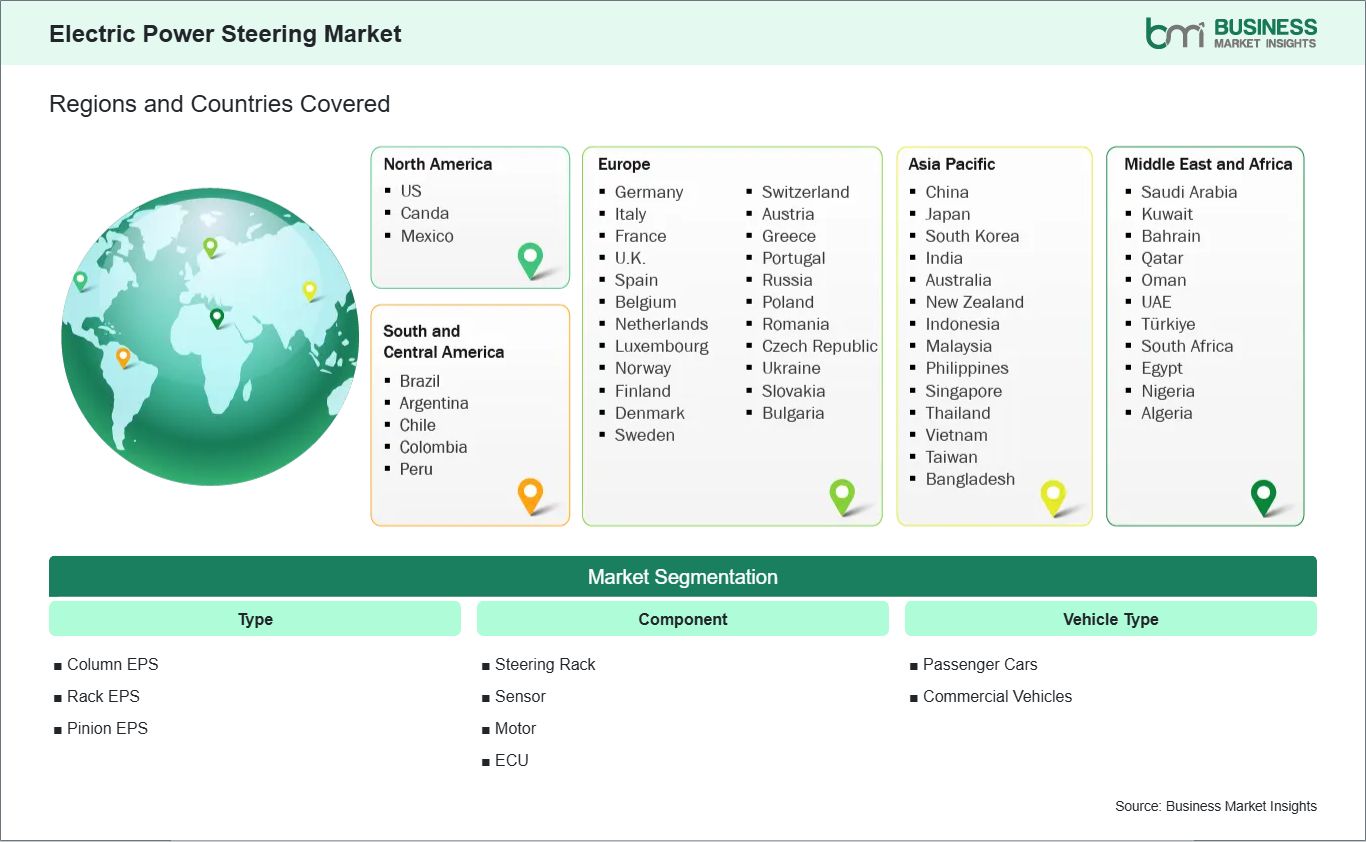
The electric power steering market is segmented based on type, component, and vehicle type, reflecting the increasing deployment of electronically controlled steering systems across automotive applications.
By Type
- Column EPS: Widely deployed in compact and mid-sized passenger vehicles due to cost efficiency, compact packaging, and ease of integration.
- Rack EPS: Accounts for a significant share owing to superior steering performance, higher load-handling capability, and growing adoption in SUVs, premium vehicles, and electric vehicles.
- Pinion EPS: Increasingly utilized in vehicles requiring balanced steering performance, efficiency, and cost optimization.
By Component
- Steering Rack: Forms the core mechanical structure of EPS systems and accounts for a substantial portion of system value.
- Sensor: Enables real-time monitoring of steering angle, torque, and vehicle dynamics for precise steering assistance.
- Motor: Provides electric steering assistance and plays a critical role in system efficiency and performance.
- ECU: Serves as the control center for steering operations, integrating sensor inputs and steering algorithms.
By Vehicle Type
- Passenger Cars: Account for the largest market share due to increasing vehicle production, electrification, and ADAS integration.
- Commercial Vehicles: Witnessing growing adoption as fleet operators seek improved fuel efficiency, driver comfort, and safety performance.
Market Forces
Electric Power Steering Market Drivers and Opportunities
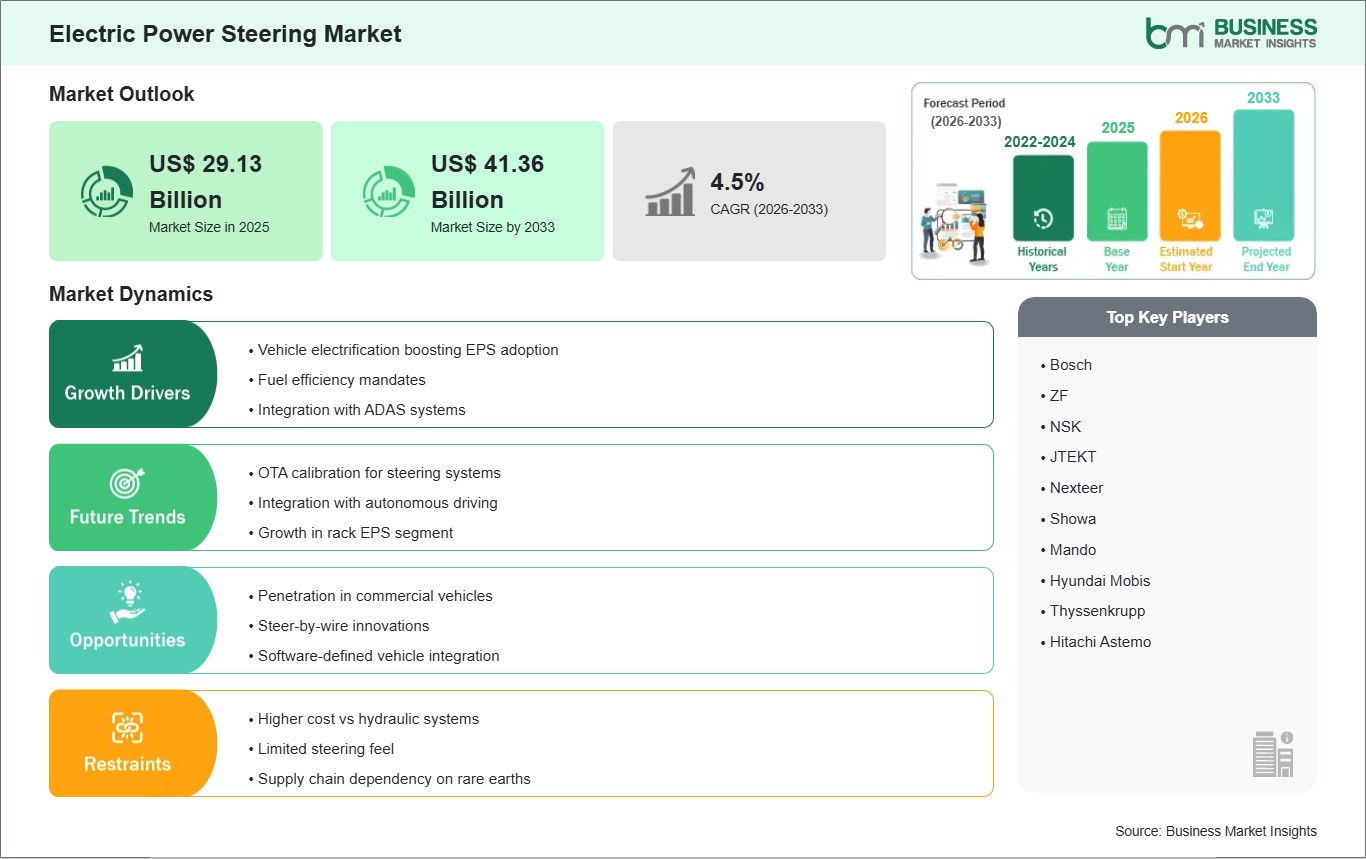
Vehicle Electrification Boosting EPS Adoption
The worldwide move toward electric vehicles is causing a dramatic increase in the number of electric power steering systems being used in new cars. The difference between hydraulic and electric power steering systems is that hydraulic systems must always be powered by the engine, while electric power steering systems only use power when steering assist is necessary. This results in improved vehicle efficiency and reduced energy consumption.
As battery electric vehicles (BEV), hybrid electric vehicles (HEV) and plug-in hybrid electric vehicles (PHEV) are experiencing greater success in the marketplace, manufacturers are beginning to change out hydraulic steering systems in favor of electric power steering systems. EPS systems help support lightweight vehicle designs, as well as extending the range or overall efficiency of electric vehicles.
EPS systems are also compatible with advanced electronic vehicle control systems and architectures, making the EPS system a critical part of many current and future electrified vehicles. The growth of EV manufacturing around the world is expected to create ongoing demand for EPS systems for both passenger and commercial vehicles.
Penetration in Commercial Vehicles
There is a significant potential for the growth of the electric power steering market from the growth of electric power steering systems on commercial vehicles. Traditionally, there was with have some commercial vehicles that need to use hydraulic steering system because they needed a lot of steering assistance to get the job done. More recently, the emergence of high powered electric motors along with better quality electronic controls and new rack assist system have led to the ability to use EPS in cars, and light trucks, and trucks used to deliver freight around the World.
There has also been an increase in fleet owners looking for solutions that help to save fuel, decrease the maintenance of vehicles and provide additional functions for the operation of the vehicle using advanced driver assist systems.
Fleet owners have begun replacing traditional commercial vehicle fleet platforms with electric versions or with fleets that will be electronically linked, which will drive up EPS adoption. Additionally, there are new opportunities for EPS suppliers as the market for autonomous capability, lane departure warning, and steer by wire systems in the commercial transportation industry continues to grow.
Size and Share Analysis
Electric Power Steering Market Size and Share Analysis
The electric power steering market is projected to grow from US$ 29.13 billion in 2025 to US$ 41.36 billion by 2033, registering a CAGR of 4.5% from 2026 to 2033.
By type, rack EPS systems account for a significant market share due to increasing deployment in electric vehicles, SUVs, and premium vehicle platforms. Column EPS continues to maintain strong adoption across compact passenger vehicles, while pinion EPS remains important in mid-range vehicle segments.
By component, steering racks and motors contribute substantially to market revenues owing to their critical role in system functionality. ECU and sensor segments are also witnessing growth as steering systems become increasingly software-intensive.
By vehicle type, passenger cars dominate market demand due to widespread EPS standardization and increasing ADAS integration. Commercial vehicle adoption is expanding as manufacturers introduce advanced steering technologies across fleet and heavy-duty applications.
Report Coverage
Electric Power Steering Market Report Coverage and Deliverables
The "Electric Power Steering Market Size and Forecast (2022 - 2033)" report provides a detailed analysis of the market covering below areas:
- Market size and forecast at global, regional, and country levels for all key market segments covered under the scope
- Market trends, along with market dynamics such as drivers, restraints, and key opportunities
- Market analysis covering key trends, global and regional frameworks, major players, regulations, and recent developments
- Industry landscape and competitive analysis covering market concentration, heat map analysis, prominent players, and recent developments
- Detailed company profiles, including SWOT analysis
Geographic Insights
Electric Power Steering Market Geographic Insights
Varying levels of growth in regional electric power steering (EPS) markets will be driven by factors such as volume of auto production, vehicle electrification strategies, government regulations and frequency of advanced driver assistance systems (ADAS) implementations. Over the next few years, as intelligent vehicle technologies and electrified mobility continue to develop around the globe, the EPS market is forecasted to continue to grow in parallel.
The North American EPS market has remained very active, in part because of the increasing use of electric vehicles (EVs), increased use of advanced driver assistance systems (ADAS) technologies and strong consumer interest in safety-related features. In addition to growing end-user demand for EPS systems, automotive OEMs in this region are making significant investments in software-enabled steering system architectures.
The electric power steering system market in Asia-Pacific is expected to be the largest and fastest-growing region as it has a very large automotive manufacturing base and a rapidly growing base of EV production. Countries with large automotive markets, such as China, Japan, South Korea and India, continue to increase their investments in vehicle electrification and next-generation mobility technologies.
Additionally, due to the new requirements surrounding fuel efficiency regulations, identified decarbonisation targets and developing economies, Europe is still a significant EPS market. European vehicle manufacturers are placing an increasing emphasis on integrating advanced EPS technology into their vehicles to enable ADAS and autonomous driving capabilities.
Emerging markets in the Middle East and Africa, and in South and Central America, have begun to progressively adopt EPS technology through vehicle modernisation programmes, upgraded automotive production capabilities and/or increased consumer demand for advanced vehicle safety features.
Industry Activity
Recent Developments
The electric power steering market is evaluated by gathering qualitative and quantitative data post primary and secondary research, which includes important corporate publications, association data, and databases. Recent developments and news in the market include:
- In March 2025, Nexteer launched its new Rear-Wheel Steering (RWS) system and announced two production contracts with a leading Chinese OEM, with production scheduled for 2026. The system complements Nexteer's EPS and steer-by-wire portfolio.
- In April 2025, Nexteer Automotive announced its new High-Output Column-Assist Electric Power Steering (HO CEPS) system. The technology expands steering assist capacity up to 110 Nm, enabling broader deployment across heavier vehicles, electric vehicles, and global vehicle platforms while offering OEMs greater flexibility in balancing performance, cost, and scalability.
Trust & Transparency
Research Methodology
The market analysis combines proprietary research with secondary data from government agencies, company disclosures, regulatory filings, industry databases and expert interviews. Market estimates are validated through data triangulation, cross-market benchmarking and analyst
review.
View Full Research Methodology
Key Sources Referred:
International Energy Agency International Organization of Motor Vehicle Manufacturers World Bank International Monetary Fund International Trade Administration World Trade Organization European Automobile Manufacturers' Association Society of Automotive Engineers International Council on Clean Transportation United Nations Economic Commission for Europe