Market Summary
Executive Summary and Global Market Analysis
Electric mid and large buses are zero-emission public transportation vehicles powered by battery-electric or fuel-cell electric propulsion systems. These buses are increasingly deployed across urban transit networks, intercity transportation routes, and school transportation systems to support decarbonization objectives and improve air quality. The 9 - 14m category represents a core segment of modern public transportation fleets due to its versatility, passenger capacity, and suitability for a broad range of operating environments.
The market is experiencing strong growth as governments, transit authorities, and fleet operators accelerate the replacement of conventional diesel-powered buses with zero-emission alternatives. Public transportation electrification has become a key component of national sustainability strategies, urban mobility planning, and greenhouse gas reduction programs. Increasing investments in charging infrastructure and clean transportation initiatives are further supporting market expansion.
Urbanization and population growth are increasing demand for efficient and environmentally sustainable public transportation systems. Electric buses provide significant advantages in terms of lower operating costs, reduced noise pollution, and zero tailpipe emissions. As cities continue to prioritize sustainable mobility solutions, adoption of electric buses is expected to increase substantially across both developed and emerging markets.
Technological advancements in battery systems, energy management software, charging technologies, and fuel-cell platforms are improving vehicle performance and operational reliability. Enhanced battery energy density, faster charging capabilities, and improved vehicle range are helping transit operators overcome traditional adoption barriers. Integration of intelligent fleet management systems is also enabling greater operational efficiency and predictive maintenance capabilities.
Competitive conditions remain highly dynamic, with manufacturers focusing on product innovation, localization strategies, and strategic partnerships with public transit agencies. Continuous investments in electric mobility technologies are expected to drive long-term market growth.
Segment Analysis
Electric Mid & Large 9-14m Bus Market Segmentation
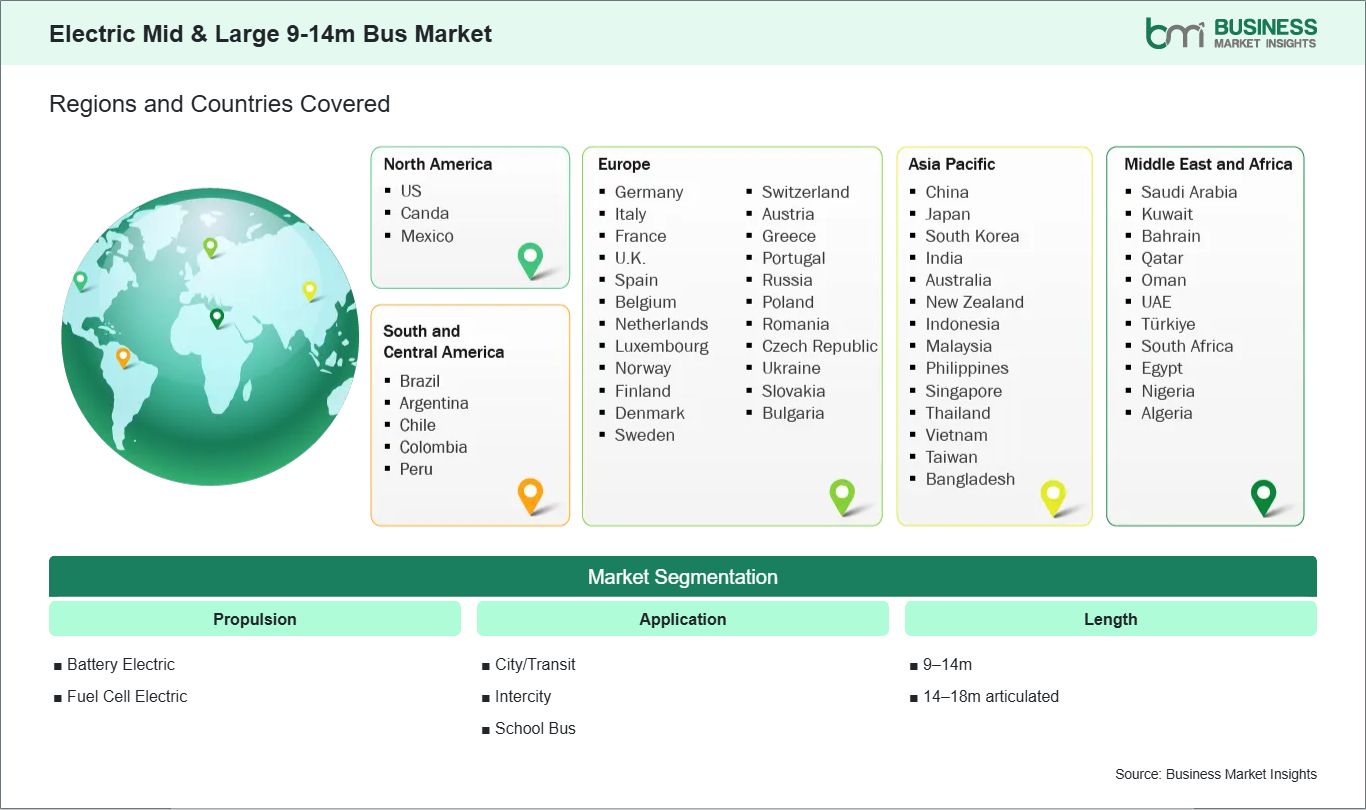
The electric mid and large 9 - 14m bus market is segmented based on propulsion, application, and length, reflecting the growing adoption of electrified public transportation solutions across diverse operating environments.
By Propulsion
- Battery Electric: Dominates market demand owing to widespread deployment across public transportation systems, lower operating costs, and expanding charging infrastructure.
- Fuel Cell Electric: Gaining attention in long-range and high-utilization applications requiring rapid refueling and extended operational flexibility.
By Application
- City/Transit: Represents the largest market segment due to increasing electrification of municipal and urban transportation fleets.
- Intercity: Experiencing growing adoption as battery performance improvements support longer-distance transportation requirements.
- School Bus: Witnessing increased deployment through government-supported clean transportation initiatives and school fleet modernization programs..
By Length
- 9 - 14m: Accounts for a significant market share owing to its suitability for urban transit, regional transportation, and educational transportation services.
- 14 - 18m articulated: Increasingly utilized in high-capacity transit corridors requiring greater passenger-carrying capability and operational efficiency.
Market Forces
Electric Mid & Large 9-14m Bus Market Drivers and Opportunities
Diesel Retirement Mandates Boosting Demand
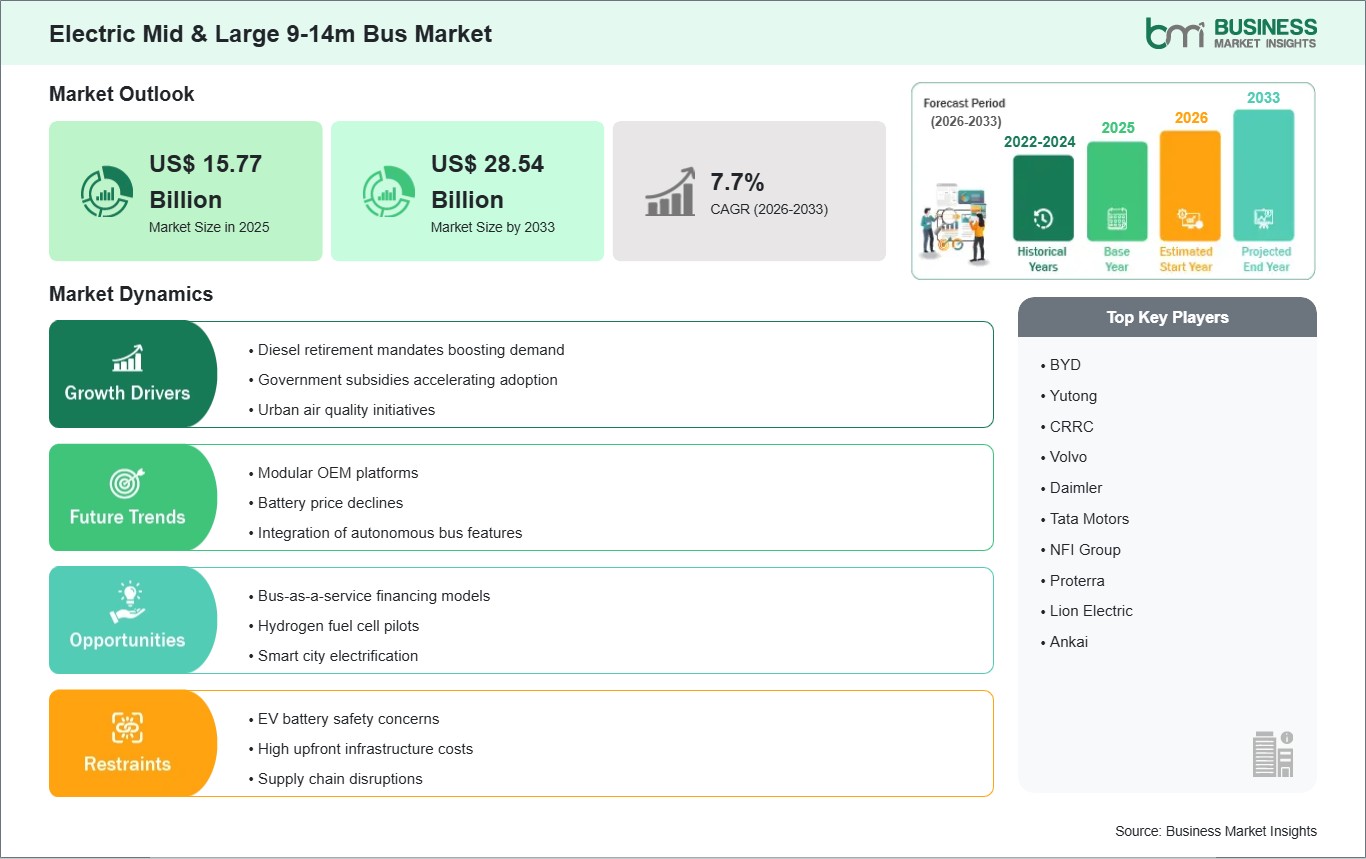
Multiple diesel retirement mandates are being implemented across various areas at a fast pace. These mandates will create more demand for electric mid- to large-sized buses. Regulations being developed by governments and transportation authorities that phase out older diesel-powered fleets will reduce emissions and improve urban air quality, and help to meet climate goals.
Transit agencies are moving to replace old diesel buses with battery-electric or fuel-cell electric buses in order to comply with the regulations and be eligible for government funding programs. The mandates create long-term procurement opportunities for bus manufacturers and facilitate large-scale fleet electrification programs.
Cities worldwide are creating low- and zero-emission transportation zones, which limit the use of traditional diesel vehicles. These and other policies help to drive demand for electric buses, as municipalities are pursuing sustainable options to modernize public transportation.
Bus-as-a-Service Financing Models
One area of opportunity for the expansion of buses into new markets is through the creation of bus-as-a-service (BaaS) financing models. BaaS provides the operator an opportunity to access electric buses by way of a subscription or service-based business model, which lowers the upfront cost of capital and creates greater financial flexibility for operators.
Most BaaS offerings bundle together the vehicle, charging infrastructure, maintenance, software platform, and operational support into one package, thereby assisting transit agencies with their financing barriers during fleet electrification, while also limiting the risks associated with the adoption of new technologies.
BaaS will also provide the opportunity for additional municipalities and private transportation companies with limited capital resources to gain access to innovative financing options for purchasing electric buses, which will result in an acceleration of electric bus deployment. Given the continued evolution of service-based mobility offerings, BaaS will likely play a significantly larger role in the development of the electric bus market.
Size and Share Analysis
Electric Mid & Large 9-14m Bus Market Size and Share Analysis
The electric mid and large 9 - 14m bus market is projected to grow from US$ 15.77 billion in 2025 to US$ 28.54 billion by 2033, registering a CAGR of 7.7% from 2026 to 2033.
By propulsion, battery electric buses account for the largest market share due to established charging ecosystems, declining battery costs, and strong government support. Fuel-cell electric buses are gradually expanding in markets requiring longer operating ranges and rapid refueling capabilities.
By application, city/transit buses dominate market demand as urban transportation authorities continue implementing large-scale fleet electrification programs. Intercity and school bus segments are also witnessing growing adoption driven by advancements in battery technology and clean transportation policies.
By length, the 9 - 14m segment represents the largest share owing to its broad deployment across public transportation networks. Demand for 14 - 18m articulated buses is increasing in densely populated urban corridors requiring high-capacity transportation solutions.
Report Coverage
Electric Mid & Large 9-14m Bus Market Report Coverage and Deliverables
The "Electric Mid and Large 9 - 14m Bus Market Size and Forecast (2022 - 2033)" report provides a detailed analysis of the market covering below areas:
- Market size and forecast at global, regional, and country levels for all key market segments covered under the scope
- Market trends, along with market dynamics such as drivers, restraints, and key opportunities
- Market analysis covering key trends, global and regional frameworks, major players, regulations, and recent developments
- Industry landscape and competitive analysis covering market concentration, heat map analysis, prominent players, and recent developments
- Detailed company profiles, including SWOT analysis
Geographic Insights
Electric Mid & Large 9-14m Bus Market Geographic Insights
Regional variations in the electric mid- and large-bus sector such as transportation policy, urbanisation rates, investment in public infrastructure and environmental regulations, are responsible for the varying levels of growth in electric bus markets across the world. In addition to government support for the establishment of clean public transportation systems, electric bus sales also have a close connection to overall market growth.
In the Asia-Pacific region, electric bus adoption is very high due to strong government support for public transportation electrification, advanced manufacturing capacity for electric buses, and the use of large-scale electric bus deployment programs. Countries like China and India are making large investments in public transport electrification as part of the overall urban air quality improvement plan in order to help reduce reliance on fossil fuels.
Europe is also a large market due to both the strict emissions regulations and climate targets placed on the region by the European Union and due to the continued investment in public transport projects that support public transportation electrification efforts of various municipal transit authorities throughout Europe.
In North America, strong electric bus market growth has largely been driven by governments at both the federal and state levels, providing funding to assist with public transportation electrification projects and investments in charging infrastructure. There are currently many public transportation agencies that are working to accelerate their fleet replacement processes to meet both sustainability metrics and improve public transportation service efficiency.
Emerging Markets in the Middle East and Africa, South and Central America similarly are seeing the gradual expansion of electric bus adoption as public transport investments, urban mobility projects, and smart city initiatives are increasingly becoming part of their overall economic strategy development plans.
Industry Activity
Recent Developments
The electric mid & large 9-14m bus market is evaluated by gathering qualitative and quantitative data post primary and secondary research, which includes important corporate publications, association data, and databases. Recent developments and news in the market include:
- In January 2025, BYD Japan unveiled the new J7 medium-size electric bus and announced deliveries beginning in 2025. The J7 was specifically developed for the Japanese market and expands BYD's electric bus portfolio in the mid-size segment.
- In February 2026, BYD, the leading manufacturer of new energy vehicles, has announced a strategic partnership with DLL, a global asset finance company for equipment and technology, to provide comprehensive financing solutions for BYD electric trucks and buses across Europe.
Trust & Transparency
Research Methodology
The market analysis combines proprietary research with secondary data from government agencies, company disclosures, regulatory filings, industry databases and expert interviews. Market estimates are validated through data triangulation, cross-market benchmarking and analyst
review.
View Full Research Methodology
Key Sources Referred:
International Energy Agency (IEA) - Global EV Outlook International Association of Public Transport (UITP) International Organization of Motor Vehicle Manufacturers (OICA) World Bank - Urban Mobility and Transport Data International Monetary Fund (IMF) International Trade Administration (ITA) World Trade Organization (WTO)