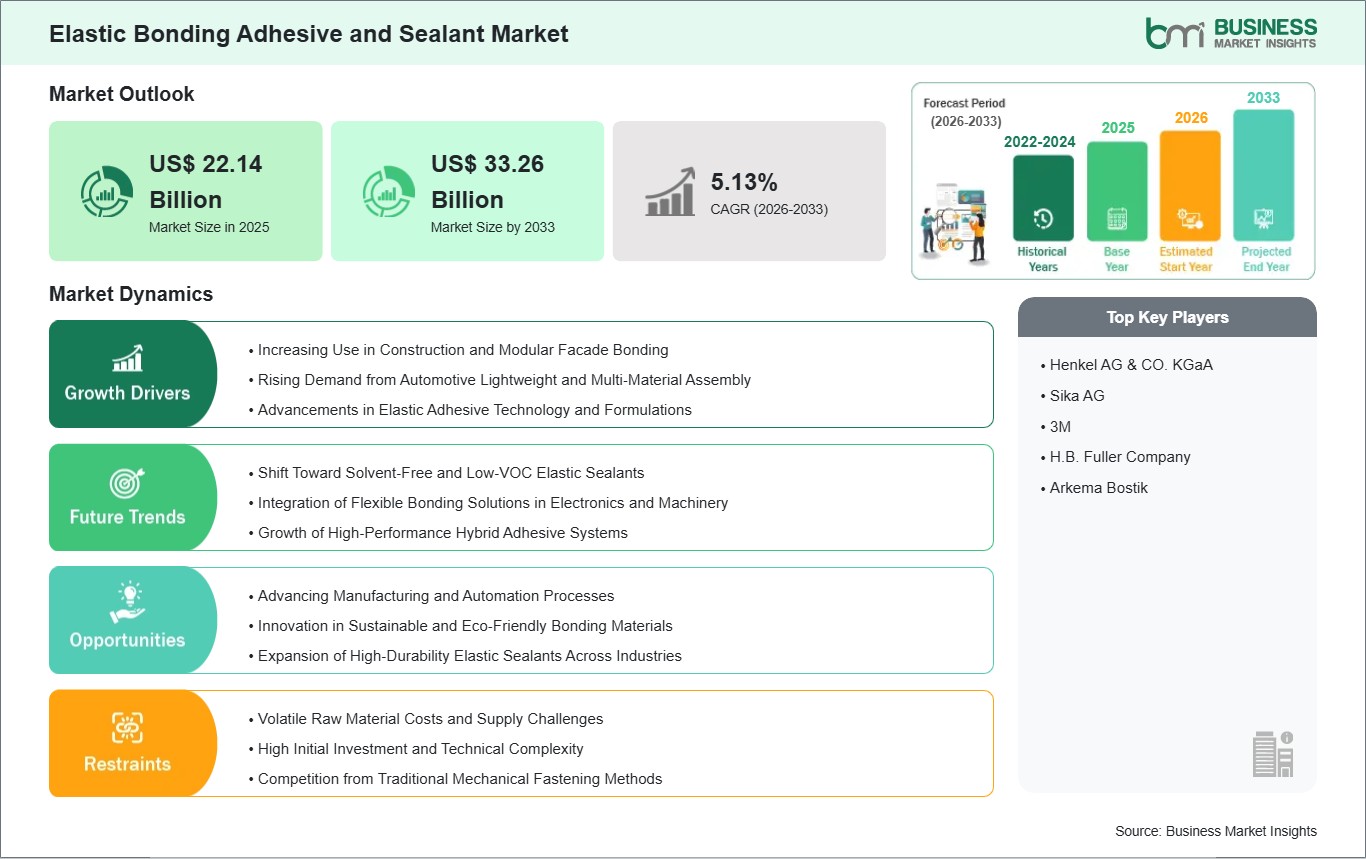
The Elastic Bonding Adhesive and Sealant Market size is expected to reach US$ 33.26 Billion by 2033 from US$ 22.14 Billion in 2025 .The market is estimated to record a CAGR of 5.13% from 2026 to 2033.
The world market for elastic bonding adhesives and sealants is in development as a solution-based market serving industries in need of materials that can accommodate movement, stress, and environmental changes. The adhesives and sealants are increasingly being used for applications in which conventional rigid bonding is no longer possible, such as in dynamic construction joints, flexible facades, and vibrating machine assemblies. This is driven by the growing interest in design flexibility, as architects and engineers look for materials that can perform while ensuring structural integrity is not compromised. Besides serving industries, consumer-driven markets for home renovations and DIY markets are driving the use of versatile adhesives and sealants that can accommodate temperature changes and minor substrate movement. One unique driver for this market is the focus on multi-material bonding, where industries are increasingly using composite materials made from metal, glass, plastics, and other lightweight alloys. The role of elastic adhesives and sealants in this regard is significant, as they help in bonding these composite materials without using mechanical fasteners, thus providing better aesthetics and saving labor costs. On the other hand, this market may also be restrained by the common perception that these materials are more expensive and require critical conditions for their application. However, as experimentation continues in hybrid polymers and delivery systems, this market is becoming increasingly relevant and thus integral to contemporary design and manufacturing practices.

Key segments that contributed to the derivation of the elastic bonding adhesive and sealant market analysis are product type and end-use industry.
The demand for elastic bonding adhesives and sealants is growing as construction techniques evolve toward modern, modular designs. Builders and architects are increasingly relying on these adhesives to join materials like glass, metal, and composites in facades, curtain walls, and structural elements. Unlike traditional mechanical fasteners, elastic adhesives provide flexibility, absorb vibrations, and maintain long-term durability, making them an essential component in contemporary construction projects.
Modular construction, in particular, benefits from the use of elastic adhesives and sealants. Prefabricated panels and building sections can be bonded efficiently on-site or in factories, reducing installation time while ensuring structural integrity. This approach also allows for safer, cleaner construction with fewer mechanical fixings and minimal disturbance to the environment, aligning with growing sustainability considerations in building practices.
The driver is not just practical but also aesthetic. Designers increasingly prefer seamless facades and joints that adhesives can provide. Elastic bonding adhesives maintain performance under temperature fluctuations, wind loads, and other environmental stresses, enabling architects to create innovative building exteriors without compromising on safety or longevity. As modern construction trends continue to favor modularity and design flexibility, the reliance on elastic adhesives and sealants continues to rise.
Advancements in manufacturing and automation present significant opportunities for the elastic bonding adhesive and sealant market. Automated production lines, precision dispensing systems, and robotics are making it easier to apply adhesives consistently, reducing waste and improving product performance. This technological shift opens the door for broader adoption in high-volume industrial applications where accuracy and repeatability are critical.
The opportunity also lies in tailored formulations that meet specific manufacturing requirements. Adhesives and sealants can now be customized for rapid curing, high adhesion to multiple substrates, or enhanced elasticity to match modern building materials. These innovations allow manufacturers to develop products that fit seamlessly into automated assembly processes, supporting faster construction cycles and higher efficiency in prefabrication and modular building setups.
Additionally, automation and advanced processing enable broader applications in complex construction and industrial projects. From large-scale curtain walls to precision-bonded panels in transportation and electronics, manufacturers can leverage these adhesives to meet both performance and operational demands. As production technologies continue to advance, elastic bonding adhesives and sealants are positioned to play an increasingly central role in enabling faster, more sustainable, and aesthetically sophisticated construction and industrial solutions.

The elastic bonding adhesive and sealant market is experiencing steady growth, with market size and share analysis reflecting evolving treatment preferences and competitive dynamics among key players. The report evaluates important subsegments categorized within product type and end-use industry, highlighting their respective contributions to overall market performance.
By product type, the Polyurethane (PU) subsegment dominated the Elastic Bonding Adhesive and Sealant market in 2025. Polyurethane adhesives and sealants offer excellent flexibility, strong bonding strength, and durability, making them highly suitable for demanding applications, which drives their widespread adoption.
In terms of end‑user industry, the Building and Construction subsegment dominated the Elastic Bonding Adhesive and Sealant market in 2025. Building and construction applications benefit from these adhesives and sealants’ superior performance in sealing, bonding, and weather resistance, supporting strong market demand.
| Report Attribute | Details |
|---|---|
| Market size in 2025 | US$ 22.14 Billion |
| Market Size by 2033 | US$ 33.26 Billion |
| Global CAGR (2026 - 2033) | 5.13% |
| Historical Data | 2022-2024 |
| Forecast period | 2026-2033 |
| Segments Covered | By Product Type
|
|
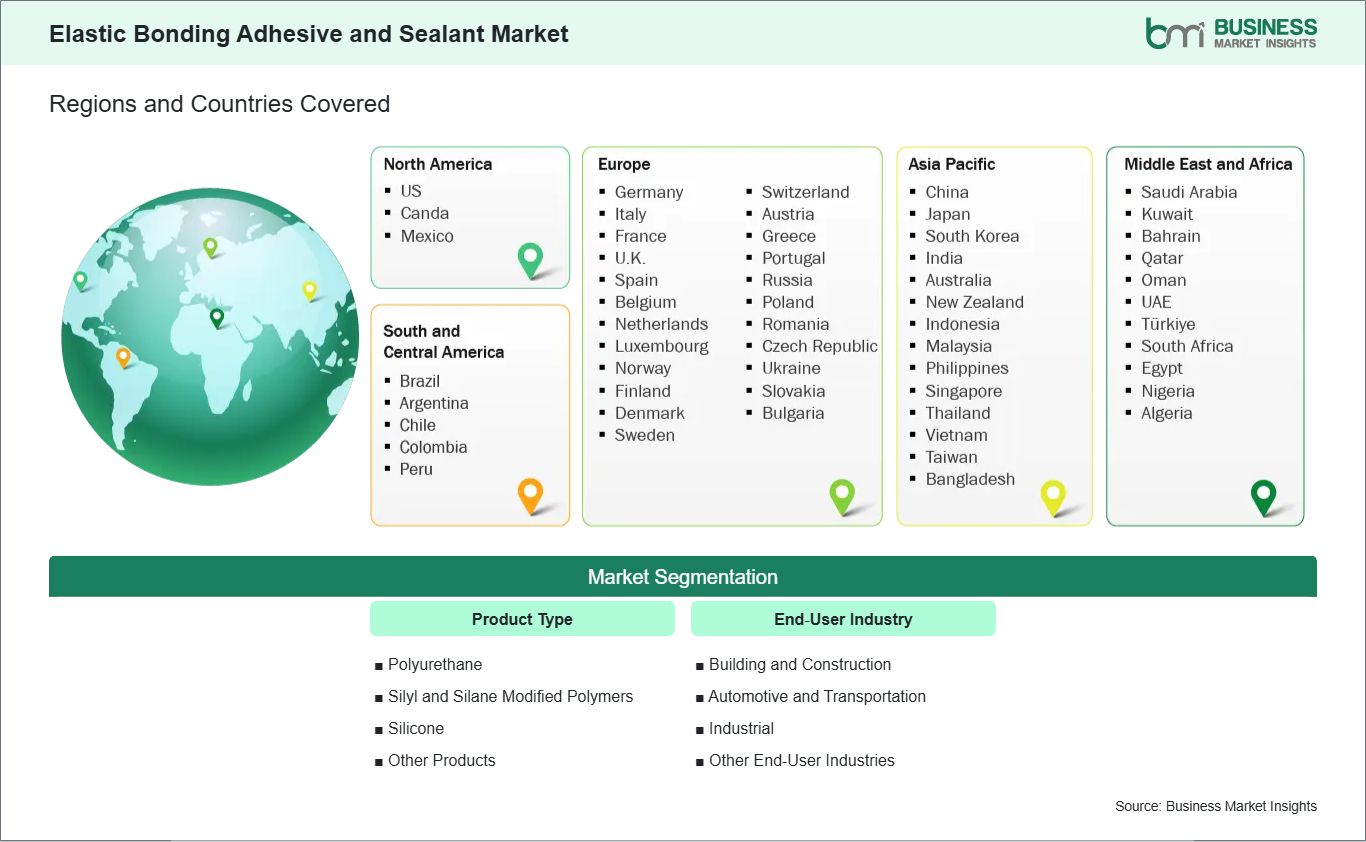
Regions and Countries Covered
| |
| North America | US, Canada, Mexico |
| Europe | Belgium, Austria, Finland, Denmark, Greece, Poland, Romania, Russia, Ukraine, Czech Republic, Slovakia, Bulgaria, Italy, Luxembourg, Germany, Switzerland, France, Netherlands, Norway, Portugal, Spain, Sweden, United Kingdom |
| Asia-Pacific | Australia, China, India, Japan, South Korea, Indonesia, Malaysia, Philippines, Singapore, Thailand, Vietnam, Bangladesh, New Zealand, Taiwan |
| South and Central America | Brazil, Argentina, Peru, Chile, Colombia |
| Middle East and Africa | Bahrain, Kuwait, Oman, Qatar, Saudi Arabia, United Arab Emirates, Turkiye, South Africa, Egypt, Algeria, Nigeria |
| Market leaders and key company profiles |
|
The "Elastic Bonding Adhesive and Sealant Market Size and Forecast (2022 - 2033)" report provides a detailed analysis of the market covering below areas:
The geographical scope of the Elastic Bonding Adhesive and Sealant market report is divided into five regions: North America, Asia Pacific, Europe, Middle East & Africa, and South & Central America. The Elastic Bonding Adhesive and Sealant market in North America is expected to grow during the forecast period.
North America leads the market due to a combination of industrial diversity, innovative construction trends, and a focus on high-performance building materials. In this region, the market is shaped by advanced commercial and residential projects emphasizing flexibility, thermal adaptation, and design aesthetics. Urban development projects, particularly in areas prone to temperature variations or seismic activity, rely on elastic bonding solutions to maintain integrity over time. Moreover, North American manufacturers leverage these adhesives in niche applications such as modular construction, specialty vehicles, and smart infrastructure installations where adaptable bonding is essential. A key characteristic of the North American market is the partnership between designers, contractors, and manufacturers to provide solutions for unique architectural challenges. There is a focus on materials that can be part of intelligent building technologies, adhesives and sealants that can support sensors, modular panels, or moveable joints without compromising integrity. Although costs and expertise are barriers to using these materials, the emphasis on quality, innovation, and durability in North America positions elastic bonding adhesives and sealants as a solution that is not just feasible but also desirable, thus impacting trends in other markets.

The elastic bonding adhesive and sealant market is evaluated by gathering qualitative and quantitative data post primary and secondary research, which includes important corporate publications, association data, and databases. A few of the key developments in the elastic bonding adhesive and sealant market are:
The Elastic Bonding Adhesive and Sealant Market is valued at US$ 22.14 Billion in 2025, it is projected to reach US$ 33.26 Billion by 2033.
As per our report Elastic Bonding Adhesive and Sealant Market, the market size is valued at US$ 22.14 Billion in 2025, projecting it to reach US$ 33.26 Billion by 2033. This translates to a CAGR of approximately 5.13% during the forecast period.
The Elastic Bonding Adhesive and Sealant Market report typically cover these key segments-
The historic period, base year, and forecast period can vary slightly depending on the specific market research report. However, for the Elastic Bonding Adhesive and Sealant Market report:
The Elastic Bonding Adhesive and Sealant Market is populated by several key players, each contributing to its growth and innovation. Some of the major players include:
The Elastic Bonding Adhesive and Sealant Market report is valuable for diverse stakeholders, including:
Essentially, anyone involved in or considering involvement in the Elastic Bonding Adhesive and Sealant Market value chain can benefit from the information contained in a comprehensive market report.
Please tell us your area of interest
(Market Segments/ Regions and Countries/ Companies)