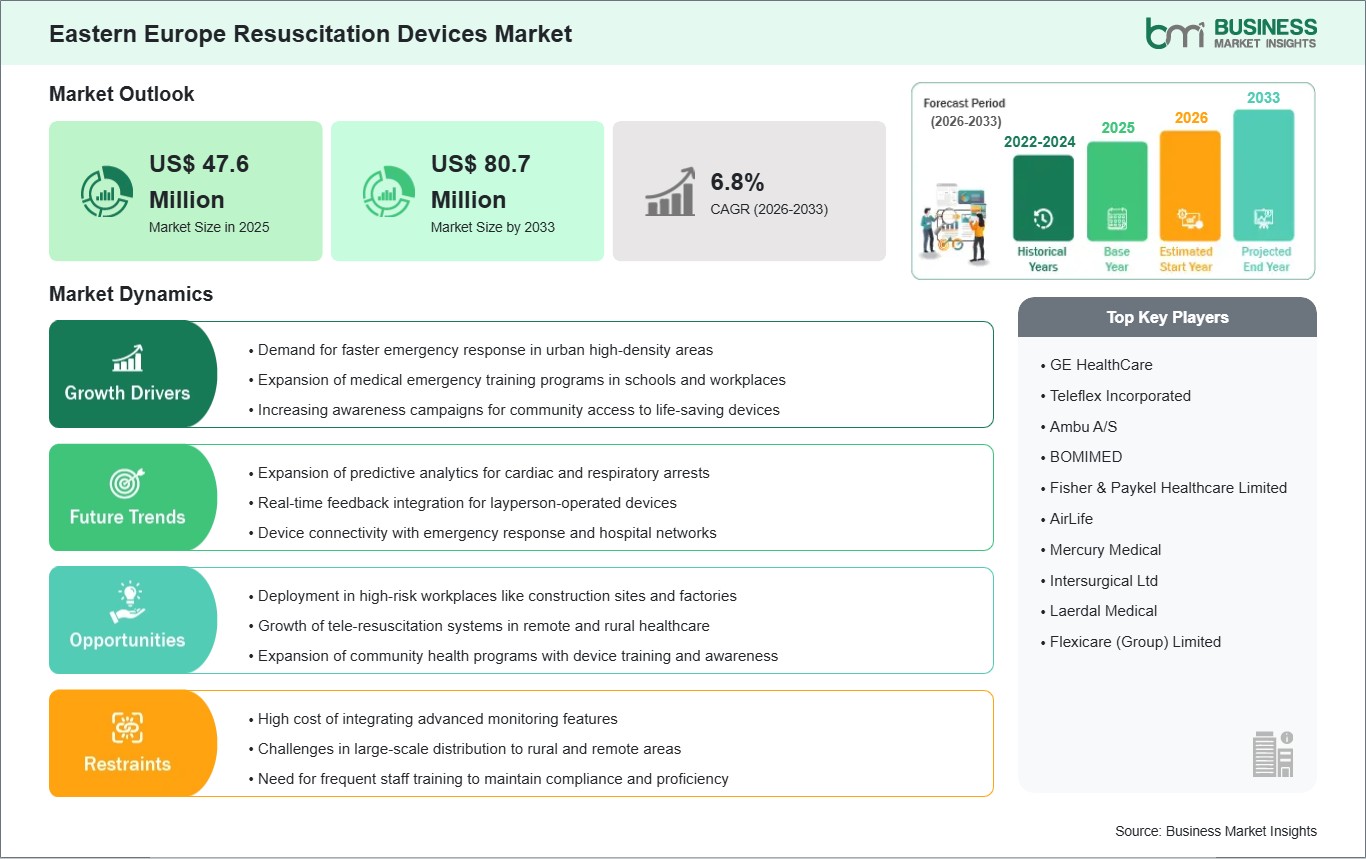
The Eastern Europe Resuscitation devices market size is expected to reach US$ 80.7 million by 2033 from US$ 47.6 million in 2025. The market is estimated to record a CAGR of 6.8% from 2026 to 2033.
The Eastern Europe resuscitation devices market is influenced by a blend of existing health facilities and their modernization, indicating the region’s continuous strive towards improving its critical care and emergency medical facilities. The market includes several countries such as Russia, Poland, Ukraine, Czech Republic, among others, which have varying degrees of incorporation of modern medical devices in their practices. Russia emerges as the market leader in this region due to huge investments in hospital facility improvements, increased surgeries, and ICU development. The rising concern among hospitals to improve perioperative care and emergency response is one of the major drivers behind the expansion of the market in Eastern Europe. With hospitals adopting modern equipment, like videolaryngoscopy, supraglottic airway devices, and ventilatory tools, the emphasis has been placed on minimizing risks associated with procedures performed on patients. Moreover, the growing awareness about respiratory health along with various government measures taken to strengthen pre-hospital emergency response is also contributing towards the demand for airway management equipment. The expansion of the market is being hampered due to certain hindrances, including the lack of adequate healthcare facilities, especially in rural areas, financial constraints that affect the purchase of advanced equipment, cumbersome regulations, and dependence on imports for advanced equipment. Nevertheless, there is a potential for this market to grow, with hospitals recognizing the importance of airway management for their patients.

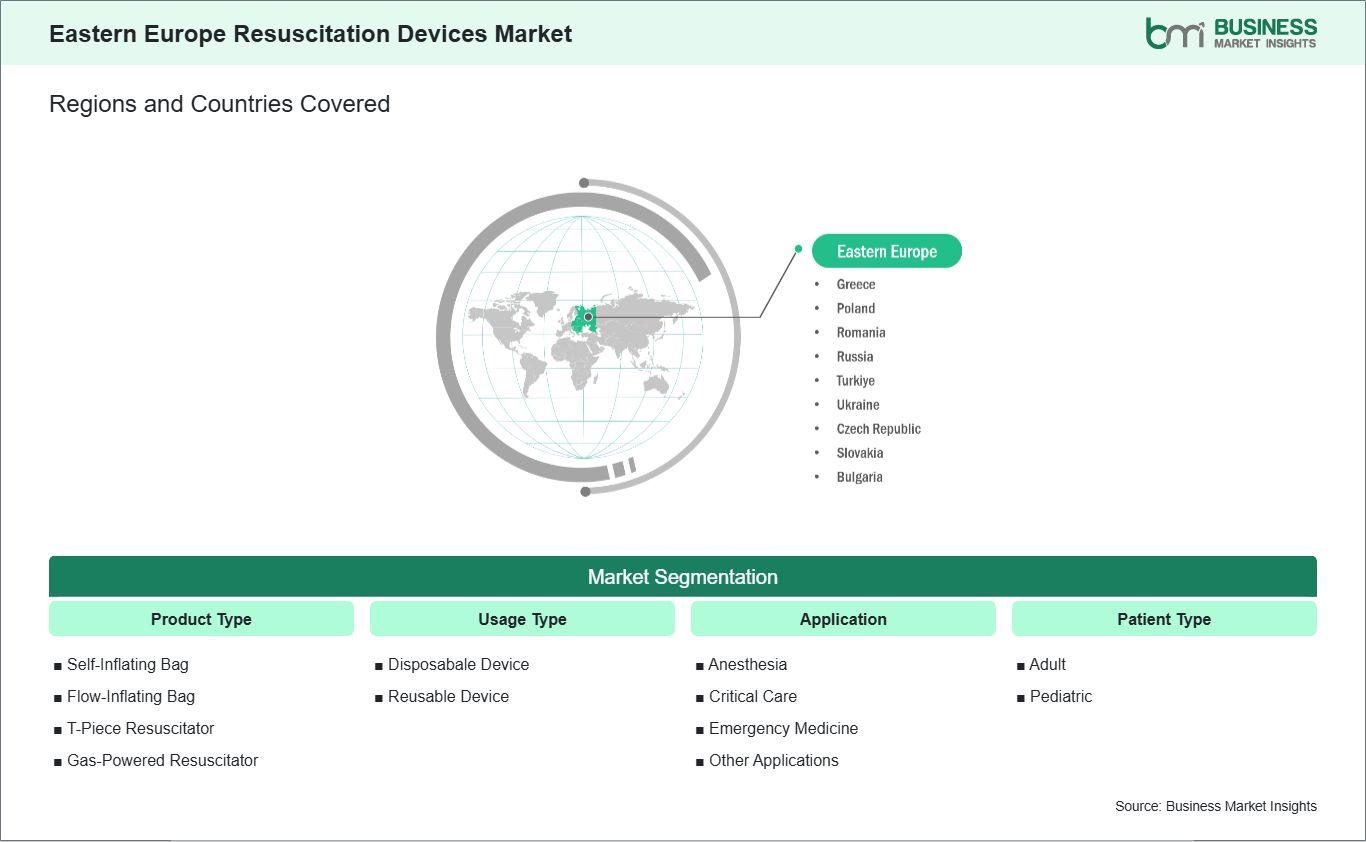
Key segments that contributed to the derivation of the Eastern Europe Resuscitation devices market analysis are product type, usage type, application, patient type, and end user.
In eastern European nations like Poland, Hungary, Romania, and Czech Republic, there is a notable impact of urban population density on emergency services requirements. The cities in these countries are facing a burden in their ambulance systems because of traffic, older age groups, and the increased number of patients with cardiovascular problems. There have been reforms made to the emergency medical systems in order to reduce the time taken in emergencies because prompt attention is very essential in such cases.
The governments and other health-related agencies have started taking measures, such as the optimal placement of ambulance stations, the use of improved dispatching mechanisms, and incorporating advanced navigation methods. In cases like Romania, where urban centers house numerous emergency centers, there is often overcrowding and long waiting periods, despite having comparatively developed infrastructure. This contradiction has led to the development of mobile, automatic resuscitation tools that can be utilized straightaway after delivery to reduce the time taken to perform lifesaving measures.
Another reason that plays an important role in the effectiveness of resuscitation devices is the relation between survival rates and the rate of response in urban areas. According to Hungarian studies, faster responses in urban areas have been associated with higher resuscitation success rates than those in rural locations. Such findings have led to the development of compact defibrillation tools and automatic CPR tools specifically designed for dense locations. The growth of urban centers in Eastern Europe should continue to contribute to the demand for resuscitation devices in the coming years.
The industrial profile of Eastern Europe are more specifically, regions such as Poland, Slovakia, and Bulgaria is marked by the prevalence of industries such as manufacturing, mining, and construction. By nature, these industries have high potential for work-related accidents involving factors such as heart attacks, electrocution, and trauma. The modernization of safety laws at workplaces has led to a focus on providing necessary equipment for emergency situations, such as resuscitation aids.
It is also important to highlight that employers are starting to take emergency preparedness on the site much more seriously. For instance, there are locations in Eastern Europe which are relatively isolated in terms of the possibility to have quick access to hospitals. Consequently, employers have begun investing in automated external defibrillators and general basic life support kits for use during work. The demand for resuscitation technology was driven by the necessity to train workers in CPR, resulting in an additional need for easy-to-use and rugged resuscitation products.
Moreover, multinational companies doing business in Eastern Europe have been coordinating their operations according to international safety standards and thus increasing the use of modern resuscitation devices. In industries such as automobiles and heavy manufacturing, industrial parks are increasingly adopting centralized safety systems with resuscitation devices installed throughout factory premises. Construction sites are also benefiting from this approach because mobile and tough resuscitation equipment is necessary on these sites. With improvements in workplace safety practices in Eastern Europe, the installation of resuscitation devices on dangerous sites will become a prerequisite.

The Eastern Europe resuscitation devices market is experiencing steady growth, with market size and share analysis reflecting evolving treatment preferences and competitive dynamics among key players. The report evaluates important subsegments categorized within product type, usage type, application, patient type, and end user, highlighting their respective contributions to overall market performance.
By product type, the self-inflating Bag subsegment dominated the market in 2025, as they are easy to use and do not require external gas or power sources, making them ideal for emergencies. They allow precise manual control of ventilation, which is crucial in critical care. Their portability makes them suitable for both hospital wards and transport situations.
Based on usage type, the disposable devices subsegment dominated the market in 2025 due to their ability to prevent cross-contamination and infection. They eliminate the need for complex sterilization processes, saving time and reducing operational costs. In high-volume hospital settings, disposables improve workflow efficiency. This makes them highly preferred in emergency rooms, ICUs, and surgical units.
On the basis of application, the anesthesia subsegment dominated the market in 2025, as resuscitation devices are essential for safe ventilation during induction and recovery. They provide backup support if mechanical ventilators fail. Their precise control helps manage patients with varying lung compliances. Hospitals rely on these devices to prevent hypoxia and ensure patient safety during surgeries.
In terms of patient type, the adult subsegment dominated the market in 2025, as they experience more surgical procedures and critical emergencies than pediatric populations. Their larger lung capacity requires devices designed for adult ventilation. High prevalence of cardiac and respiratory conditions in adults increases usage frequency.
Based on end user, the hospitals subsegment dominated the market in 2025 due to constant emergency and surgical care needs. ICUs, operating rooms, and emergency departments require rapid access to resuscitation devices. High patient volume and stringent safety protocols make hospitals the key market driver. Their centralized procurement and standardized protocols ensure widespread device adoption.
| Report Attribute | Details |
|---|---|
| Market size in 2025 | US$ 47.6 Million |
| Market Size by 2033 | US$ 80.7 Million |
| CAGR (2026 - 2033) | 6.8% |
| Historical Data | 2022-2024 |
| Forecast period | 2026-2033 |
| Segments Covered | By Product Type
|
|
Regions and Countries Covered
| |
| Eastern Europe | Russia, Poland, Romania, Czech Republic, Greece, Ukraine, Slovakia, Bulgaria |
| Market leaders and key company profiles |
|
The "Eastern Europe Resuscitation Devices Market Size And Forecast (2022–2033)" report provides a detailed analysis of the market covering below areas:
The geographical scope of the Eastern Europe resuscitation devices market report is divided into: Russia, Poland, Romania, the Czech Republic, Ukraine, Romania, Greece, Slovakia, and Bulgaria. Russia held the largest share in 2025.
Russia dominates the Eastern Europe resuscitation devices market due to its large-scale healthcare infrastructure and centralized approach to medical procurement and emergency services. Currently, Russia has been working on improving its emergency service capabilities, and the development of ambulances, trauma rooms, and intensive care wards using modern technologies in the field of resuscitation is becoming one of the priorities for the nation. Among the main centers where there is an ongoing process of improving capabilities in the sphere, urban centers like Moscow and St. Petersburg should be mentioned. Another factor which had a significant impact on the current status of the market was Russia's focus on boosting its indigenous production. A distinguishing feature about the Russian market is that the healthcare needs there are primarily met through the implementation of state-oriented programs, thus ensuring steady demand at the minimum level for all required devices among public establishments. Another important factor in the use of such devices is the training of emergency services in various regions, especially those where disasters are likely. Yet, some problems arise owing to logistical complications due to wide territorial expanses resulting in uneven distribution of modern resuscitation devices. Also, the lower familiarity with innovative technologies compared to the Western European counterparts may negatively impact technology adoption processes. Still, the size, policy orientation, and self-sufficiency make Russia a leader in Eastern Europe’s resuscitation devices market.

The Eastern Europe resuscitation devices market is evaluated by gathering qualitative and quantitative data post primary and secondary research, which includes important corporate publications, association data, and databases. A few of the key developments in the Eastern Europe resuscitation devices market are:
The Eastern Europe Resuscitation Devices Market is valued at US$ 47.6 Million in 2025, it is projected to reach US$ 80.7 Million by 2033.
As per our report Eastern Europe Resuscitation Devices Market, the market size is valued at US$ 47.6 Million in 2025, projecting it to reach US$ 80.7 Million by 2033. This translates to a CAGR of approximately 6.8% during the forecast period.
The Eastern Europe Resuscitation Devices Market report typically cover these key segments-
The historic period, base year, and forecast period can vary slightly depending on the specific market research report. However, for the Eastern Europe Resuscitation Devices Market report:
The Eastern Europe Resuscitation Devices Market is populated by several key players, each contributing to its growth and innovation. Some of the major players include:
The Eastern Europe Resuscitation Devices Market report is valuable for diverse stakeholders, including:
Essentially, anyone involved in or considering involvement in the Eastern Europe Resuscitation Devices Market value chain can benefit from the information contained in a comprehensive market report.
Please tell us your area of interest
(Market Segments/ Regions and Countries/ Companies)