Market Summary
Executive Summary and Market Analysis
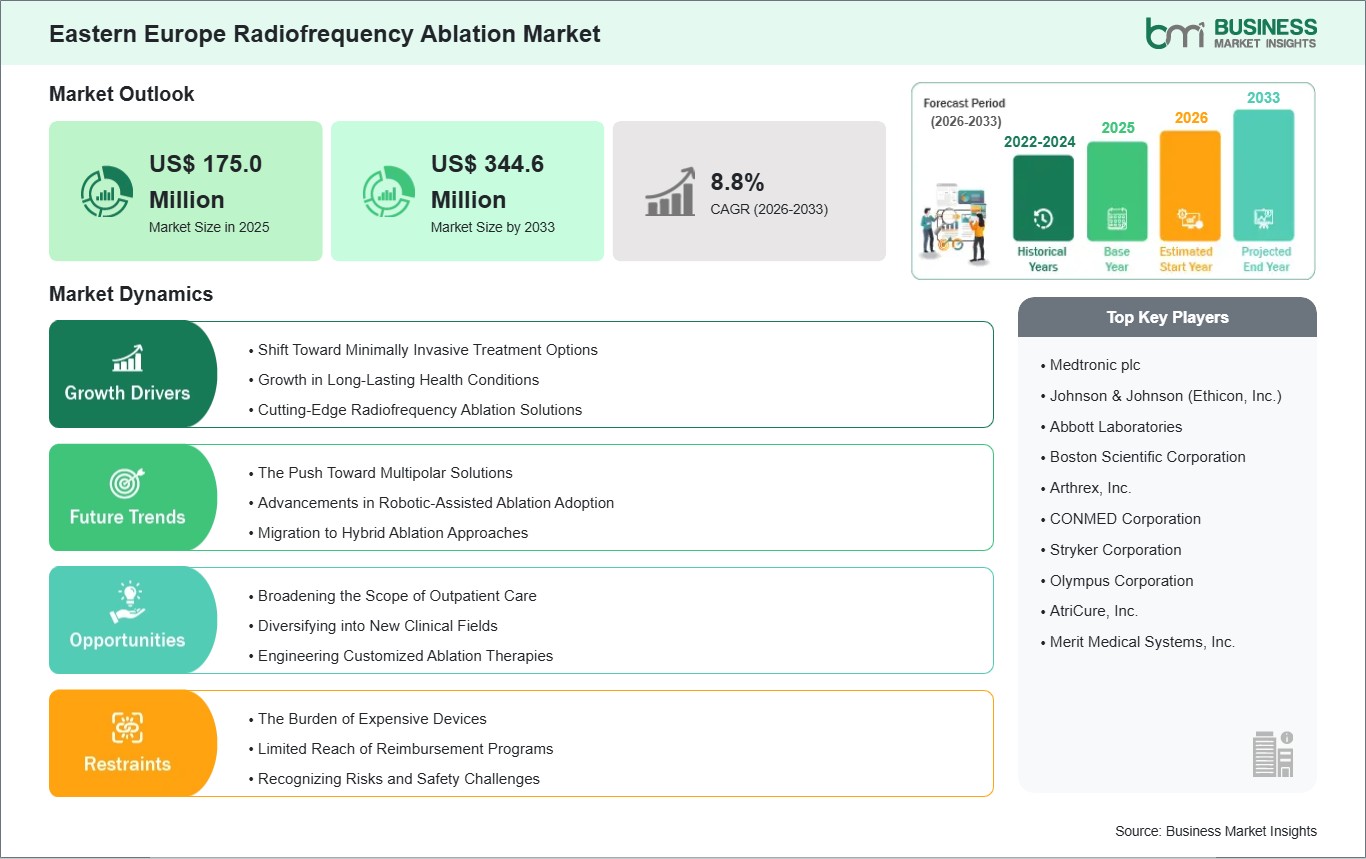
The Eastern Europe radiofrequency ablation (RFA) market is characterized by the gradual modernization of interventional healthcare services in cardiology and oncology. Across the region, healthcare systems are incorporating minimally invasive procedures to address the rising burden of cardiovascular diseases, solid tumors, and chronic pain disorders. Urban tertiary hospitals and specialized medical centers are expanding electrophysiology labs and interventional oncology units, creating a favorable environment for RFA adoption. Growing clinician familiarity with catheter-based and image-guided ablation techniques, with patient preference for shorter hospital stays and reduced post-operative discomfort, is supporting procedural uptake.
At the same time, the market faces structural and economic constraints. Public healthcare systems in several Eastern European countries operate under tight budgetary controls, which can slow procurement of advanced ablation generators and single-use consumables. Access to high-end RFA platforms is often concentrated in capital cities and leading academic hospitals, limiting broader geographic penetration. Additionally, disparities in reimbursement policies and regulatory alignment across the region create variability in how quickly new ablation technologies are adopted. While demand for minimally invasive therapies is steadily increasing, sustained investment in specialist training and infrastructure expansion remains critical to unlocking the region’s full potential in the RFA market.
Segment Analysis
Eastern Europe Radiofrequency Ablation Market Segmentation
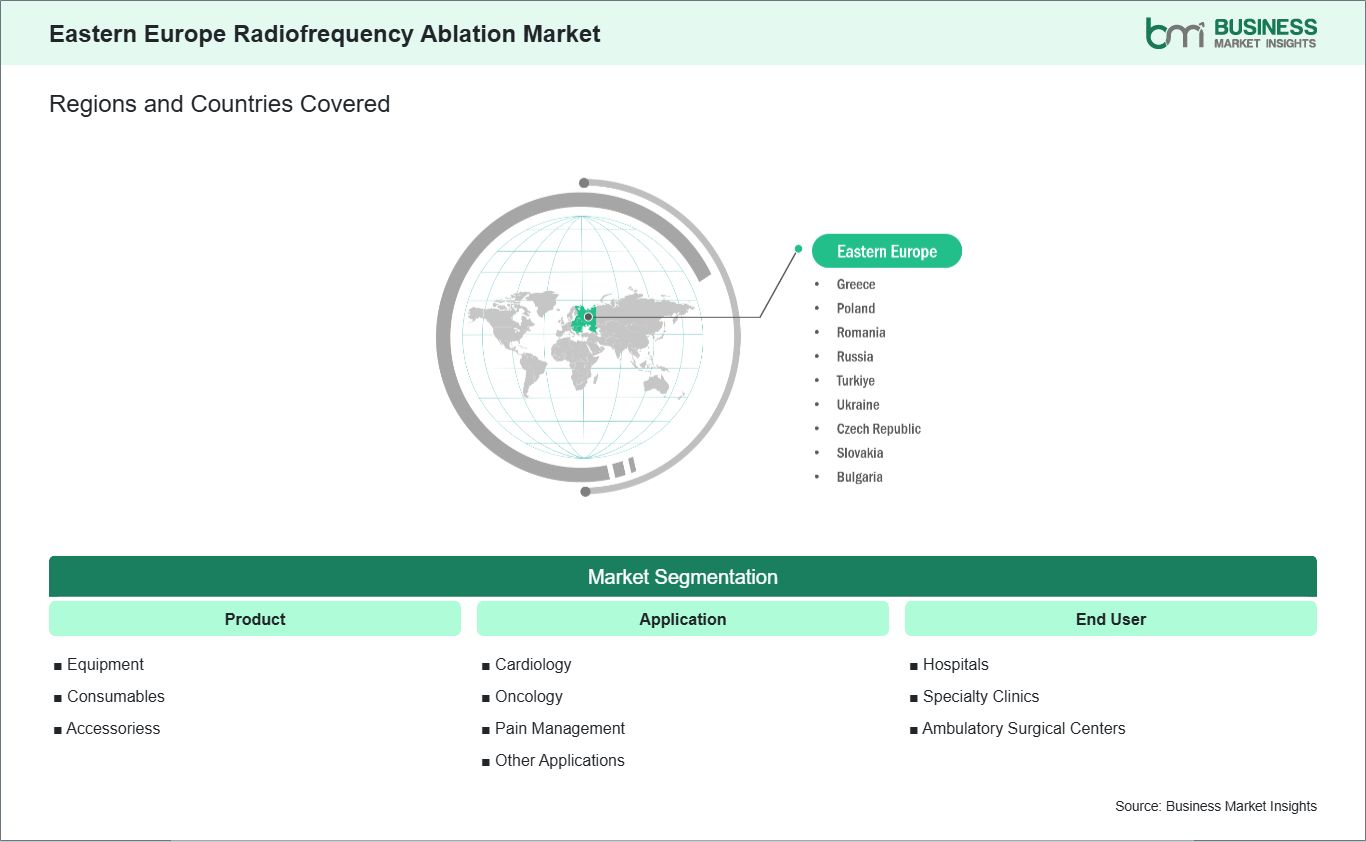
Key segments that contributed to the derivation of the Eastern Europe radiofrequency ablation market analysis are product type, application, and end user.
- By product type, the radiofrequency ablation market is segmented into equipment, consumables, and accessories. The consumables segment dominated the market in 2025.
- Based on application, the radiofrequency ablation market is classified into cardiology, oncology, pain management, and others. The cardiology segment dominated the market in 2025.
- In terms of end user, the radiofrequency ablation market is categorized into hospitals, specialty clinics, and ambulatory surgical centers. The hospitals segment dominated the market in 2025.
Market Forces
Eastern Europe Radiofrequency Ablation Market Drivers and Opportunities
Shift Toward Minimally Invasive Treatment Options
Eastern Europe is witnessing a steady shift toward minimally invasive treatment modalities, with radiofrequency ablation (RFA) gaining importance across cardiology, oncology, and pain management applications. Healthcare systems across the region are prioritizing procedures that reduce surgical trauma and shorten recovery time, particularly as hospitals aim to improve efficiency amid budgetary constraints. The rising burden of cardiovascular disorders and solid tumors has accelerated interest in catheter-based and image-guided ablation therapies as alternatives to conventional open surgery.
Tertiary hospitals and university-affiliated medical centers are leading adoption, particularly in larger metropolitan areas where access to advanced imaging and electrophysiology laboratories is stronger. Structural healthcare reforms and modernization programs in Eastern Europe encouraged the procurement of updated interventional equipment, enabling broader use of RFA in arrhythmia management and tumor ablation. In addition, participation in European clinical training networks has improved physician familiarity with minimally invasive techniques, strengthening procedural confidence.
Patient awareness is also evolving across the region. Working-age populations prefer treatments that minimize hospitalization and allow faster reintegration into daily and professional life. While public healthcare systems remain cost-sensitive, the long-term economic benefits of reduced complication rates and shorter inpatient stays support the gradual incorporation of RFA into treatment guidelines. As healthcare infrastructure continues to modernize, the preference for minimally invasive options is expected to stimulate regional market growth.
Broadening the Scope of Outpatient Care
The expansion of outpatient and ambulatory care services is reshaping the healthcare delivery landscape in Eastern Europe and creating favorable conditions for radiofrequency ablation procedures. Governments and healthcare administrators are placing greater emphasis on decentralizing services and reducing pressure on inpatient hospital capacity. As a result, selected RFA procedures—particularly for chronic pain and certain cardiac rhythm disorders—are performed in day-care or short-stay settings.
Private healthcare providers are crucial in advancing outpatient capabilities, investing in dedicated procedural suites equipped for minimally invasive interventions. The development of same-day surgery units within larger hospital systems is also contributing to procedural migration from inpatient wards to ambulatory departments. This shift not only enhances operational efficiency but also aligns with patient demand for more convenient treatment pathways.
However, disparities remain between urban and rural areas in terms of access to specialized equipment and trained interventional specialists. In smaller cities and regional hospitals, limited resources can slow the adoption of advanced outpatient ablation services. Despite these challenges, ongoing healthcare restructuring efforts and targeted investments in outpatient infrastructure are expected to expand access gradually. Over time, the broadening scope of outpatient care is likely to serve as a key growth driver for the Eastern Europe radiofrequency ablation market.
Size and Share Analysis
Eastern Europe Radiofrequency Ablation Market Size and Share Analysis
The Eastern Europe radiofrequency ablation market demonstrates steady growth, with size and share analysis highlighting evolving trends and competitive dynamics among key players. The report evaluates important subsegments categorized within product type, application type, and end user, highlighting their respective contributions to overall market performance.
By product type, the consumables subsegment dominated the market in 2025. This is driven by the recurring need for disposable catheters, electrodes, and other consumable components during RFA procedures, making them a driver for manufacturers and ensuring consistent demand in clinical settings.
In terms of application, the cardiology subsegment dominated the market in 2025. The leadership of cardiology applications is attributed to the rising prevalence of arrhythmias and other cardiac conditions, growing adoption of minimally invasive ablation procedures, and increasing awareness among healthcare providers about the effectiveness of RFA in managing heart rhythm disorders.
Based on end user, the hospitals subsegment dominated the market in 2025. Hospitals maintain a stronghold due to their well-established surgical and electrophysiology departments, access to advanced RFA equipment, trained cardiologists and staff, and the capability to handle complex procedures with comprehensive patient care.
Report Coverage
Eastern Europe Radiofrequency Ablation Market Report Coverage and Deliverables
The "Eastern Europe Radiofrequency Ablation Market Size and Forecast (2022–2033)" report provides a detailed analysis of the market covering below areas:
- Eastern Europe Radiofrequency Ablation market size and forecast at regional and country levels for all market segments covered under the scope
- Eastern Europe Radiofrequency Ablation market trends, as well as drivers, restraints, and opportunities
- Eastern Europe Radiofrequency Ablation market analysis covering key trends, regional framework, major players, regulations, and recent developments
- Industry landscape and competition analysis covering market concentration, heat map analysis, prominent players, and recent developments for the Eastern Europe Radiofrequency Ablation market
- Detailed company profiles, including SWOT analysis
Geographic Insights
Eastern Europe Radiofrequency Ablation Market Geographic Insights
The geographical scope of the Eastern Europe Radiofrequency Ablation market report is divided into: Russia, Poland, Romania, the Czech Republic, Ukraine, Romania, Greece, Slovakia, and Bulgaria. Russia held the largest share in 2025.
Russia dominates the Eastern European RFA market, supported by its extensive network of large public hospitals, specialized research institutes, and expanding private healthcare providers. Major metropolitan centers such as Moscow and St. Petersburg serve as key hubs for advanced cardiac electrophysiology and interventional oncology procedures. Within these cities, tertiary care institutions have established dedicated units for arrhythmia management and tumor ablation, integrating RFA into standard treatment pathways for selected indications.
The country’s medical research institutions play an important role in advancing ablation techniques and adapting best practices to local clinical settings. Training programs for cardiologists and interventional radiologists have contributed to growing procedural expertise, strengthening Russia’s leadership position in the region. However, adoption remains uneven outside major urban centers, where infrastructure limitations and funding constraints can restrict access to advanced interventional technologies. Furthermore, procurement processes and import dependencies for certain medical devices can influence equipment availability. Despite these challenges, Russia’s scale, clinical capacity, and concentration of specialized facilities position it as the driver of radiofrequency ablation market development across Eastern Europe.
Industry Activity
Recent Developments
The Eastern Europe radiofrequency ablation market is evaluated by gathering qualitative and quantitative data post primary and secondary research, which includes important corporate publications, association data, and databases. A few of the key developments in the Eastern Europe radiofrequency ablation market are:
- In January 2025, Johnson & Johnson MedTech announced that its Dual Energy THERMOCOOL SMARTTOUCH SF Catheter received CE Mark approval in Europe. This catheter allows physicians to switch between radiofrequency and pulsed field energy in a single device, offering flexible ablation options and expanding the range of tools available in electrophysiology labs throughout the European Union, including Eastern Europea.
- In November 2025, Boston Scientific Corporation announced that it had received a CE mark for its FARAPOINT Pulsed Field Ablation Catheter, the newest addition to its FARAPULSE platform for cardiac ablation, including atrial flutter and atrial fibrillation. This CE mark approval allows the device to be marketed and used across European Union and EMEA, including Eastern European EU member states, broadening ablation technology options for clinicians who perform RFA-based procedures.
Trust & Transparency
Research Methodology
The market analysis combines proprietary research with secondary data from government agencies, company disclosures, regulatory filings, industry databases and expert interviews. Market estimates are validated through data triangulation, cross-market benchmarking and analyst
review.
View Full Research Methodology
Key Sources Referred:
The World BankWorld Health Organization (WHO)Center for Disease Control and Prevention (CDC)Food and Drug Administration (FDA)European Database on Medical Devices (EUDAMED)European Society of Cardiology (ESC)American College of Cardiology (ACC)American Heart Association (AHA)Company WebsitesCompany Annual ReportsCompany Investor Presentations