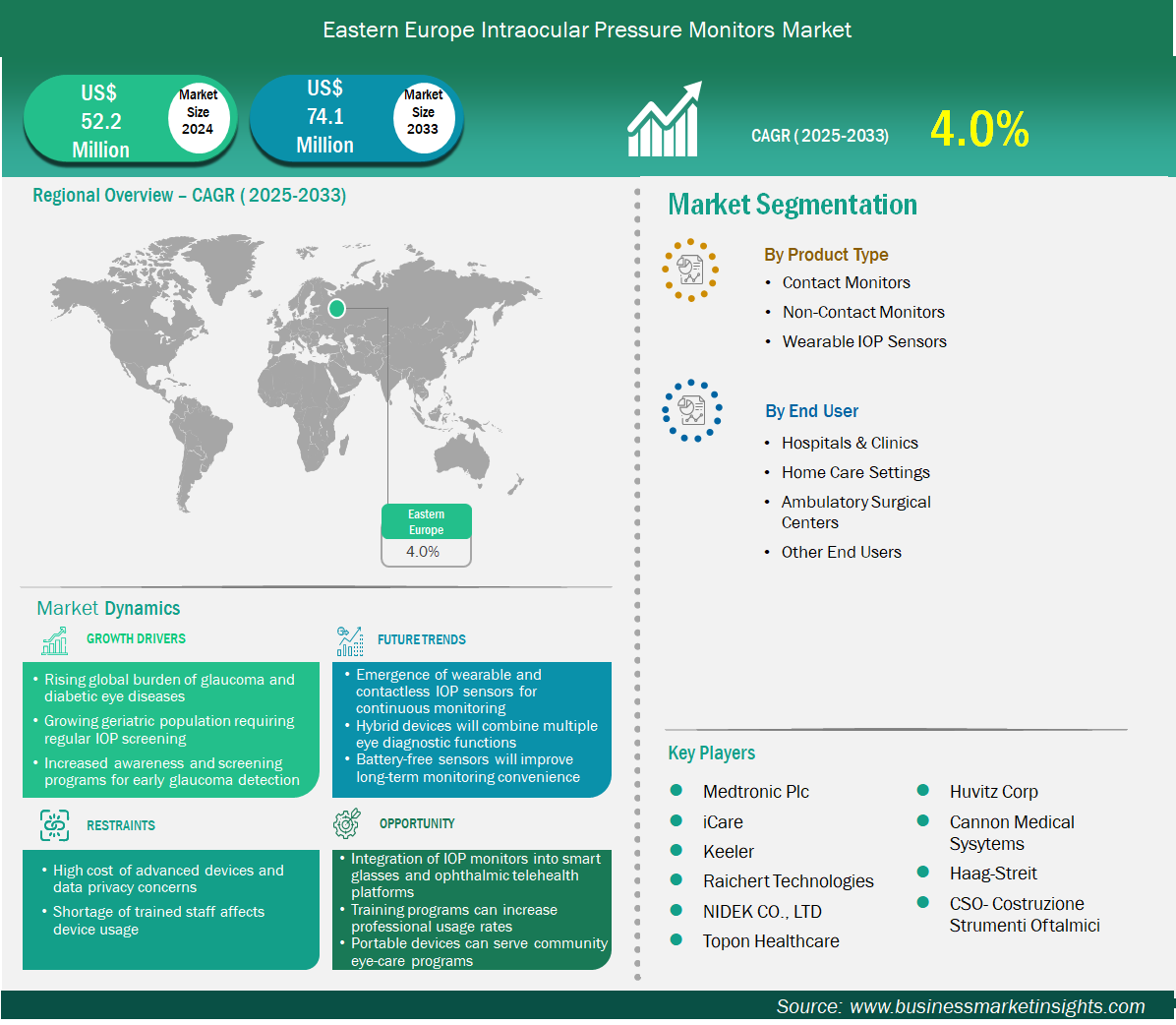
The Eastern Europe intraocular pressure monitors market size is expected to reach US$ 74.1 million by 2033 from US$ 52.2 million in 2024. The market is estimated to record a CAGR of 4.0% from 2025 to 2033.
Executive Summary and Eastern Europe Intraocular Pressure Monitors Market Analysis:
The intraocular pressure monitors market in Eastern Europe is experiencing significant growth driven by rising global burden of glaucoma and diabetic eye diseases, growing geriatric population requiring regular IOP screening, increased awareness, and screening programs for early glaucoma detection. The IOP monitors market in Eastern Europe is characterized by a transitional healthcare environment. In this environment, traditional diagnostic methods are still in use, while new technologies are just beginning to emerge. Contact monitors remain the leading product segment due to their proven accuracy and affordability. Thus, they are the most preferred both in publicly and privately-run healthcare facilities. Non-contact monitors are slowly becoming popular in big cities, especially in Poland and the Czech Republic, where patient comfort and efficiency are of the utmost importance in high-volume clinics.
Hospitals and clinics are the major end-user segments, which are backed by the presence of specialists in glaucoma and diagnostic infrastructure in metropolitan areas. The competitive scenario is dominated by global manufacturers like Reichert Technologies, Topcon, and NIDEK, along with local players who serve the markets that are sensitive to cost. There are still issues with affordability, uneven distribution of advanced devices, and a shortage of trained personnel in rural and less developed areas. The regional market analysis indicates a region with strong demand drivers, along with significant disparities.
Eastern Europe Intraocular Pressure Monitors Market Segmentation Analysis:
Key segments that contributed to the derivation of the intraocular pressure monitors market analysis are product and end user.
- By product, the intraocular pressure monitors market is segmented into contact monitors, non-contact monitors, and wearable IOP sensors. The contact monitors segment dominated the market in 2024. This is the largest segment due to its established clinical reliability and widespread use in glaucoma diagnostics across Eastern Europe.
- By end user, the market is segmented into hospitals and clinics, home-care Settings, ambulatory surgical centers, and other end users. The hospitals and clinics segment held the largest market share in 2024. This is the largest segment due to the concentration of ophthalmologists and the availability of diagnostic infrastructure in Eastern European healthcare systems.
Eastern Europe Intraocular Pressure Monitors Market Outlook
The Eastern Europe IOP monitors market forecast is influenced by various factors such as demographic changes, healthcare expenditures, and technology developments. Due to the rising incidence of glaucoma in the region, early detection and continuous monitoring will be the primary reasons for the demand for advanced devices. Non-contact monitors are significant in community health programs, mainly in those countries where the government has supported preventive care. Although wearable IOP sensors are still in their early stages, they are the fastest-growing segment and align with the global trend of personalized and home-based care. The adoption will be facilitated more effectively through integration with teleophthalmology platforms and digital health ecosystems, especially in remote and underserved areas. Additionally, agreements between foreign manufacturers and local health care providers will facilitate faster technology transfer and training, improving accessibility. Besides, regulatory harmonization over different Eastern European markets will be instrumental in easing device approvals as well as in attracting investment.
Eastern Europe Intraocular Pressure Monitors Market Country Insights
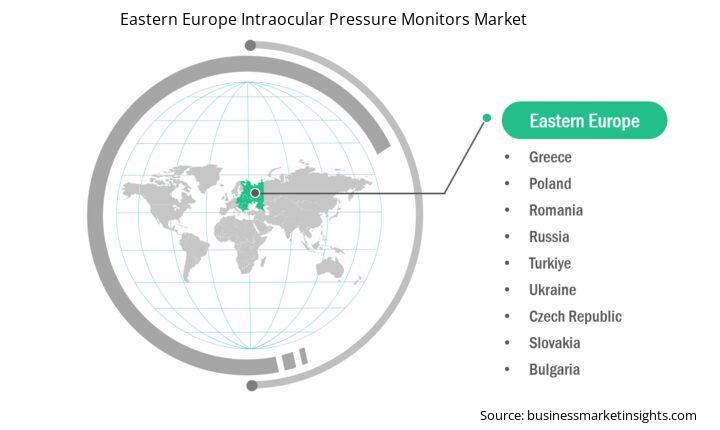
Based on country, the Eastern Europe intraocular pressure monitors market is segmented into Russia, Poland, Ukraine, Romania, the Czech Republic, Slovakia, Bulgaria, and Greece. Russia held the largest share in 2024.
Analysis of local country-level dynamics unveils a significant diversity of adoption patterns across different countries of Eastern Europe. Russia is a leader in the region with its modern ophthalmic infrastructure and a strong market penetration of both contact and non-contact monitors, which is supported by government-backed initiatives aimed at expanding access to glaucoma diagnostics. The Czech Republic shows a strong demand for non-contact devices, especially in urban hospitals, due to its relatively well-developed healthcare system. Small economies face constraints of affordability and a shortage of specialists; thus, high-end device penetration is limited. Nevertheless, donor-funded initiatives and regional collaborations are slowly removing these barriers, and portable and inexpensive contact monitors are the most popular in resource-constrained areas. Countries with expanding medical tourism are also investing in advanced ophthalmic diagnostics, thereby creating opportunities for high-end device manufacturers. Together, these country-level insights highlight that the region is a combination of different levels of adoption and consequently presents a variety of opportunities where tailored strategies—from affordable solutions to advanced technologies—are required to be successful in the market.
Eastern Europe Intraocular Pressure Monitors Market Company Profiles
Medtronic Plc, iCare, Keeler, Reichert Technologies, NIDEK, Topcon Healthcare, Huvitz, Canon Medical Systems, Haag-Streit Diagnostics, and CSO - Costruzione Strumenti Oftalmici are among the key players operating in the market. These players adopt strategies such as expansion, product innovation, and mergers and acquisitions to stay competitive in the market and offer innovative products to their consumers.
Eastern Europe Intraocular Pressure Monitors Market Research Methodology:
The following methodology has been followed for the collection and analysis of data presented in this report:
-
Secondary Research
The research process begins with comprehensive secondary research, utilizing both internal and external sources to gather qualitative and quantitative data for each market. Commonly referenced secondary research sources include, but are not limited to:
- Company websites, annual reports, financial statements, broker analyses, and investor presentations
- Industry trade journals and other relevant publications
- Government documents, statistical databases, and market reports
- News articles, press releases, and webcasts specific to companies operating in the market
Note: All financial data included in the Company Profiles section has been standardized to US$. For companies reporting in other currencies, figures have been converted to US$ using the relevant exchange rates for the corresponding year.
-
Primary Research
Business Market Insights conducts a significant number of primary interviews each year with industry stakeholders and experts to validate and analyze the data and gain valuable insights. These research interviews are designed to:
- Refine findings from secondary research
- Enhance the expertise and market understanding of the analysis team
- Gain insights into market size, trends, growth patterns, competitive dynamics, and future prospects
Primary research is conducted via email interactions and telephone interviews with industry experts across various markets, categories, segments, and sub-segments in different regions. Participants typically include:
- Industry stakeholders: Vice Presidents, business development managers, market intelligence managers, and national sales managers
- External experts: Valuation specialists, research analysts, and key opinion leaders with industry-specific expertise
Key Sources Referred:
- World Health Organization (WHO)
- Organisation for Economic Cooperation and Development (OECD)
- The World Bank Group
- Worldometer
- The Lancet
- BMC Medical Education
- Eurostat
Eastern Europe Intraocular Pressure Monitors Market Strategic Insights
Eastern Europe Intraocular Pressure MonitorsMarket Report Highlights
| Report Attribute | Details |
| Market size in 2024 | US$ 52.2 Million |
| Market Size by 2033 | US$ 74.1 Million |
| CAGR (2025 - 2033) | 4.0% |
| Historical Data | 2022-2023 |
| Forecast period | 2025-2033 |
| Segments Covered |
By Product
|
|
Regions and Countries Covered
|
|
| Eastern Europe | Russia, Poland, Ukraine, Romania, Czech Republic, Slovakia, Bulgaria, Greece |
| Market leaders and key company profiles |
|
Eastern Europe Intraocular Pressure Monitors Market Country and Regional Insights