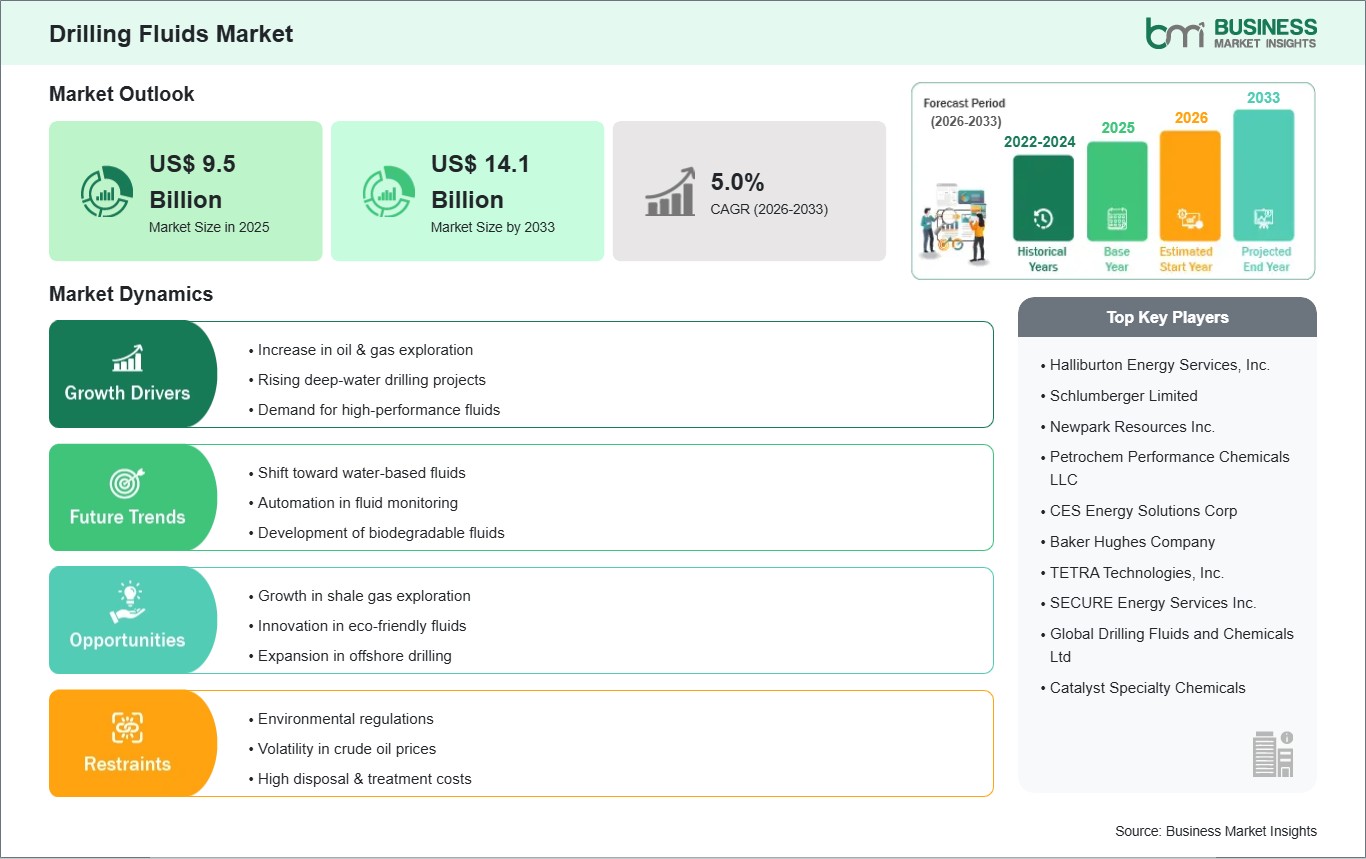
The Drilling Fluids Market size is expected to reach US$ 14.1 billion by 2033 from US$ 9.5 billion in 2025. The market is estimated to record a CAGR of 5.0% from 2026 to 2033.
Drilling fluids, commonly referred to as drilling muds, are indispensable in modern drilling operations across the oil & gas, mining, and construction sectors. These fluids ensure well control, maintain wellbore stability, transport drill cuttings, and provide cooling and lubrication for drilling equipment. Their performance directly impacts operational safety, efficiency, and cost optimization.
However, the market faces notable challenges. Volatility in crude oil prices continues to influence exploration budgets, while stringent environmental regulations impose restrictions on oil-based fluids, increasing compliance costs. Additionally, the high cost of formulating advanced drilling fluids and the complexity of managing extreme drilling conditions remain significant barriers.
Despite these restraints, the market presents lucrative opportunities. The global transition toward environmentally compliant solutions is accelerating demand for water-based and synthetic-based fluids, creating space for innovation in biodegradable and low-toxicity additives. The rise of unconventional resources such as shale gas and tight oil, coupled with deepwater and ultra-deepwater exploration, opens new high-value segments. Furthermore, digitalization and real-time fluid monitoring technologies promise operational efficiency gains, offering competitive advantages for companies investing in smart drilling solutions.

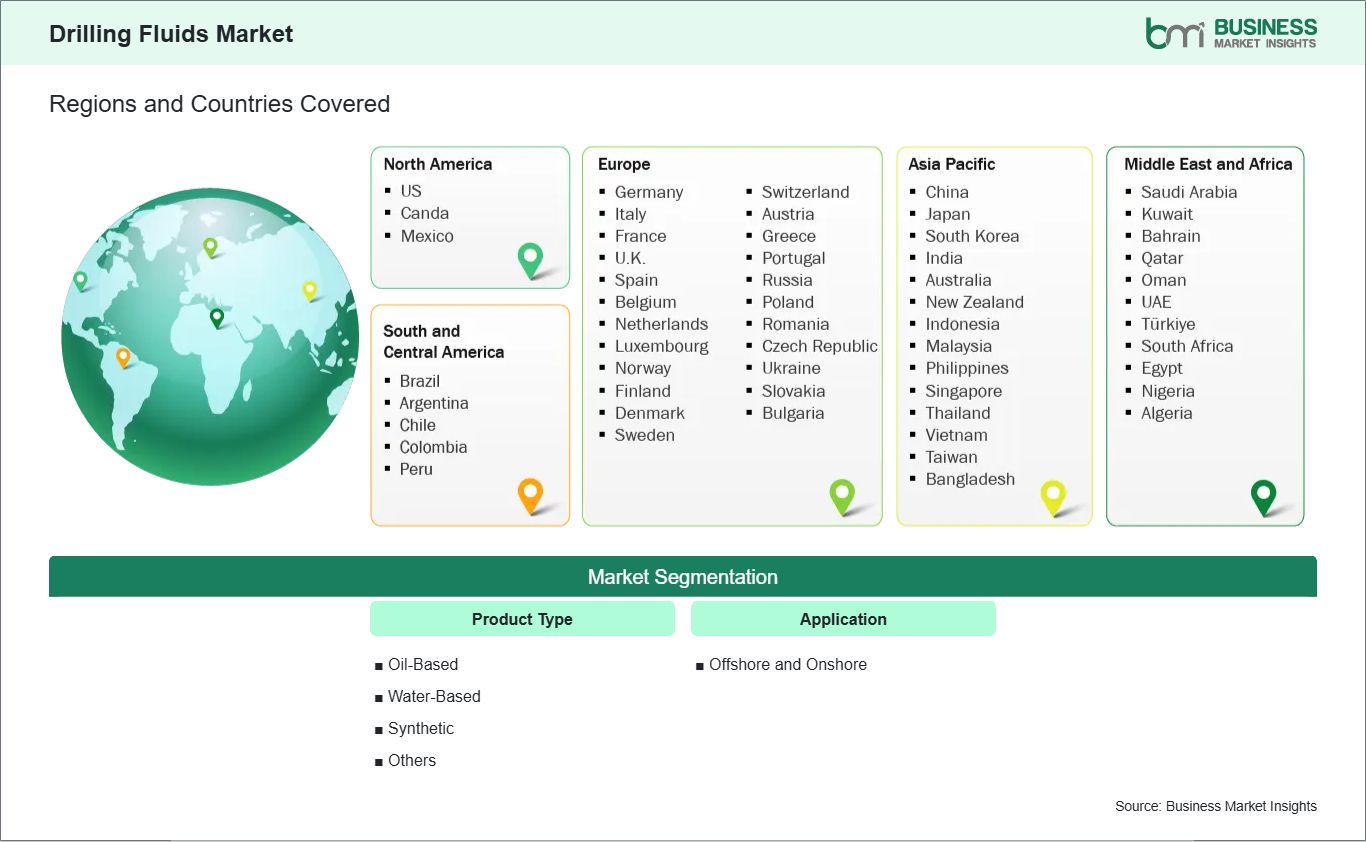
Key segments that contributed to the derivation of the Drilling Fluids market analysis are product type and application.
The depletion of easily accessible conventional hydrocarbon reserves is prompting exploration and production (E&P) companies to accelerate investment in both unconventional and offshore resources. In shale gas and tight oil basins—most notably across North America—operators are increasingly drilling long horizontal wells that demand sophisticated, inhibited water-based fluid systems. These advanced fluids are essential for maintaining wellbore stability in reactive shale formations, enhancing lubricity, and ensuring efficient cuttings transport across extended lateral sections. As drilling programs expand and laterals continue to lengthen, the consistent operational need for these high-performance water-based systems is generating sustained volume demand for drilling fluids.
Simultaneously, deepwater and ultra-deepwater exploration in regions such as the Gulf of Mexico, offshore Brazil, West Africa, and Southeast Asia is reinforcing global market growth. These environments present extreme technical challenges, including high pressures, elevated temperatures, and complex geomechanical conditions. To operate safely and efficiently, offshore drillers rely on premium synthetic-based fluids and advanced water-based formulations engineered to deliver thermal stability, low toxicity, and superior rheological performance under extreme conditions. The specialized requirements and high operational stakes associated with deepwater drilling create significant value opportunities for fluid service providers with the capability to develop reliable, environmentally compliant, and performance-enhanced fluid systems.
Together, the expanding footprint of unconventional development and sustained offshore activity are shaping a robust, long-term growth outlook for the drilling fluids market.
Increasingly stringent environmental regulations across global markets are reshaping drilling practices and accelerating the shift toward sustainable fluid technologies. Regulatory bodies are imposing tighter restrictions on the use and disposal of oil-based drilling fluids, particularly in offshore operations where the ecological risks are significantly higher. These regulations aim to minimize marine pollution, reduce toxicity levels, and ensure safer handling of drilling waste. As a result, operators are steadily transitioning toward non-toxic, biodegradable water-based drilling fluids (WBDFs) and low-toxicity synthetic-based fluids (SBFs) that meet both environmental and performance requirements.
This regulatory shift is putting pressure on drilling companies to modernize their fluid management systems, driving demand for solutions that deliver high lubricity, thermal stability, and shale inhibition without compromising environmental compliance. While these mandates create operational challenges, they also open the door for meaningful innovation. Manufacturers are increasingly investing in research and development to formulate advanced eco-friendly fluids, such as plant-derived polymers, synthetic esters, and high-performance additives designed for challenging geologies.
Environmental compliance is no longer optional; it has become a competitive differentiator. Companies that successfully develop sustainable drilling fluid systems—balancing environmental stewardship with robust operational performance—are positioned to gain market share, appeal to ESG-focused investors, and support the industry’s broader shift toward responsible resource extraction.

The Drilling Fluids Market demonstrates steady growth, with size and share analysis revealing evolving trends and competitive positioning among key players. The report further examines subsegments categorized within product type and application, offering insights into their contribution to overall market performance.
For instance, within product types, water-based fluids continue to dominate conventional onshore drilling due to their cost-effectiveness and regulatory compliance. On the application side, offshore drilling represents a premium segment, where synthetic-based fluids are increasingly preferred for their superior performance under extreme pressure and temperature conditions.
| Report Attribute | Details |
|---|---|
| Market size in 2025 | US$ 9.5 Billion |
| Market Size by 2033 | US$ 14.1 Billion |
| Global CAGR (2026 - 2033) | 5.0% |
| Historical Data | 2022-2024 |
| Forecast period | 2026-2033 |
| Segments Covered | By Product Type
|
|
Regions and Countries Covered
| |
| North America | US, Canada, Mexico |
| Europe | Belgium, Austria, Finland, Denmark, Greece, Poland, Romania, Russia, Ukraine, Czech Republic, Slovakia, Bulgaria, Italy, Luxembourg, Germany, Switzerland, France, Netherlands, Norway, Portugal, Spain, Sweden, United Kingdom |
| Asia-Pacific | Australia, China, India, Japan, South Korea, Indonesia, Malaysia, Philippines, Singapore, Thailand, Vietnam, Bangladesh, New Zealand, Taiwan |
| South and Central America | Brazil, Argentina, Peru, Chile, Colombia |
| Middle East and Africa | Bahrain, Kuwait, Oman, Qatar, Saudi Arabia, United Arab Emirates, Turkiye, South Africa, Egypt, Algeria, Nigeria |
| Market leaders and key company profiles |
|
The Drilling Fluids Market Size and Forecast (2022–2033) report provides a detailed analysis of the market covering below areas:
The geographical scope of the Drilling Fluids Market report is divided into five regions: North America, Europe, Asia Pacific, the Middle East & Africa, and South & Central America.
North America remains a critical hub for drilling fluid demand, driven by extensive shale development and offshore projects. Asia-Pacific is witnessing rapid growth, supported by rising energy needs and upstream investments in countries like China and India. The Middle East & Africa offer significant opportunities through large-scale exploration programs and offshore developments in West Africa. Europe’s market is shaped by stringent environmental regulations, favoring low-toxicity formulations, while South & Central America continue to attract attention with deepwater projects in Brazil and Guyana.

The Drilling Fluids Market is evaluated by gathering qualitative and quantitative data data post-primary and secondary research, which includes important corporate publications, association data, and databases. A few of the key developments in the Drilling Fluids market are:
The Drilling Fluids Market is valued at US$ 9.5 Billion in 2025, it is projected to reach US$ 14.1 Billion by 2033.
As per our report Drilling Fluids Market, the market size is valued at US$ 9.5 Billion in 2025, projecting it to reach US$ 14.1 Billion by 2033. This translates to a CAGR of approximately 5.0% during the forecast period.
The Drilling Fluids Market report typically cover these key segments-
The historic period, base year, and forecast period can vary slightly depending on the specific market research report. However, for the Drilling Fluids Market report:
The Drilling Fluids Market is populated by several key players, each contributing to its growth and innovation. Some of the major players include:
The Drilling Fluids Market report is valuable for diverse stakeholders, including:
Essentially, anyone involved in or considering involvement in the Drilling Fluids Market value chain can benefit from the information contained in a comprehensive market report.
Please tell us your area of interest
(Market Segments/ Regions and Countries/ Companies)