
Distillers Grain Market Outlook: Size, Share, Trends, Growth Analysis, Competitive Landscape & Forecast, 2026–2033

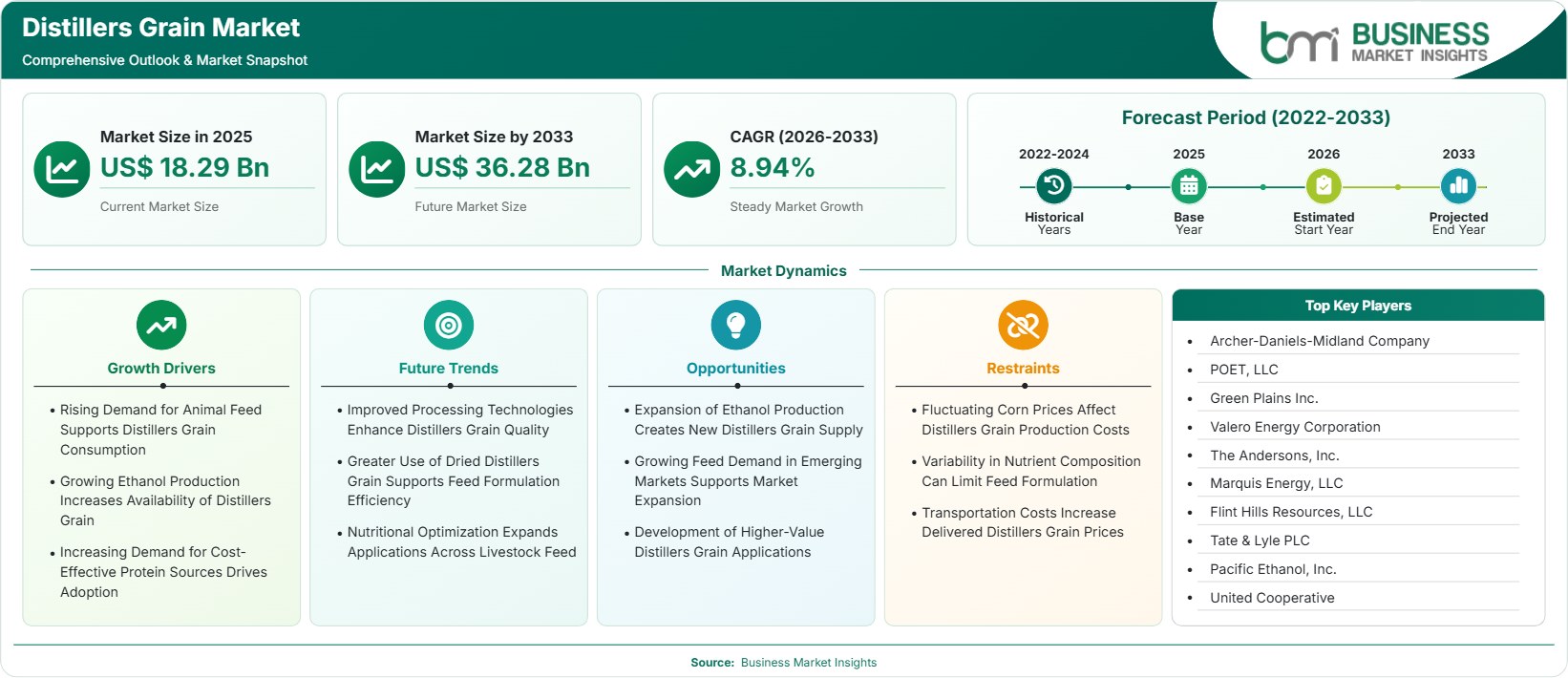
The Distillers Grain Market size was valued at US$ 18.29 Billion in 2025 and is projected to reach US$ 36.28 Billion by 2033, growing at a CAGR of 8.94% during 2026–2033, supported by expanding ethanol output, animal feed demand, export opportunities, and higher-value coproduct development.

Report Coverage
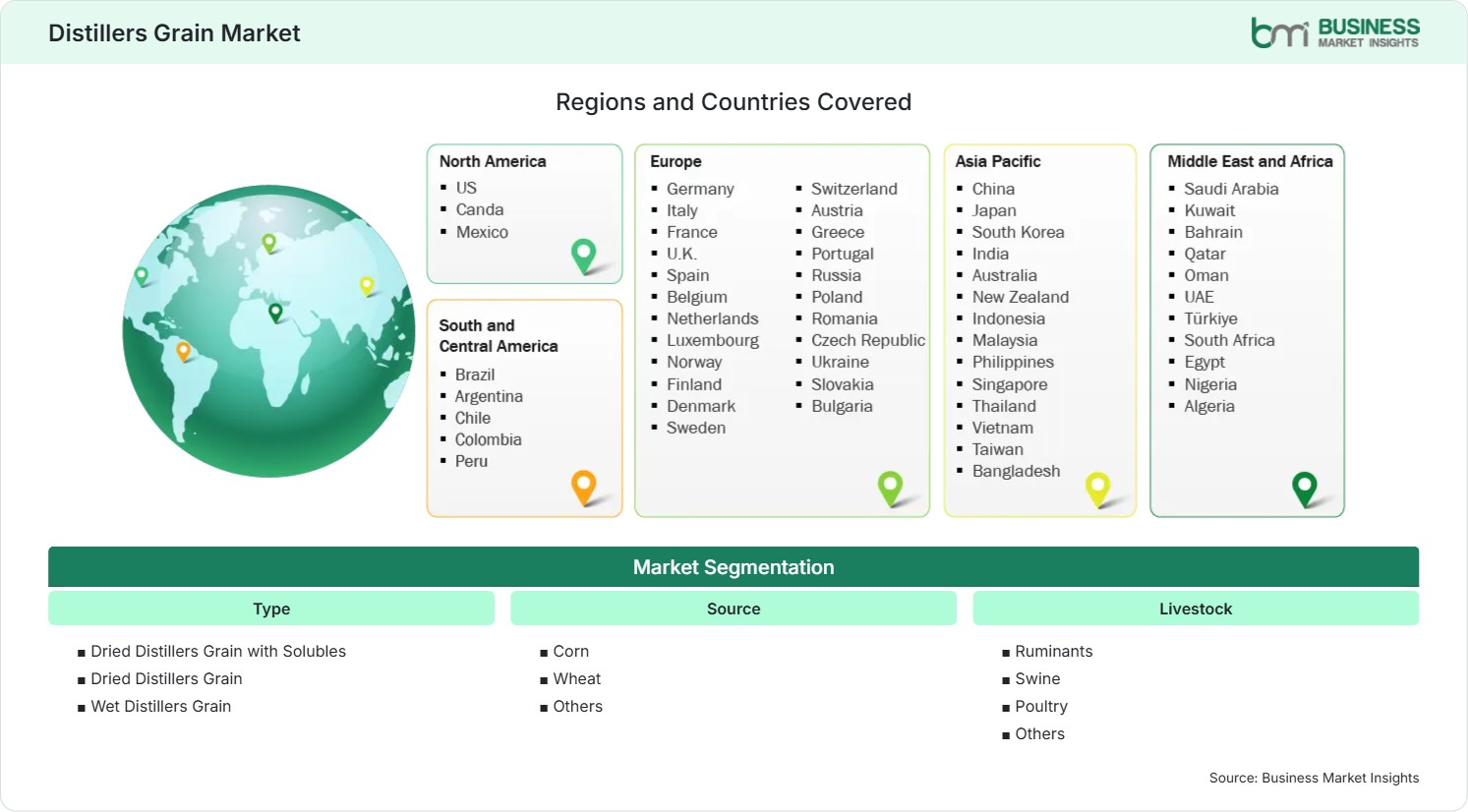
  • Type: Dried Distillers Grain with Solubles, Dried Distillers Grain, Wet Distillers Grain
  • Source: Corn, Wheat, Others
  • Livestock: Ruminants, Swine, Poultry, Others
US$ 18.29 Bn Market size in 2025
US$ 36.28 Bn Market Size by 2033
8.94% CAGR, 2026 - 2033
2026-2033 Forecast Period

01 AI Overview

Distillers Grain Market Summary

  • North America Region: holds a 36%–39% Distillers Grain Market share in 2025, growing at a 7.8%–8.4% CAGR during 2026–2033, driven by ethanol capacity, demand for protein-rich feed ingredients. The U.S. market remains the regional anchor, supported by integrated ethanol-feed production, mature grain logistics, and established export channels, with a 7.9%–8.5% CAGR.
  • Fastest Growing Region: Asia Pacific holds a 29%–32% share in 2025, expanding at a 10.2%–10.8% CAGR, supported by expanding feed production, rising meat consumption, ethanol development, import diversification, feed-cost optimization, and growing acceptance of grain-based coproducts across livestock nutrition markets.
  • Leading Segment: Dried Distillers Grain with Solubles holds a 58%–62% share in 2025, advancing at an 8.8%–9.4% CAGR, supported by longer storage capability, transport flexibility, concentrated nutrients, broad feed formulation compatibility, and established international trading networks.
  • High Growth Segment: Poultry holds a 23%–27% share in 2025, advancing at a 9.8%–10.5% CAGR, supported by expanding commercial poultry production, pressure to control feed costs, demand for digestible protein sources, and increasing formulation flexibility.
  • Key Market Opportunity: Higher-value processing can improve margins through nutrient concentration, protein enrichment, moisture optimization, and differentiated feed products, while export development can broaden market access beyond traditional ethanol-linked demand.
  • Major Market Players: Archer-Daniels-Midland Company, POET, LLC, Green Plains Inc., Valero Energy Corporation, The Andersons, Inc., Marquis Energy, LLC, Flint Hills Resources, LLC, Tate & Lyle PLC, Pacific Ethanol, Inc., and United Cooperative.
02 Strategic Insights

Distillers Grain Market: Strategic Insights

Distillers Grain Market Strategic Framework
FREE PDF
Request your free sample
Request free sample
03 Stakeholder View

Key Takeaways

  • The value chain remains closely connected to corn procurement, ethanol conversion, coproduct recovery, drying, storage, feed formulation, and domestic or export distribution, making plant utilization and logistics central to supplier economics.
  • DDGS retains the strongest commercial position because its dry form supports storage and long-distance transportation, while poultry and other intensive livestock applications provide additional upside as feed producers seek economical protein and energy sources.
  • Product development is moving toward higher protein concentration, improved digestibility, lower fiber content, and tighter nutrient consistency, allowing producers to address formulation requirements beyond conventional bulk DDGS markets.
  • Asia Pacific presents the strongest regional investment case as expanding livestock production, feed manufacturing capacity, and ethanol development combine with growing demand for imported feed ingredients and cost-efficient nutritional inputs.
  • The investment focus is evolving to include greater emphasis on the efficiency of the plants, coproduct yield enhancements, fractionation, logistics, and carbon-intensity reduction, all of which aim to produce better margins for ethanol and coproducts.
  • Profitability in the commercial arena will be achieved through the careful balancing of corn price, ethanol margin, feed ingredient cost, exports, moisture content, and product quality.
04 Geographic Outlook

Distillers Grain Market Regional Highlights

North America Distillers Grain Market

North America held a 36%–39% share in 2025 and is projected to grow at a 7.8%–8.4% CAGR through 2033. The region is endowed with ethanol production, feed markets, grain transport facilities, and livestock demands. The Market share in the region is derived from the large-scale production and exportation capacity in the region, and the Distillers Grain Market growth is directly related to the ethanol usage, corn economics, and coproduct pricing.

  • High ethanol utilization provides a dependable coproduct supply base, while integrated transportation networks support movement from production centers toward livestock regions and export terminals.
  • Established dairy, beef, swine, and poultry industries maintain broad feed demand, allowing producers to manage changing relative prices between distillers grains, corn, soybean meal, and other feed ingredients.
  • Product differentiation is increasing as processors target higher protein concentration, improved consistency, and reduced fiber content to address more specific feed formulation requirements.
  • Export infrastructure remains strategically important because international sales provide additional outlets when domestic feed demand weakens or regional production exceeds local consumption.

US Distillers Grain Market

The U.S. accounted for 82%–86% of North American demand in 2025 and is expected to expand at a 7.9%–8.5% CAGR through 2033. Strong ethanol production capacity, abundant corn supply, feed manufacturing facilities, and distribution networks are among the factors that enhance both domestic demand and exports. According to statistics from the United States Department of Agriculture (USDA), one bushel of corn produces around 17.5 pounds of DDGS.

  • Large ethanol-processing capacity supports consistent distillers grain availability, while proximity between production plants and livestock operations helps control transportation costs for wet and modified products.
  • The U.S. export position remains important, with Southeast Asia representing a significant destination for agricultural products including DDGS, strengthening international demand diversification.
  • Product innovation is increasingly focused on higher-value feed ingredients, helping producers improve returns when conventional DDGS pricing becomes exposed to commodity-market volatility.

Europe Distillers Grain Market

Europe represented a 20%–23% share in 2025 and is expected to grow at an 8.0%–8.6% CAGR through 2033. Germany, France, Spain, and the Netherlands continue to be dominant markets, whereas Poland witnesses better growth rates of 9.0%-9.6% CAGR. The size of the feed manufacturing industry, production of livestock, demand for imported feeds, and renewable fuel regulations affect regional adoption and purchases.

  • Germany is one of the key markets due to its high presence of livestock and compound feed industries, resulting in sustained demand for coproducts.
  • France is favored by its high agricultural output and feed manufacturing industries, supporting domestic utilization and distribution across livestock-producing areas.
  • Spain and the Netherlands maintain strong feed demand linked to intensive livestock production, although import economics and feed formulation costs influence purchasing decisions.
  • Poland represents a faster-growth market as expanding feed production and livestock operations increase the requirement for competitively priced protein and energy inputs.

Asia Pacific Distillers Grain Market

Asia Pacific accounted for a 29%–32% share in 2025 and is projected to grow at a 10.2%–10.8% CAGR, making it the fastest-growing region. China, Japan, South Korea, and India remain important markets, while India records a 10.8%–11.4% CAGR. Expanding feed production, livestock consumption, ethanol capacity, and ingredient diversification support regional demand.

  • China remains a major feed market where large-scale livestock production creates demand for alternative protein and energy ingredients that can improve ration economics.
  • India offers strong expansion potential as ethanol capacity develops and feed manufacturers increasingly incorporate coproduct ingredients into livestock formulations.
  • Japan and South Korea have already well-established feed industries where dependency on foreign raw materials is quite substantial, contributing to an increased demand for processed feed ingredients that can be easily transported and standardized.
  • Nutrient consistency, stability in storage, and reliable supply are becoming more important aspects for regional producers and importers due to formulation-oriented procurement practices.

Rest of World Distillers Grain Market

South and Central America accounted for an important portion of remaining demand, supported by livestock production, expanding feed manufacturing, and growing biofuel activity. Brazil remains the leading market, while Argentina records a 9.1%–9.7% CAGR as ethanol and livestock value chains develop.

Middle East and Africa demand remains smaller but is expanding through feed-import diversification and commercial livestock production. South Africa leads regional adoption, while Saudi Arabia records a 8.5%–9.1% CAGR. The combined Rest of World share stands at 12%–15%, with a 7.2%–7.8% CAGR through 2033.

  • Brazil benefits from a strong agricultural base and expanding ethanol industry, creating both supply and demand opportunities for grain-based coproducts.
  • Argentina offers growth through livestock production and biofuel development, with feed manufacturers increasingly assessing alternative protein and energy sources.
  • South Africa remains the leading African market because commercial poultry and livestock production support demand for cost-efficient feed ingredients.
  • Middle Eastern markets depend more heavily on imported feed materials, creating opportunities for shelf-stable dried products supported by reliable international logistics.
Global Market Geography
FREE PDF
Request your free sample
Request free sample
05 Segment Analysis

Distillers Grain Market Segmentation

Type

The Type segment is led by Dried Distillers Grain with Solubles, accounting for a 58%–62% share in 2025 and advancing at an 8.8%–9.4% CAGR. Dry products command stronger commercial reach because storage, handling, and export are easier than moisture-rich alternatives. The Distillers Grain Market scope continues broadening through product differentiation and nutrient optimization.

  • Dried Distillers Grain with Solubles (DDGS): Broad feed compatibility, concentrated nutrients, and long storage capability support its dominant position across domestic feed markets and international trade.
  • Dried Distillers Grain (DDG): Lower-solubles formulations appeal where feed manufacturers require specific nutrient profiles, supporting demand through controlled ration formulation and ingredient substitution.
  • Wet Distillers Grain (WDG): High moisture content limits transport distance but supports economical local use near ethanol facilities, particularly where livestock operations can consume fresh material rapidly.

Source

Corn continues to be the predominant source, contributing the majority of the total production, owing to the high volume of coproducts that corn ethanol produces along with already existing processing technologies. The production from wheat offers geographical diversity, whereas production from other sources is relatively minimal. Source economics affect availability, nutritional make-up, and feed formulation preferences.

  • Corn: Extensive ethanol processing capacity, established grain supply chains, and predictable coproduct generation make corn the principal commercial source for distillers grain production.
  • Wheat: Wheat-based production supports regional feed markets where wheat ethanol processing is established, providing an alternative ingredient with different nutrient and formulation characteristics.

Livestock

Ruminants remain the leading livestock application, accounting for a 34%–38% share in 2025 and expanding at an 8.4%–9.0% CAGR. Poultry is the high-growth segment, supported by commercial feed demand and tighter feed-cost management. Adoption depends on nutrient specifications, inclusion levels, ingredient prices, and livestock performance requirements across feed formulations.

  • Ruminants: Dairy and beef producers value distillers grains for protein and energy contribution, while local availability supports efficient use of moisture-rich products near processing facilities.
  • Swine: Swine feed formulations use distillers grains where pricing and nutrient specifications support substitution, with quality consistency remaining important for controlled inclusion levels.
  • Poultry: Rapid commercial poultry production and pressure to optimize feed economics support stronger demand, particularly for standardized products with predictable nutrient composition.
06 Market Forces

Distillers Grain Market Dynamics

Key Market Drivers

Rising Animal Feed Demand Supports Distillers Grain Consumption

The demand for animal feed continues to be the key foundation downstream since the distillers grains offer protein, energy, fiber, phosphorus, and other nutrients in the ration. The Market growth will be bolstered by the fact that feed companies look for cheaper sources for their ingredients without sacrificing the nutritional requirements. There has been improved nutrient testing, which is assisting buyers in dealing with consistency of formulation. Livestock farmers are now becoming aware of feed margins.

Growing Ethanol Production Increases Distillers Grain Availability

The production process is directly responsible for the generation of the supply of distiller’s grain, making renewable fuel demand an important factor from a production point of view. Hence, the Distillers Grain Market trends have started to reflect the developments happening in the area of renewable fuels more than the development of feed demand. An increase in ethanol throughput will lead to increased DDGS supply, while coproduct yields will add to the economic benefits of the facility.

Increasing Demand for Cost-Effective Protein Sources Drives Adoption

Feed manufacturers are increasingly evaluating alternative protein sources as raw-material prices fluctuate and livestock producers seek tighter feed-cost control. Distillers grains can reduce reliance on conventional ingredients when their nutrient contribution and delivered cost are favorable. The Distillers Grain Market growth benefits from improved formulation software, nutrient testing, and differentiated feed products that allow nutritionists to account for protein, fiber, fat, and phosphorus levels more precisely.

Key Market Opportunities

Expansion of Ethanol Production Creates New Distillers Grain Supply

Increased ethanol production capacity translates to increased coproduct production since distiller’s grains are an integral product from grain fermentations. Increased production capacity can also increase the availability of feed ingredients and the local supply chain. In addition, it offers more than just increased volume since producers have the ability to optimize other processes such as drying, nutrients extraction, storage and logistics in tandem with increased ethanol production capacity. Investors are therefore able to consider coproducts as another revenue stream within their renewable fuel production ventures.

Growing Feed Demand in Emerging Markets Supports Market Expansion

Emerging feed markets provide a substantial opportunity as livestock production becomes more commercialized and manufacturers seek additional protein and energy inputs. Asia Pacific offers the strongest growth profile because expanding poultry, swine, dairy, and aquaculture value chains are increasing demand for competitively priced feed materials. Distillers grains can support feed diversification where local soybean meal or other protein sources face cost or availability pressures. The Distillers Grain Market Forecasts favor suppliers with reliable export logistics, consistent specifications, and regional distribution partnerships.

Development of Higher-Value Distillers Grain Applications

Higher-value processing represents an opportunity to move beyond conventional bulk DDGS by improving protein concentration, reducing fiber, and tailoring nutrient profiles to specific feed applications. Fractionation and enhanced separation can create multiple coproduct streams while improving the economic value of the remaining feed material. These approaches also support better utilization of each corn component, strengthening overall biorefinery economics. Demand for specialized feed ingredients can create pricing differentiation when products deliver measurable formulation benefits.

Market Restraints and Challenges

High Production Costs and Nutrient Variability Affect Distillers Grain Economics

Factor: Drying, transportation, storage, and quality-control requirements can raise delivered costs, particularly for products shipped over long distances or exposed to changing energy and freight prices. Impact: Higher costs can narrow the price advantage over conventional feed ingredients and reduce purchasing interest when soybean meal or corn prices become comparatively favorable. Consistent nutrient specifications, efficient logistics, and quality monitoring can reduce commercial friction, but smaller operators may face greater difficulty achieving the same cost efficiency as integrated facilities.

Feed Formulation and Market Volatility Create Commercial Uncertainty

Factor: Distillers grain pricing is influenced by corn costs, ethanol margins, livestock feed demand, export conditions, and competing protein ingredients, creating exposure to multiple commodity cycles. Impact: Feed manufacturers may reduce inclusion levels or delay purchases when relative ingredient economics change, weakening demand visibility for producers. However, commodity-linked pricing remains a structural challenge because distillers grains compete directly with other feed ingredients whose values can change independently.

07 Company Analysis

Competitive Landscape

The Distillers Grain Market analysis shows competition extending beyond ethanol production into coproduct quality, nutrient concentration, logistics, feed distribution, and international market access. Large integrated producers benefit from scale and established grain networks, while specialized operators compete through product quality and regional supply relationships.

Company Name

Overview

Products and Services relevant to this market

Archer-Daniels-Midland Company

Global agricultural processor with extensive grain sourcing, processing, nutrition, and commodity distribution capabilities across major agricultural markets.

DDGS, corn-based feed ingredients, animal nutrition products, grain merchandising, processing, storage, and international distribution services.

POET, LLC

Major biofuel producer with integrated bioprocessing operations and a substantial coproduct platform serving agricultural feed markets.

Dried distillers grains, protein ingredients, corn oil, ethanol coproducts, feed ingredients, processing, and distribution.

Green Plains Inc.

Integrated biorefinery operator focused on ethanol, feed ingredients, renewable corn oil, and higher-value protein production.

DDGS, wet and modified distillers grains, Ultra-High Protein, corn-derived feed ingredients, marketing, and distribution.

Valero Energy Corporation

Large renewable-fuels producer operating ethanol facilities that generate substantial livestock-feed coproduct volumes.

Dried and modified distillers grains, ethanol coproducts, corn oil, processing, storage, and transportation through established logistics channels.

The Andersons, Inc.

Diversified agricultural company combining grain merchandising, ethanol production, feed products, logistics, and renewable operations.

DDGS, high-protein feed ingredients, ethanol coproducts, grain merchandising, transportation, storage, and feed ingredient distribution.

Marquis Energy, LLC

U.S. ethanol producer with integrated grain processing and coproduct production capabilities serving agricultural markets.

Distillers grains, ethanol coproducts, corn oil, feed products, grain processing, and regional distribution services.

Flint Hills Resources, LLC

Energy and agricultural processing company with ethanol operations producing feed and renewable coproducts.

Distillers grains, ethanol coproducts, corn oil, grain processing, feed distribution, and logistics support.

Tate & Lyle PLC

Global ingredient company with extensive grain-processing and specialty ingredient capabilities supporting food, feed, and industrial applications.

Corn-derived ingredients, grain processing, nutritional inputs, feed-related coproducts, and technical ingredient solutions.

Pacific Ethanol, Inc.

Renewable-fuels producer with experience in corn ethanol processing and associated agricultural coproduct markets.

Distillers grains, ethanol, corn-based coproducts, grain processing, and agricultural commodity services.

United Cooperative

Agricultural cooperative supporting grain procurement, processing, merchandising, and feed-related activities across regional farming markets.

Distillers grains, grain handling, feed ingredients, agricultural merchandising, storage, transportation, and producer services.

10 Trust & Transparency

Research Methodology

The market analysis combines proprietary research with secondary data from government agencies, company disclosures, regulatory filings, industry databases and expert interviews. Market estimates are validated through data triangulation, cross-market benchmarking and analyst review.

View Full Research Methodology

11 Questions Answered

Frequently Asked Questions

What does the Distillers Grain Market Report indicate about future product development?

The outlook increasingly favors differentiated feed ingredients with higher protein concentration, improved digestibility, controlled nutrient profiles, and stronger traceability rather than reliance on undifferentiated bulk products.

What factors determine the competitiveness of imported distillers grains?

Delivered nutrient cost, freight, moisture, product consistency, import requirements, currency conditions, and competing feed ingredient prices determine the attractiveness of imported material.

How does ethanol production affect distillers grain availability?

Distillers grains are generated during ethanol processing, so changes in grain-based ethanol output directly influence coproduct availability. Higher plant utilization generally increases the volume available for feed markets.

Why is coproduct quality becoming more important for feed buyers?

Feed manufacturers increasingly require predictable protein, fiber, fat, and phosphorus levels so formulations can be optimized precisely and performance differences between batches can be minimized.

Which product form has the strongest commercial position in the Distillers Grain Market?

Dried Distillers Grain with Solubles has the strongest position because its lower moisture content improves storage, handling, transportability, and export suitability compared with wet products.

Access the Full Distillers Grain Market Report

Get segment-level forecasts, regional estimates, competitive benchmarking, company profiles and downloadable Excel datasets.

Access the full Distillers Grain Market Report
350 pages PDF & Excel | 2026-08-20