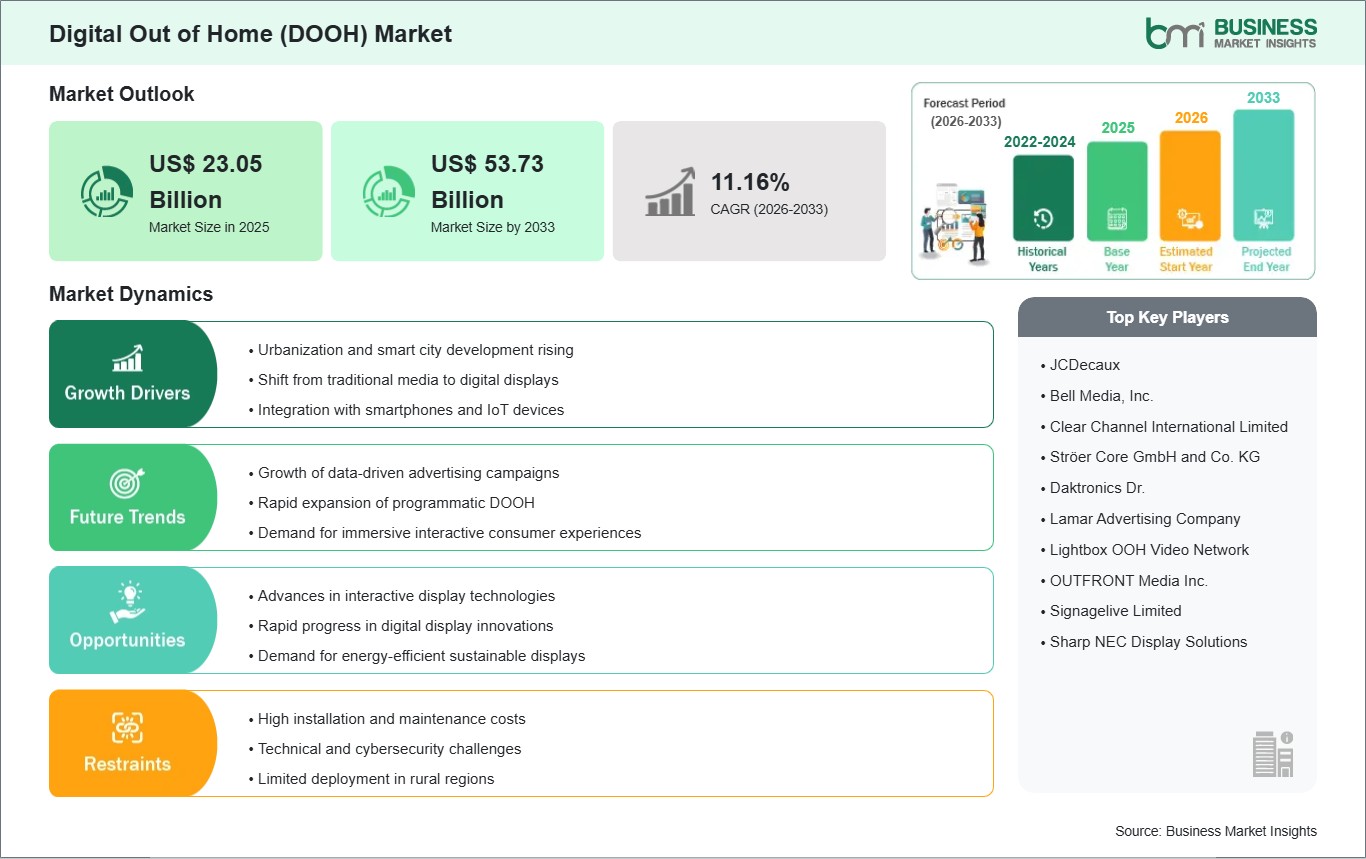
The Digital Out of Home (DOOH) Market size is expected to reach US$ 53.73 Billion by 2033 from US$ 23.05 Billion in 2025. The market is estimated to record a CAGR of 11.16% from 2026 to 2033.
Digital Out of Home (DOOH) advertising refers to the use of digital screens and displays in public spaces—such as malls, airports, transit stations, and highways—to deliver dynamic, targeted marketing messages. Unlike traditional static billboards, DOOH allows real-time content updates, audience targeting, and interactive campaigns, enhancing engagement and relevance. Its benefits include higher visibility, measurable impact through analytics, flexibility in messaging, and the ability to integrate with mobile and social campaigns. The market growth is driven by increasing urbanization, rising smartphone penetration, advancements in display technology, and growing demand for programmatic advertising that can reach audiences efficiently. Brands are leveraging DOOH to create immersive experiences, promote timely offers, and track campaign effectiveness in real time. As consumer attention shifts toward screens in everyday environments, the DOOH sector continues to expand, fueled by its adaptability, measurable ROI, and the ability to deliver context-aware and location-specific advertising content.

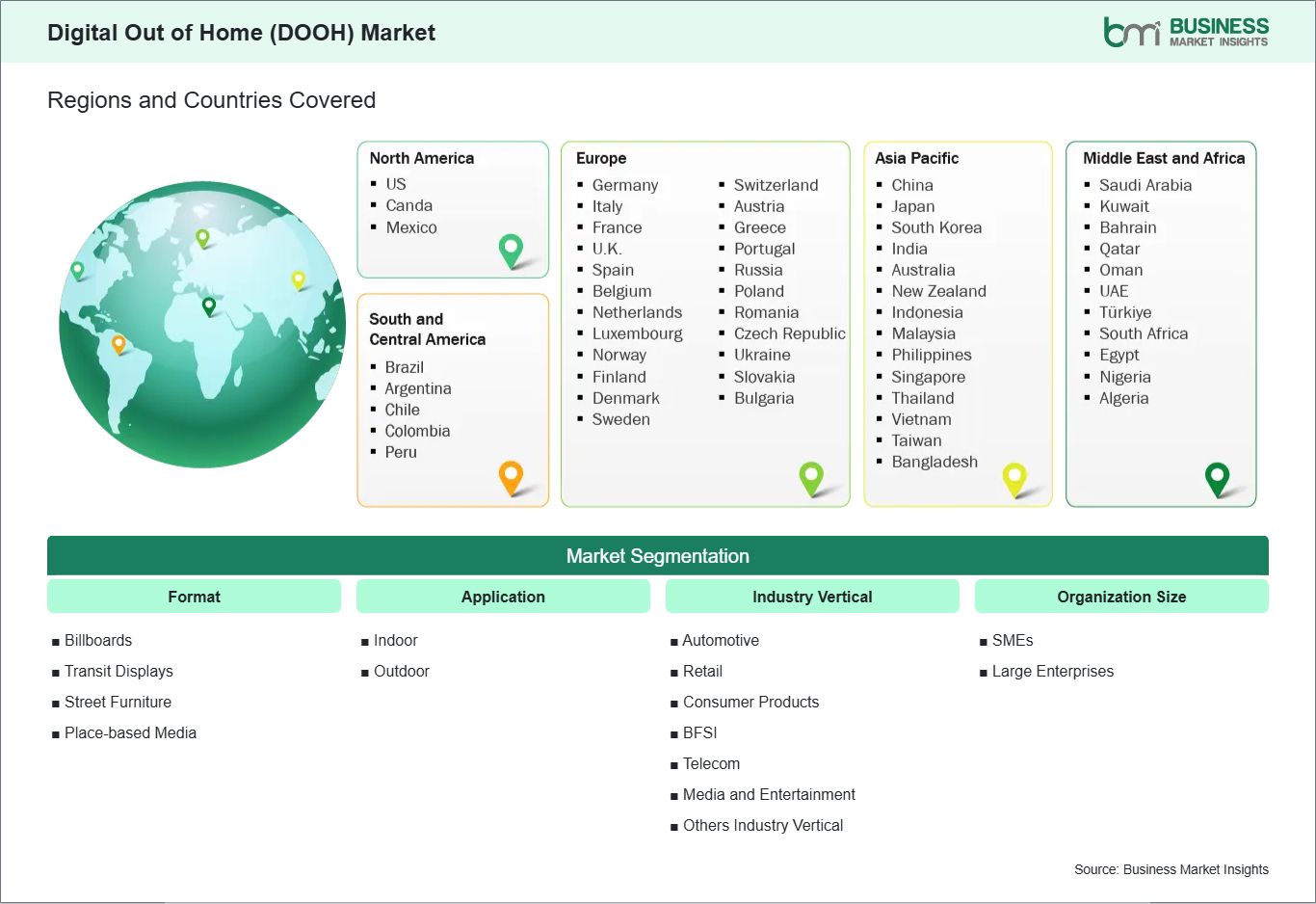
Key segments that contributed to the derivation of the digital out of home (DOOH) market analysis are format, application, industry vertical, and organization size.
Rapid urbanization in major cities such as New York City, London, and Tokyo is significantly driving the growth of the Digital Out of Home (DOOH) market. Increasing population density in urban centers creates high-traffic environments where digital screens deliver strong visibility and audience reach. Governments worldwide are investing in smart city initiatives that integrate digital infrastructure into transportation hubs, public spaces, and commercial districts. These projects often include connected digital billboards and interactive kiosks that support real-time communication and public information. The shift from static billboards to dynamic digital displays enables advertisers to run multiple campaigns on a single screen, optimize content by time of day, and quickly adapt messaging. As cities become more technologically advanced, DOOH platforms benefit from improved connectivity, data integration, and centralized content management, reinforcing their value as a scalable and flexible advertising medium.
Technological innovation offers significant opportunities for the evolution of DOOH advertising. Advancements in artificial intelligence, augmented reality, and high-resolution LED displays are transforming traditional outdoor advertising into immersive brand experiences. Interactive kiosks, touch-enabled screens, and facial recognition technologies allow advertisers to deliver personalized content in real time. Integration with mobile devices through QR codes and near-field communication enhances engagement and bridges online-offline marketing strategies. Major technology companies such as Samsung Electronics and LG Electronics are developing next-generation display solutions that offer energy efficiency and superior visual performance. As 5G connectivity expands globally, faster data transmission will enable seamless streaming of dynamic content and real-time updates. These innovations not only enhance audience engagement but also open new revenue streams for media owners, strengthening the overall value proposition of the DOOH ecosystem.
By format, the market is segmented into billboards, transit displays, street furniture, and place-based media. The billboards segment held the largest share of the market in 2025, driven by the rising urbanization, high commuter traffic, and brands seeking broader visibility. Advertisers value their constant exposure and location-based impact. This surge accelerates the digital out-of-home (DOOH) market, as dynamic screens offer real-time updates, targeted messaging, and measurable engagement beyond traditional static displays.
By application, the market is segmented indoor and outdoor. The outdoor segment held the largest share of the market in 2025, due to smart city growth, data-driven targeting, and dynamic content capabilities. Brands leverage advanced screens and real-time analytics to engage audiences effectively, especially in high-traffic urban locations, transit hubs, and shopping districts, maximizing visibility and measurable impact.
By industry vertical, the market is segmented into automotive, retail, consumer products, BFSI, telecom, media and entertainment, and other industry vertical. The retail segment held the largest share of the market in 2025, driven by businesses focusing on advanced audience targeting, real-time content updates, and data-driven advertising strategies. Retailers leverage DOOH to enhance customer engagement, boost brand visibility, integrate omnichannel campaigns, and influence purchasing decisions at critical in-store touchpoints.
By organization size, the market is segmented SMEs and large enterprises. The large enterprises segment held the largest share of the market in 2025. Large enterprises increasingly adopt digital out-of-home (DOOH) advertising due to its dynamic content capabilities, real-time audience targeting, measurable engagement, and ability to enhance brand visibility in high-traffic areas, providing a cost-effective, flexible solution compared to traditional static displays.

| Report Attribute | Details |
|---|---|
| Market size in 2025 | US$ 23.05 Billion |
| Market Size by 2033 | US$ 53.73 Billion |
| Global CAGR (2026 - 2033) | 11.16% |
| Historical Data | 2022-2024 |
| Forecast period | 2026-2033 |
| Segments Covered | By Format
|
|
Regions and Countries Covered
| |
| North America | US, Canada, Mexico |
| Europe | Belgium, Austria, Finland, Denmark, Greece, Poland, Romania, Russia, Ukraine, Czech Republic, Slovakia, Bulgaria, Italy, Luxembourg, Germany, Switzerland, France, Netherlands, Norway, Portugal, Spain, Sweden, United Kingdom |
| Asia-Pacific | Australia, China, India, Japan, South Korea, Indonesia, Malaysia, Philippines, Singapore, Thailand, Vietnam, Bangladesh, New Zealand, Taiwan |
| South and Central America | Brazil, Argentina, Peru, Chile, Colombia |
| Middle East and Africa | Bahrain, Kuwait, Oman, Qatar, Saudi Arabia, United Arab Emirates, Turkiye, South Africa, Egypt, Algeria, Nigeria |
| Market leaders and key company profiles |
|
The "Digital Out of Home (DOOH) Market Size and Forecast (2022 - 2033)" report provides a detailed analysis of the market covering below areas:
The geographical scope of the digital out of home (DOOH) market report is divided into five regions: North America, Asia Pacific, Europe, Middle East & Africa, and South & Central America. The digital out of home (DOOH) market in North America is expected to grow significantly during the forecast period.
The North America digital out of home (DOOH) market is segmented into US, Canada, and Mexico. The demand for Digital Out of Home (DOOH) advertising in North America has been growing at an unprecedented pace, driven by advancements in technology, changing consumer behavior, and the increasing effectiveness of dynamic, data-driven campaigns. Unlike traditional static billboards, DOOH integrates digital screens, programmatic advertising, and real-time content updates, allowing brands to deliver highly targeted messages to audiences in high-traffic locations such as shopping malls, transit hubs, and urban centers. The rise of mobile connectivity and location-based data has further amplified the value of DOOH, enabling advertisers to tailor content based on demographics, time of day, and even weather conditions. Additionally, the post-pandemic recovery has accelerated out-of-home media consumption, as people resume commuting, shopping, and traveling, creating more opportunities for advertisers to reach consumers in situ. North American cities have invested heavily in large-format digital displays and smart signage, reflecting a shift from conventional static media to interactive, visually engaging platforms. The scalability, flexibility, and measurable ROI of DOOH make it increasingly attractive to marketers seeking to combine traditional outdoor reach with digital precision. As a result, the sector is expected to continue its rapid expansion, solidifying its role as a central pillar of modern advertising strategies in the region.

The digital out of home (DOOH) market is evaluated by gathering qualitative and quantitative data post primary and secondary research, which includes important corporate publications, association data, and databases. A few of the key developments in the digital out of home (DOOH) market are:
The Digital Out of Home (DOOH) Market is valued at US$ 23.05 Billion in 2025, it is projected to reach US$ 53.73 Billion by 2033.
As per our report Digital Out of Home (DOOH) Market, the market size is valued at US$ 23.05 Billion in 2025, projecting it to reach US$ 53.73 Billion by 2033. This translates to a CAGR of approximately 11.16% during the forecast period.
The Digital Out of Home (DOOH) Market report typically cover these key segments-
The historic period, base year, and forecast period can vary slightly depending on the specific market research report. However, for the Digital Out of Home (DOOH) Market report:
The Digital Out of Home (DOOH) Market is populated by several key players, each contributing to its growth and innovation. Some of the major players include:
The Digital Out of Home (DOOH) Market report is valuable for diverse stakeholders, including:
Essentially, anyone involved in or considering involvement in the Digital Out of Home (DOOH) Market value chain can benefit from the information contained in a comprehensive market report.
Please tell us your area of interest
(Market Segments/ Regions and Countries/ Companies)