
Digital Blood Pressure Monitors Market Outlook: Size, Share, Trends, Growth Analysis, Competitive Landscape & Forecast, 2026-2033

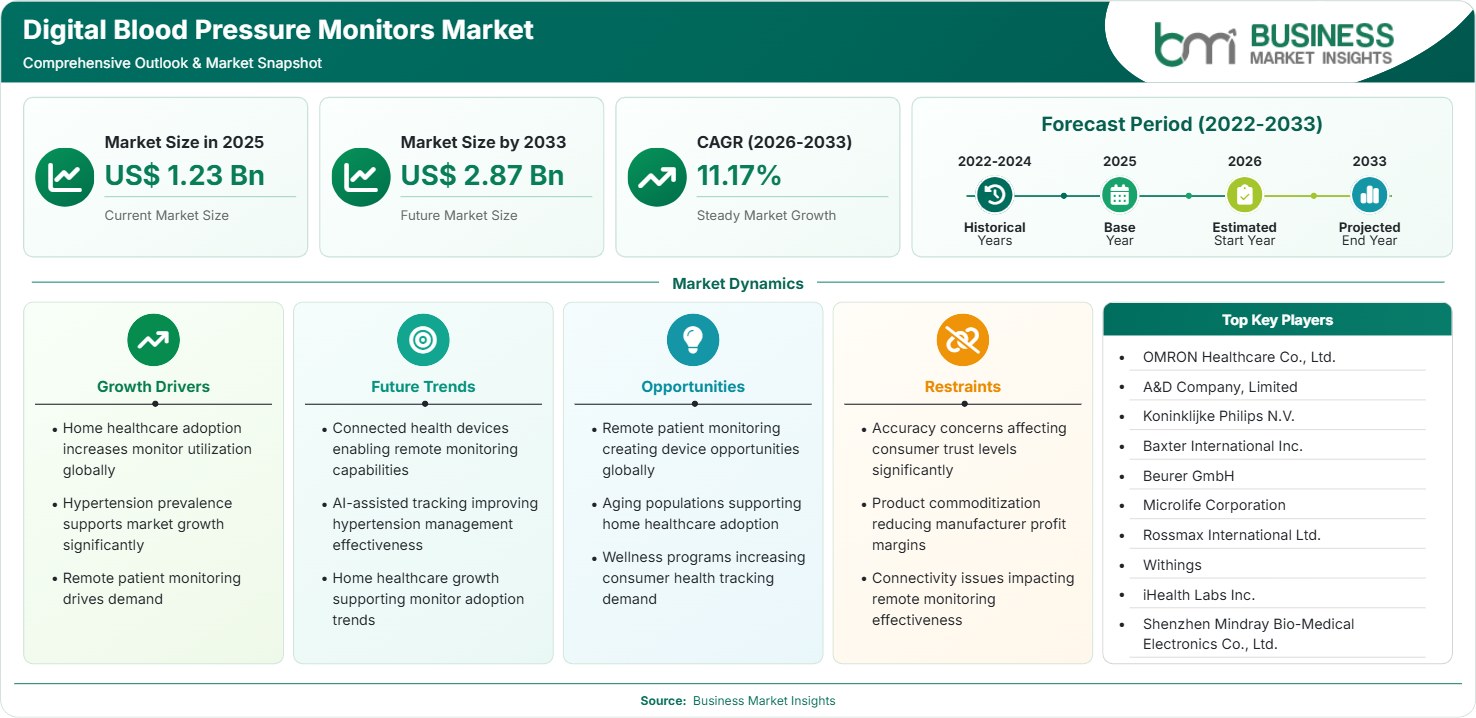
The Digital Blood Pressure Monitors Market size was valued at US$ 1.23 Billion in 2025 and is projected to reach US$ 2.87 Billion by 2033, growing at a CAGR of 11.17% during 2026–2033, driven by opportunities in hypertension screening, homecare adoption, connected health technologies, preventive care, and remote patient monitoring.

Report Coverage
  • Product Type: Arm Type, Wrist Type
  • End User: Hospitals, Ambulatory Surgical Centers & Clinics, Homecare Settings, Others
US$ 1.23 Bn Market size in 2025
US$ 2.87 Bn Market Size by 2033
11.17% CAGR, 2026 - 2033
2026-2033 Forecast Period

AI Overview

Digital Blood Pressure Monitors Market Summary

  • North America Region: North America holds an analyst-modelled 39%–42% share in 2025, growing at a CAGR of 9%–11% during 2026–2033. Established healthcare infrastructure, reimbursement-supported monitoring, retail availability, and digital health integration sustain demand for validated devices across clinical and homecare channels. The US Digital Blood Pressure Monitors Market benefits from established clinical protocols, adoption of home monitoring, and connected cardiovascular care, supporting a modeled CAGR of 9%–11%.
  • Fastest Growing Region: Asia Pacific holds a modeled 25%–28% share in 2025 and is projected to grow at a CAGR of 13%–15% during 2026–2033. Expanding healthcare access, substantial patient populations, urbanization, domestic manufacturing, and smartphone-enabled monitoring create opportunities for affordable devices and distribution partnerships.
  • Leading Segment: Arm Type monitors hold a modelled 68%–72% share in 2025 and are projected to grow at a CAGR of 9%–11% during 2026–2033. Clinical familiarity, established measurement protocols, validated upper-arm cuffs, and suitability for routine home monitoring underpin segment leadership.
  • High Growth Segment: Homecare Settings account for a modelled 28%–32% Digital Blood Pressure Monitors Market share in 2025 and are projected to grow at a CAGR of 13%–15% during 2026–2033. Longitudinal blood pressure tracking, clinician-guided self-measurement, telehealth integration, and aging populations are strengthening demand for accessible monitoring solutions.
  • Key Market Opportunity: Manufacturers can differentiate through validated measurement accuracy, accessible cuff designs, connected records, clinician dashboards, and affordable subscription-free products that extend monitoring beyond hospitals while improving adherence and continuity of care.
  • Major Market Players: OMRON Healthcare Co., Ltd.; A&D Company, Limited; Koninklijke Philips N.V.; Baxter International Inc.; Beurer GmbH; Microlife Corporation; Rossmax International Ltd.; Withings; iHealth Labs Inc.; and Shenzhen Mindray Bio-Medical Electronics Co., Ltd.
Strategic Insights

Digital Blood Pressure Monitors Market: Strategic Insights

Digital Blood Pressure Monitors Market Strategic Framework
FREE PDF
Request your free sample
Request free sample
Stakeholder View

Key Takeaways

  • Competitive advantage depends on more than device assembly. Sensor quality, cuff fit, manufacturing consistency, regulatory documentation, distribution reach, and after-sales support determine whether manufacturers can secure recurring institutional orders and consumer trust. Component suppliers and software partners can capture value by improving reliability and simplifying integration into clinical workflows.
  • Homecare offers a strategic route to sustained demand because patients need repeated measurements rather than occasional equipment access. Manufacturers should evaluate total ownership cost, ease of use, replacement cuffs, accessible displays, and connectivity options alongside the initial selling price. Clinician-supported programs can strengthen adherence and reduce avoidable barriers to repeat measurement.
  • Research and development should focus on validated algorithms, movement-error detection, irregular heartbeat alerts where clinically supported, flexible cuff sizing, and accessible interfaces. Mobile applications should preserve readable measurement histories and enable secure sharing with healthcare professionals. Feature development must not imply that a consumer monitor independently diagnoses every cardiovascular condition.
  • Asia Pacific provides a differentiated opportunity through population scale, domestic electronics manufacturing, expanding retail access, and demand for lower-cost monitoring. Companies entering the region should assess country-specific registration, language requirements, price sensitivity, service coverage, and local clinical practices before committing to large production or marketing investments.
  • Collaboration among device manufacturers, digital health providers, pharmacies, and healthcare systems can strengthen customer acquisition and data integration. Investors should distinguish commercial agreements and product launches from completed acquisitions or disclosed financing transactions. Due diligence should examine the durability of distribution relationships, product authorizations, manufacturing resilience, and the economics of connected services.
  • The most defensible product propositions combine measurement validation with practical usability. Buyers should examine independent validation, appropriate cuff sizing, repeatability, data-export options, and support arrangements rather than treating smartphone connectivity or automated alerts as substitutes for accuracy.
Geographic Outlook

Digital Blood Pressure Monitors Market Regional Highlights

North America Digital Blood Pressure Monitors Market

North America Digital Blood Pressure Monitors Market is estimated to account for 39%–42% of global revenue in 2025, with a modeled CAGR of 9%–11% during 2026–2033. Demand benefits from established primary care, strong retail availability, and familiarity with home measurement. The United States is the principal regional market, supported by connected health services and clinical guidance favoring home readings for appropriate patients. Canada contributes through community care and chronic disease management, while purchasing decisions increasingly emphasize validation, usability, and reliable data sharing.

  • Home monitoring programs provide a commercial foundation for upper-arm devices, particularly where clinicians use repeated readings to assess treatment response. Manufacturers can differentiate through clear instructions, memory functions, and uncomplicated sharing of results.
  • Retail pharmacies and e-commerce expand product access but increase the importance of trustworthy product information. Clear validation claims, appropriate cuff sizing, warranty coverage, and accessible customer support help distinguish established manufacturers from unverified alternatives.
  • Connected monitors can support telehealth workflows when readings are recorded consistently, and patients understand how to take measurements. Interoperability, secure transmission, and easy-to-read histories matter more than adding features that complicate everyday use.
  • Institutional buyers value dependable procurement, calibration procedures, and staff familiarity. Suppliers that provide training, product documentation, and responsive servicing can strengthen long-term relationships with clinics, hospitals, and home health providers.

US Digital Blood Pressure Monitors Market

The United States Digital Blood Pressure Monitors Market is estimated to account for 75%–80% of North America's regional revenue in 2025, with a modelled CAGR of 9%–11% over 2026–2033. Demand is shaped by home measurement, chronic disease management, consumer access, and growing interest in connected monitoring. The American Heart Association recommends home monitoring for people with high blood pressure and advises using automatic upper-arm cuff-style devices. These recommendations support established cuff-based products without guaranteeing demand for every connected feature.

  • Clinical recommendations support demand for devices that deliver consistent readings and maintain measurement histories. Product education remains important because incorrect positioning, cuff selection, and measurement technique can undermine the usefulness of otherwise capable hardware.
  • FDA communications caution against unauthorized devices claiming to measure or estimate blood pressure, including certain wearable software features. Authorization status and substantiated performance claims therefore matter to consumers, distributors, and healthcare professionals.
  • Commercial opportunities extend to pharmacies, health plans, remote patient monitoring providers, and healthcare systems. Suppliers should demonstrate how their products fit existing workflows rather than assuming connectivity alone creates clinical or economic value.

Europe Digital Blood Pressure Monitors Market

Europe will account for 21%–24% of worldwide Digital Blood Pressure Monitors Market revenue in 2025, with a forecast CAGR of 9%–11% from 2026 to 2033. The drivers include healthcare infrastructure, an aging population, heart disease prevention, and the availability of retail pharmacies and e-commerce distribution. Germany, the UK, France, and Italy present major business prospects, with opportunities varying depending on purchasing conditions, consumer purchasing power, and digital health trends. Registration and product qualification are essential aspects of market entry.

  • Germany's established medical technology ecosystem supports demand for reliable devices, clinical procurement, and consumer products with clear documentation. Suppliers should compete through durability, validated performance, and distribution partnerships rather than price alone.
  • The United Kingdom offers opportunities through primary care, pharmacy retail, and digital health services. Product usability and integration into clinician-supervised monitoring can help manufacturers address demand beyond episodic measurements in healthcare facilities.
  • France and Italy offer established consumer and clinical channels, although market access depends on local purchasing behavior and distribution strength. Local-language instructions, appropriate cuff options, and reliable product support can improve adoption.
  • Wider European expansion requires attention to applicable medical-device requirements, privacy obligations, and substantiation of clinical claims. Manufacturers should align product documentation and software practices with the requirements relevant to each intended use and jurisdiction.

Asia Pacific Digital Blood Pressure Monitors Market

Asia Pacific is estimated to hold 25%–28% of global revenue in 2025 and is projected to record a modelled CAGR of 13%–15% during 2026–2033, making it the fastest-growing region in this assessment. China, Japan, and India offer distinct opportunities shaped by domestic manufacturing, healthcare access, consumer affordability, and chronic disease management. The regional outlook depends as much on local distribution and product suitability as on technology. The Digital Blood Pressure Monitors Market share can expand as accessible devices reach households and primary-care providers.

  • China combines substantial domestic manufacturing capacity with a large consumer market. Companies can compete through reliable production, tiered pricing, local distribution, and products designed for different household needs and healthcare settings.
  • India offers opportunities in pharmacy retail, online commerce, and primary-care programs. Affordable upper-arm monitors, multilingual instructions, dependable service, and partnerships with healthcare providers can help manufacturers reach consumers outside major urban centers.
  • Japan provides a mature market for compact, user-friendly monitoring devices and established medical technology products. Product differentiation can center on accessible interfaces, dependable measurement, and practical support for older users.
  • Southeast Asian markets present opportunities through urban healthcare expansion and greater access to consumer electronics. Market entry requires country-specific registration, channel development, after-sales coverage, and pricing suited to local purchasing power.
  • Domestic manufacturing and regional supply partnerships can improve availability, but companies must maintain consistent quality across production sites. Export growth depends on meeting destination-market requirements and providing clear product documentation.

Rest of World Digital Blood Pressure Monitors Market

South and Central America is estimated to account for 5%–8% of the Digital Blood Pressure Monitors Market's total global revenues in 2025, with a modeled compound annual growth rate of 10%–12% during 2026–2033. Opportunities in Brazil and Mexico lie in pharmacies, private healthcare, and consumer channels. Factors affecting adoption include purchasing power, import costs, and the availability of reliable services; therefore, affordable and validated products, as well as local distributors, become commercially relevant.

The Middle East and Africa will collectively generate 3%–5% of the world’s revenue in 2025, with a modelled CAGR of 10%–12%. Gulf nations can provide support for premium and connected products through their established networks of healthcare professionals, and South Africa and other selected larger African nations can be tapped through primary care and retail channels.

  • Brazil offers opportunities through retail pharmacies, private clinics, and chronic disease management. Suppliers need dependable distribution, local-language product materials, and a clear approach to product registration and after-sales support.
  • Mexico can support demand through urban pharmacies, private providers, and online channels. Products with straightforward operation and accessible pricing can appeal to households, while institutional buyers require consistent supply and reliable documentation.
  • Gulf countries offer opportunities for connected monitoring in digitally enabled healthcare settings. Manufacturers should align products with local procurement expectations, registration processes, and the technical capabilities of provider networks.
  • South Africa provides a potential access point for established distributors serving clinical and consumer channels. Affordable validated devices and accessible servicing can help address price sensitivity without compromising product reliability.
  • Across underserved markets, public health programs and private distribution partnerships can widen access. Commercial plans should account for import lead times, currency movements, product registration, and the cost of maintaining service beyond major cities.
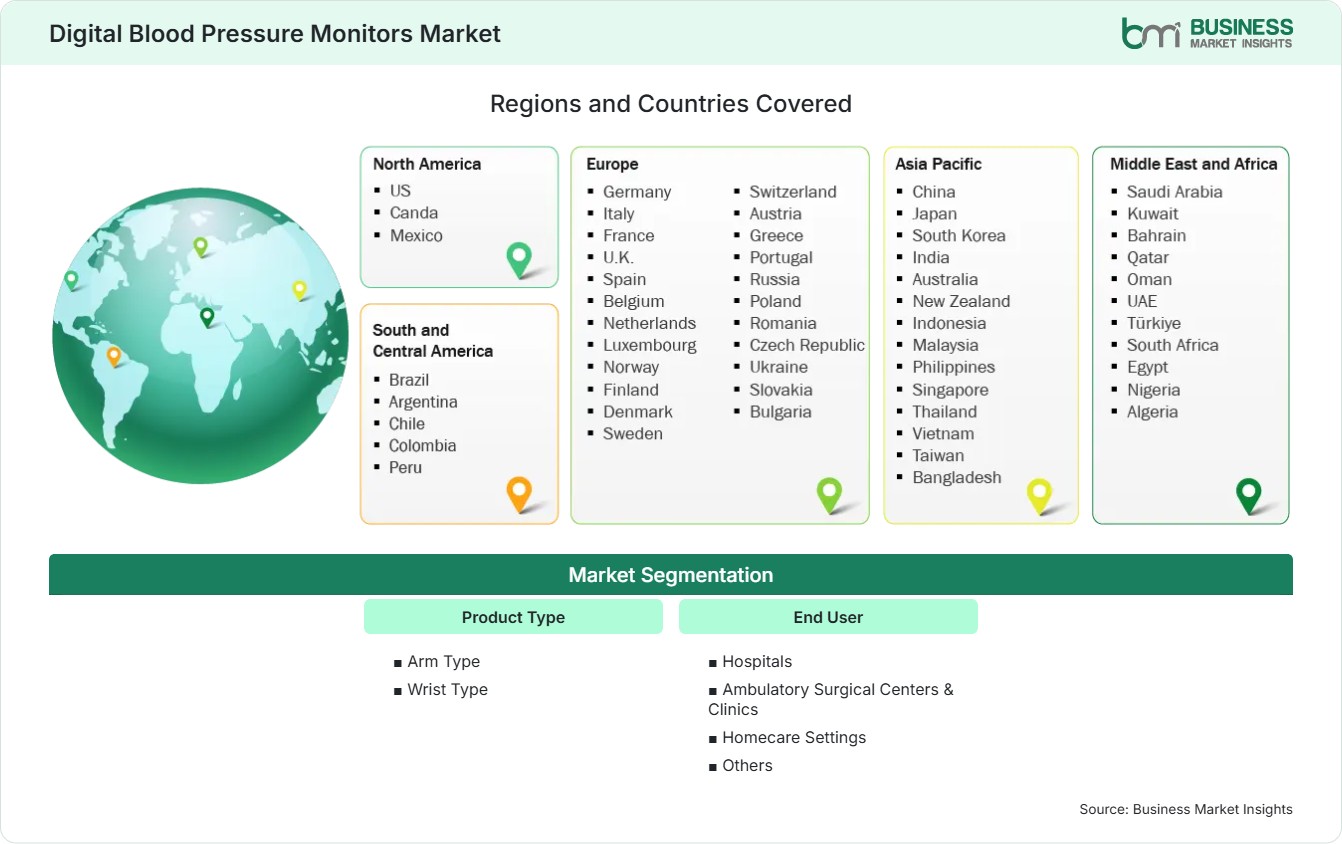
Global Market Geography
FREE PDF
Request your free sample
Request free sample
Segment Analysis

Digital Blood Pressure Monitors Market Segmentation

Product Type

The demand for product-type blood pressure monitors is driven by preferences for measurement, portability, and clinical use. According to calculations, arm-type blood pressure monitors will account for 68%-72% of the market's income in 2025 and are predicted to have a 9%-11% CAGR from 2026 to 2033 in the Digital Blood Pressure Monitors Market, driven by their clinical acceptance and use for routine home monitoring. The wrist-type blood pressure monitor is preferred by consumers who value its small size.

  • Arm Type: Upper-arm monitors support routine clinical checks and home measurement, with familiar cuff placement and straightforward operation. Memory, irregular heartbeat indicators, and optional connectivity add utility when accuracy and ease of use remain priorities.
  • Wrist Type: Wrist monitors appeal to users prioritizing portability and compact storage. Their usefulness depends on proper wrist positioning and adherence to product instructions, making clear guidance essential for reliable readings in everyday settings.

End User

End-user demand reflects different purchasing cycles and operational needs. Hospitals and ambulatory centers look for equipment that is consistent, while the residential sector requires equipment that is convenient and affordable, with an understandable measurement history. Homecare Settings are projected to expand at a CAGR of 13%–15% in 2026-2033 in the Digital Blood Pressure Monitors Market, driven by repeat measurements and connected care. Providers of this equipment can benefit from focusing their approach based on specific settings.

  • Hospitals: Hospitals require reliable monitors for routine observations and patient assessment. Procurement decisions emphasize performance, durability, staff familiarity, infection-control procedures, and continuity of supply across departments.
  • Ambulatory Surgical Centers & Clinics: Clinics and ambulatory surgical centers need convenient devices for patient intake, pre-procedure assessment, and follow-up. Compact designs, readable results, dependable service, and efficient workflows influence purchasing decisions.
  • Homecare Settings: Homecare users need accessible devices that support repeat measurement and readable histories. Simple controls, appropriate cuff sizing, storage of readings, and optional clinician sharing can improve routine use.
Market Forces

Digital Blood Pressure Monitors Market Dynamics

Key Market Drivers

Increasing Need for Hypertension Detection and Control

According to the World Health Organization, there were an estimated 1.4 billion adults between the ages of 30-79 with high blood pressure in 2024, with some 600 million adults undiagnosed with the disease. This gap in identification is a driver of demand for measurement opportunities in both homes and primary care. The Digital Blood Pressure Monitors Market growth is driven by the ability to measure multiple times, which allows physicians to identify patterns of high blood pressure and its response to treatment. However, devices cannot substitute for a professional diagnosis, but accurate home measurements may assist with the clinical assessment.

Greater Adoption of Home-Based Monitoring

Home monitoring enables patients and clinicians to observe blood pressure beyond isolated healthcare visits. The American Heart Association recommends home monitoring for people with high blood pressure and advises using automatic upper-arm cuff-style devices. It will drive demand for real-world products with memory functions, readable screens, and simple instructions for taking measurements. Digital Blood Pressure Monitors Market trends are gradually pointing towards usability and valuable measurement history, and away from unnecessary feature bloat. Device manufacturers can further drive adoption by developing user-friendly products for older people and those less tech-savvy. There should be clinical guidelines along with the connectivity features.

Product Innovation and Connected Care Integration

Measurement history, smartphone connection, and certain rhythm-screening capabilities have been integrated into existing cuff-based devices. OMRON Healthcare, for instance, has launched home BP monitors equipped with AI technology to detect atrial fibrillation during measurements taken in May 2025. These technologies illustrate how such capabilities can be added to existing devices. They can help distinguish between devices, provided there is sufficient evidence and clear instructions for users. The development of competing products should focus on accurate measurements, a convenient interface, and valuable data exchange with healthcare providers. The best propositions will include valid technology and honest claims.

Key Market Opportunities

Scaling Affordable Monitoring in Underserved Markets

Manufacturing companies can enhance the availability of these monitors by developing reliable, user-friendly entry-level models with durable cuffs, readable displays, simple controls, and readily available replacement parts. Cost-effectiveness should be considered in lower-income countries throughout the entire product lifecycle, including battery, servicing, cuff replacement, and distribution costs. Manufacturing companies need to be careful not to jeopardize the quality of their products in order to reduce cost because erroneous measurements will defeat the purpose of using such devices. A range of product lines is an option in catering for budget-constrained consumers.

Developing Clinician-Connected Home Monitoring Services

Monitoring devices that connect can facilitate care pathways whereby patient readings are combined with clinical interpretation, education, and follow-up. The key is in productive workflows, not simply connectivity, as patients will need to know when to measure their blood pressure, while doctors will need information and workflows to make sense of it. Digital Blood Pressure Monitors Market Forecasts offer a roadmap for assessing hardware and service opportunities, but each case requires its own analysis of uptake, retention, and reimbursement. Manufacturers could work with telemedicine providers and hospitals to enhance compatibility and availability of information. Such a service should also be secure, have a consent policy in place, and avoid making false promises about improved patient outcomes.

Expanding Institutional and Preventive Health Partnerships

Employers, pharmacies, community health initiatives, and healthcare professionals may make BP monitoring available beyond hospitals. Sponsors can package products and services that include equipment, education materials, procurement, and maintenance services. Documenting the product will make it easier to compare devices and standardize the measurement process. The partnership approach will also create a need for more cuffs and devices as the initiative grows. Success will depend on the value provided to the buying company rather than on the number of devices rolled out. Before extending the partnership approach, manufacturers should consider device usage, measurement process quality, maintenance costs, and the initiative's sustainability.

Market Restraints and Challenges

Measurement Errors and Product Validation Gaps

Factor: Misapplication, improper cuff size, inadequate measurement method, or lack of device validation may lead to erroneous readings. Impact: Individuals making decisions based on such measurements will have their trust undermined, possibly affecting their treatment. In September 2025, the US Food and Drug Administration issued a warning about non-approved software solutions that claim to estimate or measure blood pressure, including some wearables. The manufacturers have to prove their products' effectiveness, disclose information about their products' limitations, and provide instructions for use. Validation and compliance with the requirements will cost something; however, lack of control may increase risks. Providers need to distinguish validated cuff-measurement products from innovative techniques.

Affordability and Uneven Distribution Access

Factor: The combination of dependence on imports, foreign exchange rate movements, a lack of service facilities, and limited budgets at the consumer level could limit access to reliable monitors. Impact: There could be delays in purchases, wrong choice of affordable but inappropriate equipment, or inability to change cuffs. In such circumstances, even the presence of clinical demand does not translate into rapid uptake. The manufacturers can meet this challenge by offering appropriate pricing for their products in local markets, ensuring the instrument's durability, partnering with distributors, and ensuring the availability of spare parts. However, lowering prices cannot lead to decreased measurement performance or compromised product quality.

Company Analysis

Competitive Landscape

The Digital Blood Pressure Monitors Market analysis indicates competition across established medical-device manufacturers, consumer health brands, and connected-care specialists. Differentiation rests on validated measurement, product usability, distribution coverage, clinical credibility, and integration with digital health services. The following companies represent relevant participants across clinical and home monitoring; their inclusion does not imply equivalent market share or product availability in every country.

Company Name

Overview

Products and Services relevant to this market

OMRON Healthcare Co., Ltd.

A Japanese healthcare technology company with an established international presence in home blood pressure monitoring and preventive cardiovascular health.

Upper-arm and wrist monitors, connected home devices, measurement memory, and selected products featuring automated atrial fibrillation screening.

A&D Company, Limited

A Japanese measurement technology manufacturer supplying medical measurement equipment for professional and consumer healthcare applications.

Digital blood pressure monitors, upper-arm devices, professional measurement equipment, and connected monitoring solutions for home and clinical use.

Koninklijke Philips N.V.

A Netherlands-based health technology company serving hospitals, healthcare professionals, and patients through medical equipment and connected care.

Patient monitoring systems and blood pressure measurement capabilities within broader clinical monitoring portfolios, subject to product availability and configuration.

Baxter International Inc.

A global medical technology company with a portfolio spanning hospital equipment, patient monitoring, and healthcare delivery solutions.

Clinical patient monitoring equipment and blood pressure measurement capabilities associated with relevant monitoring systems and care environments.

Beurer GmbH

A German health and wellbeing products manufacturer offering consumer medical devices and home health monitoring products.

Upper-arm and wrist blood pressure monitors, cuff-position indicators, arrhythmia alerts, and selected Bluetooth-connected products.

Microlife Corporation

A medical diagnostic equipment specialist with international distribution and a portfolio focused on home and professional measurement.

Digital blood pressure monitors, upper-arm and wrist models, automated measurement technologies, and selected devices with averaging functions.

Rossmax International Ltd.

A healthcare equipment manufacturer supplying diagnostic and monitoring devices through international distribution channels.

Digital blood pressure monitors, cuff-based measurement products, and selected devices incorporating positioning guidance and irregular heartbeat indicators.

Withings

A connected health company integrating consumer medical devices with digital applications and health data services.

BPM Vision and professional blood pressure monitoring products, app-based measurement histories, connected records, and selected ECG-enabled monitoring capabilities.

iHealth Labs Inc.

A digital health company offering connected consumer medical devices and applications for tracking personal health measurements.

Digital blood pressure monitors, smartphone-compatible products, and applications designed to record and review home measurement histories.

Shenzhen Mindray Bio-Medical Electronics Co., Ltd.

A China-based medical equipment manufacturer with international operations across patient monitoring, diagnostics, and clinical equipment.

Patient monitoring systems with blood pressure measurement functions and related clinical monitoring technologies for healthcare facilities.

Trust & Transparency

Research Methodology

The market analysis combines proprietary research with secondary data from government agencies, company disclosures, regulatory filings, industry databases and expert interviews. Market estimates are validated through data triangulation, cross-market benchmarking and analyst review.

View Full Research Methodology

Questions Answered

Frequently Asked Questions

How can the Digital Blood Pressure Monitors Market Report support procurement decisions?

It can help procurement teams compare product categories, assess regional demand drivers, evaluate supplier positioning, and identify potential distribution or technology partnerships. Buyers should supplement market-level findings with device-specific validation evidence, local regulatory requirements, and total ownership costs.

What role does regulation play in product differentiation?

Regulatory clearance or authorization, as applicable, and credible evidence of performance help buyers distinguish evaluated devices from products that make unsupported claims. Manufacturers must communicate intended use and limitations accurately, particularly when devices add automated screening or software-based interpretation.

Why are upper-arm devices important in home monitoring?

Automatic upper-arm cuff monitors are recommended by the American Heart Association for home blood pressure monitoring. Proper cuff fit and measurement technique remain essential because a sophisticated device cannot compensate for incorrect use.

How can healthcare providers evaluate connected monitoring products?

Providers should assess measurement validation, data security, interoperability, patient usability, clinician workload, and the process for reviewing abnormal readings. Pilot programs can establish whether the technology fits existing care pathways before large-scale deployment.

What should buyers prioritize when selecting a digital blood pressure monitor?

Buyers should prioritize independently validated measurement performance, appropriate cuff sizing, clear operating instructions, ease of reading results, and dependable after-sales support. Connectivity and additional screening features are secondary to reliable measurement and should be evaluated against the user's needs.

Access the Full Digital Blood Pressure Monitors Market Report

Get segment-level forecasts, regional estimates, competitive benchmarking, company profiles and downloadable Excel datasets.

Access the full Digital Blood Pressure Monitors Market Report
350 pages PDF & Excel | 2026-11-10
Similar Research

Related Market Reports