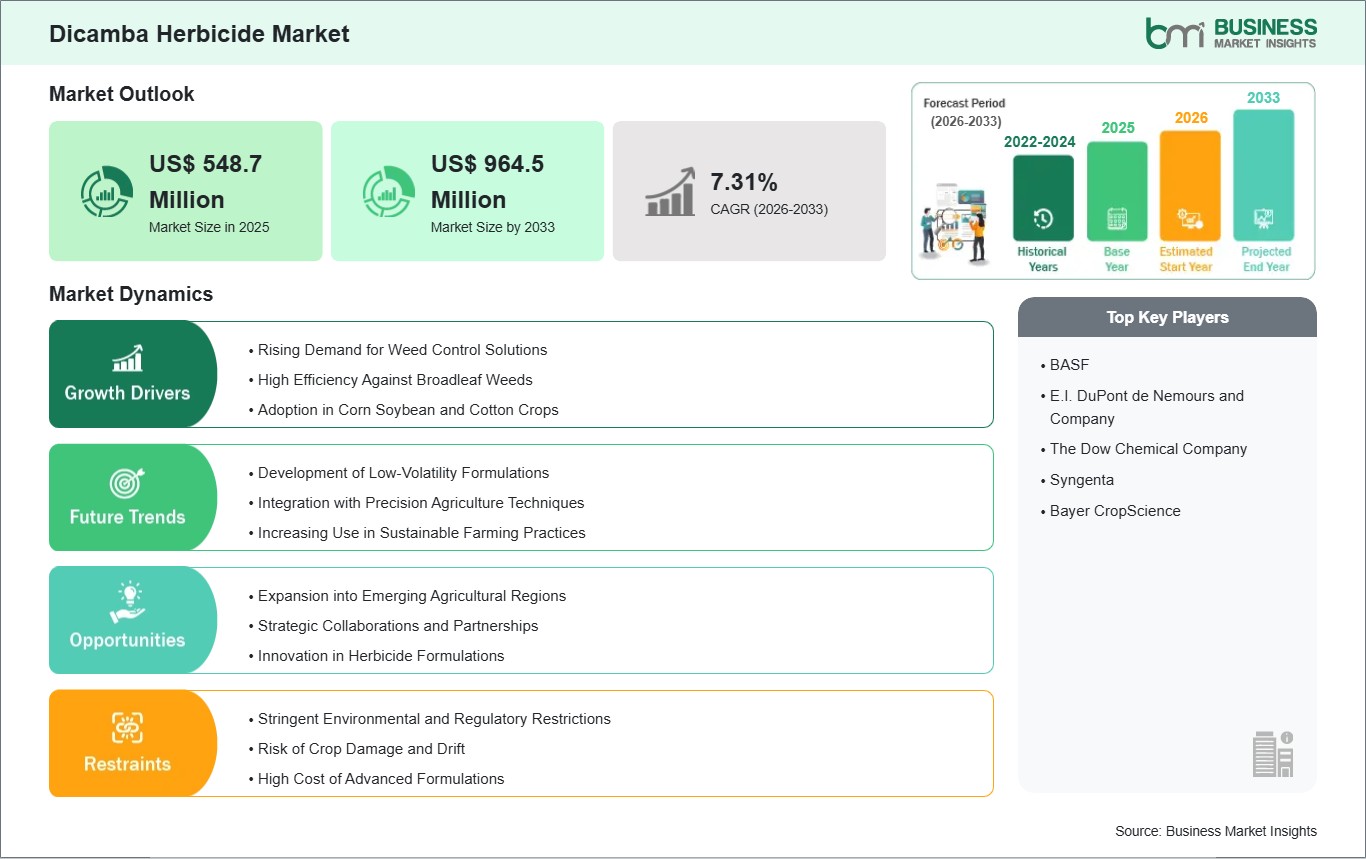
The Dicamba Herbicide Market size is expected to reach US$ 964.5 Million by 2033 from US$ 548.7 Million in 2025. The market is estimated to record a CAGR of 7.31% from 2026 to 2033.
The global dicamba herbicide market is based on the use of dicamba as a herbicide with broad-spectrum properties, which is most important in controlling hard broadleaf weeds that are a threat to important crops such as soybeans, cotton, and cereals. The way in which dicamba works, imitating the natural growth hormone in plants that inhibits weed growth, makes it an essential part of modern weed management practices, especially in situations where other herbicides are not effective. Dicamba`s ability to be used in both pre- and post-emergence applications makes it an important part of many different crop management practices, ensuring that crop yields are consistent. One of the main factors that is increasing the use of dicamba is the appearance of herbicide-resistant weeds. In addition to this, with the advent of dicamba-tolerant crops, farmers are increasingly using this chemical to ensure maximum productivity while controlling resistant weeds effectively. On the other hand, concerns regarding environmental protection prevent the unrestricted use of this chemical. Dicamba has been known to evaporate beyond the target area, affecting other plants as well. This has led to appropriate application techniques, regulatory measures, and the development of less volatile formulations. These aspects reflect the balance that is required to be maintained in the market with respect to weed control and environmental protection.

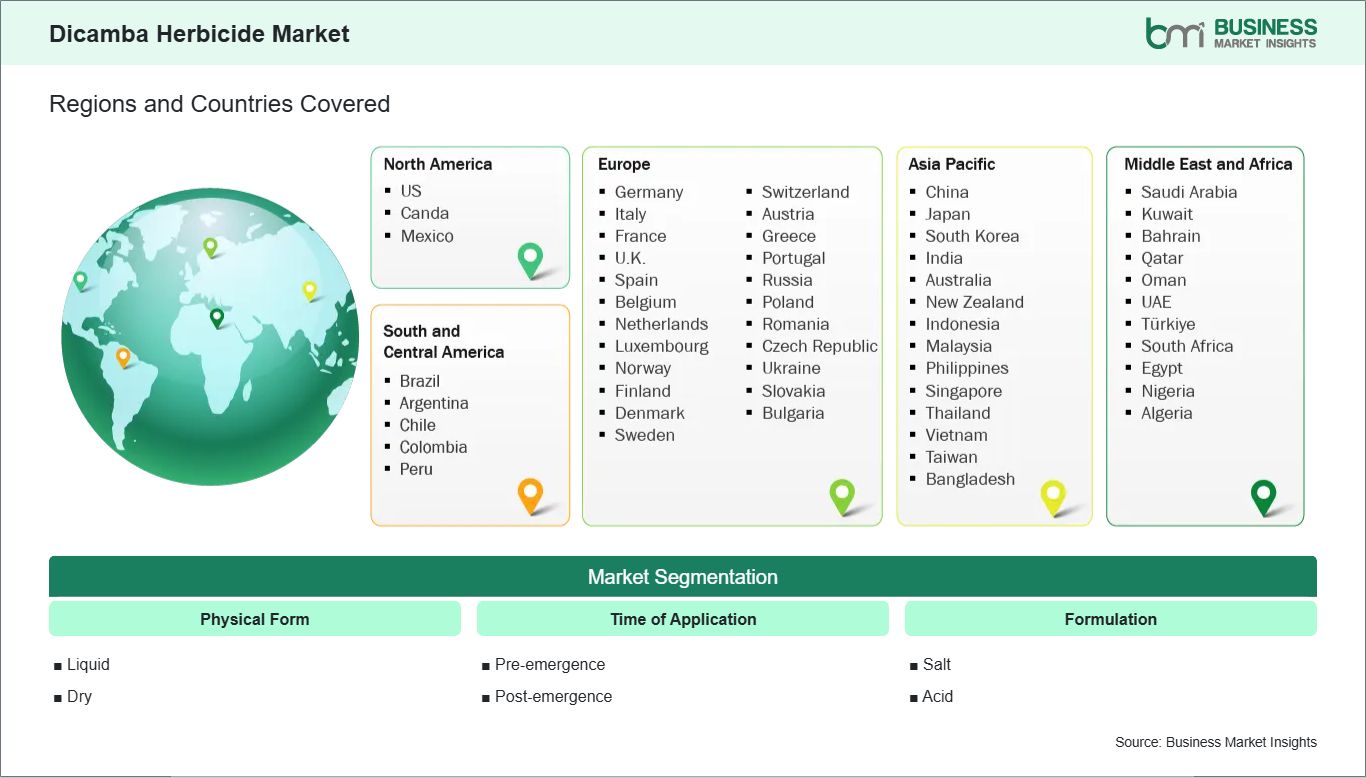
Key segments that contributed to the derivation of the dicamba herbicide market analysis are physical form, time of application, crop type, and formulation.
The global dicamba herbicides market faces increased demand mainly because of the need for effective weed management in agriculture. Farmers are facing increased challenges in the form of resistant weed species, and dicamba herbicides are the best solution as they are effective in managing difficult weed growth in soybean, cotton, and corn crops. In the US, the problem of resistant weed growth has increased in the Midwest region, and dicamba herbicides are in high demand as they are being used in crop rotation programs to maintain high crop yields.
Improvements in dicamba formulations have also increased the product's popularity in the weed control industry. New low-volatility and controlled-release dicamba formulations enable the product to be applied accurately, ensuring that the product remains effective in weed control while keeping the risk of drift low. The product has, therefore, gained popularity in precision agriculture, especially in areas with dense cultivation.
In addition, regulatory frameworks and crop management strategies continue to shape market demand. Countries with strict agricultural policies, such as Australia and Brazil, have encouraged the use of more targeted herbicide solutions, increasing the popularity of dicamba among professional growers. Its integration into comprehensive weed management programs highlights its essential role in supporting sustainable agricultural productivity and securing farmer confidence.
Dicamba herbicides are gaining traction in developing agricultural areas as the focus is on increasing crop productivity and controlling invasive weed growth. In Southeast Asian countries, the expansion of soybean and cotton farming has paved the way for the development of herbicides, with dicamba`s ability to control a variety of weed growth making it an ideal solution for improving crop productivity. Dicamba is being used by Southeast Asian farmers as part of integrated weed management strategies, with the focus on protecting newly developed agricultural land.
In Africa and Latin American countries, the modernization of agriculture is taking center stage, with dicamba herbicides being developed as a solution to the increasing problem of herbicide-resistant weeds. In Brazil, the cotton-growing regions are increasingly adopting dicamba herbicides as a means of maintaining the quality of their products, as well as preventing productivity declines. In West Africa, soybean farmers are increasingly adopting dicamba as a solution to the problem of broadleaf weeds, with the focus on maintaining productivity in an area that lacks access to other herbicides.
The expansion into these emerging markets is supported by educational initiatives and partnerships with agricultural cooperatives, which promote best practices for application and crop safety. By enabling farmers to manage resistant weed populations effectively, dicamba contributes to sustainable agricultural growth and encourages the adoption of modern crop protection strategies. This trend underscores the herbicide`s growing global footprint and its potential to become a mainstay in emerging agricultural landscapes.

The dicamba herbicide market is experiencing steady growth, with market size and share analysis reflecting evolving treatment preferences and competitive dynamics among key players. The report evaluates important subsegments categorized within are physical form, time of application, crop type, and formulation, highlighting their respective contributions to overall market performance.
By physical form, the Liquid subsegment dominated the Dicamba Herbicide market in 2025. Liquid formulations enable easier application, uniform coverage, and faster absorption by crops, driving their widespread adoption.
Based on time of application, the Post‑emergence subsegment dominated the Dicamba Herbicide market in 2025. Post‑emergence application allows targeted weed control after crop emergence, improving effectiveness and crop yield, supporting strong demand for dicamba herbicides.
In terms of crop type, the Cereals & Grains subsegment dominated the Dicamba Herbicide market in 2025. Cereals and grains require effective weed management solutions to maximize yield and quality, reinforcing the leading position of this segment.
On the basis of formulation, the Salt subsegment dominated the Dicamba Herbicide market in 2025. Salt formulations offer enhanced solubility, stability, and ease of use, driving their widespread adoption in agricultural practices.
| Report Attribute | Details |
|---|---|
| Market size in 2025 | US$ 548.7 Million |
| Market Size by 2033 | US$ 964.5 Million |
| Global CAGR (2026 - 2033) | 7.31% |
| Historical Data | 2022-2024 |
| Forecast period | 2026-2033 |
| Segments Covered | By Physical Form
|
|
Regions and Countries Covered
| |
| North America | US, Canada, Mexico |
| Europe | Belgium, Austria, Finland, Denmark, Greece, Poland, Romania, Russia, Ukraine, Czech Republic, Slovakia, Bulgaria, Italy, Luxembourg, Germany, Switzerland, France, Netherlands, Norway, Portugal, Spain, Sweden, United Kingdom |
| Asia-Pacific | Australia, China, India, Japan, South Korea, Indonesia, Malaysia, Philippines, Singapore, Thailand, Vietnam, Bangladesh, New Zealand, Taiwan |
| South and Central America | Brazil, Argentina, Peru, Chile, Colombia |
| Middle East and Africa | Bahrain, Kuwait, Oman, Qatar, Saudi Arabia, United Arab Emirates, Turkiye, South Africa, Egypt, Algeria, Nigeria |
| Market leaders and key company profiles |
|
The "Dicamba Herbicide Market Size and Forecast (2022 - 2033)" report provides a detailed analysis of the market covering below areas:
The geographical scope of the Dicamba Herbicide market report is divided into five regions: North America, Asia Pacific, Europe, Middle East & Africa, and South & Central America. The Dicamba Herbicide market in North America is expected to grow during the forecast period.
North America is the largest market for dicamba herbicides due to the widespread adoption of modern farming techniques and the cultivation of crops such as soybeans and cotton. Farmers in this region are using dicamba to manage resistant broadleaf weeds that cannot be managed with other herbicides. The availability of dicamba-tolerant crop varieties has also increased the importance of dicamba in the management of weeds, which are considered essential in the region to protect crop yields. Environmental factors are also considered important factors in the management of dicamba herbicides. Guidelines are set to restrict the timing, mode of action, and conditions of dicamba herbicides to reduce the environmental impact of the herbicides. However, North America still remains the largest market for dicamba herbicides due to the availability of modern farming infrastructure and the role of dicamba in the management of weeds as part of integrated weed management systems.

The dicamba herbicide market is evaluated by gathering qualitative and quantitative data post primary and secondary research, which includes important corporate publications, association data, and databases. A few of the key developments in the dicamba herbicide market are:
The Dicamba Herbicide Market is valued at US$ 548.7 Million in 2025, it is projected to reach US$ 964.5 Million by 2033.
As per our report Dicamba Herbicide Market, the market size is valued at US$ 548.7 Million in 2025, projecting it to reach US$ 964.5 Million by 2033. This translates to a CAGR of approximately 7.31% during the forecast period.
The Dicamba Herbicide Market report typically cover these key segments-
The historic period, base year, and forecast period can vary slightly depending on the specific market research report. However, for the Dicamba Herbicide Market report:
The Dicamba Herbicide Market is populated by several key players, each contributing to its growth and innovation. Some of the major players include:
The Dicamba Herbicide Market report is valuable for diverse stakeholders, including:
Essentially, anyone involved in or considering involvement in the Dicamba Herbicide Market value chain can benefit from the information contained in a comprehensive market report.
Please tell us your area of interest
(Market Segments/ Regions and Countries/ Companies)