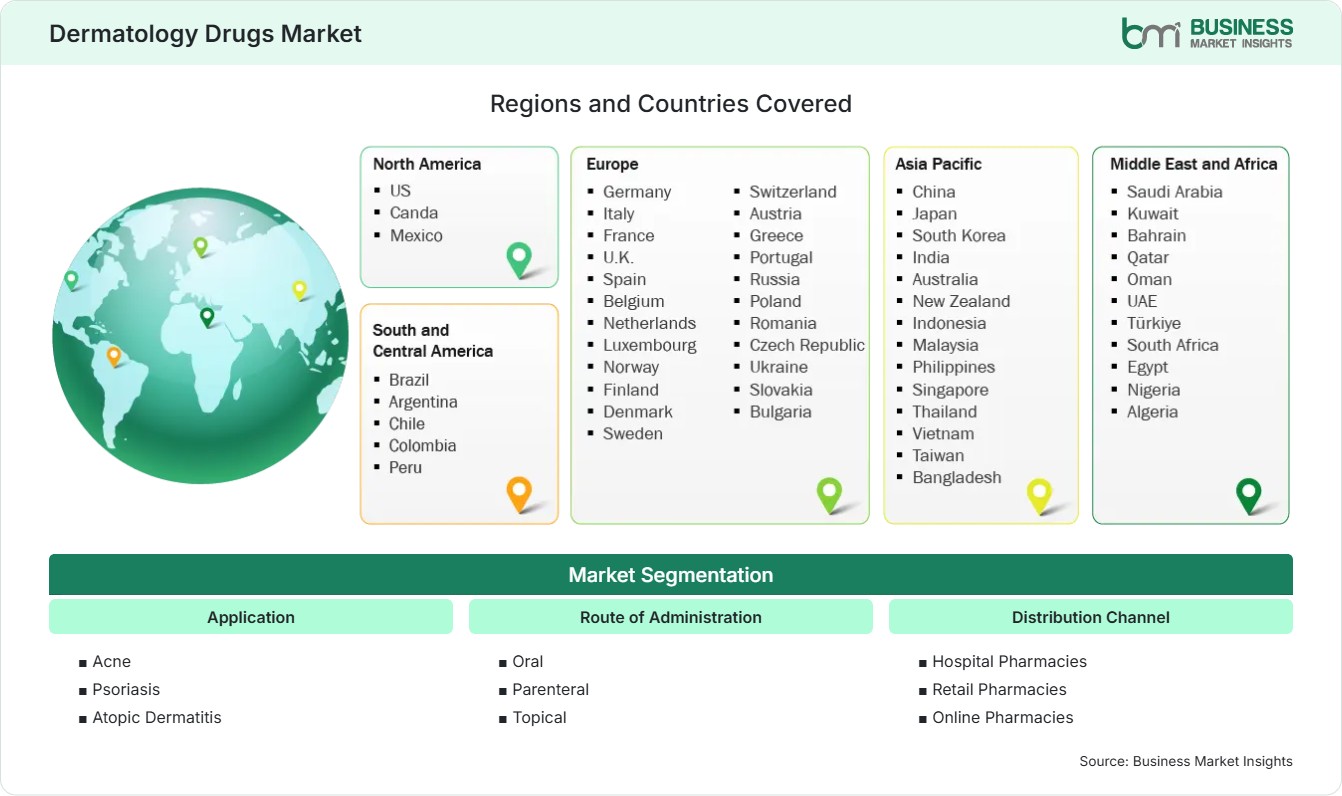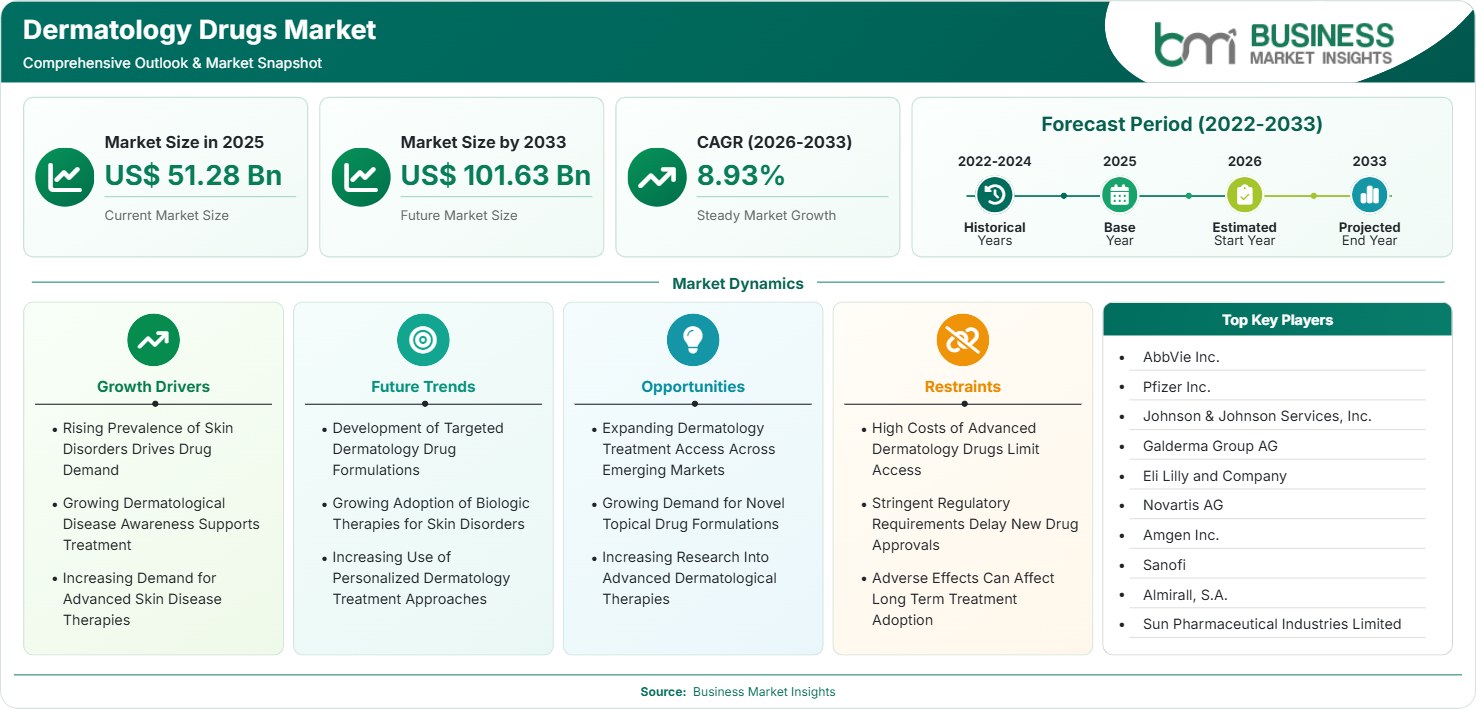
Dermatology Drugs Market Regional Highlights
North America Dermatology Drugs Market
North America Dermatology Drugs Market accounts for a 37%–40% share in 2025 and is projected to expand at a CAGR of 8.0%–8.5% through 2033. There are advantages for the region, such as advanced diagnostics, high penetration of specialty care, a good payment system, and the rapid introduction of biological products. The dermatology segment gets support from a strong research base and access to specialty medications. There are also good patient support systems and specialty pharmacies in the region. Growth drivers for the dermatology segment include innovations in psoriasis, atopic dermatitis, acne, and other inflammatory diseases.
- Biologics adoption is still robust, given that doctors are relying more on biologic immune treatments to manage moderate-to-severe inflammatory diseases when regular topical or systemic treatments fail to adequately control and tolerate the condition.
- Specialty pharmacies offer medication access, adherence support, payment assistance, and education support, thus helping pharma companies market premium products, which are either injectable or need prior authorization.
- Research work adds value to products through the development of long-term efficacy, safety, quality of life, and real-world evidence for broader physician uptake and lifecycle extension.
- The United States is the major market, whereas Canada offers another growth market because of specialist prescriptions, public insurance coverage, and new dermatology drugs becoming accessible.
US Dermatology Drugs Market
The United States Dermatology Drugs Market represents approximately 78%–82% of North American demand in 2025 and is projected to grow at a CAGR of 7.8%–8.3% through 2033. The country's market is supported by high healthcare expenditure, specialist access, advanced clinical research, and extensive commercial insurance coverage. Specialty pharmacies play a major role in biologic distribution, while direct-to-patient initiatives are increasingly used to address affordability.
- High-value biologics continue gaining adoption because they provide targeted mechanisms and durable disease control for patients with moderate-to-severe inflammatory skin disorders.
- Patient affordability is becoming strategically important as manufacturers experiment with direct-to-patient models, copay support, and alternative distribution structures designed to reduce access barriers.
- Expansion of regulations is useful in the lifecycle of a product because existing drugs can be extended to treat other diseases at other stages of life.
Europe Dermatology Drugs Market
Europe Dermatology Drugs Market holds a 26%–29% share in 2025 and is projected to grow at a CAGR of 8.2%–8.7% through 2033. These countries still constitute important markets, but countries such as Poland and some other Central European nations have more room for market growth. Factors influencing market development include reimbursement evaluation, reference pricing, biosimilar competition, and HTA systems. Innovations will see their widespread application as long as clinical efficacy results in decreased burden of disease, decreased usage of medical care, and decreased switching between treatments.
- Germany continues to be an important market due to the presence of a strong specialist network, sophisticated reimbursement system, pharmaceutical structure, and high usage of systemic therapies.
- The United Kingdom emphasizes cost-effectiveness and evidence-based reimbursement, making comparative effectiveness, long-term outcomes, and health-economic data increasingly important for commercial success.
- There are significant commercial opportunities in France, Italy, and Spain in both psoriasis and atopic dermatitis, even though price negotiations and reimbursement may take longer.
- Poland represents a comparatively higher-growth opportunity as healthcare infrastructure, diagnosis, and access to specialty medicines continue improving across Central Europe.
Asia Pacific Dermatology Drugs Market
Asia Pacific Dermatology Drugs Market holds a 22%–25% share in 2025 and records the fastest regional CAGR of 10.0%–10.6% through 2033. The key markets include China, Japan, South Korea, India, and Australia. In contrast, growth prospects are greater in India, Indonesia, Vietnam, and Thailand. Increased health consciousness, urbanization, specialization, expertise, drug production, and healthcare spending from private sources aid in acceptance. Domestic production also reduces the cost of branded generics and certain specialty drugs. Foreign firms are becoming more interested in regional partnerships.
- China possesses vast opportunities due to its huge patient base, growing specialist community, greater research capacity, and more advanced systemic drug options.
- India provides a unique combination of an established industry of pharmaceuticals, increased healthcare consciousness, better access to specialists, and greater demand for generic specialty dermatology medicines.
- In Japan and South Korea, advanced treatment conditions exist, which factor in such aspects as safety, convenience, efficacy, and improved quality of life.
- Southeast Asia offers longer-term upside as private healthcare investment, medical tourism, urbanization, and consumer awareness increase demand for professional dermatology services.
Rest of World Dermatology Drugs Market
South and Central America Dermatology Drugs Market account for an estimated 6%–8% of 2025 demand, while the Middle East and Africa represent approximately 4%–5%. Combined Rest of World demand is projected to expand at a CAGR of 7.2%–7.8% through 2033. Brazil and Mexico have significant commercial centers, whereas Saudi Arabia, the United Arab Emirates, and South Africa offer possibilities via healthcare modernization. Market penetration will continue to be limited owing to issues of accessibility and affordability, making it necessary to introduce tiered pricing.
There is recurrent demand for Brazil in acne, inflammation, and generics, whereas Mexico has benefited from an increased presence of private healthcare, drug production, and improved supply chain integration. Gulf countries have premium opportunities for healthcare investing in specialized healthcare and therapy.
- Brazil still presents a good opportunity in Latin America due to the infrastructure needed for pharmaceutical distribution and private healthcare systems that require more access to prescription dermatology products.
- Mexico is advantaged by its manufacturing facilities and its proximity to the US market for pharma companies.
- Saudi Arabia and the UAE have started health care modernization programs, and thus, there is an opportunity in specialty drugs, diagnostic solutions, and dermatological treatments.
- South Africa is a good regional hub for drug distribution to sub-Saharan Africa, but factors like cost, reimbursement, and specialist availability still matter commercially.