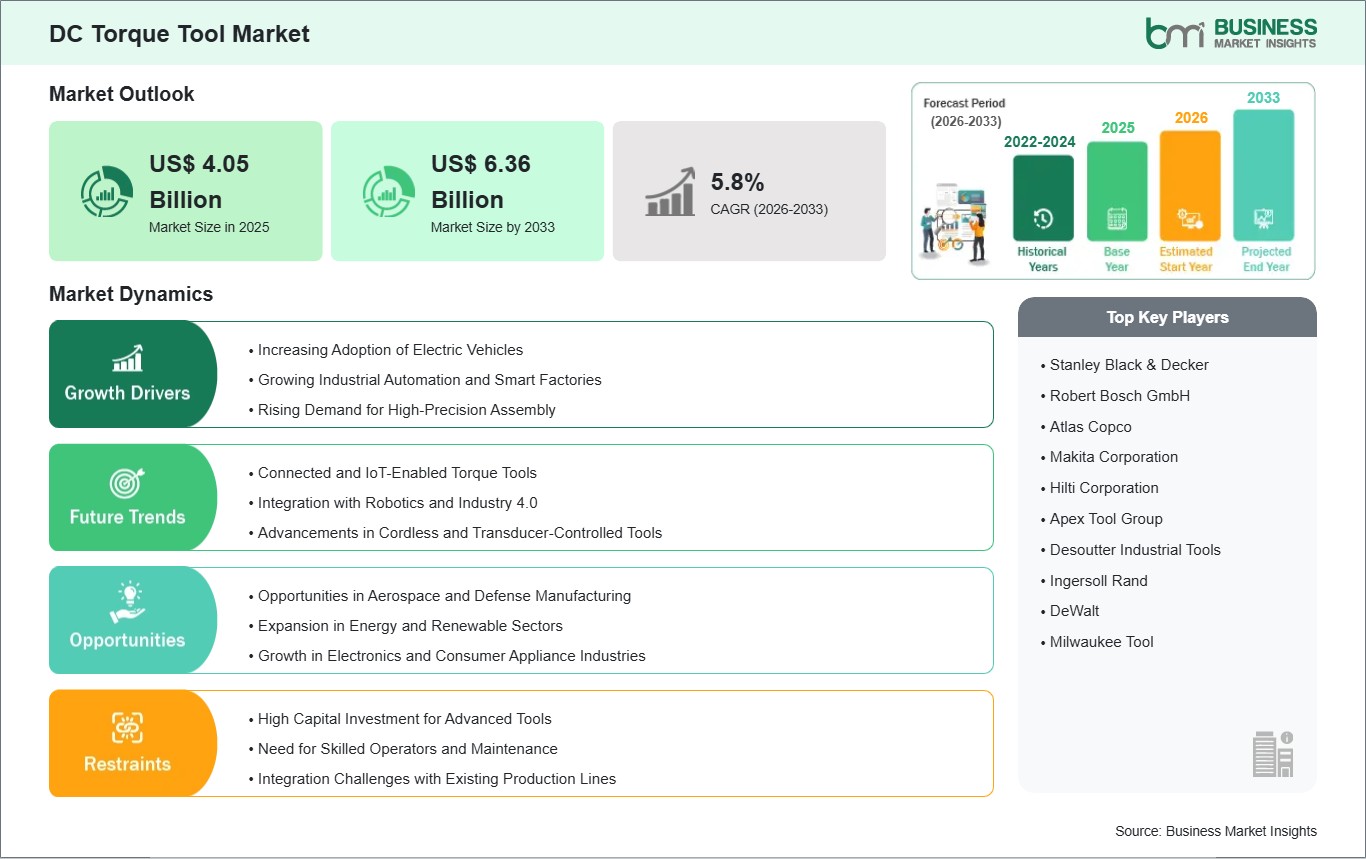
The DC torque tool market size is expected to reach US$ 6.36 billion by 2033 from US$ 4.05 billion in 2025. The market is estimated to record a CAGR of 5.8% from 2026 to 2033.
DC torque tools have become an essential component in modern manufacturing and assembly operations across various industries worldwide. DC torque tools, including handheld torque tools, fixtured torque tools, electric screwdrivers, electric nut runners, and electric torque wrenches, are increasingly used in automotive manufacturing, aerospace, industrial machinery, energy, and electronics industries. These tools provide manufacturers with numerous advantages, including precise torque application, consistent assembly quality, reduced risk of equipment failure, and improved compliance with quality standards. Growing automation in manufacturing, the increasing adoption of electric vehicles, and the demand for high-precision assembly have generated significant focus on the deployment of DC torque tools.
However, the DC torque tool market faces several challenges that may hinder its growth. These include the high initial investment for advanced tools, complexity in integrating these tools with existing production lines, costs associated with calibration and maintenance, and the need for skilled operators. Capital expenditure constraints and varying industry standards also influence the market for DC torque tools. Despite these challenges, the market has promising growth opportunities, driven by the adoption of battery-powered and transducerized torque tools, expansion of automotive and aerospace production, increased focus on assembly line automation, and the growing requirement for accurate torque measurement and traceability in critical applications.

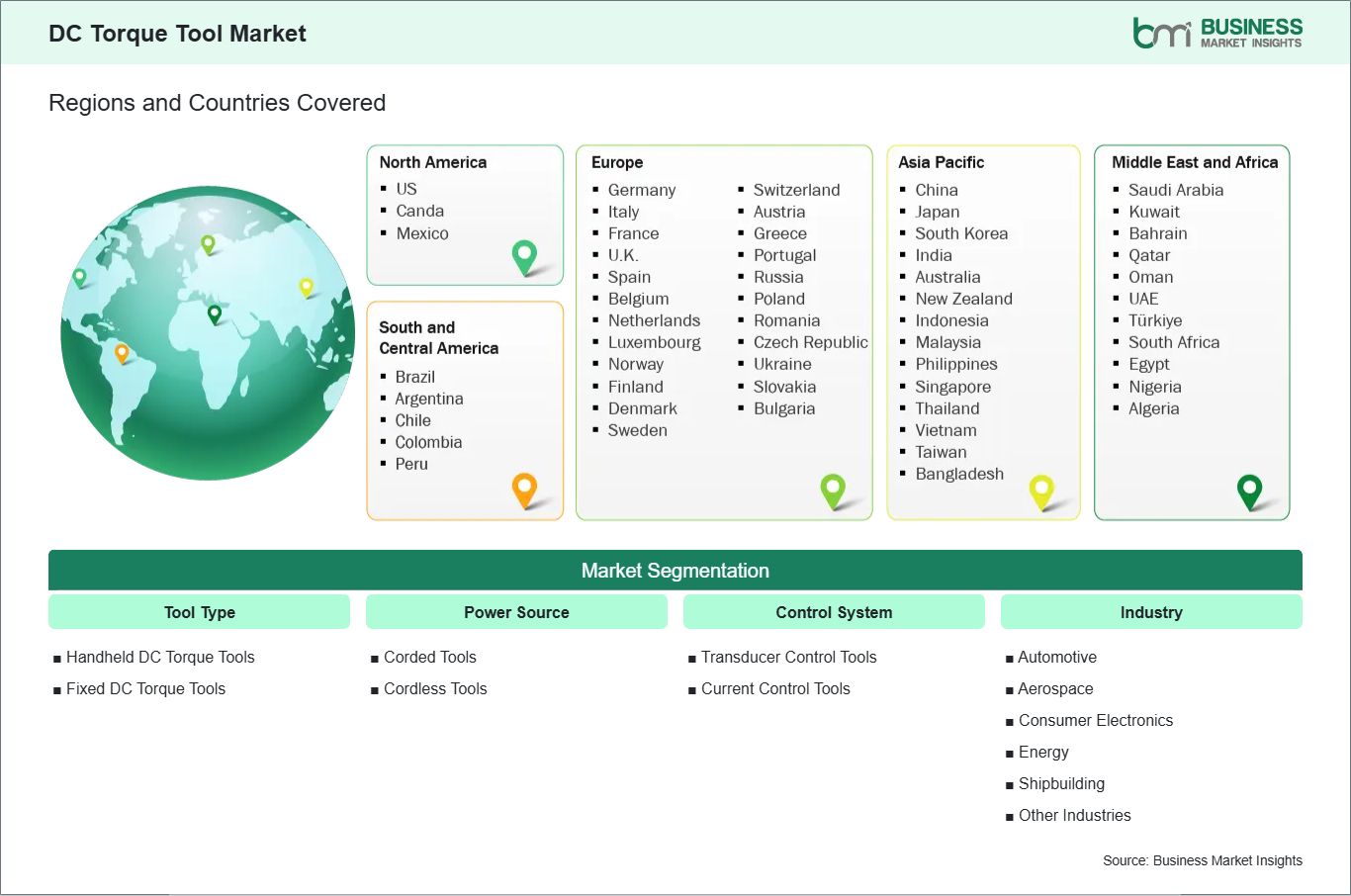
Key segments that contributed to the derivation of the DC torque tool market analysis are tool type, power source, control system, and industry.
The rising production and adoption of electric vehicles (EVs) worldwide is driving demand for DC torque tools. Automotive assembly for EVs requires high-precision torque application to ensure battery modules, chassis components, and electronic systems are securely and accurately fastened. DC torque tools, especially transducer-controlled and cordless variants, provide manufacturers with consistent torque application, reduced assembly errors, and real-time feedback for quality assurance. As global EV sales continue to rise, automotive manufacturers are increasingly integrating advanced DC torque tools into their production lines, making this trend a major driver for market growth.
The ongoing shift toward industrial automation presents a significant growth opportunity for the DC torque tool market. Automated assembly lines in automotive, aerospace, and electronics industries require precise, repeatable, and traceable torque application to maintain product quality and reduce rework. DC torque tools, particularly fixtured and transducer-controlled models, can be integrated with robotic systems, enabling real-time monitoring and improved efficiency. With manufacturers globally investing in smart factories and Industry 4.0 initiatives, the demand for DC torque tools capable of automated operation is expected to increase substantially, offering considerable revenue potential for tool manufacturers.
By tool type, the DC torque tool market is bifurcated into handheld DC torque tools and fixed DC torque tools. The handheld tools segment dominated the market in 2025 due to its versatility and widespread adoption across multiple assembly lines.
By power source, the market is categorized into corded tools and cordless tools. The cordless tools segment led the market in 2025, driven by the increasing demand for mobility and ease of use in modern manufacturing environments.
By control system, the market is divided into transducer control tools and current control tools. The transducer control tools segment accounted for the largest share in 2025, owing to its higher precision, real-time torque feedback, and traceability features.
By industry, the market is segmented into automotive, aerospace, consumer electronics, energy, shipbuilding, and others. The automotive industry held the largest market share in 2025, driven by high-volume production requirements and the growing adoption of electric vehicles.
| Report Attribute | Details |
|---|---|
| Market size in 2025 | US$ 4.05 Billion |
| Market Size by 2033 | US$ 6.36 Billion |
| Global CAGR (2026 - 2033) | 5.8% |
| Historical Data | 2022-2024 |
| Forecast period | 2026-2033 |
| Segments Covered | By Tool Type
|
|
Regions and Countries Covered
| |
| North America | US, Canada, Mexico |
| Europe | Belgium, Austria, Finland, Denmark, Greece, Poland, Romania, Russia, Ukraine, Czech Republic, Slovakia, Bulgaria, Italy, Luxembourg, Germany, Switzerland, France, Netherlands, Norway, Portugal, Spain, Sweden, United Kingdom |
| Asia-Pacific | Australia, China, India, Japan, South Korea, Indonesia, Malaysia, Philippines, Singapore, Thailand, Vietnam, Bangladesh, New Zealand, Taiwan |
| South and Central America | Brazil, Argentina, Peru, Chile, Colombia |
| Middle East and Africa | Bahrain, Kuwait, Oman, Qatar, Saudi Arabia, United Arab Emirates, Turkiye, South Africa, Egypt, Algeria, Nigeria |
| Market leaders and key company profiles |
|
The "DC Torque Tool Market Size and Forecast (2022-2033)" report provides a detailed analysis of the market covering below areas:
The geographical scope of the DC torque tool market report is divided into five regions: North America, Asia Pacific, Europe, Middle East & Africa, and South & Central America. The DC torque tool market in Asia Pacific is expected to grow significantly during the forecast period.
The Asia-Pacific DC torque tool market is segmented into China, Japan, South Korea, India, Australia, New Zealand, Indonesia, Malaysia, the Philippines, Singapore, Thailand, Vietnam, Taiwan, Bangladesh, and the Rest of Asia. The region is witnessing strong growth, driven by rapid industrialization, expansion of automotive and electronics manufacturing, and increasing investments in smart factories and automated assembly lines. Major economies such as China, Japan, and India are leading market growth due to rising demand for high-precision torque tools in automotive, aerospace, energy, and consumer electronics sectors.
The region is also experiencing growing adoption of advanced DC torque tool technologies, including cordless tools, transducer-controlled tools, and fixtured automation-ready systems. Increasing focus on product quality, assembly accuracy, and compliance with industry standards, along with government initiatives supporting manufacturing modernization, are further boosting market demand. Additionally, rising investments in industrial automation, integration of torque tools with robotics, and technological advancements are positioning Asia-Pacific as a key growth region in the global DC torque tool market.

The DC torque tool market is evaluated by gathering qualitative and quantitative data post primary and secondary research, which includes important corporate publications, association data, and databases. A few of the key developments in the DC torque tool market are:
The DC Torque Tool Market is valued at US$ 4.05 Billion in 2025, it is projected to reach US$ 6.36 Billion by 2033.
As per our report DC Torque Tool Market, the market size is valued at US$ 4.05 Billion in 2025, projecting it to reach US$ 6.36 Billion by 2033. This translates to a CAGR of approximately 5.8% during the forecast period.
The DC Torque Tool Market report typically cover these key segments-
The historic period, base year, and forecast period can vary slightly depending on the specific market research report. However, for the DC Torque Tool Market report:
The DC Torque Tool Market is populated by several key players, each contributing to its growth and innovation. Some of the major players include:
The DC Torque Tool Market report is valuable for diverse stakeholders, including:
Essentially, anyone involved in or considering involvement in the DC Torque Tool Market value chain can benefit from the information contained in a comprehensive market report.
Please tell us your area of interest
(Market Segments/ Regions and Countries/ Companies)