Market Summary
Executive Summary and Global Market Analysis
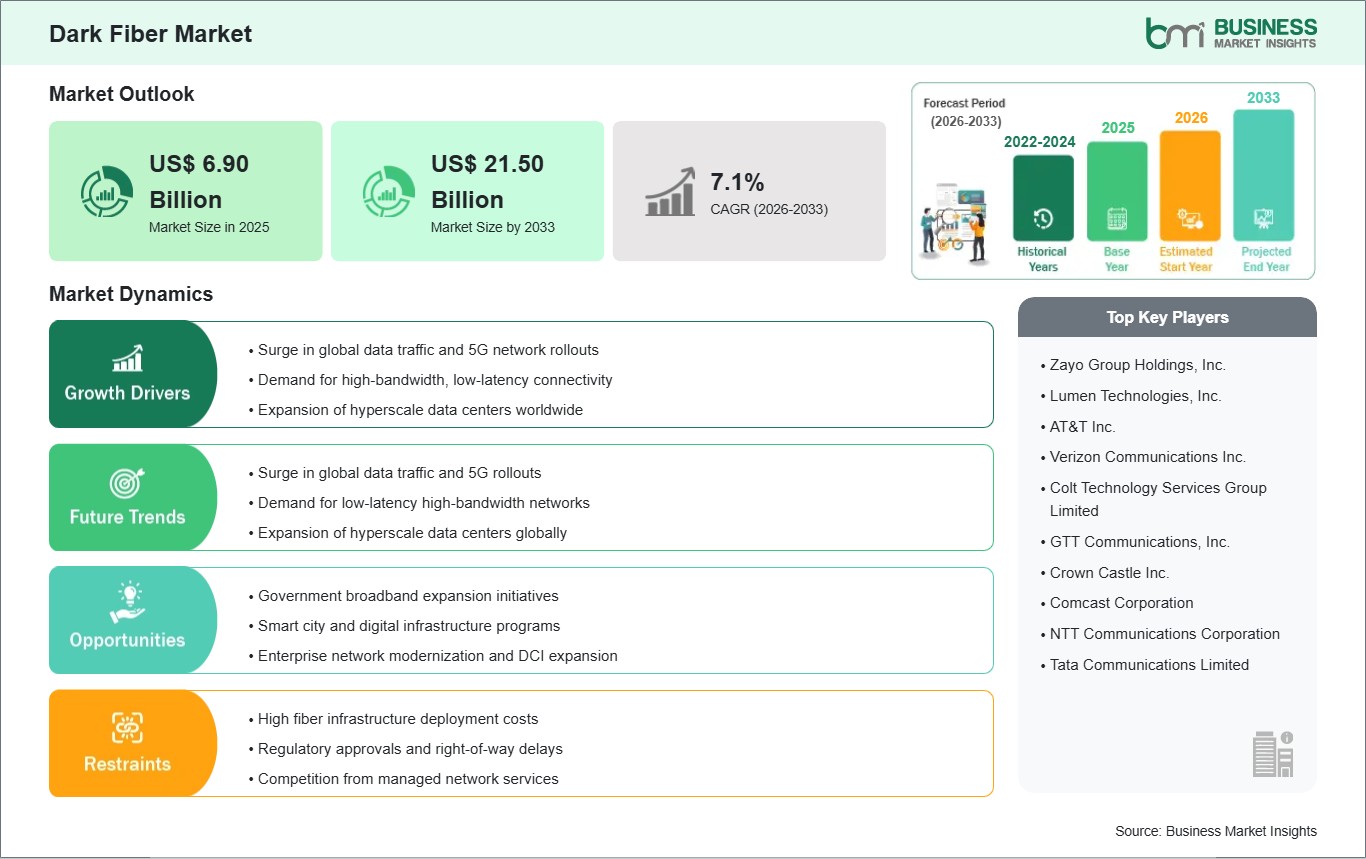
The Dark Fiber market serves as a foundational component of high-capacity, secure, and scalable communication infrastructure across enterprises, telecom operators, hyperscale data centers, and government networks. Dark fiber refers to unused optical fiber infrastructure leased or sold to organizations seeking dedicated, high-bandwidth connectivity with full operational control. Unlike managed network services, dark fiber allows enterprises to deploy proprietary equipment, customize network architecture, and scale bandwidth without reliance on third-party service constraints. Growing data traffic driven by cloud computing, 5G deployment, edge computing, video streaming, and enterprise digital transformation is significantly accelerating demand. Organizations are increasingly seeking low-latency, high-security, and future-proof connectivity solutions, positioning dark fiber as a strategic long-term investment.
Dark fiber networks support mission-critical applications including data center interconnect (DCI), disaster recovery, financial trading platforms, and secure government communications. Technological advancements in dense wavelength division multiplexing (DWDM) and optical transmission equipment enable substantial capacity upgrades without new fiber deployment, improving return on infrastructure investments. Rising investments in smart cities, broadband expansion initiatives, and hyperscale data center construction are further strengthening global market growth. While high upfront deployment costs and regulatory complexities pose challenges, long-term scalability, enhanced security, and operational flexibility continue to drive sustained adoption across industries.
Segment Analysis
Dark Fiber Market Segmentation
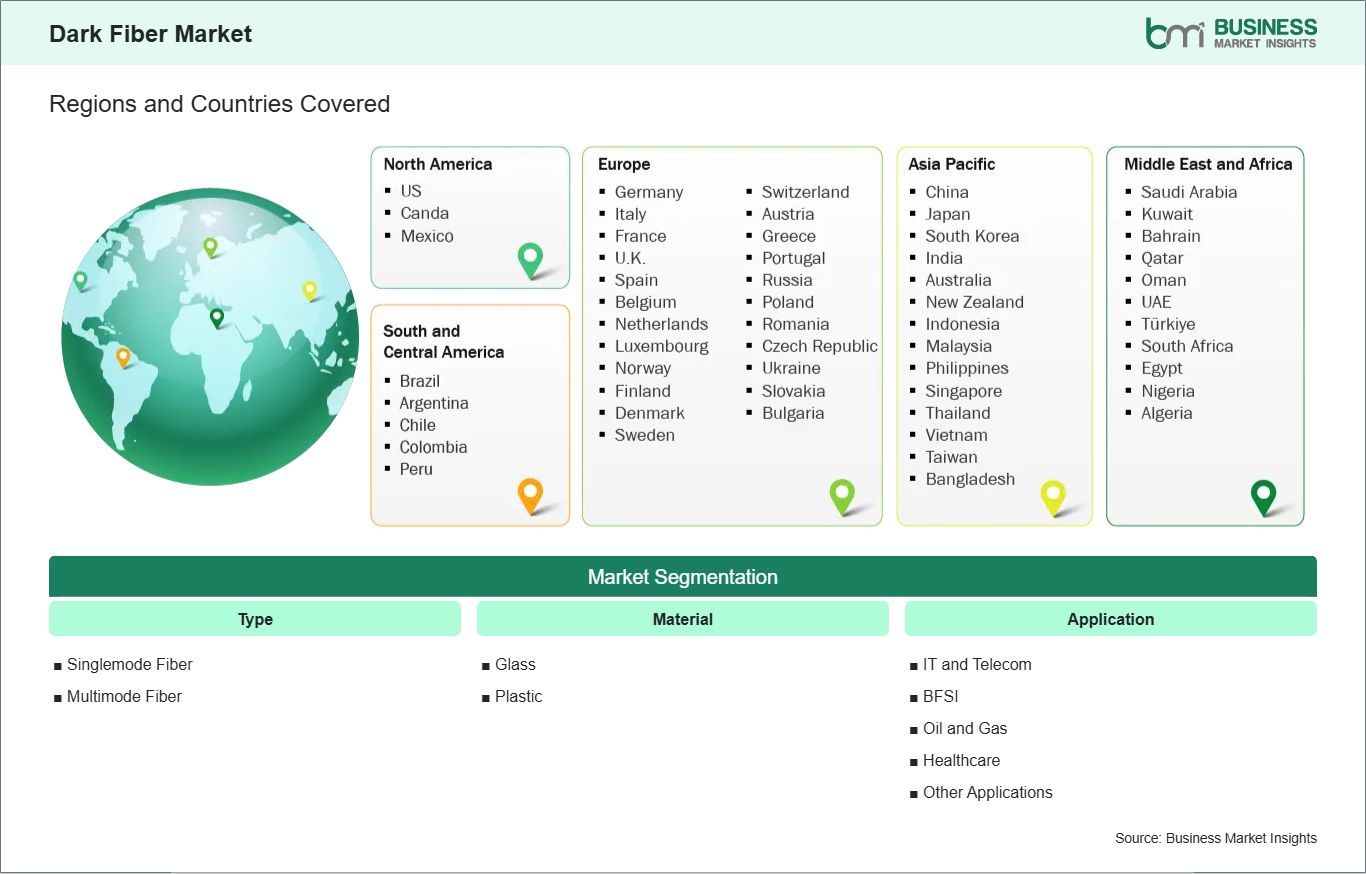
Key segments contributing to the derivation of the Dark Fiber market analysis include type, material, and application.
- By type, the market is divided into Singlemode Fiber and Multimode Fiber. The Singlemode Fiber segment held the larger share in 2025 due to its superior long-distance transmission capability and suitability for telecom-grade and metropolitan networks.
- By material, the market is categorized into Glass and Plastic. The Glass Fiber segment dominated in 2025 owing to its higher bandwidth capacity, lower signal attenuation, and extensive deployment in core and long-haul networks.
- By application, the market is segmented into IT & Telecom, BFSI, Oil & Gas, Healthcare, and Others. The IT & Telecom segment accounted for the largest share in 2025, supported by rapid 5G rollout, data center expansion, and increasing enterprise bandwidth requirements.
Market Forces
Dark Fiber Market Drivers and Opportunities
Surge in Data Traffic and 5G Network Expansion
The exponential growth in global data consumption is a primary driver of the Dark Fiber market. Increased adoption of cloud services, video conferencing, AI workloads, IoT ecosystems, and streaming platforms has intensified the need for scalable, low-latency connectivity infrastructure. Telecom operators are deploying extensive fiber backhaul networks to support 5G base stations, small cell architectures, and edge data centers, significantly boosting dark fiber demand. Enterprises are increasingly investing in dedicated fiber networks to ensure high-speed data transfer, enhanced cybersecurity, and operational independence.
Dark fiber enables virtually unlimited bandwidth scalability through optical equipment upgrades, making it a future-ready solution for evolving digital ecosystems. Government-backed broadband initiatives and national digital transformation programs are further accelerating fiber infrastructure development, particularly in underserved and rural areas. These investments are creating long-term growth opportunities for dark fiber providers across both developed and emerging markets.
Expansion of Hyperscale Data Centers and Enterprise Network Modernization
The rapid expansion of hyperscale data centers and colocation facilities is generating strong demand for dark fiber connectivity. Data center interconnect (DCI) requires ultra-high bandwidth, low latency, and secure point-to-point communication, making dark fiber an optimal solution. Cloud service providers and large enterprises prefer dedicated fiber infrastructure to ensure performance reliability and network customization. Financial institutions, healthcare providers, and energy companies are modernizing legacy network infrastructure to enhance resilience, disaster recovery capabilities, and regulatory compliance.
Dark fiber enables secure transmission of sensitive data while providing redundancy and operational continuity. Additionally, smart city projects, intelligent transportation systems, and industrial automation networks rely on fiber-rich infrastructure to support real-time analytics and high-speed connectivity. As enterprises continue migrating toward hybrid and multi-cloud architectures, demand for scalable and high-performance dark fiber networks is expected to increase steadily through 2033.
Size and Share Analysis
Dark Fiber Market Size and Share Analysis
By type, the Dark Fiber market is segmented into Singlemode and Multimode Fiber. The Singlemode segment dominated in 2025 due to its long-distance transmission efficiency and widespread use in metropolitan and long-haul telecom networks.
By material, the market is categorized into Glass and Plastic Fiber. The Glass segment held the larger share in 2025, supported by its superior bandwidth capacity, durability, and lower signal loss characteristics.
By application, the market is divided into IT & Telecom, BFSI, Oil & Gas, Healthcare, and Others. The IT & Telecom segment accounted for the largest share in 2025, driven by rapid 5G deployment, cloud computing expansion, and escalating enterprise data traffic requirements.
Report Coverage
Dark Fiber Market Report Coverage and Deliverables
The "Dark Fiber Market Size and Forecast (2022 - 2033)" report provides a detailed analysis of the market covering below areas:
- Dark Fiber market size and forecast at global, regional, and country levels for all the key market segments covered under the scope
- Dark Fiber market trends, as well as market dynamics such as drivers, restraints, and key opportunities
- Dark Fiber market analysis covering key market trends, global and regional framework, major players, regulations, and recent market developments
- Industry landscape and competition analysis covering market concentration, heat map analysis, prominent players, and recent developments for the Dark Fiber market
- Detailed company profiles, including SWOT analysis
Geographic Insights
Dark Fiber Market Geographic Insights
The Dark Fiber market is geographically segmented into North America, Asia Pacific, Europe, the Middle East & Africa, and South & Central America. Asia Pacific is projected to witness the fastest growth and maintain a leading position throughout the forecast period. Growth is driven by rapid digital transformation, large-scale 5G deployment, expansion of hyperscale data centers, and increasing government investments in broadband infrastructure across key economies such as China, India, Japan, and South Korea. Rising enterprise adoption of cloud computing, edge infrastructure, and high-capacity metro networks is further accelerating demand for dedicated fiber connectivity solutions across the region.
North America and Europe represent mature markets characterized by well-established fiber infrastructure, strong regulatory frameworks, and high penetration of advanced telecom and data center networks. In these regions, demand is primarily driven by 5G backhaul expansion, data center interconnect (DCI) requirements, enterprise network modernization, and increasing adoption of secure, high-bandwidth connectivity solutions across BFSI, healthcare, and government sectors. Ongoing investments in smart city initiatives and edge computing infrastructure are also supporting steady market growth.
The Middle East & Africa and South & Central America are experiencing moderate growth, supported by expanding telecom infrastructure, national broadband development programs, and increasing digitalization across enterprises and public institutions. Governments in these regions are prioritizing connectivity enhancement to support economic diversification, smart infrastructure projects, and industrial modernization. Rising demand for reliable, high-speed communication networks and growing investments in regional data centers are gradually strengthening dark fiber adoption across these emerging markets.
Industry Activity
Recent Developments
The Dark Fiber market is evaluated by gathering qualitative and quantitative data post primary and secondary research, which includes important corporate publications, association data, and databases. A few of the key developments in the Dark Fiber market are:
- In November 2025, Apar Industries Ltd. formally entered the dark fibre monetisation business via its wholly owned subsidiary, Apar Transmission & Distribution Project Pvt. Ltd. (ATDPPL). The company announced that ATDPPL has been selected by Karnataka Power Transmission Corporation Ltd. (KPTCL) to operate, maintain and monetise KPTCL’s extensive Optical Ground Wire (OPGW) network across the state for the next 15 years.
- In July 2025, Lumen Technologies (Lumen) announced it will provide the terrestrial backhaul connectivity for the JUNO cable system, the highest-capacity trans-Pacific subsea cable linking Japan and the United States. Lumen’s dark fiber backhual network connects with JUNO cable system at the Grover Beach Cable Landing Station and extend it into two major points of presence (PoPs) in San Jose and Los Angeles.
Trust & Transparency
Research Methodology
The market analysis combines proprietary research with secondary data from government agencies, company disclosures, regulatory filings, industry databases and expert interviews. Market estimates are validated through data triangulation, cross-market benchmarking and analyst
review.
View Full Research Methodology
Key Sources Referred:
International Data Corporation (IDC)Institute of Electrical and Electronics Engineers (IEEE)International Telecommunication Union (ITU)National Institute of Standards and Technology (NIST)Company websiteCompany annual reportsCompany investor presentations